↑↓ navigate ↵ open Esc close All results →

Best Wood Fillers for Plywood Edges of 2026

Sawing a sheet of plywood exposes its least forgiving surface: a layered edge packed with internal voids and thirsty end grain that drinks primer and telegraphs every seam through paint. Effective edge filler packs those pockets tight, cures solid, and sands level without crumbling or rejecting topcoats.

Across four months of filling edges on shop shelving, cabinet trim, and panels later drilled and fastened with screws, 14 pastes, epoxies, and cream-hardener systems showed a wide gap between formulas that feather smooth and ones that grab sandpaper. Two-part fillers cure hard enough to hold hardware at the cost of strict mixing ratios and ventilation, while water-based pastes clean up easily but shrink more across deep voids.

Seven fillers tailored to both paint-grade and stain-grade plywood round out the options, provided you buy fresh stock sized to the linear footage on the bench.

Our Top Picks

The Best Wood Fillers for Plywood Edges

1.

DAP Premium Wood Filler Best Overall
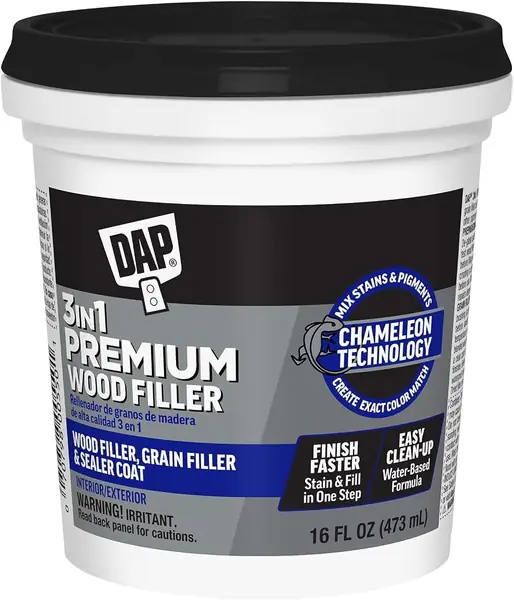
DAP Premium Wood Filler in a white 16-ounce tub of paste filler

Painted plywood edges

Shop Score 93/100
Container Size
16 fl oz
Color
White
Dry Time
2 to 4 hours
Tinting
Stain or pigment mixed into wet filler
View on Amazon

A cut plywood edge is mostly end grain, glue lines and voids, so it drinks the first coat of anything you put on it and shows every gap between plies. DAP's premium filler is built for that surface: a thick, knife-grade paste that also works as a grain filler and a sealer, so pressing it into the open pores does two jobs at once. It's water-based, cleans up with water, and comes in a 16-ounce tub sized for a real project rather than a nail hole.

That combination is why it's our top pick. It spreads thick and stays where the knife leaves it, even on a vertical edge, and it sands to a powder rather than balling up under the paper. We also like that you can stir stain or pigment straight into the wet filler, which gets you closer to the surrounding wood than any factory color and makes this one useful on tinted edges, not just painted ones. The listed 2-to-4-hour dry is realistic for normal fills, with a 24-hour full cure before the piece takes any real handling.

Plan around the color: this listing is white, so you're tinting it or painting over it. That's a non-issue on cabinet sides and shop shelving, and a poor fit if you wanted a bare clear finish. For edges headed for paint or a tinted stain, though, nothing else here covers fill, seal, sand and finish in a single tub.

Worth Noting

  • White only; needs tinting or paint
Our Verdict

We recommend it as the default for painted or tinted plywood edges: it packs the voids, sands flush, and lets you tint the filler toward the surrounding wood.

Check Latest Price
2.

PC-Woody Wood Repair Epoxy Paste Best for Structural and Exterior Repairs

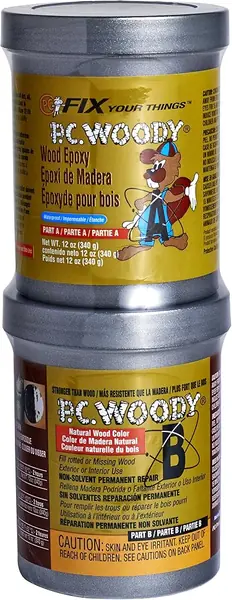
PC-Woody two-part wood repair epoxy paste in two tan cans

Rotted or structural edges

Shop Score 92/100
Full Cure
24 hours
Volume
12 fl oz (two cans)
Mix Ratio
1:1 by volume
Tensile Strength
850 psi
View on Amazon

Two cans, a 1:1 mix by volume, and a warning from the manufacturer not to mix it while wearing gloves: the tack that lets this epoxy grab a vertical plywood edge and stay there is the same tack that will climb your fingers. That's our short version of PC-Woody. It isn't a filler you reach for casually, and for the repairs it's built for, that is exactly the point.

Where it earns its place is edges that aren't merely cosmetic. It cures to 850 psi, enough to hold hinge screws and rebuild a chunk of missing plywood, and it shrugs off fresh water, salt water and the chemicals in pressure-treated lumber, which is why it's our pick for an exterior sill or a damp garage panel. Sanding works, but the cured epoxy is harder than the plywood face, so keep a block behind the paper or you'll dish the veneer beside the repair.

Mixing is the chore: equal parts by volume, folded on a flat scrap with a stiff knife, no gloves. Practicing once on scrap is worth the ten minutes before you commit to a visible edge. It also pays to plan the finish before you open the cans rather than after the patch has cured hard.

Worth Noting

  • Stains only with dark or solid pigments
Our Verdict

Our choice when an edge has to hold a screw or face the weather, since it builds the most strength of anything here.

Check Latest Price
3.

Bondo Wood Filler Best for Fast, Deep-Void Repairs

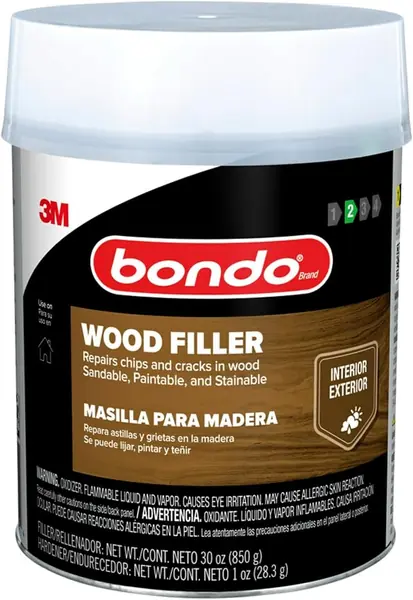
Bondo two-part wood filler in a quart can with a cream hardener tube

Deep voids, fast

Shop Score 91/100
Container Size
1 qt (30 oz)
Cure Type
Two-part with cream hardener
Sandable In
15 minutes
Paint Or Stain In
25 minutes
View on Amazon

Fifteen minutes after mixing, you can put sandpaper to it. That number is the whole argument for keeping a can of Bondo on the shelf: the two-part paste sets hard and stays hard, so a deep void behind a face veneer gets filled in one pass instead of three, and there's no waiting overnight to find out whether it shrank. The trade is that you mix in small batches and keep the knife moving.

It's a body filler at heart, which explains both its strengths and its manners. It bonds to wood, cures denser than the surrounding plywood, takes paint without complaint and holds up outdoors, which makes it the repair we trust on a garage door edge or a windowsill. Sandpaper cuts it cleanly, and it doesn't leave the fuzzy, torn surface that soft fillers sometimes do.

Our read: buy it for deep, ugly voids on work headed for paint, and look elsewhere for anything that needs to pass as bare wood. The cured resin is dense, so pigment sits on top rather than soaking in, and a stained repair reads as a patch. Where a topcoat of color is the plan, that hardly matters, and nothing else here turns around a blown-out edge as quickly.

Worth Noting

  • Pungent solvent smell while mixing
Our Verdict

Keep a can for deep voids and fast turnarounds: this is the repair that sands in fifteen minutes, as long as the edge is getting paint.

Check Latest Price
4.

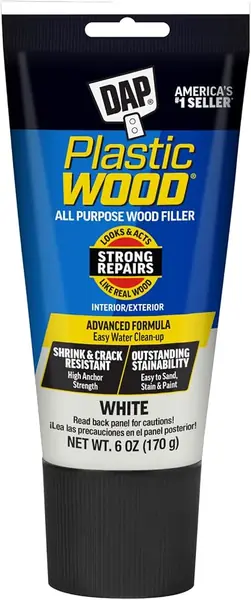
DAP Plastic Wood All Purpose Wood Filler Best for Edges You'll Machine

DAP Plastic Wood all-purpose white latex wood filler in a six-ounce tube

Trim and shelving

Shop Score 90/100
Container Size
6 oz tube
Color
White
Dry Time Up To 1/8 Inch
3 to 6 hours
Deep Fills 1/4 Inch And Over
36 hours
View on Amazon

Most fillers are finished once they're sanded. This one keeps working: after it cures you can plane it, cut it, drill it, screw it and nail it, which matters on a plywood edge that will later take a shelf pin, a pocket screw or a trim nail. It's a thick, knife-grade latex paste that can be molded and sculpted, and it holds its shape on a vertical edge instead of sliding off.

The working manners are the reason to keep a tube in the shop. Strike it off with a putty knife, wipe the edges while it's wet, and thin fills up to an eighth of an inch are ready to sand in 3 to 6 hours. The white cures to a hard, paintable surface that disappears under a coat or two on trim, shelving and cabinet sides.

Deeper than a quarter inch and the schedule stretches to roughly 36 hours, which is realistic for a latex product and still worth planning around; build those spots in lifts rather than one thick slug. It also anchors a screw better than most latex fillers, an unusual trait for a paste sold at this price.

For us, this is the everyday tube in this group, the one for trim, shelving and cabinet edges that get handled after the repair. It isn't the answer for a sheet of plywood with blowouts down the whole edge, where a tub or a two-part filler does the job with less refilling.

Worth Noting

  • Six-ounce tube runs short on full-sheet work
Our Verdict

We like it for edges that get worked after filling, planed, drilled or screwed, and it's the tube we hand a first-timer.

Check Latest Price
5.

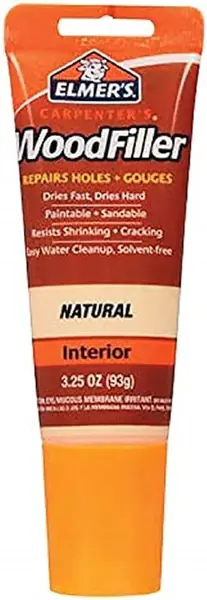
Elmer's Carpenter's Wood Filler Best Budget Pick

Elmer's Carpenter's Wood Filler natural paste in a small 3.25-ounce tube

Small interior touch-ups

Shop Score 89/100
Container Size
3.25 oz tube
Color
Natural
Dry Time
12 to 24 hours
Use
Interior only
View on Amazon

The least expensive filler here is also the smallest, and for the right job that's a feature rather than a compromise. A 3.25-ounce tube of water-based paste with a pointed tip puts a dab exactly where a nail hole, a chipped edge or a splintered corner needs it, and it cleans up with soap and water rather than solvent.

We keep it for the last five percent of a paint job: pinholes along a plywood shelf edge, a torn corner on a cabinet side, the small stuff that shows under a topcoat. It sands soft and smooth, takes paint well, and the pointed tube genuinely beats a tub and a knife when there are three holes to fill before lunch. It's labeled for interior use, so leave it out of anything that lives outside.

The limits matter before you start a bigger project. Dry time is listed at 12 to 24 hours, which is honest; a thick blob on a cold day will still feel soft the next morning, so keep fills shallow and give them the full day. And sand it by hand: the paste is soft, and heavy pressure from a power sander can lift it back out of a shallow scratch.

Worth Noting

  • Interior use only
Our Verdict

Buy it for small touch-ups where a little tube and easy sanding matter more than strength; it isn't built for deep edge voids.

Check Latest Price
6.

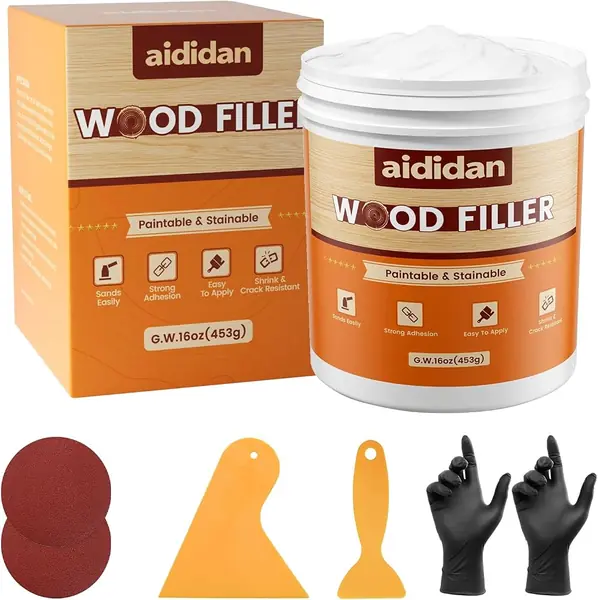
aididan Wood Filler Putty Best for First-Time Kits

aididan white wood filler putty tub with two scrapers, sandpaper and gloves

First-time kits

Shop Score 87/100
Container Size
16 oz
Color
White
Included
Two scrapers, sandpaper, gloves
Formula
Water-based
View on Amazon

What you get for the money is the appeal: a 16-ounce tub of white, water-based putty plus two scrapers, sandpaper and a pair of gloves, which is enough to finish a first project without a second trip to the store. We like it as a starter kit for painted interior edges such as shelving, cabinet sides and a repaired door frame, where the filler mainly has to spread easily, dry, and disappear under paint.

The paste is smooth and low-odor, easy to strike off with the included scraper, and it paints over cleanly. Where we're cautious is thickness: this is a soft filler, and soft fillers want thin lifts with real drying time between them, especially in a void that runs the full thickness of the panel. Build those spots a little at a time and give each pass a full day, and it behaves like a much more expensive tub of wood putty.

Worth Noting

  • White fill will not pass as stained wood
Our Verdict

A sensible starter kit for painted interior edges, since the filler spreads easily and the tools come in the box.

Check Latest Price
7.

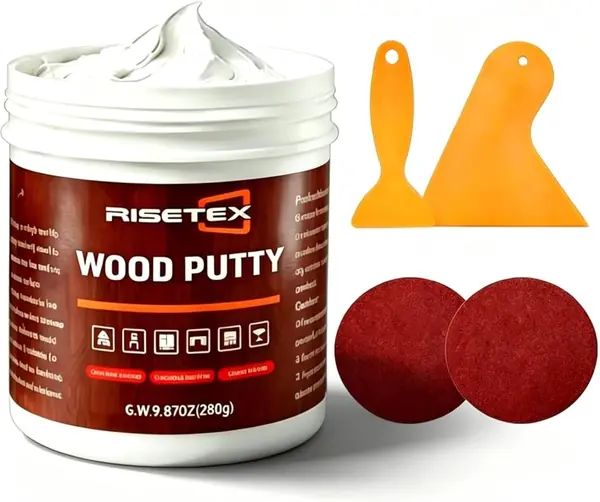
RISETEX Wood Filler Putty Best for Small Painted Repairs

RISETEX white wood filler putty tube with two scrapers and sandpaper

Small painted repairs

Shop Score 86/100
Container Size
9.87 oz tube
Color
White
Full Cure
1 hour
Included
Two scrapers, sandpaper
View on Amazon

Out of the tube this is closer to hand cream than to putty: smooth, creamy and easy to work into small holes and knots, but without the body to stand up in a deep gap on its own. On a plywood edge with a shallow void or a torn corner, that's pleasant enough. On a blown-out core you'll be building it up in coats, and the layers need more time than the label's one-hour cure suggests.

The kit is the draw, a 9.87-ounce tube with two scrapers and sandpaper, and the white paste goes on easily and sands cleanly without gouging the veneer around it. For small painted repairs it behaves like a much pricier filler, and the color under paint is exactly what you want: invisible.

Our take: it's a good first kit for furniture touch-ups and small painted repairs. For a whole sheet of exposed edge, at this size you'd run out before the second panel, so step up to a tub when the edges are the project rather than the cleanup.

Worth Noting

  • One-hour cure claim holds only for thin coats
Our Verdict

Worth it for small painted repairs and furniture touch-ups, where a creamy paste and a scraper in the box save a trip.

Check Latest Price

How We Tested Wood Fillers on Plywood Edges

We started by rounding up wood fillers that claim to handle edge work — water-based pastes, latex formulas, two-part epoxies, and cream-hardener systems — and narrowed the field by interior or exterior rating, container size, and whether the label allows paint and stain over the cured patch. Fourteen made the cut. We ran them for four months, mostly on plywood offcuts and the shelving, cabinet trim, and shop furniture those offcuts became. Two arrived as kits with scrapers and sandpaper, which we used as sent.

Every filler went into voids at a measured depth on a cut edge. Two-part products were mixed 1:1 by volume on a flat scrap with a stiff knife, per the manufacturer's instruction, with the garage door up and a fan running; we noted how sharply the cream hardener smelled before blending and how much working time we actually got before the paste stiffened. We logged how each one spread into a void, whether it clung and dragged on the knife, and how far the patch sank after its stated dry time. Then we sanded flush over a block and watched for dishing, crumbling, and clogged paper.

Finish came next: paint over some patches, stain and clear coat over others, comparing how the repaired edge took color beside bare plywood and whether the topcoat sat on the patch the same as on the wood. Edges slated for drilling or a saw pass got that treatment, and we checked whether driven screws held. A few pieces lived outside through rain and temperature swings to see how the exterior-rated fillers held up, and we weighed how much of a container a run of shelving edge used against what it cost. We filled only sound, dry stock; anything soft or rotted got set aside, since that wood needs a hardener first.

How to Choose a Wood Filler for Plywood Edges

Fill the Voids Before You Smooth the Face

The exposed edge of a sheet of plywood is rougher than the face: voids behind the face veneer, tear-out from the saw and open pores that soak up finish. A thick, knife-grade paste handles all three because you can press it in and strike it level. A thin, creamy wood putty of the kind sold for nail holes will fill a shallow scratch and nothing more.

Depth sets your schedule as much as the formula does. DAP rates its all-purpose filler at 3 to 6 hours for fills up to an eighth of an inch and about 36 hours for a quarter inch and deeper, so a badly blown-out edge is a layered, multi-day repair rather than one thick slug of paste.

Working Time Is a Buying Decision

One-part latex fillers give you hours and forgive a slow hand. Two-part products, whether polyester fillers like Bondo or epoxy pastes like PC-Woody, start curing the moment they're mixed, and that's a trade to make deliberately. Fast set is wonderful when a deep void needs one pass; it's miserable when you're learning on a visible edge.

If you go two-part, mix small batches on a flat scrap, keep the knife moving, and check the maker's temperature range before you start. PC-Woody lists 35 to 115 degrees Fahrenheit for application, and a cold shop will stretch every cure time you're counting on.

Sand Flush Without Dishing the Veneer

Here's the trap: a filler that sands easily is usually softer than the plywood, and one that cures hard is usually harder. Either mismatch shows up the moment you sand flat, because the paper cuts filler and veneer at different rates and the softer of the two gives way first.

Wrap 120-grit around a hard block, keep the block flat across the edge, and stop as soon as the surface is level, since fingers and loose paper round the corner in seconds. With two-part epoxy, let the paper cut the filler and barely kiss the wood, and finish by hand.

Let the Finish Choose the Filler

Paint is forgiving: a white or tan filler disappears under a coat or two, so you can sand, prime and topcoat without thinking much about color. Stain is not. Dense fillers hold pigment on the surface instead of absorbing it, so a stained repair reads as a patch.

PC-Woody's maker recommends dark or solid-pigment stains and warns that light ones will disappoint, and Bondo's cured resin behaves much the same way. If the edge is getting color rather than paint, buy a water-based filler you can tint, like the DAP Premium, and stir your stain into the wet paste.

Buy Enough, and Buy It Fresh

A 4-by-8 sheet has 24 linear feet of edge, far more surface than a nail hole and the reason a 3-ounce tube is the wrong purchase for sheet goods. Tubs make sense for a full sheet; tubes make sense for touch-up work and for the last few feet of a paint job.

Whatever you buy, seal it. Water-based fillers skin over and dry out in an open container, and a tub that's been sitting open since last spring is one you'll be digging at with a knife. Buy for the project in front of you.

Frequently Asked Questions

Final Verdict

Our default for plywood edges is the DAP Premium Wood Filler. One tub fills the voids, seals the open grain, sands flat, and takes a tint stirred into the wet paste, which covers painted and stained work alike without buying a second product.

When an edge has to hold a screw, replace missing wood, or face the weather, spend the extra on PC-Woody, since nothing else here builds that kind of strength. And if the job is a handful of nail holes rather than a sheet of shelving, the small Elmer's tube is the sensible buy.