↑↓ navigate ↵ open Esc close All results →

Best Wood Fillers for Screw Holes of 2026

A stray screw hole takes a second to drill and surprising effort to erase cleanly. Too soft a filler leaves a shallow dimple under paint, while an overly dense plug resists sandpaper until the surrounding wood dishes out around it.

Testing 14 water-based pastes, solvent-based fillers, and two-part epoxy putties over four months highlighted quick trade-offs on vertical trim and hardware repairs. A paste that stays workable for ten minutes simplifies smoothing a door casing yet slumps in a deep bore, whereas two-part epoxies anchor a stripped hinge screw and withstand wet exterior trim if mixed to exact ratios with a window cracked open.

Color expectations trip up many repairs too, since both off-white and natural tints dry darker than they appear wet, and stainable formulas behave differently from fast-drying paintable pastes across cabinet doors, stripped bores, and weathered sills.

Our Top Picks

The Best Wood Fillers for Screw Holes

1.

DAP Plastic Wood-X with DryDex Best Overall
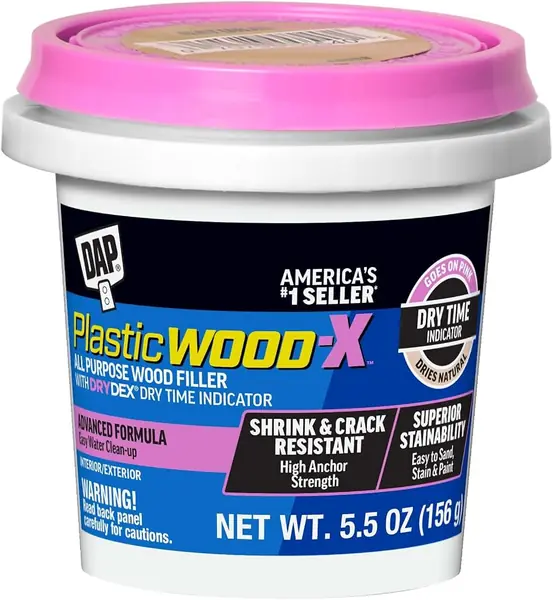
DAP Plastic Wood-X natural wood filler in a small tub

Small interior repairs

Shop Score 94/100
Size
5.5 oz
Finish
Sandable and paintable or stainable
Dry Time
3 to 36 hours depending on depth
Indicator
Pink to natural
View on Amazon

The pink-to-natural color change is the reason this is our top pick. You can see exactly where you have filled, and when the pink fades you know the surface is ready to sand; that removes the usual poke-and-guess on a screw hole. We also like that the thick knife-grade paste stays where you put it on a vertical cabinet stile instead of sliding down the face.

The latex formula is sandable, paintable, and stainable, and it can be planed, cut, drilled, or screwed once cured, which makes it more forgiving than a hard epoxy if you are filling a row of hinge holes. It dries in 3 to 6 hours for shallow repairs and longer for deep fills, so a deep countersink may need a second pass. Cleanup with water is a real convenience when you are working on installed trim.

The main catch is size: 5.5 ounces is enough for a few small holes but not a furniture restoration. The tub also needs to be sealed well between uses; we keep the lid tight and scoop out what we need rather than working from the container. For a homeowner with a handful of screw holes to hide under paint, the trade-off is easy to accept.

Worth Noting

  • Small 5.5 oz tub for larger jobs
  • Tub can dry out after opening
Our Verdict

We recommend the DAP Plastic Wood-X for most screw-hole repairs because the color-change indicator and water-cleanup latex make a small job predictable.

Check Latest Price
2.

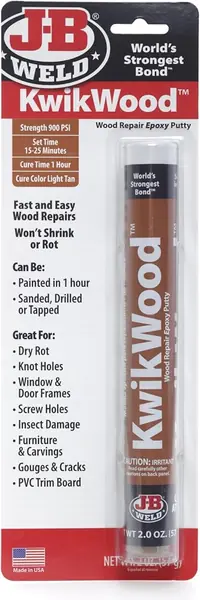
J-B Weld KwikWood Best for Structural Repairs

J-B Weld KwikWood beige epoxy putty stick for wood repair

Stripped structural holes

Shop Score 93/100
Size
7 inch stick
Color
Beige
Cure Time
60 minutes
Tensile Strength
2,450 psi
View on Amazon

A wallowed-out hinge screw hole is the repair that makes a putty stick worth keeping around. KwikWood is a hand-mixable two-part epoxy putty that you knead, press into the hole, and shape before it cures; it is beige, so it disappears under paint but not under a clear finish.

We reach for it when the hole needs to hold a screw again or when the wood is damp, rotted, or exterior. It cures to a hard, water-resistant repair and can be sanded and painted; the 2,450 psi tensile strength is far more than a cosmetic latex filler offers. The catch is that it is an epoxy, not a stain-grade wood filler: it will not blend into an oak table under clear coat, and the 60-minute cure leaves little time for fussing.

Application is simple but sticky. Once you start mixing, the putty wants to cling to your fingers, so we press it into the hole with a putty knife and keep the exposed surface slightly proud. A small amount goes a long way in a screw hole, which makes the 2-ounce stick more useful than its size suggests. Sand it after it hardens and before painting; a light touch keeps the surrounding wood flat.

Worth Noting

  • Beige color needs paint to disappear
  • Sticky once mixed and hard to shape
Our Verdict

We keep J-B Weld KwikWood for stripped or exterior holes where the repair needs to hold; it is stronger than a cosmetic filler, but plan to paint it.

Check Latest Price
3.

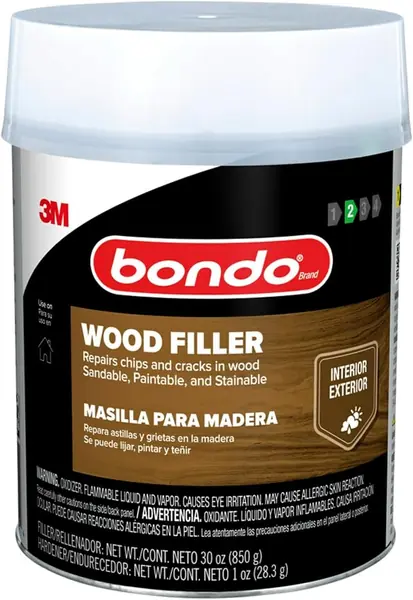
Bondo Wood Filler Best for Exterior Repairs

Bondo two-part wood filler bottle with cream hardener

Exterior structural repairs

Shop Score 92/100
Size
30 oz
Color
Light brown
Sand Time
15 minutes
Paint Or Stain
25 minutes
View on Amazon

The clock starts as soon as you mix Bondo. The two-part filler comes with a cream hardener, cures fast enough to sand by hand in about 15 minutes, and is ready for paint or stain in roughly 25 minutes; that speed is why it has a place in a shop despite being fussier than a tub of latex filler.

It is a permanent, non-shrinking repair that bonds to wood and stands up to exterior conditions. We like it for larger screw-hole repairs, window and door frames, and any place where a soft filler might shrink back or crumble. It is also water-resistant, so an exterior sill or fence repair is within its range.

Where it loses ground for a casual buyer is color. We keep it under paint or a solid-color finish rather than relying on it for a clear stain match; the light brown color does not blend invisibly on its own. It is also a two-part product, so you need to measure the hardener and accept a firmer, less forgiving surface than latex.

The 30-ounce kit is a lot for a handful of screw holes, and the opened container has a shelf life. For a whole house of trim or an exterior repair, that volume is the point. For one small indoor patch, a smaller water-based filler is easier to live with.

Worth Noting

  • Short working time demands small batches
Our Verdict

We choose Bondo when an exterior or large repair needs a fast, non-shrinking fill; it is not the easiest choice for a first-timer.

Check Latest Price
4.

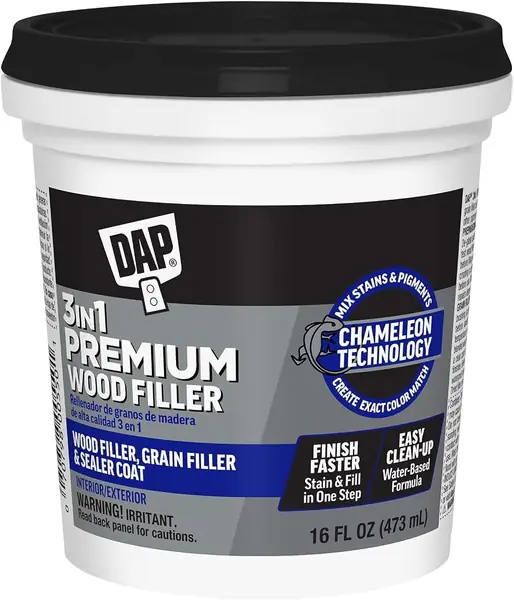
DAP Premium Wood Filler Best for Large Projects

DAP Premium Wood Filler white tub with tintable paste

Large tinted repairs

Shop Score 91/100
Size
16 fl oz
Finish
Sandable and paintable or stainable
Use
Interior and exterior
Dry Time
2 to 4 hours
View on Amazon

A 16-ounce tub and a tintable white paste make DAP Premium the pick for a whole room of trim or a furniture project with many holes. It is a water-based 3-in-1 filler, grain filler, and sealer that dries in about 2 to 4 hours and can be sanded, painted, or stained.

The useful trick is the color blending: you can mix stain, paint, or pigment into the wet filler to get closer to the surrounding wood before it dries. That is more control than a pre-colored putty gives you, and it is the reason we reach for this tub on a mixed batch of trim rather than a single tube. It is also thick enough to hold on a vertical surface without sagging.

The wide tub is the trade-off: it can dry out if you leave the lid off or dig into it with a dirty tool. Scoop out what you need, reseal it promptly, and keep the rim clean.

For a large painted or tinted repair, we like having enough material to work without rationing, and the water cleanup is easy. For one or two screw holes, a small tube or a color-matched putty is simpler; this is the tub we keep for a project, not a single hinge.

Worth Noting

  • 16 oz tub is overkill for a few holes
  • White base needs tinting for natural wood
Our Verdict

We recommend DAP Premium for a whole room of trim or a furniture project where you want to tint the filler to match; the 16-ounce tub is overkill for a few holes.

Check Latest Price
5.

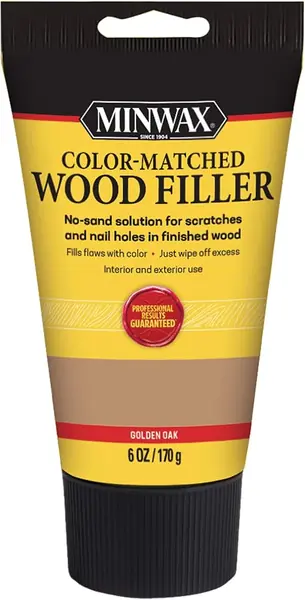
Minwax Color-Matched Wood Filler Best Color Match

Minwax Color-Matched wood filler tube in Golden Oak

Golden oak furniture

Shop Score 90/100
Size
6 oz
Color
Golden Oak
Finish
No sanding needed
Use
Interior wood
View on Amazon

The color is already in the tube, which is the whole point of Minwax Color-Matched. In Golden Oak it is a no-sand putty meant for finished wood, so a screw hole in a cabinet face or floor can be filled and wiped without a dye experiment; that convenience is why we keep it for small finished repairs.

It is ready to use and can be sanded, cut, drilled, planed, stained, varnished, painted, or lacquered. The paste is thick enough to press into a screw hole with a putty knife, and a little goes a long way. The tube is easy to control for a small hole, and the paste does not need mixing. For a golden oak floor or cabinet, the match can be close enough that the repair disappears under a fresh coat of finish.

The match is not universal. Golden Oak can dry darker or lighter than the surrounding wood, so test it in an inconspicuous spot and be ready to tint or topcoat. It is a color-matched product, not a stainable blank canvas; if your finish is not close to Golden Oak, start with a natural filler and test your stain instead.

Worth Noting

  • Small 6 oz tube limits larger repairs
Our Verdict

We use Minwax Color-Matched when a finished golden oak surface needs a quick color match, not a bare-wood stain job.

Check Latest Price
6.

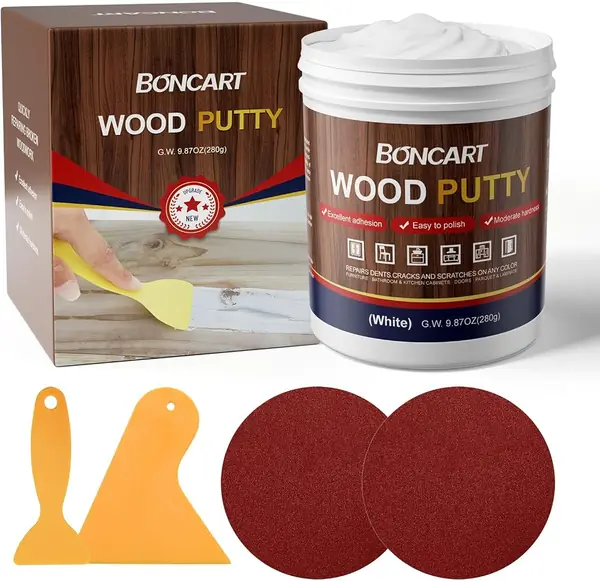
Boncart Wood Filler Best All-In-One Kit

Boncart white wood filler can with two scrapers and sandpaper

White furniture touch-ups

Shop Score 89/100
Size
9.87 oz
Color
White
Water Resistance
Not water resistant
Included
Two scrapers and two sandpapers
View on Amazon

The scrapers and sandpaper in the box are what make Boncart a sensible first kit. You get a 9.87-ounce can of white wood filler plus two plastic scrapers and two sanding pads, so there is no separate trip for tools when you are filling a row of screw holes in a white dresser or cabinet.

We like it for small white furniture repairs because the paste spreads smoothly, dries white, and sands without a lot of dust; the included scrapers are shaped well enough to press filler into a counterbored screw hole. It is also paintable, so it can be topcoated to match the surrounding trim.

The included scrapers are useful for small holes but too flexible for a large flat patch; a stiff metal putty knife does a cleaner job on a wide repair. The paste can also crack in a thick fill, so build deep screw holes in thin layers rather than one heavy dollop.

For a quick apartment repair under paint, the kit is convenient, and the resealable can is easier to live with than a tube that has been squeezed in the middle. We keep the extra scraper in the can so the tools stay with the filler.

Worth Noting

  • White color needs a paint topcoat
  • Not water resistant for exterior holes
Our Verdict

We like the Boncart kit for a first-timer fixing white furniture; the tools come in the box and the paste sands easily.

Check Latest Price
7.

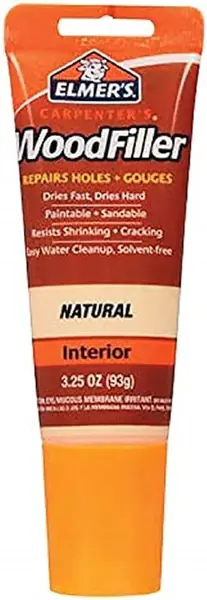
Elmer's Carpenter's Wood Filler Best for Small Cosmetic Repairs

Elmer's Carpenter's Wood Filler natural tube for interior repairs

Small painted holes

Shop Score 88/100
Size
3.25 oz
Finish
Paintable and stainable
Use
Interior only
Dry Time
12 to 24 hours
View on Amazon

A small tube for a few interior holes is the right way to think about Elmer's Carpenter's Wood Filler. It is a natural-colored, water-based paste for nail holes, dents, gouges, and other minor defects, and the pointed tube is easy to aim into a screw hole without loading up a putty knife.

The formula sands easily, resists shrinking and cracking, and cleans up with soap and water. It is paintable and stainable, though the natural color is a starting point rather than a finish match. For a quick cosmetic repair on interior trim, it is about as simple as filler gets.

We reach for it when the hole is small, the surface is getting painted, and we want a low-odor filler that does not need mixing. It is a good match for a beginner with a tube and a few nail holes, and the paste feathers out well enough that a light sanding leaves a smooth surface.

The pointed tip helps place filler precisely; we keep a damp rag nearby to wipe the surrounding trim before it sets. A deep countersink may need a second pass after the first application dries, so plan to check the hole rather than filling it once and walking away.

Worth Noting

  • 12-to-24-hour dry time slows the job
  • Tube can be hard to squeeze
Our Verdict

Elmer's is the filler we keep for small painted interior holes, where no mixing matters more than speed.

Check Latest Price
8.

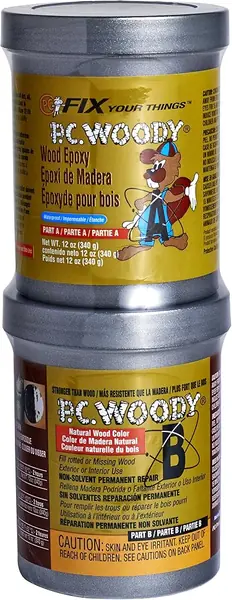
PC-Woody Wood Repair Epoxy

PC-Woody two-part tan epoxy paste in two cans

Rotted exterior wood

Shop Score 87/100
Size
12 oz
Water Resistance
Fresh and salt water resistant
Mix Ratio
1:1 by volume
Application Range
35 to 115 degrees F
View on Amazon

Two cans and a 1:1 mix make PC-Woody a different kind of repair from a tub of latex filler. It is a two-part epoxy paste for replacing missing or rotted wood, with high tack that helps it stay on a vertical window frame or door sill instead of sliding down before it cures.

The paste is resistant to dry rot, UV light, fresh water, and salt water, and it can be used indoors or outdoors within a 35-to-115-degree-F application range. That makes it a candidate for an exterior screw hole that has wallowed out or a sill that has gone soft, not just a cosmetic dimple in a cabinet.

Mixing is straightforward but not instant: combine equal volumes on a flat surface with a stiff putty knife, then press the paste into the repair before it sets. The high tack is helpful on a vertical face, but it also means you need to work neatly; a little goes a long way.

We see PC-Woody as the specialist in this group: choose it when the wood is rotted or the repair is exterior and wet, and accept that you are mixing epoxy rather than squeezing a tube. For a dry interior screw hole under paint, a simpler water-based filler is easier to sand and finish.

Worth Noting

  • Bulk 12 oz kit suits larger repairs
  • Tan epoxy is not a stain-grade match
Our Verdict

PC-Woody is our choice for rotted or wet exterior wood, where high-tack epoxy and water resistance earn the extra mixing.

Check Latest Price

How We Tested Wood Fillers for Screw Holes

We started by reading the fine print on every container we could get our hands on: what the filler is made of, whether it's a water-based paste, a solvent-based one, or a two-part epoxy putty, what the maker claims about sanding and finishing, and how long the product stays usable once it's open. Then we bought 14 that spanned the range, from small squeeze tubes to big tubs, and put them to work over four months.

Most of the testing happened where screw holes actually live. We filled rows of holes in pine and oak boards, then moved to the real work: cabinet face frames, door casings, a painted bookshelf, hinge screw holes that had stripped out, a fence rail, and a soft spot on an exterior sill. For each we noted how the filler came out of the container, whether it was a smooth paste, a crumbly putty, or a gritty epoxy, how long it stayed workable enough to shape with a knife, how it cleaned up off the tool, and how many holes a container actually covered.

Once cured, we sanded each patch by hand with 120- then 220-grit and ran a palm across it to feel for a hollow, the tell that a filler is softer than the wood around it. We painted some patches and stained others, watching whether the filler took color evenly or flashed lighter than the surrounding wood. Two-part epoxies were mixed at the maker's ratio in a ventilated shop, and the exterior patches stayed outdoors through sun and rain.

We also kept the leftover containers sealed on a shelf and reopened them weeks later to see whether they skinned over or set up solid in the tub, and we drove screws back into the structural repairs to check they held. Value came down to yield: a big tub is no bargain if a hole needs three passes to come flush.

How to Choose a Wood Filler for Screw Holes

Start With the Finish

The finish decides more than the filler label. If the repair will be painted, a white or natural latex filler is easy to sand and forgiving; if it will be stained or clear-coated, choose a stainable or color-matched filler and test it on a scrap of the same wood. Epoxies are strong and water-resistant, but most are paint-grade rather than stain-grade. Pick the finish first, then buy the filler that can disappear under it.

A stainable label is not a promise of an invisible repair. Filler absorbs stain differently from wood, and end grain can turn much darker. Test on an offcut, and plan to tint or topcoat if the match drifts.

Match Working Time to the Hole

Two-part fillers can stiffen in minutes, while water-based fillers give you hours. That matters most when you are filling a row of screw holes and want to level each one before moving on. Bondo is the speed option here, sandable in about 15 minutes; DAP Plastic Wood-X gives you a 3-to-6-hour window for shallow fills. Mix or squeeze out only what you can use in the stated window.

A screw hole is usually deeper than it looks. For a deep countersink, fill in thin layers rather than one heavy plug; a thick fill can shrink, crack, or stay soft in the center. Fill slightly above the surface and sand flush after the repair is hard.

Think About Strength and Moisture

Indoors and under paint, a latex filler is usually enough. For a hinge jamb, a sill, or a hole that has gone soft from moisture, choose a two-part epoxy or epoxy putty. J-B Weld KwikWood and PC-Woody are the heavy-duty options here: they cure hard, resist water, and can be shaped before they set.

Do not expect a cosmetic filler to hold a screw that has pulled out. If the screw must bite again, repair the wood with epoxy or a wood plug, or move the screw to fresh wood. A filler that is strong enough to sand is not automatically strong enough to carry a load.

Check the Container

Tubes are convenient for a few holes, but they can dry out or become hard to squeeze after opening. Tubs are better for a room of trim, provided you reseal them and scoop out only what you need. A wood putty in a small tube is handy for a quick touch-up, but check that it is labeled sandable and paintable before you rely on it for a screw hole.

If you are buying for a single afternoon, a kit with scrapers and sandpaper can save a trip. If you already have tools, spend the difference on a larger tub or a filler that matches your finish.

Sand Flush Without Hollowing the Repair

Let the filler cure until it is hard and no longer tacky, then sand with a block rather than a loose sheet. A block keeps the repair flat and prevents you from dishing out the surrounding wood. Start with a medium grit, finish with the grit your finish schedule calls for, and wipe the dust before painting.

If the filler shrinks after sanding, a second thin coat is better than pressing hard on the first one. The goal is a repair that is flush and invisible under finish, not a bump that you keep sanding down.

Frequently Asked Questions

Final Verdict

For most screw holes, we reach for DAP Plastic Wood-X. The pink-to-natural indicator tells you when to sand, the latex paste cleans up with water, and the repair takes paint without fighting you. It is the least fussy way to make a row of holes disappear.

When the hole is in a hinge jamb or an exterior sill and needs strength, choose J-B Weld KwikWood. For a whole room of painted trim, DAP Premium gives you a larger tintable tub, and Minwax Color-Matched is the one to try on finished golden oak. Buy the small format for a handful of holes and a larger one for a whole room.