↑↓ navigate ↵ open Esc close All results →

Best Wood Fillers for Trim of 2026

Trim repairs look like ten-minute chores until nail-hole putty shrinks overnight or a patch on a door casing sags before setting. Because moldings are narrow and sit at eye level, filler must bridge gaps cleanly and feather flush without lifting the surrounding paint edge under sandpaper.

Color-change dry indicators only signal that the surface skin is ready for sandpaper, not that a deep fill has hardened through—a trap that showed up quickly while working 14 wood fillers across casings, baseboards, and a chipped door frame over four months. Format counts nearly as much as chemistry, since squeeze tubes fit scattered nail holes while wide tubs move faster along full-room baseboards.

Water-based pastes that wipe clean with a damp rag handle most indoor moldings, alongside a two-part filler built to rebuild rotted exterior trim.

Our Top Picks

The Best Wood Fillers for Trim

1.

DAP Premium Wood Filler Best Overall
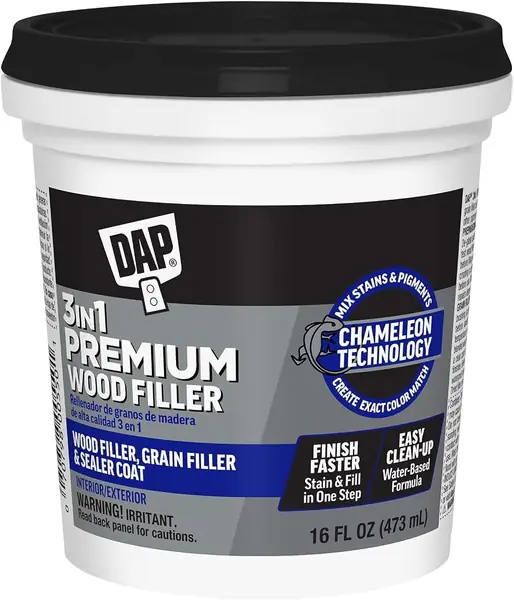
DAP Premium Wood Filler 16-ounce white tub of knife-grade latex paste

Painted interior trim

Shop Score 94/100
Color
White
Container
16 fl oz tub
Use
Interior and exterior
Dry Time
2 to 4 hours
View on Amazon

A 16-ounce tub of thick, knife-grade white filler is the right shape of container when the job is every casing, baseboard, and door frame in a room, and this is the one that stays on our shelf. It sits where you put it on a vertical face instead of creeping down toward the floor, which is most of what you are asking a trim filler to do.

We rank it first because it behaves well at both ends of the job. Wet, the acrylic-latex paste spreads with almost no drag, and the Chameleon color system is more useful than it sounds: you can stir stain, paint, or pigment directly into the filler and push a white product toward a stained-wood tone. Dry, it sands to a flat, feathered edge that disappears under paint without leaving a halo around the repair.

The label puts dry time at 2 to 4 hours and full cure at 24. For nail holes and shallow splits the short end is what matters, so you can fill a room's worth of molding in the morning and paint the same afternoon. It also holds in the places trim actually fails: corners, the seam where a casing meets a wall, and the vertical face of a door frame. DAP rates it for interior and exterior use, which makes it the one we take outside for painted porch trim.

What you give up is portability. A tub is a two-hand proposition on a ladder, so we decant into a paper cup for overhead crown work. Sixteen ounces is also more than one afternoon of touch-ups needs, though it is the right amount for a full run of trim, and leftovers keep if you press the lid down hard.

Worth Noting

  • Tub is awkward to handle two-handed on a ladder
  • Sixteen ounces is more than a single afternoon of touch-ups needs
Our Verdict

Our default for a full trim run: this white filler holds its shape on vertical casings, sands flat, and can be tinted toward stained wood when paint is not the plan.

Check Latest Price
2.

Elmer's Carpenter's Wood Filler Best for Touch-Ups on White Trim

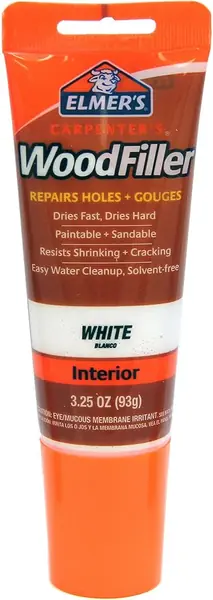
Elmer's Carpenter's Wood Filler 3.25-ounce white tube with screw cap

White trim touch-ups

Shop Score 93/100
Color
White
Container
3.25 oz tube
Dry Time
12 to 24 hours
Cleanup
Water
View on Amazon

A run of new baseboard means something close to a hundred nail holes, and the tube you can hold in one hand while the other runs a putty knife is the one that actually gets used. That is why this 3.25-ounce Elmer's tube stays in our kit. It is a white, water-cleanup filler sized for touch-up work rather than a whole-room job, and at that it is hard to argue with.

The color is the quietly useful part. It dries to a white that sits close to factory-primed and painted molding, so a nail hole in white trim can often go straight to a wipe and be finished, with no paint and no second trip. Where the white does not land, it is sandable and paintable over, and it resists shrinking and cracking in the shallow fills that trim work is made of.

The friction is in the tube. Cold or long-stored filler can be stiff enough that it fights the nozzle, and squeezing harder just lays a worm of filler across the casing. Kneading the tube in your hands before you cut the tip solves most of that, and a putty knife, not the nozzle, does the actual placement.

Elmer's prints 12 to 24 hours for dry time. Shallow nail holes do not need the whole window, but do not count on deep fills the same day. It is also interior only, which is the boundary that matters here: this is the tube for inside trim, not a porch rail or an exterior sill.

Worth Noting

  • Interior only, not for exterior trim
Our Verdict

For nail holes in painted white trim this is the tube we reach for: small, water-cleanup, and it dries close enough to white that paint is optional.

Check Latest Price
3.

FamoWood Water-Based Wood Filler Best for Smooth Sanding

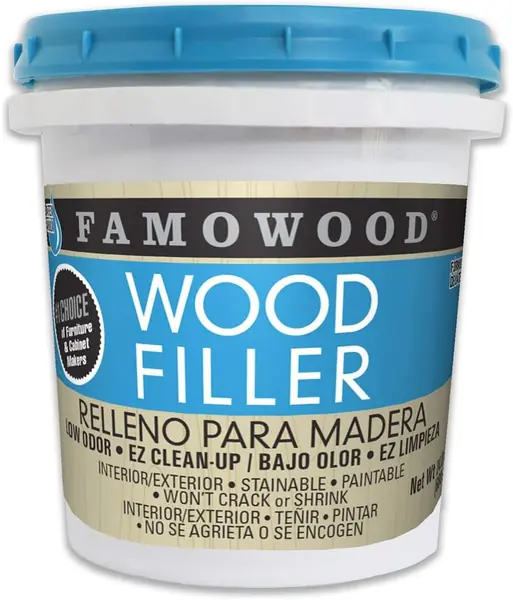
FamoWood water-based latex wood filler in a one-pint natural-color container

Clear-finished trim

Shop Score 92/100
Color
Natural
Container
1 pint
Use
Interior and exterior
Dry Time
15 minutes
View on Amazon

FamoWood's "natural" comes out of the container a warm pink, which is a surprise if you expected something close to pine. On trim you are painting, the pink is irrelevant. On trim you are finishing clear, it is the reason we treat the shade as a starting point rather than a match: sand it, seal a test piece, and see what the color does before you commit a whole casing to it.

What the shade does not tell you is how well this filler sands. Fifteen minutes to a workable surface is as quick as anything in this group, and it feathers down without loading up the paper, so the edge of the repair blends into the surrounding wood instead of leaving a ridge you can feel with a fingertip. That is the property that decides whether a repair shows under a finish, and it is why this pint earns a place next to a much larger tub.

We keep it for trim that gets handled and inspected: a window stool, a stair skirt, a built-up casing. The water-based formula is low-odor and cleans up with water, it is rated for interior and exterior use, and it stays workable in the container instead of skinning over halfway through a job. The speed comes with a habit attached: work in small sections rather than mixing one big batch of repairs.

Worth Noting

  • Stain can dry darker than the surrounding wood
Our Verdict

We keep this pint for trim that will be sanded and looked at closely: it dries in 15 minutes and feathers smoother than anything else here, as long as a finish goes over it.

Check Latest Price
4.

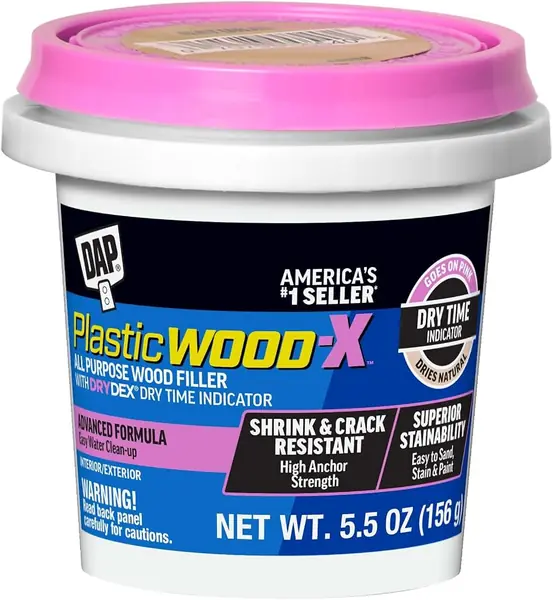
DAP Plastic Wood-X Wood Filler Best Dry-Time Indicator

DAP Plastic Wood-X wood filler 5.5-ounce natural-color can with pry lid

Small detail repairs

Shop Score 91/100
Color
Natural
Container
5.5 oz can
Dry Time
3 to 6 hours; 36 hours for deep fills
Vertical Use
Corners and vertical surfaces
View on Amazon

Two DAP fillers made this list for different reasons: the big white tub covers a room, and this 5.5-ounce can is for the repairs you want to look at twice. What earns it a spot is the color change. The filler goes on pink and dries to a natural wood tone, so you can tell by eye whether the inside of a deep nail hole or a split casing is ready for sandpaper.

It is a thick, knife-grade paste that stays on vertical faces and in corners, and it sands cleanly, powdering off and feathering without pulling at the paint edge you are trying not to disturb. DAP lists 3 to 6 hours for fills up to an eighth of an inch and 36 hours for quarter-inch-and-deeper fills, and the color cue earns the most on the deep ones, where guessing costs you a sanded divot around the repair.

Worth Noting

  • Small can runs out on room-sized jobs
Our Verdict

We reach for this small can when we want to see that a fill is dry before touching it; the pink-to-natural cue is worth having on deep nail holes and split casings.

Check Latest Price
5.

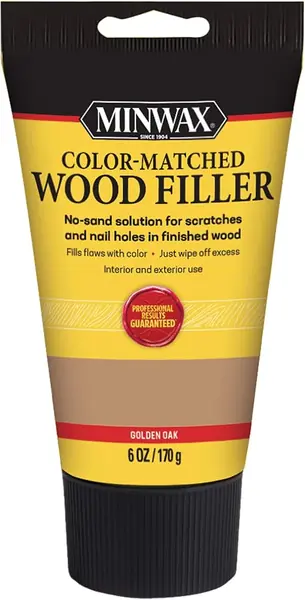
Minwax Color-Matched Wood Filler Best for Finished Stained Trim

Minwax color-matched wood filler 6-ounce tube in Golden Oak shade

Finished stained trim

Shop Score 90/100
Color
Golden Oak
Container
6 oz tube
Use
Finished interior wood
Sanding
No sanding needed
View on Amazon

If the trim is already finished and the damage is a gouge, a nail hole, or a scratched edge, you are not repairing wood, you are repairing a color. That is the job this 6-ounce Minwax tube is built for, and it is the one we carry when sanding and re-staining a whole casing would be out of proportion to one ding.

What we appreciate most is the no-sand part. It is a ready-to-use wood putty you press in with a fingertip or a knife and wipe flush, and on a small defect the color does most of the work, which is the entire point of a matched shade. Golden Oak is the color in this listing and the match is the risk you take: factory golden oak covers everything from pale honey to orange-brown, so try a dot on the hinge side of a door before you work along the face of the casing.

It stays workable in the tube but skins over when the cap is not seated, so wipe the threads before you close it. A little goes a long way on nail holes, too. Six ounces looks small next to a tub, and for touch-up duty it will outlast several trim projects.

Worth Noting

  • Cosmetic repairs only, not moving gaps
Our Verdict

For a gouge in already-finished oak trim this is the fastest fix on the list: press it in, wipe it flush, and skip the sanding entirely.

Check Latest Price
6.

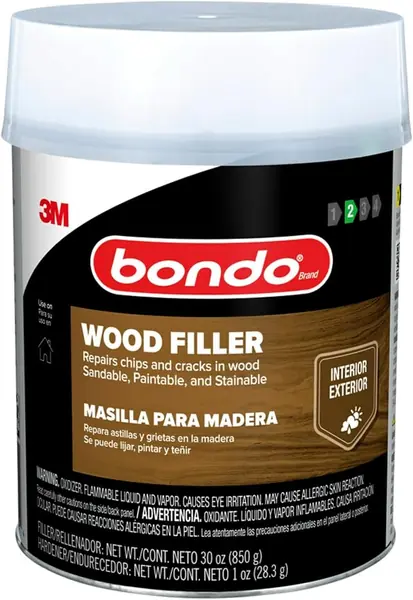
Bondo Wood Filler Best for Rotted Exterior Trim

Bondo two-part wood filler 30-ounce container with a cream hardener tube

Rotted exterior trim

Shop Score 89/100
Use
Interior and exterior
Size
30 oz
Hardener
0.5 oz cream hardener
Sandable
15 minutes
View on Amazon

The cream hardener is the first thing you notice, sharp enough that we mix this one with the garage door up and the lid back on between batches. The second is the clock. Once the hardener is stirred into the resin you have minutes, not hours, so the batch size stays small and the repair is planned before anything gets squeezed out of the container.

What you get for the hassle is a repair that behaves like the wood around it. It cures hard, sands to a smooth edge in about 15 minutes, and takes paint soon after, which nothing else here matches. On a rotted window sill or an exterior casing that has been taking weather, that hardness is the whole point: it rebuilds a missing section rather than skimming over it.

Technique matters more than with a tube of filler. Measure the hardener instead of eyeballing it, mix small batches, and pare the excess off with a chisel a couple of minutes after it goes on. You sand less and the profile of the molding stays crisper. Thick areas want layers, since one heavy pass is where a fast-curing resin gets away from you.

None of that makes it everyday trim filler. We keep the quart for rot, for split sill noses, and for exterior casing that has to survive a winter, then reach for a latex filler for the nail holes above it.

Worth Noting

  • Stain will not take predictably
Our Verdict

Keep this two-part filler for rotted sills and exterior casing that has to hold; it cures hard and sands smooth, and it is overkill for nail holes.

Check Latest Price
7.

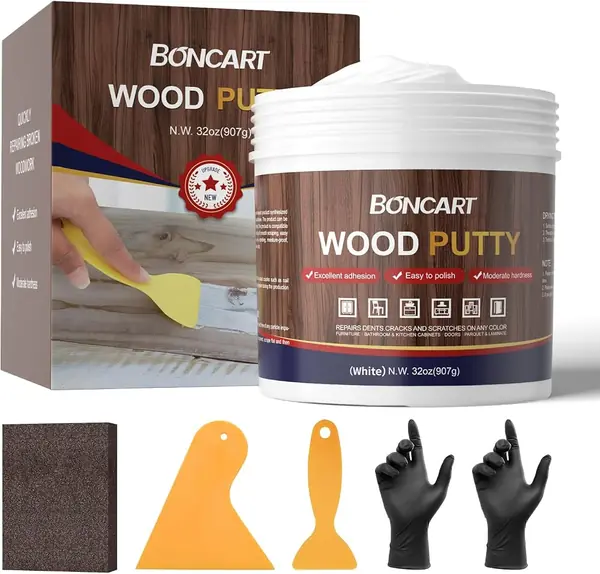
Boncart Wood Filler Best for Whole-House Trim Jobs

Boncart white wood filler 32-ounce tub with scrapers, sanding block, and gloves

Whole-house trim jobs

Shop Score 88/100
Color
White
Container
32 oz tub
Included
Two scrapers, sanding block, gloves
Water Resistance
Water resistant
View on Amazon

Thirty-two ounces of white filler, two scrapers, a sanding block, and a pair of gloves in one tub is the most filler for the money in this group, and that arithmetic matters when the job is every baseboard and door casing in a house rather than a single gouge behind a door.

What surprised us is how little it fights back. It spreads with almost no drag, rinses off tools and fingers with water, and goes on thick enough to close a nail hole in one pass. The white is bright and opaque, so on trim that is getting painted white anyway you are not chasing a color match or a second coat, and the tub stays water resistant once cured, which is more than some fillers at this size promise.

The included scrapers are the flexible plastic kind: handy in a corner, less precise than steel across a flat casing, and not the reason to buy. The reason is volume. For a paint-grade run of trim, cabinet doors, or a rental turnover, this is the tub we hand over, and it is the wrong one for a repair you intend to show off in stain.

Worth Noting

  • Can crack when packed into deep holes
Our Verdict

For a paint-grade job measured in door frames, this is the tub we buy: 32 ounces, tools in the box, and a white that covers without a fight.

Check Latest Price
8.

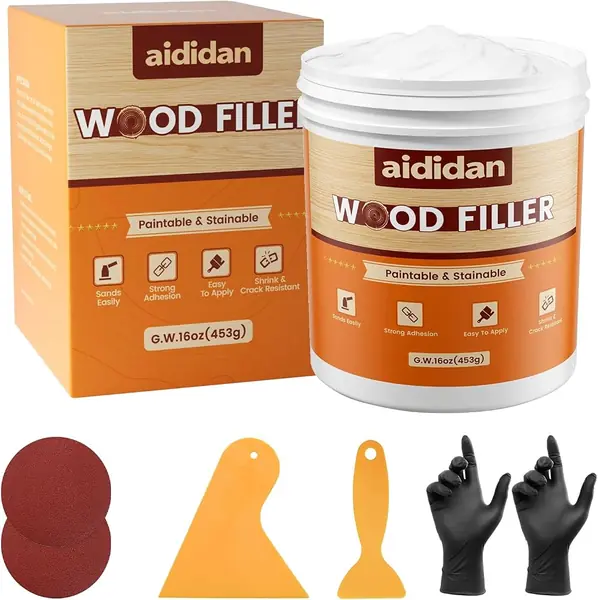
aididan Wood Filler Putty Best for Painted Trim Touch-Ups

aididan white wood filler putty 16-ounce tub with scrapers, sandpaper, and glove

Painted trim touch-ups

Shop Score 87/100
Color
White
Container
16 oz tub
Included
Two scrapers, two sandpaper sheets, glove
Formula
Water-based
View on Amazon

A tub of white filler with two scrapers, two sheets of sandpaper, and a glove is a friendlier unboxing than most fillers manage. For someone patching a rental before a walkthrough or fixing up a first house, that is a real convenience: you can start the repair without hunting through a toolbox for something to spread with.

On painted trim it does what it promises. It spreads smoothly, wipes off with water, and dries to a bright white that disappears under white paint. It is low-odor, which matters in a closed bedroom, and the wide resealable lid gives the leftovers a better chance than a tube does of surviving to the next repair.

The bigger limit is color. It dries very white, so it is a paint-grade filler: on stained or natural trim it reads as a patch rather than a repair no matter how carefully you sand it flush. That is not a flaw if your trim is painted, which most interior trim is, but it is why we do not hand this tub to someone finishing oak.

Treated as a starter kit for shallow, painted repairs, it earns its shelf space, and the extras make it easy to hand to someone who does not own a putty knife yet. For anything deeper, or anything that will be seen under a clear finish, the Minwax tube or the DAP tub does the job with fewer second thoughts.

Worth Noting

  • Deep fills can stay soft for days
  • Included sandpaper is thin and coarse
Our Verdict

Our read: worth it for white painted trim and shallow holes, with the tools included, but it is not a filler for anything going under stain.

Check Latest Price

How We Tested Wood Fillers for Trim

We built the shortlist from spec sheets, container formats, and interior/exterior ratings, then bought fillers in tubes, tubs, pints, and cans so we could compare formats side by side. Anything that arrived stiff, dried out, or skinned over in the container was noted before a single hole got filled, since a filler that won't spread is a filler that won't push into a nail hole. We also tracked how far each container went and what it cost per job.

Over four months we tested 14 fillers on real trim: nail holes in window casings, a split along a baseboard, chipped corners on door frames, and a soft spot on exterior trim beside a garage door. Each one went onto a vertical casing and an inside corner, and we checked for sagging after ten minutes and again after cure. Deep gouges were filled both in one pass and in layers, then checked for shrink, cracking, and whether the middle had hardened through; pressing a fingernail in told us more than the label did.

Once cured, we sanded each fill flush on a profiled edge, watching for gouging in the molding and for paint torn off the surrounding trim. We primed and painted over the white fills and stained the natural and color-matched ones, comparing the cured color to the board, and exterior fills got checked again after a stretch of wet weather. Tubes were squeezed, tubs scooped, and we timed how long each stayed workable. Sanding happened with a NIOSH-rated respirator and open windows; a casing in a pre-1978 house got wet sanding with containment instead of dry sanding, and the two-part filler was mixed with gloves in a ventilated garage.

How to Choose Wood Filler for Trim

Match the Filler to the Finish

Painted trim and clear-finished trim want different products. For paint, a white latex filler is the easy answer: it covers, it takes paint, and a near-white tone means small holes need no topcoat at all. For stained or natural trim, the filler has to match the wood rather than just fill it, which means either a tintable filler you blend with stain while it is wet, like the DAP Premium tub, or a color-matched wood putty like Minwax's Golden Oak.

The trap is trusting a shade name. "Natural" and "golden oak" each cover a wide range of wood, and a filler that dries darker than the trim leaves a visible dot under a clear finish. Test on an offcut or an inconspicuous edge before you commit to the face of a casing.

Pick the Container by the Size of the Job

Count the holes before you buy. A tube in the 3- to 6-ounce range is right for nail holes, a gouge or two, and anything you do standing on a ladder, because you can squeeze a controlled bead one-handed. A tub in the 16- to 32-ounce range is for whole-room trim runs and cabinet doors. A pint of latex filler suits work you intend to sand and finish carefully.

The trap is buying volume for touch-up work. A tub is a two-hand object at head height, and a tube is the wrong shape for a hundred holes in an afternoon. Owning both is not extravagant, it is how the job actually goes.

Fill in Layers and Work Vertically

Trim repairs fail in two places: a fill that is too deep and a fill that slides off a vertical face. A thick, knife-grade formula stays where you put it on casing and door frames, but nothing should go on thicker than about an eighth of an inch in one pass. Build deep holes in two or three passes and let each one firm up first.

The Plastic Wood-X can spells the difference out: 3 to 6 hours for fills up to an eighth of an inch, 36 hours for quarter-inch-deep fills. Pack a deep hole in one go and you are inviting a crack or a center that never hardens through, which is exactly the second visit you were trying to avoid.

Know What Dry Time Actually Means

Dry time on the label is the point at which you can sand, not the point at which you can paint, and the two can sit hours apart. Speed has a cost: a two-part filler is sandable in 15 minutes, but once the hardener is in you are working against a clock, so mix small batches and plan the repair before you start.

Ready-to-use latex fillers run from about 15 minutes to a full day before sanding, which is plenty of latitude for trim as long as you read the label rather than assuming. If a second coat of anything is going over the repair, wait for cure, not just a skin.

Frequently Asked Questions

Final Verdict

Our pick for most trim work is the DAP Premium Wood Filler in the 16-ounce tub. It grips vertical casings, sands flat, and can be tinted toward the wood when the trim is not getting painted, which covers more trim jobs than any single tube can.

Buy the Elmer's 3.25-ounce tube alongside it for nail holes you fill one-handed on a ladder, and reach for FamoWood when the repair is going to be sanded and inspected closely. If the trim is already finished and you are patching color rather than wood, skip all three and use the Minwax matched putty.