↑↓ navigate ↵ open Esc close All results →

Best Wood Rot Repair Epoxies of 2026

Treating decayed wood with a single jar of filler is the mistake that sinks most exterior repairs before the paint even dries. Rot hollows fibers from the inside out long before paint blisters on a windowsill, and soft, spongy grain needs a thin penetrating consolidant to harden the substrate before a paste or putty can anchor into missing sections.

Testing 11 repair epoxies across nine months on a spongy sill, a punky garage door frame, and a hollow railing post underscored how differently those two formulas work in practice. Beyond picking the right viscosity, clean two-part mixing, sag resistance on vertical faces, working time before tack-up, and sandability decide whether a repair blends flush or fights the sander.

Container size sets the final trade-off between waste and value, from hand-kneaded sticks sized for a single stripped screw hole to bulk two-part kits built for full trim seasons.

Our Top Picks

The Best Wood Rot Repair Epoxies

1.

Abatron WoodEpox Kit Best Overall
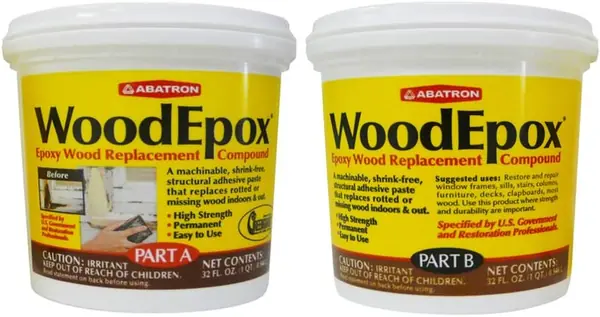
Abatron WoodEpox two-part epoxy wood replacement putty in a two-quart pail

Rebuilding missing wood

Shop Score 93/100
Full Cure
2 hours
Kit Size
2 quarts (64 fl oz)
Work Time
20-30 minutes
Certification
GREENGUARD
View on Amazon

A rotted sill rarely needs a skim coat; it needs material. WoodEpox is a two-part putty that goes into a cavity at whatever thickness the cavity happens to be — a deep corner, a missing inch of edge, a gap behind a hinge — and it holds that shape without slumping or shrinking as it sets. There's no building up in layers and no waiting between passes.

The cure is what convinced us. Twenty to thirty minutes of working time is enough to fill several checks in one batch, and two hours later you can put a saw, a drill, or a sander to it. On a molded sill edge, being able to carve and then sand in the same afternoon is the difference between a repair and a project.

It also behaves itself in a shop: no solvents, a GREENGUARD certification, and almost no odor, which matters when the work is inside a window frame in a closed-up house in February. It bonds to more than wood, too — stucco, concrete, ceramic — which is handy when rot has crept past the trim onto the surround. On pressure-treated stock the bond is the weak link, so rough the surface and test a patch before committing a whole repair to it.

Where we hesitate is the buy-in. The two-quart pail is the largest single purchase in this group and far more than one windowsill needs, so a smaller can of the same product makes more sense for a single fix. Ounce for ounce it beats the specialty putties here, though, and if you have a porch full of soft sills, this is the pail that won't run out mid-job.

Worth Noting

  • Expensive to buy in the two-quart pail
Our Verdict

We reach for WoodEpox when wood is missing rather than merely dented: it packs a void of any depth, holds its shape, and sands and paints like the wood around it.

Check Latest Price
2.

PC-Woody Wood Repair Epoxy Paste Best for Vertical and Overhead Repairs

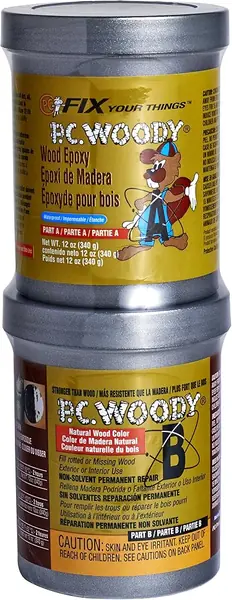
PC-Woody tan two-part epoxy wood repair paste in two 12-ounce cans

Vertical face repairs

Shop Score 92/100
Full Cure
24 hours
Mixing Ratio
1:1
Can Size
12 oz
Application Temperature
35 to 115 degrees F
View on Amazon

Gravity is what defeats most repairs on a door jamb, a sash, or an overhead sill: the paste slides off before it sets. PC-Woody has the tack of thick peanut butter, so it hangs where you put it and bridges a gap on a vertical face instead of running down it.

The open time is generous for a paste — enough to work a repair, step back, and reshape it, and enough to fill a run of cracks rather than a single hole. It cures without shrinking or popping out of exterior wood, takes nails and screws once hard, and sands fair under paint or a dark stain.

We keep it for exterior trim because that tack earns its keep where nothing else stays put. The trade is handling and time: 24 hours to a full cure means a Saturday morning repair isn't ready to sand until Sunday, and the paste grabs at the knife while you spread it — mix it on a flat board with a stiff putty knife, as the label directs, and work it flat rather than troweling at it.

Worth Noting

  • Full cure takes about 24 hours
  • Light-tinted stains barely register on the patch
Our Verdict

We keep PC-Woody for sills and jambs: the paste is tacky enough to hang on a vertical face instead of sliding off while it sets.

Check Latest Price
3.

System Three SculpWood Putty Best for Detail and Molding Work

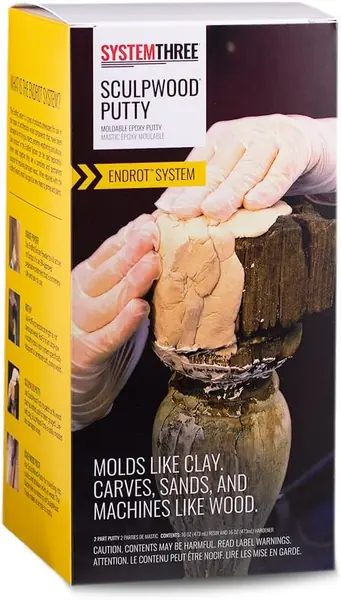
System Three SculpWood moldable epoxy putty in a one-quart pail

Shaping missing profiles

Shop Score 91/100
Full Cure
1 day
Kit Size
1 quart (32 oz)
Mixing Ratio
1:1
Water Resistance
Waterproof
View on Amazon

Out of the pail SculpWood feels like modeling clay: soft, smooth, and easy to pinch into shape. That's the whole appeal for restoration work, because you press it into a void and carve the missing profile back before it sets. Of the putties here, we found it the easiest to work into a fine edge and the one that takes the finest sandpaper afterward.

Its jobs are the fussy ones: a rotted window sill, a chipped corner on a door frame, a chewed chair leg, a missing bead of molding. It won't slump or sag while it cures, won't shrink, and won't go brittle, so it holds up outdoors on rails and frames as readily as it does indoors on furniture. Once hard it can be sanded, carved, sawed, and machined; it cures to a light brown, noticeably lighter than the wood around it.

Two things to know before you buy. The cure is a full day, so this isn't the product for a patch you want to paint this afternoon — schedule it for the end of the day and sand tomorrow. And it's priced like the specialty material it is: for a hairline crack a cheaper paste does the same job, while for a shaped repair that otherwise means splicing in new wood, the extra is easy to justify.

Worth Noting

  • A full day before you can sand
Our Verdict

SculpWood is for repairs that need a shape rather than a smear — missing molding, a chipped corner — and it sands finer than anything else here.

Check Latest Price
4.

Abatron LiquidWood Best for Soft and Spongy Wood

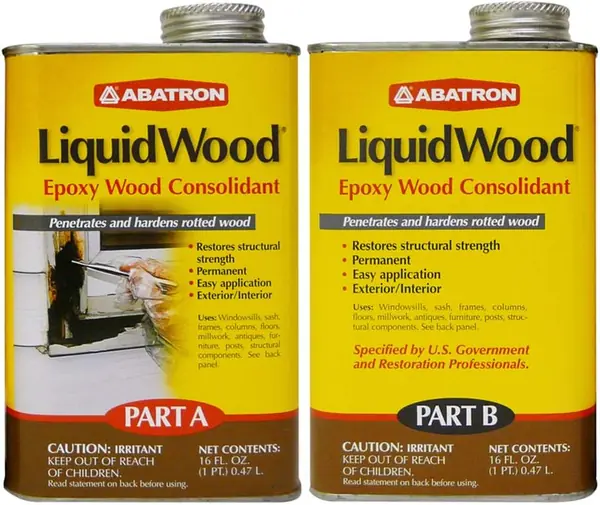
Abatron LiquidWood two-part epoxy wood hardener and consolidant in a two-pint kit

Soft, spongy wood

Shop Score 90/100
Full Cure
24 hours
Kit Size
2 pints
Water Resistance
Waterproof
Work Time
30-45 minutes
View on Amazon

Rot doesn't always remove wood. Often the section is still there — dark, spongy, soft enough that a thumbnail leaves a dent — and no putty will help, because there's nothing solid for it to grab. That's the case this two-part resin exists for.

LiquidWood is thin enough to soak into punky grain, and it goes on like paint with a brush: wet out the area, let it drink, and repeat on the worst of it until the surface stops absorbing. In our hands the test is a screw — if it bites and holds where it used to spin, the wood is back in business. Treated wood hardens within a few hours, and the 30- to 45-minute pot life is long enough to coat a whole window frame without mixing a second batch.

What it won't do is rebuild anything; it's a primer for a filler, and Abatron designs it to pair with WoodEpox. On a vertical face you're building up several wet coats rather than flooding it once, and in cool, damp weather the surface can stay tacky past the listed 24-hour cure, so don't count on a same-day topcoat. Harden the punky zone first, then pack the missing section.

Worth Noting

  • Rebuilds nothing on its own
Our Verdict

When a screwdriver sinks into the wood, this is the product: LiquidWood soaks into punky fibers and leaves them hard enough to hold a filler and a screw.

Check Latest Price
5.

J-B Weld KwikWood Epoxy Putty Stick Best for Small Quick Fixes

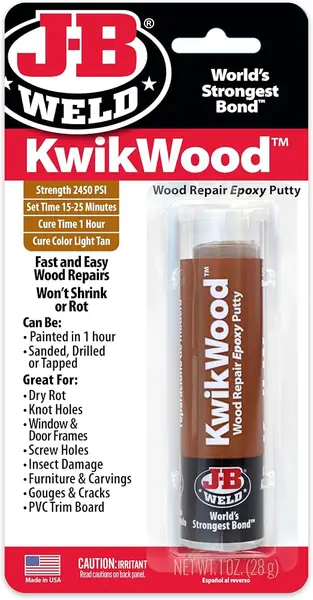
J-B Weld KwikWood tan epoxy putty stick in one-ounce packaging

Small hole repairs

Shop Score 89/100
Full Cure
1 hour
Work Life
15-25 minutes
Stick Size
1 oz
Lap Shear Strength
900 psi
View on Amazon

KwikWood arrives as a stick, like a fat crayon, with the resin on the outside and the hardener down the middle. Slice off a disc, knead it in your fingers until the color is uniform, and press it into the hole — no measuring, no cup, and nothing left over to go off. For a hinge screw that spins or a knot hole in a cabinet door, we think that convenience is worth more than any number on the label.

You get 15 to 25 minutes of work life and an hour to full cure, which makes it the fastest thing here for a small fix: drill it, tap it, sand it, and paint it the same morning. It cures to a light tan, doesn't shrink or rot, and holds at 900 PSI lap shear, which is plenty for a screw hole or a shallow gouge in trim.

Where it runs out is scale. A one-ounce stick covers a handful of holes and not much more; a sill repair would eat three of them. The work life also runs to the short end of that range in a warm shop, so knead only what you can place in a couple of minutes, and keep it to spots that aren't carrying a load — the cured putty can come out softer than the wood beside it.

Worth Noting

  • One-ounce stick runs out fast
Our Verdict

We stow a KwikWood stick in the toolbox for hinge holes and small gouges: knead, press, and an hour later it drills and sands.

Check Latest Price
6.

TotalBoat Penetrating Epoxy Wood Sealer Best for Large Sealing Jobs

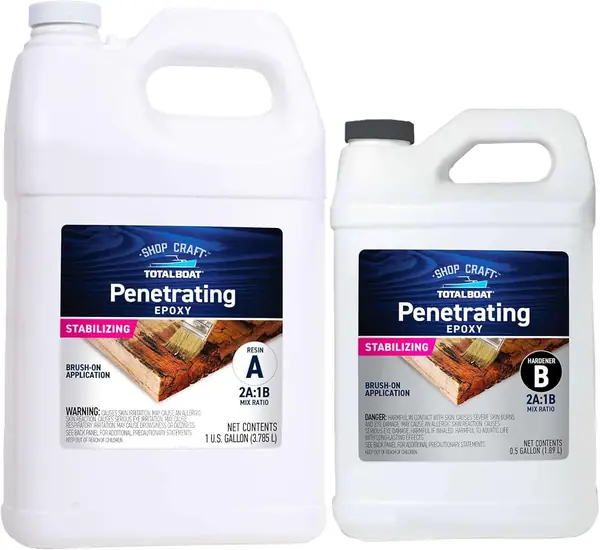
TotalBoat clear penetrating epoxy wood sealer and hardener in a 1.5-gallon kit

Large sealing jobs

Shop Score 88/100
Full Cure
7 days
Kit Size
1.5 gallons
Mixing Ratio
2 parts resin to 1 part hardener
Water Resistance
Waterproof
View on Amazon

A gallon and a half is a serious amount of epoxy, and the size tells you who this is for: deck boards, porch flooring, a boat, a run of posts — square footage, not the two-foot sill that started your search.

The formula is deliberately thin, and that's the function: it soaks into soft grain and end grain instead of sitting on top, sealing the wood and hardening the fibers it reaches. It's two parts resin to one part hardener, it goes on by brush, roller, or syringe, and the maker's own trick for dense stock is a splash of acetone to push it deeper. There's a cold-weather version for 40 to 65 degrees F if the shop is unheated.

We liked it most on boards that were soft across a wide area, where a putty would have been the wrong tool entirely: it travels farther into the wood than the thick consolidants and leaves a waterproof surface that takes varnish once cured. It is not a patch, though, and the volume is a commitment — if a section is gone, you're filling it with something else after this has soaked in.

Worth Noting

  • Oversized kit for a small repair
  • Up to seven days to full cure
Our Verdict

For decks, porch floors, and boats, this thin sealer soaks deep into soft wood and waterproofs it; it is far more epoxy than a sill repair needs.

Check Latest Price

How We Tested Wood Rot Repair Epoxies

We started with two dozen epoxies sold for rot repair and sorted them by form — thin penetrating consolidants, trowelable pastes, hand-kneaded putty sticks — then narrowed by container size against realistic jobs, whether the kit included both parts, working time, and price. Eleven made the cut. Two were dropped early for a mixing ratio so fussy we couldn't get a consistent batch out of them.

Every product went onto real rot in and around an old garage: a sill with a soft front edge, a door frame punky at the bottom, a porch post base, and a railing with a hollow core. We cut away the soft, punky wood first — epoxy brings back the look and binds the remaining fibers, but it doesn't restore strength a member has already lost — then mixed each batch exactly as its label directed and applied it within the stated temperature range, gloves and safety glasses on, garage door open.

We timed pot life with a stopwatch from the moment of mixing to the moment the material stopped spreading, pressed each batch into a vertical jamb and an overhead sill to see whether it sagged, and noted how hard it felt at the one-hour mark, the next day, and a week later. Then we sanded cured patches with coarse and fine paper, carved a molding profile with a chisel, drilled and drove a screw, primed and painted to check for fisheye, and looked at patch edges for lifting.

Exterior patches sat on the north side of the building through rain, two freezes, and a hot spell. We also tracked how far each container actually stretched, since a kit that covers half a sill is no bargain.

How to Choose Wood Rot Repair Epoxy

Harden First, Then Fill

Push a screwdriver into the damage and see what it does. If the tip sinks, the fibers are still there but they've lost their strength, and the job is consolidation — a thin two-part resin soaks in and hardens what's left. If the wood is gone and you're looking into a cavity, the job is filling: a paste or putty packed in and shaped.

Plenty of repairs need both, always in that order, because the filler bonds best to wood that has already been hardened and primed. Filling over soft fibers just leaves a hard plug sitting in mush, and the first wet season will find it.

Match the Form to the Shape of the Damage

Sticks are handiest for small holes: knead, press, done. Pastes spread with a knife and pack into voids, and the high-tack ones stay on a vertical face where a wetter mix would slide. Moldable epoxy putty such as SculpWood holds a shape you can carve, which is what a missing molding profile or a chipped corner needs. Thin consolidants are for soaking, never for filling.

Buy the form that matches the hole in front of you rather than the biggest number on the label; a one-ounce stick is the right purchase for a hinge hole and the wrong one for a sill.

Respect the Working Time and the Temperature

Two-part epoxies are temperature-sensitive: a batch that gives you half an hour at 65 degrees F can kick in half that at 85 degrees F. Mix small batches, spread them out on a scrap board rather than leaving them heaped in a cup, and keep the work in the shade.

Application ranges differ — PC-Woody lists 35 to 115 degrees F, and TotalBoat sells a cold-weather formula for 40 to 65 degrees F — so read the label before you plan a Saturday. Below the stated range, a mix can sit tacky for days instead of hardening.

Plan the Finish Before You Fill

Epoxy isn't wood and doesn't take a finish like wood. Paint hides almost anything once the patch is sanded fair and primed. Stain is fussier: light tints barely register on a tan patch, and dark or solid-pigment stains are the safer call on a repair that sits in plain sight.

Sandability separates the products here — the putties sand well, but you're still sanding a plastic, so use fresh paper and a light touch, and test any stain on a scrap of cured epoxy before it goes on the repair.

Buy Only as Much as the Job Needs

Rot repairs are small by nature, and epoxy is an expensive way to buy material. A one-ounce stick handles a handful of screw holes; a 12-ounce can or a quart covers a sill, a jamb, and some trim; a two-quart pail or a gallon-and-a-half kit is for porches, decks, and boats.

Mixed epoxy can't be saved for later, so size the container to the work in front of you: enough to finish in a couple of batches, and not so much that most of it sets in the pot.

Frequently Asked Questions

Final Verdict

We hand WoodEpox to anyone facing a cavity in a sill, a jamb, or a piece of trim: it packs to any depth, sets in about two hours, and sands and paints like the wood it replaced.

The answer changes if the wood is soft rather than missing — harden it with LiquidWood first, because filler over punky fibers is a patch on mush. And for a few hinge holes rather than a rotted section, the KwikWood stick does the job with no measuring and no waste.