↑↓ navigate ↵ open Esc close All results →

Best Corded Oscillating Tools of 2026

Instead of spinning, an oscillating blade shivers side to side at high speed, letting it plunge cleanly into drywall, undercut a door jamb without pulling trim, or flush-cut a dowel right against the surrounding wood. Corded models deliver steady power from the first cut to the last with no battery fade, handling tight flush and plunge cuts that other saws cannot reach.

Across eight months of cutting white oak, laminate, and drywall with 11 corded models, we timed blade changes and tracked handle vibration after long overhead passes. Even a quick job like trimming the bottom off a sticking closet door quickly shows which tools control chatter and which numb your hands.

Accessory counts printed on the box matter far less than the blade interface and usable low-end speeds. From light-duty punch-list tools to the strongest motors in the group, these seven corded tools balance low-end control, low vibration, and blade-mount compatibility.

Our Top Picks

The Best Corded Oscillating Tools

1.

Dremel MM50-01 Multi-Max Best Overall
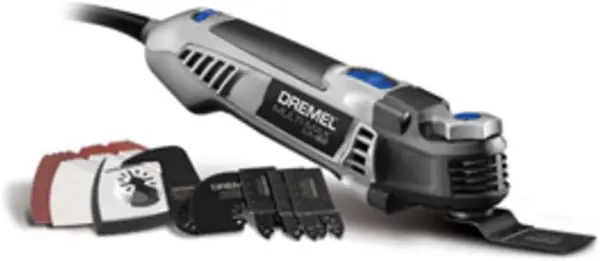
Dremel MM50-01 Multi-Max corded oscillating multi-tool with angled body and tool-free blade knob

Trim and cabinets

Shop Score 95/100
Amperage
5 A
Speed Range
10,000–21,000 OPM
Warranty
2 years limited
Accessory Change
Tool-free twist knob
View on Amazon

A flush cut along a finished cabinet face is the job that decides whether an oscillating tool earns its shelf space, and the MM50 makes that cut easier than anything else in this group. The front end is 30 percent more compact than the earlier Multi-Max body, so the tool lies flatter against the work and your knuckles clear the countertop. The head is angled as well, which keeps the blade tracking your line instead of fighting your wrist.

Power is where this tool separates itself. Five amps is the highest rating here, and the extra current shows up in the cuts that stall lesser tools, like a hardwood plank or a deck screw you did not see. Speed runs from 10,000 to 21,000 OPM on a dial, so you can drop it low to sand a curved rail and open it up for a rotted sill. We think that pairing of a compact nose and a broad speed range is what makes it the most useful tool here for trim and cabinet work.

Swapping accessories is a twist, a press and a click, with no wrench to lose in a pile of shavings. The catch is what comes in the box: two flush-cut blades and nothing else, so we put a sanding pad and a scraper on the list before the first project is finished.

It costs substantially more than the midrange picks here, and its two-year warranty is a year shorter than the DEWALT's. For the woodworker who wants one corded oscillating tool to keep through a decade of trim work, that trade is worth making; for the tool that comes out twice a year, it is not.

Worth Noting

  • Ships with only two blades
Our Verdict

We reach for the MM50 first: its 5-amp motor and shortened front end make flush cuts in installed trim feel easy, and it leaves budget for a real blade set.

Check Latest Price
2.

DEWALT DWE315K Best Kit

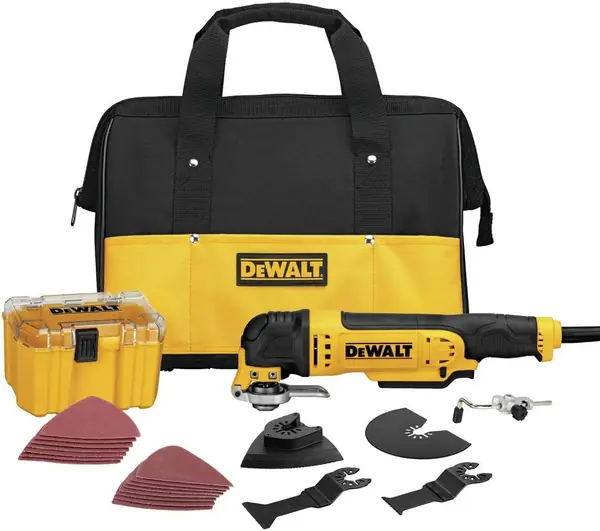
DEWALT DWE315K corded oscillating tool kit with yellow body and accessory bag

Full kit remodeling

Shop Score 94/100
Amperage
3 A
Included Accessories
29 cutting and sanding pieces
Max Speed
22,000 rpm
Accessory Change
Tool-free quick-change
View on Amazon

Twenty-nine pieces ride in the bag: wood and bi-metal blades, sandpaper triangles, a scraper, and a depth guide that no other tool here includes. That guide clamps to the tool and sets a repeatable depth or height, which is the difference between eyeballing a plunge into a doorjamb and hitting the same depth four times in a row.

The dual-grip variable-speed trigger is the other feature worth the money. You can feather it at the start of a cut in laminate and squeeze harder once the blade is buried, and the soft overmold on both grips keeps your off hand in play. A bright LED sits right where the blade meets the work, which we appreciated under a sink. Three amps and 22,000 OPM will not outrun the 5-amp Dremel in thick hardwood, but the combination is quick in pine and plywood.

We rate this the most complete kit here, not the best value. At the top of the price range it earns its place in a shop that will actually use the depth guide and wants every accessory in one bag; for straight flush cutting, the cheaper Dremel does the same work with less bulk in the way. Three years of warranty coverage is the longest in this group, and the depth guide is the one feature nobody else here offers.

Worth Noting

  • Included blades wear out fast in hardwood
Our Verdict

If you want one box that handles cutting, sanding and scraping, this is the kit we point to, provided you budget for better blades than the ones included.

Check Latest Price
3.

WORKPRO 3.0-Amp Oscillating Multi-Tool Best Value

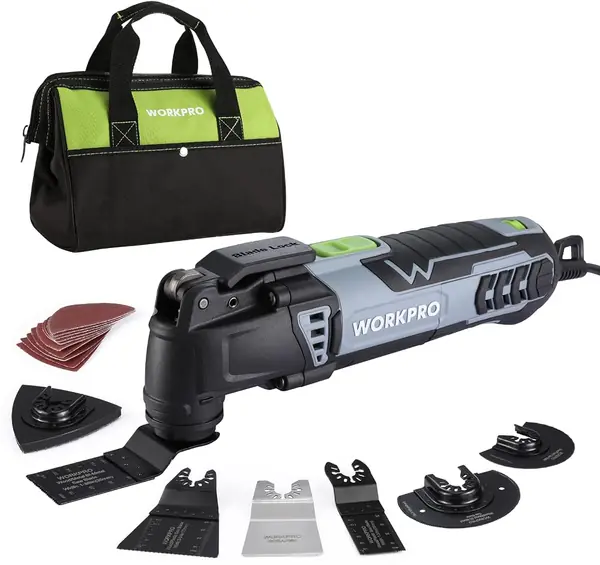
WORKPRO corded oscillating multi-tool with 17-piece accessory kit and storage bag

Value-minded DIY

Shop Score 92/100
Amperage
3 A
Oscillation Angle
3°
Speed Range
15,000–23,000 RPM
Included Accessories
17 pieces
View on Amazon

Anyone shopping on price lands here first, and the WORKPRO holds up to that scrutiny. Seven speed settings span 15,000 to 23,000 RPM, the widest range in this group, and the top end cuts a baseboard notch fast enough that you stop thinking about what the tool cost. We think it is the best value on this page.

The oscillation arc is on the narrow side at 3 degrees, and that is a real trade-off rather than a flaw. A narrow arc takes a smaller bite on each stroke, which makes the tool easier to steer along a pencil line but slower through thick stock. For trim, drywall and light hardwood, which is what most of us actually cut, that is the right compromise, and it is why this one feels less jumpy than the wide-arc tools.

The 17-piece kit covers wood, plastic, soft metal, scraping and sanding, and the flip-button change meant we never hunted for an Allen key mid-cut. Standard blades fit, so the kit is a starting point rather than a commitment to one maker's consumables.

Worth Noting

  • At 5.2 pounds it tires you out overhead
Our Verdict

Seven speeds, tool-free blade changes and a usable accessory set make this the value pick we hand anyone who wants one corded multi-tool without paying premium money.

Check Latest Price
4.

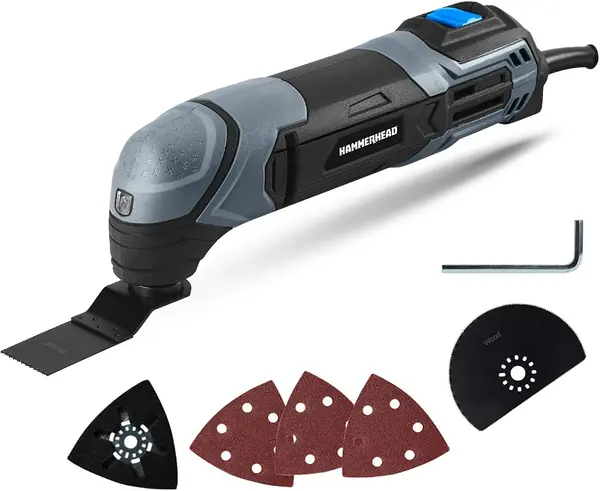
Hammerhead HAMT022 Best for Occasional Use

Hammerhead HAMT022 corded oscillating multi-tool with black and gray pencil-style body

Occasional punch lists

Shop Score 91/100
Amperage
2.2 A
Oscillation Angle
2.8° (±1.4°)
Warranty
2 years limited
Max Speed
20,000 OPM
View on Amazon

This is a tool for the punch list rather than the project: trimming a door jamb, plunging a register opening through drywall, cutting the sealant line around a window before you pry the casing. It handles all of that, and the pencil-style body with a soft grip gets into cabinet corners where a bulkier tool will not fit.

Two hands tell you what a spec sheet cannot. The 2.2-amp motor is the smallest here and the 2.8-degree arc is the narrowest, so in anything thicker than a 2x4 you feel the tool working rather than gliding. We think that is a fair trade for a homeowner who needs this three or four times a year; for a remodeling crew it is simply the wrong tool.

None of it feels premium, and we minded the two-year warranty most, but at this price the tool pays for itself the first time it saves you from pulling a casing off the wall to reach a hidden pipe. The speed dial falls under your thumb and the LED points where the blade goes, which is more than the money suggests.

Worth Noting

  • Thin six-piece accessory set
Our Verdict

For a handful of jobs a year, we think this is the least money you can spend and still get a corded tool that does real trim work.

Check Latest Price
5.

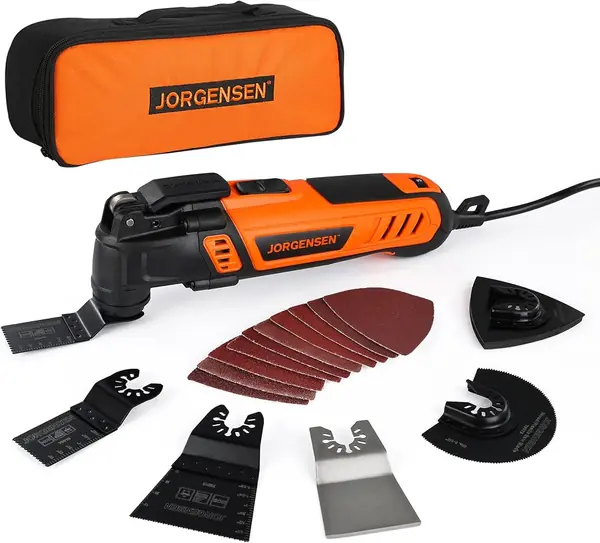
JORGENSEN 16-Piece Oscillating Multi-Tool Best for Tear-Out Work

JORGENSEN corded oscillating multi-tool with 16-piece blade set and soft-grip body

Tear-out work

Shop Score 90/100
Oscillation Angle
5°
Speed Range
8,000–16,000 OPM
Included Accessories
16 pieces
Weight
4.71 lb
View on Amazon

Five degrees of oscillation is the widest arc in this group, and it changes the character of the cut. Where a 3-degree tool nibbles along a baseboard, this one takes a wider bite on every stroke, so you cover more linear feet in the same pass. If your work is cutting out old jambs and subfloor rather than finessing a cabinet panel, that is the number that matters.

Seven speed positions run from 8,000 to 16,000 OPM. The low end is the useful part: drop it down for laminate, painted trim or plastic, where a fast blade rubs the material and burns the edge instead of cutting it cleanly.

The quick-change clamp has a locking bracket that keeps your fingers clear of the blade while you seat an accessory, a small detail we appreciated every time we swapped between the flush-cut blade and the sander. The 16-piece set covers cutting and sanding, and the slim soft-grip body is shaped for a hand wrapped around it for a long stretch.

The 16,000 OPM ceiling makes it the slowest tool here on paper, and that is the one place the wide arc cannot compensate: in thin plywood, where a fast, clean cut matters, the quicker tools finish first. Point it down at a floor and the arc does the work instead. For tearing out old jambs and subfloor, this is the one we grab.

Worth Noting

  • Included blades dull quickly
  • Gets hot during long continuous cuts
Our Verdict

A 5-degree arc and seven speeds give it more bite per pass than the narrow-arc picks, which is why we take it to flooring and tear-out jobs.

Check Latest Price
6.

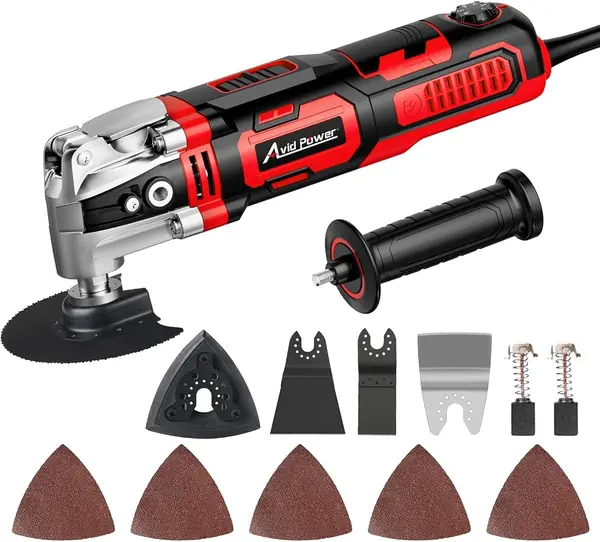
AVID POWER 3.5-Amp Oscillating Tool Best for Two-Handed Sanding

AVID POWER corded oscillating tool with red body and detachable auxiliary side handle

Two-handed sanding

Shop Score 89/100
Amperage
3.5 A
Oscillation Angle
4.5°
Speed Settings
6
Auxiliary Handle
Included
View on Amazon

Two hands are better than one on an oscillating tool, and this is the only pick here that gives you the option out of the box. Screw on the auxiliary handle and the tool stops walking: sanding a raised panel or holding a long plunge in a countertop becomes a two-handed job with the pressure spread across both palms. We like that it addresses the part of this category nobody advertises, which is the fatigue that sets in after ten minutes of one-handed cutting.

Underneath the handle sits a 3.5-amp motor, a 4.5-degree arc and six speeds, with a quick-change locking lever instead of a wrench. It is not the fastest or the most refined tool in this group, and it does not come with the biggest pile of accessories. What it offers instead is control, and control is the thing you cannot add later with a blade purchase.

Worth Noting

  • Smaller accessory set than the other kits here
Our Verdict

Two hands are better than one here: we like the side handle that steadies sanding and long plunge cuts, which is what sets this tool apart.

Check Latest Price
7.

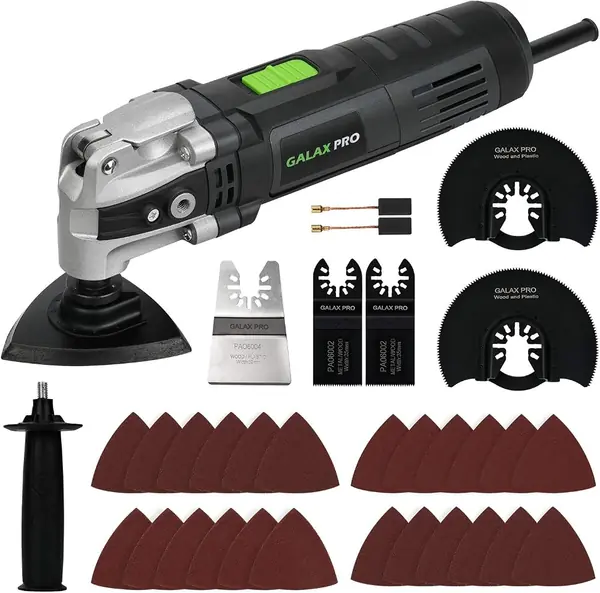
GALAX PRO 3.5-Amp Oscillating Multi-Tool

GALAX PRO 3.5-amp corded oscillating multi-tool with 30-piece accessory kit and storage bag

First shop setup

Shop Score 88/100
Amperage
3.5 A
Oscillation Angle
4.5°
Speed Range
15,000–22,000 OPM
Included Accessories
30 pieces
View on Amazon

Thirty pieces is the biggest accessory count among the picks here, and it is the reason this tool is worth a look: blades for wood, plastic and soft metal, a scraper, a sanding pad and 24 sheets of paper across four grits, all in one bag. For someone outfitting a first shop, that is a lot of capability to unbox at once.

Three and a half amps and a 22,000 OPM top speed put it near the front of this set for raw cutting speed, and six speeds between 15,000 and 22,000 OPM give you somewhere to go in plastic where heat is the enemy. We found the 4.5-degree arc wide enough to clear material without the jumpiness of the widest tools here.

Where it lands is the question. Thirty accessories and a 3.5-amp motor for the least money in the mid-tier is a genuinely good deal for someone outfitting a first shop, and the tool is capable enough that the limits show up in the consumables before they show up in the motor. It earns its place as a second tool, or as the first one in a shop that is still being built.

Worth Noting

  • Included blades and sanding pad are the weak points
Our Verdict

If accessories per dollar is what you are shopping for, this is our pick, provided you plan on replacing the blades before the first project.

Check Latest Price

How We Tested Corded Oscillating Tools

We built the shortlist from every corded oscillating tool we could find that came with a real warranty and a blade interface you can actually buy blades for, then filtered by motor size, oscillation angle, speed range, and price so the 11 we bought spanned light-duty work up to cabinet-grade trim. All 11 were purchased at retail and unboxed the way you would at home.

For eight months they lived in a basement shop and on a run of trim, flooring, and drywall jobs. We undercut door jambs during a flooring install, plunge-cut outlet openings in drywall, freed old baseboard during a tear-out, sanded paint off stair risers, and sliced plastic vent pipe. In white oak we timed a long cut and listened for the motor bogging halfway through; in laminate and plastic we dropped to the slowest setting to see whether the blade melted the edge or cut it clean. Every board got checked for nails before a plunge cut, and anything with metal in it got a bi-metal blade.

Blade changes were timed with a stopwatch, bare-handed and then in work gloves, and we unplugged the tool each time even when the system was tool-free. We flush-cut against a scrap of finished baseboard to see how close the front end reached and whether the housing scuffed the surface, and ran each tool overhead long enough to judge balance and how quickly our hands went numb. We also sorted every included accessory, noting which blades were worth loading and which were there to pad the count, and kept a running tally of blades consumed and how the clamp held up after dozens of swaps.

How to Choose a Corded Oscillating Multi-Tool

Match the motor and the arc to the cut

Amperage tells you how the tool behaves when the blade is buried. The 2.2-amp Hammerhead and the 5-amp Dremel sit at the two ends of this group: the small motor is fine in trim and drywall and audibly labors in oak, while the 5-amp tool holds its speed through a hardwood plank. Oscillation angle works in the other direction. A 5-degree arc like the JORGENSEN's removes more per stroke and covers linear feet faster, while a 3-degree arc like the WORKPRO's takes smaller bites and tracks a pencil line more easily.

If most of your work is flush cuts in finished material, favor control and a compact nose. If you are tearing out jambs, subfloor or tile, favor the wide arc and accept a heavier, jumpier tool.

Look at the low end of the speed range

Every corded tool here is variable speed, and the number of settings matters far less than where the range starts. The important figure is the bottom: 8,000 OPM on the JORGENSEN lets you sand a veneered panel or cut plastic without melting it, while tools that start higher can scorch a laminate edge before you find a workable setting. If you plan to sand, scrape adhesive or cut PVC, prioritize a low minimum over a high maximum.

Blade changes and the interface question

You will change accessories constantly, far more often than you change a circular saw blade, so a tool-free lever or knob is worth having, and most of the picks here have one. The bigger decision is the interface. A universal fit accepts other makers' blades; a proprietary mount ties you to one brand's consumables. The DEWALT ships with a universal adaptor, and the WORKPRO takes standard blades directly.

Check the mount before you buy a ten-pack of blades, and buy one blade first to confirm the fit.

Treat the accessory count as a starting point

Thirty pieces sounds better than six until you use them. The blades bundled with budget kits are consistently the weakest part of the package, and a dull blade is what makes an oscillating multi-tool feel underpowered when the motor is fine. Budget for one good bi-metal blade and a carbide scraper regardless of what comes in the box, then judge the tool on its motor, its reach and its balance instead of its piece count.

Reach, weight and the cord

A compact front end and an angled body do more for flush cutting than an extra half amp, because they let the tool sit flat against the work instead of holding the blade off the surface. Weight is the other half of that: the picks here run from a pencil-style 2.2-amp body to tools over five pounds, and the difference is obvious at chest height. Remember the cord is a two-ended commitment, since you need an outlet and a heavy enough extension cord, and that is the price of unlimited runtime.

Frequently Asked Questions

Final Verdict

The Dremel MM50-01 is the tool we point most woodworkers to. Five amps and the most compact nose in this group make short work of the flush cuts that justify owning an oscillating tool at all, and it costs well under the premium kit, with a two-year warranty as the trade you accept.

If you want the depth guide and a bag that holds every accessory, the DEWALT DWE315K is the better buy and the only tool here that makes repeatable plunge cuts easy. And if the tool will sit in a drawer eleven months a year, the Hammerhead does the same trim work for a fraction of the money.