↑↓ navigate ↵ open Esc close All results →

Best Hearing Protection for Woodworking of 2026

Hearing protection fails in a woodshop the moment a pinching headband or stiff ear cup fighting safety glasses tempts a woodworker to pull it off between cuts. A table saw pushes around 105 decibels and a router runs louder still, so cumulative damage builds silently whenever protection sits on the bench instead of sealing around the ears.

Through eight months of testing 12 earmuffs and earplugs during table saw passes, router operations, and Saturday lawn mowing, the highest number printed on the box mattered less than whether the cushions stayed sealed past the 45-minute mark. Comfort and reliable clamping force without temple pain decide whether a protector actually stays worn all afternoon.

Understanding Noise Reduction Ratings also prevents bad math: NRR is not a percentage, so a 34 dB rating does not block 34 percent of sound, and doubling up plugs under muffs adds only a few decibels rather than summing both numbers. Reliable sealing and multi-hour wearability define the muffs and plugs recommended below.

Our Top Picks

The Best Hearing Protection for Woodworking

1.

Pro For Sho 34dB NRR Ear Protection Best Overall
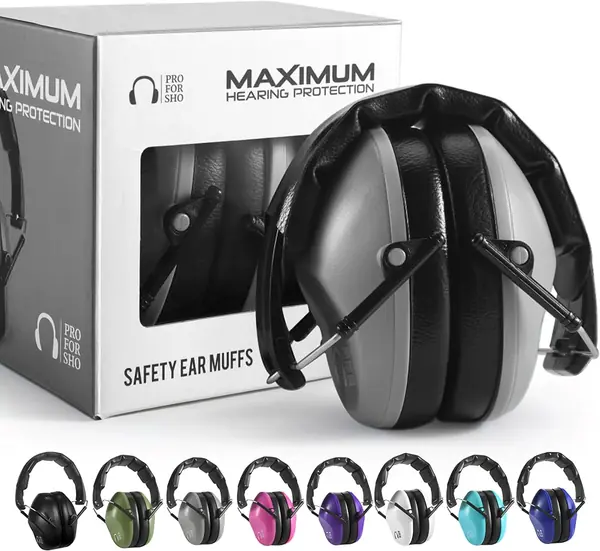
Gray Pro For Sho low-profile earmuffs with padded headband and foam ear cushions

Most workshops

Shop Score 95/100
Noise Reduction
34 dB NRR
Weight
7.2 oz
Dimensions
4.8 x 4.1 x 4.7 inches
Certification
ANSI S3.19 and CE EN 352-1
View on Amazon

Thirty-four decibels is the second-highest rating in this roundup, and it comes inside a shell that weighs 7.2 ounces. That combination is why these are the pair we hand a woodworker first. A router or a thickness planer is about the loudest thing in a small shop, and these drop it to a level you can work beside for an afternoon without your ears ringing at dinner.

What we watched for was the seal around safety glasses, and it holds. The cups are shallow enough that a temple arm slides under the cushion instead of levering the muff off your ear, and the low profile keeps them from catching on a bandsaw's frame or the edge of a face shield. The fit runs snug on purpose — a wide head will feel it — and a new pair needs a little flexing of the band before the clamp relaxes into comfortable. Give them a week before you decide.

The number is certified to ANSI S3.19 and CE EN 352-1, which is the difference between a rating and a claim printed on a box. There's nothing fussy here: no batteries, no switches, no electronics to go quiet in a dusty shop, and they cost less than most of the muffs on this list. For the money and the weight, we haven't found a better first pair here.

Worth Noting

  • Snug band feels tight on wide heads initially
Our Verdict

We recommend the Pro For Sho pair as the default: 34 dB of certified attenuation in a 7.2-ounce shell that clears safety glasses and won't fight a face shield.

Check Latest Price
2.

Decibel Defense 37dB NRR Ear Muffs Best for the Loudest Shops

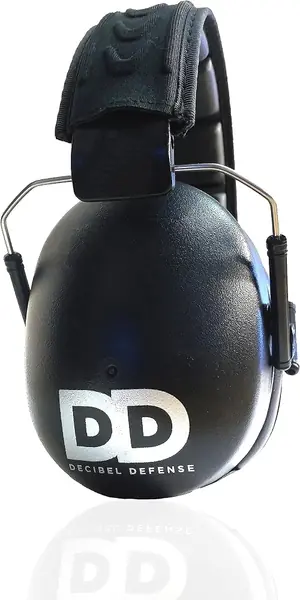
Black Decibel Defense over-the-head earmuffs with fully padded band and soft foam cups

Loudest shops

Shop Score 94/100
Noise Reduction
37 dB NRR
Weight
12.8 oz
Sizes
Regular and X-Large
View on Amazon

Some shops have one loud tool and some have a wall of them, and the Decibel Defense pair is aimed squarely at the second kind. At 37 dB NRR it is the highest-rated muff here, and it earns the number with a deep shell and thick foam rather than a band that squeezes your skull to make the seal.

Where that pays off is genuinely loud work. Running a planer, or shaping with a router, the gap between a 37 dB muff and a mid-20s plug is the difference between flinching at the start of a cut and forgetting the tool is screaming. The padding is generous — a fully cushioned band and soft foam cups — so the clamp spreads across the top of your head instead of concentrating in two spots.

The band doesn't slide, so the two sizes do the adjusting instead of a headband; order the X-Large rather than hope if your head runs big, and the Regular suits most adults. We reach for these when the afternoon is planing and routing, then swap to the lighter Pro For Sho pair when the work turns to sanding and assembly.

Worth Noting

  • Heaviest muff here at 12.8 ounces
Our Verdict

Our pick when the planer and router run together: 37 dB is the highest rating here, and two sizes give the fixed band a fighting chance of fitting.

Check Latest Price
3.

3M PELTOR Optime 105 Earmuffs Best for Long Sessions

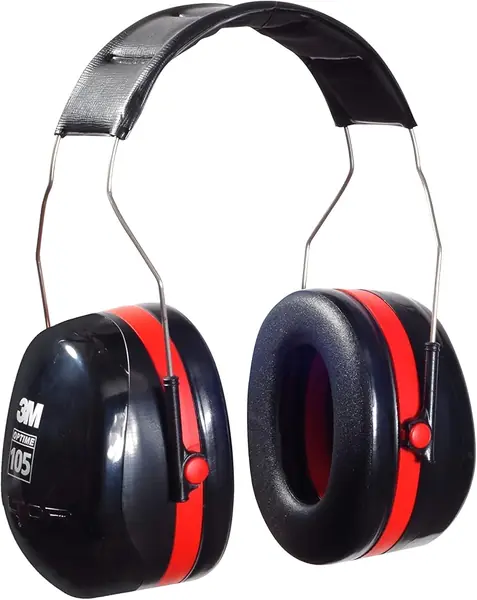
3M PELTOR Optime 105 over-the-head earmuffs in black and red with steel headband

All-day wear

Shop Score 93/100
Noise Reduction
NRR 27-30 dB
Headband
Stainless steel
Cup Design
Double shell
View on Amazon

Two shells, one nested inside the other, is what separates the Optime 105 from the rest of this group. That double cup is how 3M gets a 27-to-30 dB rating out of cushions soft enough to forget about — the attenuation comes from the shell, not from clamping down on your skull.

If you're at the bench for a whole Saturday, this is the pair we reach for. The stainless-steel band keeps its shape instead of slowly relaxing the way plastic bands do, so the seal you set at nine in the morning is still the seal at three. The cups are deep enough to sit around the ear rather than on it, and the band lies flat enough that a cap goes over the top.

They give up a few decibels to the two pairs above them. That matters if you're thickness-planing for an hour and doesn't if you're cutting joinery and running a sander, and it's the price of the softer fit. For the loudest jobs, add a plug underneath; that's the only time we've wanted more from them.

Worth Noting

  • Band runs snug on larger heads
Our Verdict

For long days at the bench we reach for the Optime 105: double-shell attenuation with a band and cushions that don't need a break by noon.

Check Latest Price
4.

Quality Plugs by Rips Corded Earplugs Best Earplugs

Quality Plugs by Rips corded reusable earplugs in individually wrapped bulk pairs

Under muffs

Shop Score 92/100
Noise Reduction
25 dB NRR
Quantity
100 pairs
Cord
Removable fabric cord
Packaging
Individually wrapped pairs
View on Amazon

A hundred pairs, each sealed in its own bag, is why the Quality Plugs box lives on a shelf in our shop instead of one lonely pair in a drawer. There's a set in the apron, a set in the toolbox, a set in the truck, and none of them has been in anybody else's ear.

Plugs win in a woodshop for reasons that have nothing to do with the number on the box. Under a face shield, with a respirator's top strap running behind your head, or in a shop that's ninety degrees by noon, a plug is the only thing that stays where you put it. The fabric cord means you can drop them around your neck when the saw stops and have them back in before the next cut.

The 25 dB rating is real only if you seat them properly: push, twist a quarter turn, and hold for a beat until the shop goes dull. A plug perched at the entrance of your ear canal gives you a fraction of that, and it's the usual reason plugs get called useless. They wash with soap and warm water, and a pair in daily use holds its spring for months.

Worth Noting

  • Less attenuation than muffs when worn alone
Our Verdict

We keep the box of corded plugs in the shop for hot days, face shields, and doubling up under muffs — a hundred wrapped pairs never leave you without a set.

Check Latest Price
5.

Peltor Sport Tri-Flange Earplugs Best for Quick Cuts

Peltor Sport tri-flange corded reusable earplugs in a three-pair pack

Quick cuts

Shop Score 91/100
Noise Reduction
26 dB NRR
Quantity
3 pairs
Care
Washable and corded
Design
Tri-flange, no rolling
View on Amazon

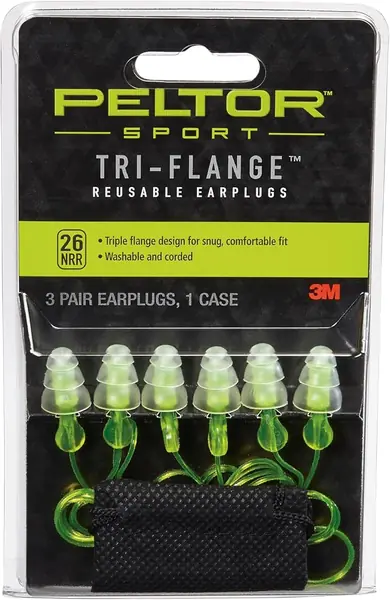
Foam plugs want rolled fingertips, and in a shop your fingertips are sawdust-covered before the second cut. The tri-flange design skips the ritual: push, twist a quarter turn, and you're sealed.

At 26 dB they sit between the muffs and the softer plugs here — plenty for a chop saw and a sander, not enough on their own for a planer. The cord hangs them around your neck while you measure, and the flanges wipe clean, so the same three pairs keep going instead of being tossed in the shavings.

We keep a pair of the Peltor Sport plugs in the apron for the jobs in between: too short to bother with muffs, too loud to skip. The three pairs split naturally — bench, mower, glove box — and the cord means you're never patting down four pockets looking for one.

Worth Noting

  • Flange seal won't suit every ear canal
Our Verdict

Three pairs of flanged plugs that go in without rolling — the ones we grab with sawdust on our hands for short, loud jobs.

Check Latest Price
6.

Dr.meter 31dB Ear Muffs Best for Kids and Helpers

Dr.meter adjustable ear muffs in black and purple with memory foam cushions

Kids and helpers

Shop Score 90/100
Noise Reduction
31 dB NRR
Headband
Adjustable
Cushions
Memory foam and PU leather
View on Amazon

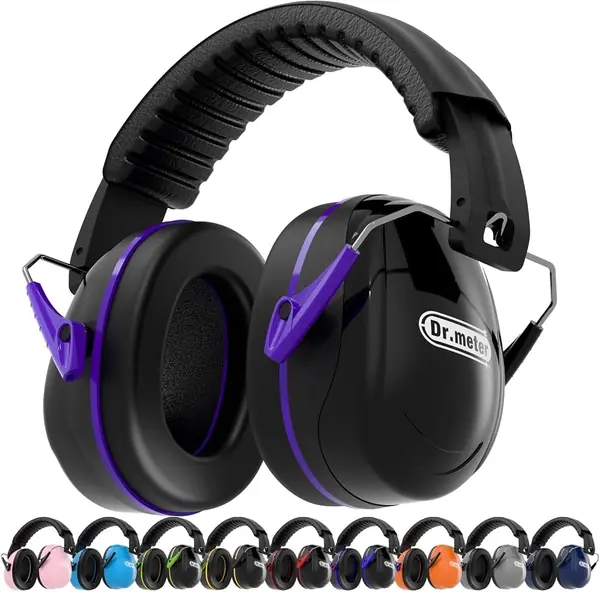
The least expensive pair here is also the smallest, and that's the point: the Dr.meter muffs are shaped for kids and smaller heads, with a band that adjusts from a first-grader to a small adult.

The 31 dB NRR is a real rating rather than a toy figure, so a young helper standing beside a table saw gets more reduction than a couple of the adult muffs here provide. Memory foam cushions under PU leather stay soft against the ears, and the ABS shells shrug off being dropped on a concrete floor.

Ours lives in a drawer as the loaner pair, for the kid who wants to watch you run the jointer or the visitor who wants to stand at the bench. It's the pair we point to when someone is outfitting a child for the shop, because the rating is honest and the cost makes a second pair painless. Check the seal every time, and keep a full-size pair for whoever's holding the push stick.

Worth Noting

  • Runs tight on a full-size adult head
Our Verdict

A genuine 31 dB protector for a small head: we keep a pair for kids at the bench and anyone who forgot theirs.

Check Latest Price

How We Tested Hearing Protection for Woodworking

We started by pulling every protector we could find with a certified noise reduction rating — ANSI S3.19 or CE EN 352 — and set aside the ones whose decibel claim on the box didn't match a certification we could verify. That left 12 units, a mix of earmuffs and earplugs, and we ran them for eight months in home shops and garages rather than on a bench: table saw and router cuts on weekend projects, a planer, a shop vac, and enough lawn mowing to keep us honest.

Sound came first. We logged each tool's noise at the operator's ear, then matched it against the rating, so the lighter plugs went under muffs for the router while the heaviest muffs went on for the planer and the dado stack. Fit was where most of them fell short: we seated every plug, checked that no hair or glasses temple sat between cushion and skull, and wore safety glasses, a face shield, a respirator, and a ball cap in turn to see what broke the seal or pushed the cups off.

Comfort we judged the way you'd notice it: clamping force after 45 minutes, pressure across the top of the head, and whether the cups stayed put when we looked down at a cut line. We weighed and measured each muff to see whether it cleared a face shield and stayed light through a hot afternoon. Earplugs got their own accounting — whether a pair washed clean and held its shape after a week in a dusty shop, how many came in a pack, and the cost per pair. The kid-sized pair went on a young helper's head, with an adult checking the seal; anything that leaked or pinched didn't stay in rotation.

How to Choose Hearing Protection for Woodworking

Match the Rating to Your Loudest Tool

Noise reduction ratings don't translate into simple arithmetic in your ears, but the shopping question is easier than the spec sheet: what's the loudest thing you run? A thickness planer or a router shaping hardwood sits at the top, a table saw and a circular saw just under that, and a random-orbit sander or a shop vac is a drone you notice after twenty minutes.

Earmuffs and earplugs both carry an NRR, and for a one-pair shop we buy for the loudest tool. Anything in the low 30s is the right call for planer and router duty; a mid-20s protector is fine if your work is mostly sawing, sanding, and assembly, and it's easier to wear for a whole session.

Fit and Seal Come Before the Rating

A muff's rating assumes the cushion sits flat against your skull with the ear entirely inside the cup. Sit the cup on top of your ear, or let a temple arm or a wad of hair hold the cushion off your head, and you get a fraction of the rated reduction. That's the trap, and it's why a mid-priced pair that fits beats a higher-rated pair that doesn't.

Adjust the band until the cups are centered over your ears, then run a tool and press the cups gently inward. If the noise drops, the seal was broken and you need a different band setting or a different size. New bands often clamp hard for the first week; flexing them a little each session settles them.

Muffs, Plugs, or Both

Muffs come off with one hand and go back on between cuts, which is why they end up being what most of us wear all day. Plugs earn their place where muffs can't go: under a face shield, under a respirator's top strap, or in a hot shop where the cushions get slick.

Doubling up is worth it for the planer and the router, and the arithmetic isn't what you'd guess — a 25 dB plug under a 30 dB muff doesn't give you 55 dB. You gain a few decibels over the better of the two. Seat the plug carefully first, then the muff over it.

Making Room for Glasses, a Respirator, and a Face Shield

Every piece of protective gear competes for the same few square inches of your head. Glasses temples are the usual culprit: they run under the cushion and open a gap. Put your glasses and respirator on first and seat the muffs last, so the cushion settles over the temple arms instead of fighting them.

Low-profile cups help — the Pro For Sho pair is the easiest fit over glasses here — and if the seal still breaks, plugs are the honest answer rather than a tighter band. If a face shield and a muff band have to share the top of your head, put the shield on first.

Frequently Asked Questions

Final Verdict

Most woodworkers should start with the Pro For Sho muffs. Thirty-four decibels of certified attenuation at 7.2 ounces is the balance we keep coming back to, and the low-profile cups are the least fussy thing here to wear over safety glasses.

If your loudest work is planing and routing, the Decibel Defense pair trades several ounces for the highest rating in this roundup. If you're at the bench for whole afternoons, the softer Optime 105 is the one still comfortable at hour three — and a corded plug in the apron covers the hot days.