↑↓ navigate ↵ open Esc close All results →

Best Paint Sprayers for Furniture of 2026

A brush and roller will get a dresser painted, but they leave their signature: brush marks in the corners, a stipple that has to be sanded back, drips that set before you catch them. A sprayer lays coating down in thin, even passes instead, so it dries faster, sands to a powder, and stays level across flat panels and the profiled edges around them.

We tested 12 paint sprayers over eight months, mostly on cabinet doors, side tables, and a set of dining chairs that had already been repainted twice. The lesson that took longest to learn: thinning is the skill. Most sputtering came from coating too thick for the nozzle, not a weak machine. Overspray is the other thing first-timers underestimate — it drifts farther than you think and decides whether you can spray in a basement or have to move outdoors.

The picks below run from a corded workhorse for whole cabinet door sets to a featherweight cordless for touch-ups, plus a couple of budget machines that surprised us. What they share is a finish you can sand and topcoat without fixing first, and a cleanup routine short enough that you'll actually use them again.

Our Top Picks

The Best Paint Sprayers for Furniture

1.

Wagner Control Spray Max Best Overall
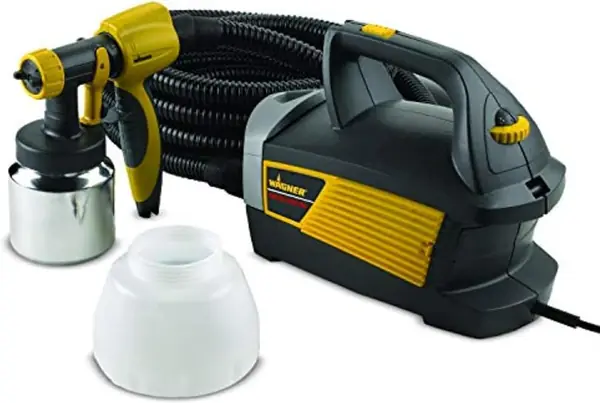
Wagner Control Spray Max blue and white HVLP sprayer with hose and two cups

Cabinet door sets

Shop Score 90/100
Cup Capacity
1.5 quarts
Weight
10 lb
Hose Length
240 inches
Included Cups
1.5 qt plastic and 1 qt metal
View on Amazon

A 20-foot hose separates the turbine from the spray gun, and that is the detail that puts this Wagner at the top of our list for furniture: the 10-pound base stays on the floor while your hand holds a light gun, so you can work across a tabletop or into the end of a carcass without dragging the machine with you. A 1-1/2 quart plastic cup and a 1 quart metal cup come in the box, which is enough to lay a coat on a door face and its edges without stopping.

The two-stage turbine means no compressor, and the pressure dial on the base is the control we came to rely on. Turn the air down for a narrow pattern on a chair leg or a drawer side; turn it up for a broad pass over a dresser top. It sprays thinned latex, stain, sealer and polyurethane, and the air cap twists between horizontal, vertical and round patterns for rails, stiles and turnings.

What we value most is that the dial changes how the paint atomizes, not just how much of it arrives. At the right pressure the coat goes down wet and even; open the material flow too far and you get a dry, textured pass that has to be sanded back. That is a setting to learn rather than a fault, and it is the reason we point first-time sprayers at the handhelds below before they spend on a turbine.

Turnover is the other quiet advantage. Only a few parts come off for washing, the cups rinse clean, and the hose flushes between colors, so a two-tone job does not stall out at the changeover. That short parts list is the reason we stopped dreading cleanup on this one.

Worth Noting

  • Turbine base and hose need bench space
  • Thick enamel still needs thinning
Our Verdict

The Control Spray Max is the one we hand to anyone refinishing a whole set of doors: the pressure dial and light gun give you even, adjustable coats.

Check Latest Price
2.

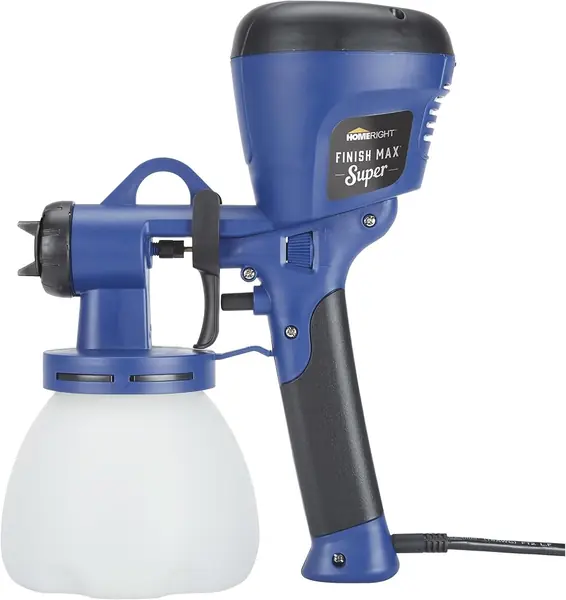
HomeRight Super Finish Max Best Handheld for Furniture

HomeRight Super Finish Max handheld paint sprayer in multicolor plastic with brass tips

Single furniture pieces

Shop Score 89/100
Cup Capacity
40 fluid ounces
Weight
3.3 lb
Included Tips
1.5 mm, 2.0 mm, 4.0 mm brass
Spray Patterns
Three
View on Amazon

Three brass tips — 1.5 mm, 2.0 mm and 4.0 mm — plus two air caps let this HomeRight move from sealer to thinned latex without changing machines, and the middle tip does most furniture work. It weighs 3.3 pounds, holds 40 ounces, and is built to need less thinning than the older Finish Max it replaces, which matters more than any single feature here: a sprayer that demands heavy thinning is a sprayer that sits on the shelf.

Easiest to live with of the handhelds we tested is this one. Fill, twist the air cap to the pattern you need, set the flow, spray, rinse — one sitting, start to finish. Our runs with thicker latex were where it asked the most of us, and the answer is always the same: thin to a viscosity cup until the paint runs off in a steady stream, because under-thinned paint is what produces the spitting and the blocked tip.

The air blow nozzle in the kit earns its place between coats, clearing the tip without a full teardown. Brass also wears better than the plastic nozzles on cheaper guns, and it is the upgrade we notice most on a tool at this price.

Worth Noting

  • Thick latex still clogs if under-thinned
Our Verdict

For a dresser, a pair of chairs or a single cabinet, we think this is the handheld to buy: three brass tips, a light body, and thinning as the one thing to get right.

Check Latest Price
3.

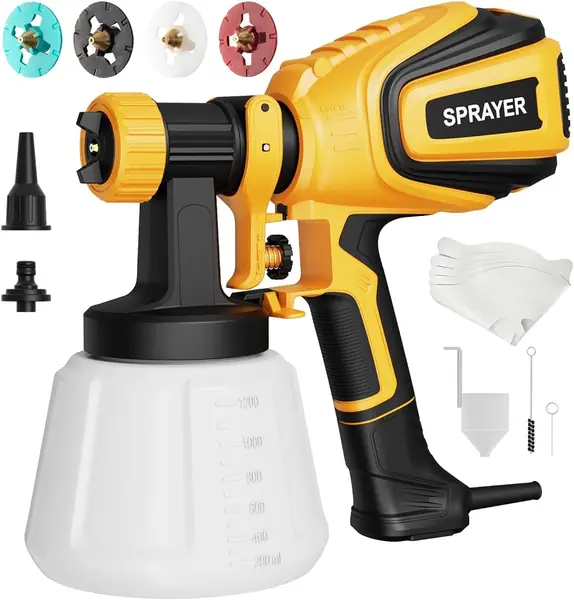
VONFORN 700W Paint Sprayer Best Value

VONFORN yellow handheld HVLP paint sprayer with cup and four nozzles

First furniture sprayer

Shop Score 88/100
Cup Capacity
1200 ml
Weight
3.7 lb
Included Nozzles
1.0, 1.5, 2.0, 3.0 mm
Power
700W
View on Amazon

A 700-watt motor, four nozzles from 1.0 to 3.0 mm, a 1200 ml cup and a dust-blowing joint in a 3.7-pound body — this is the most complete kit at the low end of the range. We think that breadth is what a beginner needs, because it lets you learn which nozzle a given paint wants instead of buying the answer one gun at a time.

The extra nozzles are the real value. Small tips suit stain, dye and sealer; the mid sizes handle thinned latex and enamel; the largest takes thicker material when you need coverage fast. You can dial back output with the flow knob and twist the air cap between horizontal, vertical, and round spray patterns. Assembly is tool-free, so the cup and nozzle come apart by hand for washing, and the clean connector flushes the body at a faucet.

Where it asks more of you is consistency. Output is sensitive to how thick the paint is, and a batch that is slightly too heavy sprays in spits rather than a mist, so keep the viscosity cup in the drawer and use it. That is the trade for the price, and it is a fair one: a careful hand gets a smooth coat, and an impatient one gets a reason to sand.

Worth Noting

  • Motor can quit within months on some units
Our Verdict

Our value pick covers four nozzle sizes, a 1200 ml cup and a dust-blowing joint for very little, and rewards anyone who thins carefully.

Check Latest Price
4.

Tilswall 800W Paint Sprayer Best for Long Sessions

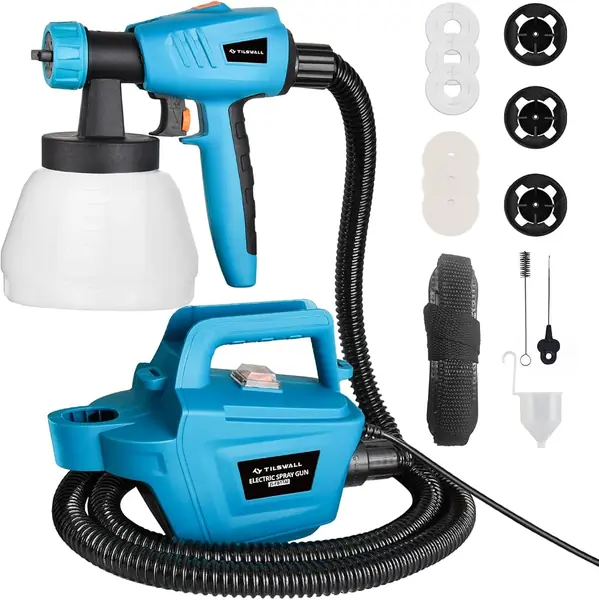
Tilswall blue 800W paint sprayer with air hose shoulder strap and large cup

Long spray sessions

Shop Score 87/100
Cup Capacity
1300 ml
Weight
4.89 lb
Included Nozzles
1.0, 1.8, 2.6 mm
Air Hose
8.2 feet
View on Amazon

The motor rides at the end of an 8.2-foot hose and hangs from a shoulder strap, so what you actually hold while spraying the side of a bookcase is a small gun and a 1300 ml cup. Nothing else here splits the machine that way, and once the strap is set you are carrying 4.89 pounds on your shoulder rather than in your wrist — we noticed the difference by the end of a session.

Three plastic nozzles (1.0, 1.8 and 2.6 mm) cover stain through thinned latex, and the 800-watt motor moves a lot of material when you open the flow. The quick-release assembly separates the gun from the handle for cleaning, and the cup comes off by hand for filling and washing.

Rigging the strap and hose takes longer than picking up a one-piece handheld, and on a single drawer front that is genuinely more setup than the job deserves. On anything with legs or spindles, the hose stops mattering and the light hand starts to.

Worth Noting

  • Plastic nozzles wear faster than brass
Our Verdict

If a project means hours of spraying, this is the Tilswall we pick: a strap carries the motor, and the 1300 ml cup keeps you spraying instead of refilling.

Check Latest Price
5.

Tilswall Dreamer400 Cordless Sprayer Best Cordless

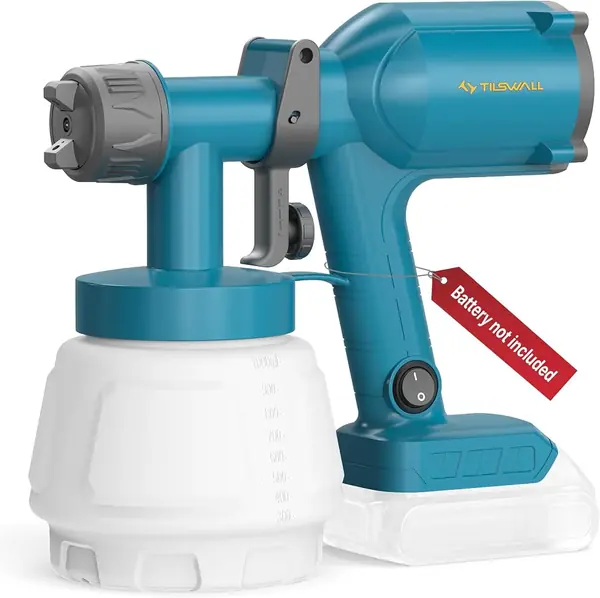
Tilswall Dreamer400 dark blue cordless paint spray gun with 1000 ml cup

Outdoor touch-ups

Shop Score 86/100
Cup Capacity
1000 ml
Weight
1.3 lb
Included Nozzles
1.5 mm and 2.0 mm
Battery
DeWalt 20V, sold separately
View on Amazon

There is no battery in the box. This Tilswall runs on a DeWalt 20V pack, so plan on one — or on already owning one — and the price makes sense. In exchange you get the only sprayer here that works on a chair in a driveway or a table in a yard where there is no outlet within reach of a cord.

Light weight is the whole point: at 1.3 pounds it is the lightest thing in this group by a wide margin, and we noticed the difference when holding it at odd angles around a turned leg. The 1000 ml cup is sized for small parts rather than a wall, and the 500-watt motor with two nozzle adapters suits stain, polyurethane, sealer and thinned paint; heavy cabinet enamel is not its job.

Cleanup is the quiet win: the cup and the two-piece nozzle assembly rinse quickly, which is what makes a short touch-up worth bothering with. Runtime depends on the pack you own, so keep a spare charged if the piece is bigger than a chair.

Worth Noting

  • Two nozzles, both sized for thin finishes
Our Verdict

We keep the Dreamer400 for pieces you cannot bring indoors: the lightest sprayer here, and the only one that runs on a battery you may already own.

Check Latest Price
6.

LESONJOY 1000W Paint Sprayer Best for Budget Door Sets

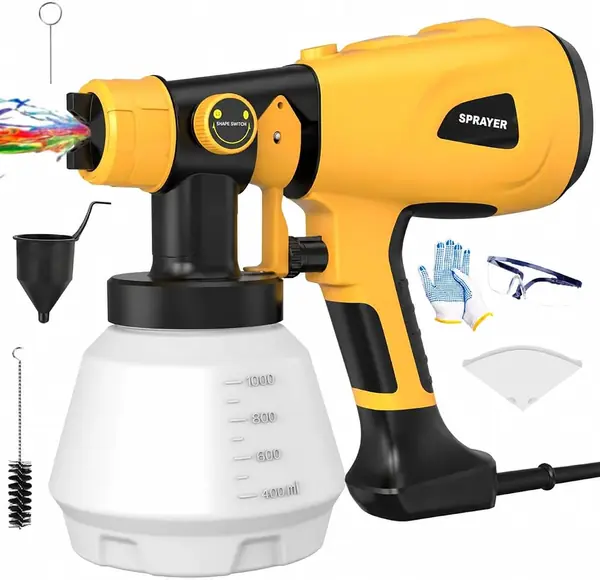
LESONJOY bright yellow handheld HVLP paint sprayer with four copper nozzles

Budget door sets

Shop Score 85/100
Cup Capacity
1000 ml
Included Nozzles
Four copper
Power
1000W
Spray Patterns
Three
View on Amazon

A 1000-watt motor is more than most budget handhelds bring, and this Lesonjoy pairs it with four copper nozzles instead of plastic. Those two details are what made us look twice: a 1000 ml cup, three patterns, a flow knob, and a kit that includes a viscosity cup, filter funnels, a cleaning needle, a brush and gloves.

The copper nozzles matter over time. Brass and copper hold their shape while plastic nozzles round off and start spitting, and having four sizes means you can match the tip to the finish instead of thinning everything to fit one nozzle. The flow knob trims volume, and the air cap gives you horizontal, vertical or round for rails, panels and turnings.

Control is where it asks for attention. At 1000 watts with the largest tip it moves material quickly, and quick is not what a raised panel door wants; start with a mid-size nozzle, keep the gun moving, and thin to the viscosity cup before you commit to a whole door. The kit makes that easy — the funnel and filter get strained paint straight into the cup.

What sells us is the motor for the money: it holds a heavier coat moving when a smaller unit starts to stutter, and at this end of the range that is the difference between a second coat and a second attempt. The gloves are the small thing we noticed — you can strain and spray without hunting for a rag.

Worth Noting

  • 1000 ml cup empties quickly on tall doors
Our Verdict

Our budget pick for someone with more doors than time: 1000 watts, four copper nozzles and a full straining kit for very little money.

Check Latest Price
7.

PULENDY PL42 Paint Sprayer Best for Small Shop Projects

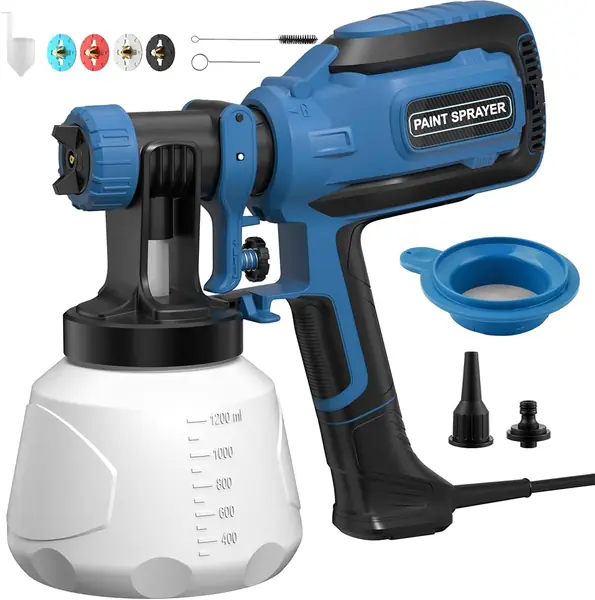
PULENDY navy blue handheld paint sprayer with 1200 ml cup and four nozzles

Small shop projects

Shop Score 84/100
Cup Capacity
1200 ml
Weight
3.5 lb
Included Nozzles
1.0, 1.5, 2.0, 3.0 mm
View on Amazon

Twelve hundred milliliters is enough for a drawer front, its sides and a second pass, and that is the scale this Pulendy is built for: a 3.5-pound handheld with four nozzles, three patterns and a flow knob, at the bottom of the price range.

The fittings are what lift it above a plain cheap gun. A dust-blowing joint clears sanding grit off a panel before the first coat — the most common cause of a gritty finish — and the clean connector attaches to a faucet to flush the body when you are done. Nozzles run 1.0 to 3.0 mm, so stain, sealer, thinned latex and thicker material all have a tip.

What we noticed is how little the fittings leave you to improvise. The blowing joint clears a sanded panel in a pass or two, and the faucet connector turns cleanup into a rinse rather than a disassembly. With no pressure dial, the finish comes from tip choice, the flow knob and your hand speed — enough for a drawer box and a bookcase, and a stretch on a high-gloss door.

Worth Noting

  • No pressure dial, only a flow knob
Our Verdict

We like the Pulendy as a second sprayer or a first one for small parts, where four nozzles and a fast rinse matter more than a pressure dial.

Check Latest Price
8.

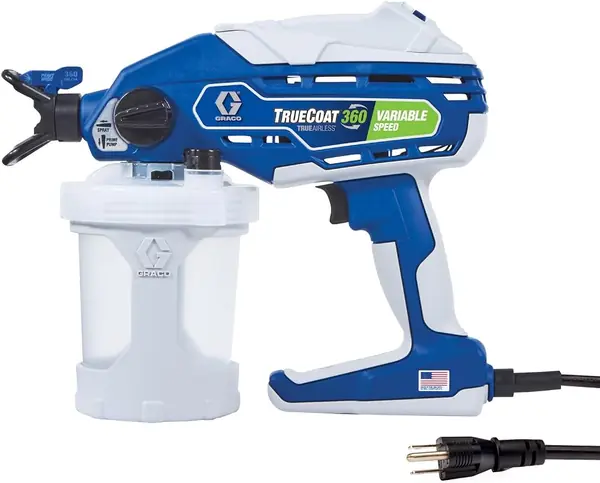
Graco TrueCoat 360 VSP Best for No-Thinning Cabinet Jobs

Graco TrueCoat 360 VSP handheld airless sprayer in blue and white

No-thinning cabinet jobs

Shop Score 79/100
Included Tips
Two paint and two stain
Maximum Pressure
1500 psi
Project Capacity
Up to 2 gallons
View on Amazon

Fifteen hundred psi is airless pressure, not turbine air, and it is why this Graco sprays paint straight from the can. No viscosity cup, no thinning, no guessing: four tips come in the box, two for paint and two for stain, and paint loads into a flexible liner bag instead of a cup.

The liner bags let you spray at any angle, including upside down under a tabletop, which no cup-fed sprayer here can do. Four tips cover paint and stain without a change of machine, and the pump builds its own pressure with no hose and no turbine to set on the floor.

The cost is in the prep and the cleanup. Airless at this pressure throws material, so masking a garage properly is not optional, and the end-of-job flush has more steps than rinsing a cup and a nozzle — bag, tip, inlet filter and pump. Skip a step and the next start is a clog.

What it buys is a whole kitchen's worth of doors in paint you never thin: no rejected batches, no sanding back a coat that went on dry. The variable-speed dial is the part we used most, slowing the pump for a flat door face and opening it up to work around the frame.

Worth Noting

  • Needs thorough masking against overspray
  • Cleanup is a multi-step flush
Our Verdict

We suggest the TrueCoat when thinning is the part of spraying you hate: it sprays from the can, though masking and cleanup ask more of you.

Check Latest Price

How We Tested Paint Sprayers on Real Furniture

We started with the sprayers sold for furniture and cabinet work — corded HVLP units, airless handhelds, and a cordless model that runs on a tool battery — comparing nozzle sizes, cup capacity, and the coatings each maker lists. That left 12 machines, which we ran for eight months in garages, a basement corner, and a driveway.

Every machine started on flat stock: cabinet doors and drawer fronts across sawhorses, sprayed with thinned water-based paint, then sanded between coats to see whether the finish powdered evenly or clogged the paper. From there we moved to profiled edges, chair legs, and turned spindles, watching each pattern in tight spots and how easy the controls were to reach mid-pass. Each one also ran a stain and a water-based topcoat, with notes on how much thinning each coating needed before it flowed instead of spitting.

Overspray we measured the crude way, hanging cardboard around the work area to see how far the fog carried. We counted cup capacity in real terms — doors sprayed before a refill — and worked each machine through a long detail session to judge wrist fatigue and how the hose or cord dragged over wet panels. Cleanup was timed, including color changes between small batches. Every unit was unplugged, or had its battery pulled, before nozzle changes, disassembly, and cleaning; solvent finishes were sprayed only outdoors with cross-ventilation and organic-vapor respirators, clear of pilot lights and water heaters.

Machines that sputtered, dripped at the nozzle, or lost their pattern after a few projects dropped off along the way. The ones that stayed were still laying down an even coat at the end of eight months, and they're the ones we didn't mind setting up again. Value got the last word: what a sprayer costs against how much of the work it does without babysitting.

How to Choose a Paint Sprayer for Furniture

Match the Machine to the Size of the Job

The first fork in the road is one piece versus a set. A handheld HVLP spray gun with a cup near a liter sets up in a minute, rinses in five and stores on a shelf, which is what a dresser, a chair or a pair of nightstands actually needs. The trap is buying a turbine with a 20-foot hose for a single table: you spend more time rigging it than spraying. Go the other way and a small cup runs dry halfway through a tall door.

Take the middle route if you are unsure: a light handheld with a cup between 40 and 44 ounces covers most furniture runs, and you only need the hose-fed machine when the job is a whole set of doors and drawer fronts.

Thinning Is the Skill, Not the Spec

Nearly every finish problem with a handheld sprayer traces back to paint that is too thick. Use the viscosity cup that comes in the kit: dip it, lift it, and watch how the stream breaks into drips. Coatings differ, so test on a scrap of the same wood before you commit a door face to a mix you have not sprayed.

Two picks here change the arithmetic. The HomeRight Super Finish Max is built to need less thinning than the older Finish Max design, and the Graco TrueCoat is airless and needs none at all. Everything else wants a viscosity test and a little water or thinner.

Tips, Patterns and What Each Nozzle Is For

Nozzle size is the setting most people ignore and then blame the machine for. Thin material — dye, stain, sealer, lacquer — wants a small tip; general latex and enamel sit in the middle; thick paint and primer want the largest. A set running from 1.0 to 3.0 mm covers the whole range, while a gun with only two mid-size tips will struggle with a heavy primer. Brass and copper tips hold their shape; plastic ones round off.

The other half of the adjustment is direction: vertical for stiles and legs, horizontal for rails and panels, round for turnings and touch-ups.

Overspray and Where You Can Spray

HVLP means high volume, low pressure, and the low pressure is why you can spray furniture in a garage without fogging the whole house. It still throws a cloud. Sheet the floor and anything within a few feet, and stand so the mist travels away from the wet surface rather than across it.

Airless units like the Graco lay paint down faster and throw far more material, so treat masking as part of the job rather than an afterthought. Whichever you use, keep solvent finishes away from pilot lights and ventilate the space.

Cleanup and Color Changes

How many pieces come apart for washing decides whether you reach for the sprayer a second time. A gun that breaks down by hand, with a nozzle you can clear with the included needle and a cup wide enough to wipe out, turns cleanup into a rinse. A flush connector that attaches to a faucet is worth having if you switch colors often.

Never leave paint sitting in the body overnight — a dried tip is the start of a sputtering, spitting sprayer. Strain what is left back into its can through a filter.

Frequently Asked Questions

Final Verdict

The Wagner Control Spray Max is the sprayer we point people to for furniture that comes in sets: the hose keeps the gun light, the pressure dial lets you tune a coat instead of hoping, and the parts come apart for a fast rinse between colors.

If your project is one dresser, the HomeRight Super Finish Max does the same work with less rigging. And if thinning paint is what has kept you from spraying at all, the Graco TrueCoat skips it entirely — just budget the masking and the longer flush.