↑↓ navigate ↵ open Esc close All results →

Best Paint Sprayers for Cabinets of 2026

Cabinet doors are the most visible surface in a kitchen and the least forgiving. A brush leaves lap marks down the stiles, a roller leaves stipple across the panels, and by the tenth door you understand what painters charge for. A sprayer skips all that, but it brings its own decisions: tip size, pressure, whether your paint needs thinning, and how much overspray the room can absorb.

We tested 12 sprayers over nine months, on door faces, drawer fronts laid flat on sawhorses, stiles, and frames. The money buys the atomization; the tip and the pressure decide whether you get a glassy coat or a pebbled one. A wide fan is fast on a panel and a mess down a stile.

We graded these on the finish they laid down unthinned, how tightly we could choke the pattern at the gun, how fast we could flush a cup before the next coat flashed, and whether the gun still felt steady one-handed at hour four. Eight earned a spot — some for a whole kitchen, some for one set of doors.

Our Top Picks

The Best Paint Sprayers for Cabinets

1.

Graco Magnum X5 Airless Paint Sprayer Best Overall
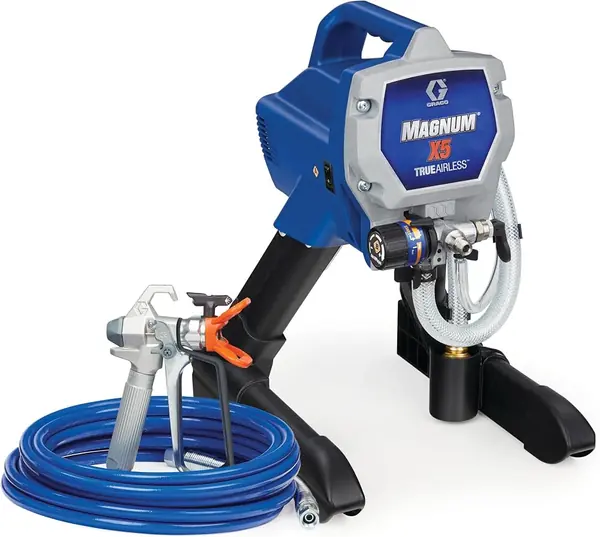
Graco Magnum X5 airless paint sprayer in blue on its stand with metal spray gun

Whole-kitchen refinishing

Shop Score 94/100
Weight
15 lb
Maximum Pressure
3000 psi
Job Capacity
Projects up to 10 gallons
Paint Feed
Suction tube for 1- or 5-gallon buckets
View on Amazon

Cabinet coating is thick, and the X5 is built to push it through without thinning: drop the flexible suction tube into a 1- or 5-gallon pail, set the pressure, and spray. That pressure dial is what turns an airless into a cabinet tool. A door face wants a narrow fan and a wet, even pass; a wall wants volume. It also carries a 10-gallon project rating, which covers a full kitchen of doors, drawer fronts and frames with room left over.

The catch is atomization. Airless output is coarser than a turbine's, and the included RAC IV 515 tip is a wide wall pattern that will put down more material than a door panel wants. Order a fine-finish tip with the machine and spray a piece of scrap before you commit a door. Once the pattern is right, the coat lays out flat and you sand far less between passes than after a roller.

Longevity is the one thing we treat carefully. The pump has quit mid-job on some units, which is why the one-year warranty and the included Pump Armor matter: flush after every session, store it wet with the fluid, and don't push it far past its rating in a season. That's ordinary airless maintenance, and it's the difference between a sprayer that keeps going and one that doesn't.

What we keep coming back to is range. This is the one here that sprays your cabinet doors on Saturday and your ceiling, fence and shutters the month after, without a compressor or a viscosity cup. For a homeowner planning one big refinish and then a list of other projects, that's the whole case.

Worth Noting

  • Cleanup takes real time and a hose hookup
Our Verdict

This is the one we recommend to most cabinet refinishers: it sprays unthinned paint straight from the bucket, gives you real pressure control, and has the capacity for a whole kitchen.

Check Latest Price
2.

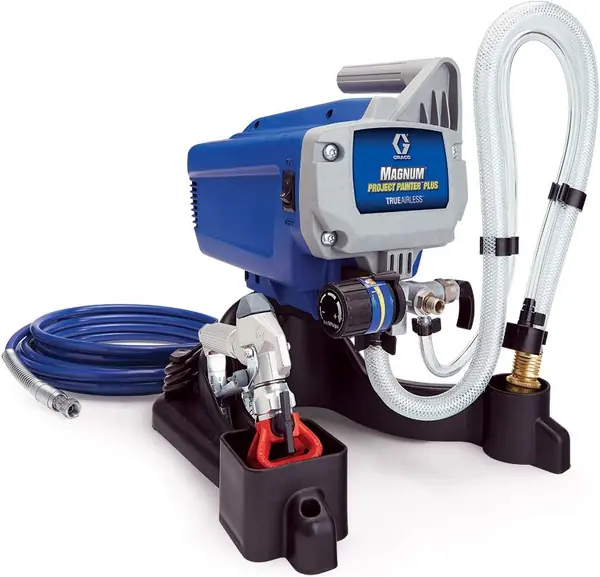
Graco Magnum Project Painter Plus Best Value Airless

Graco Project Painter Plus airless sprayer with 25-foot hose and SG2 metal gun

One-kitchen projects

Shop Score 93/100
Hose Length
25 ft
Weight
15 lb
Maximum Pressure
3000 psi
Job Capacity
Projects up to 5 gallons
View on Amazon

Same airless method, smaller appetite. The Project Painter Plus is rated for projects up to 5 gallons where the X5 is rated for 10, which for a single kitchen is still generous: doors, drawer fronts and face frames won't come close to the ceiling. You get the same 3,000 psi pump, the same adjustable pressure control, and the same suction tube that sprays straight out of a bucket instead of a cup.

We rate it as close to the X5 on the finish it leaves and easier to justify when one kitchen is the whole project. The 25-foot hose reaches around a small kitchen without moving the unit, and the pressure dial gives you the control a door face needs. Nothing about the smaller rating makes it spray worse; it just does less before capacity becomes the conversation.

One thing to plan around: thicker trim enamels can want a splash of thinning before they lay out smoothly at door-face pressure, so mix a cup and test the back of a door before you commit a panel. Once the viscosity is right, it lays a coat as flat as anything airless here — which is the whole reason to buy an airless in the first place.

Worth Noting

  • Caps out at 5-gallon projects
Our Verdict

We point one-kitchen buyers here: the same airless method and finish as our top pick, sized for a single set of doors and priced lower.

Check Latest Price
3.

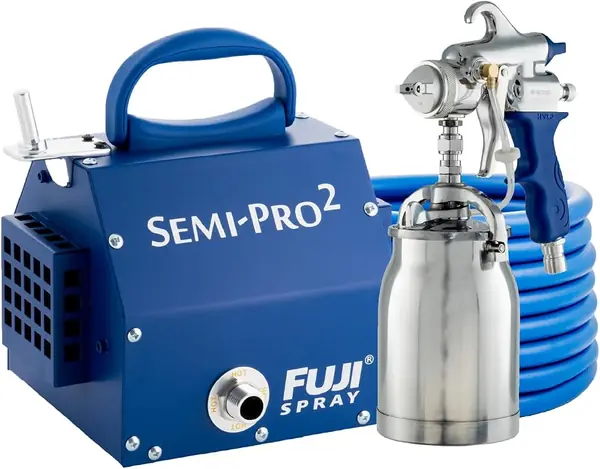
Fuji Spray Semi-PRO 2 HVLP System Best Finish Quality

Fuji Spray Semi-PRO 2 turbine system in blue with metal case and M-model gun

Furniture-grade finish

Shop Score 92/100
Hose Length
25 ft
Turbine
1400W two-stage
Cup
1 qt bottom feed
Installed Air Cap
1.3mm
View on Amazon

A turbine doesn't shove paint through a hole the way an airless does. It carries the coating on a high-volume, low-pressure air stream, and the difference shows up on a door face as a flatter, more even film with less material bouncing back into the room. It's how a lot of cabinet and furniture work gets its factory-flat look, and it's the reason a turbine is worth its bench space in a small shop.

The system is a 1400W two-stage turbine in a metal case, a 25-foot hose, and Fuji's M-model gun with a fan control at the head. We like that fan control more than any other feature here: dial down to a small circle for a stile, open up for a panel, without stopping to change parts. The gun is non-bleed, so the turbine isn't blowing air every second the hose is pressurized.

Budget for the thinning step, because on a turbine it isn't optional. Every coating goes through the viscosity cup, and some cabinet enamels need to come down before they atomize cleanly; the cup in the kit is what makes that reproducible instead of guesswork. Spray a scrap of the same material at the same setting before you touch a door.

What the money buys beyond the finish is a system that grows: additional air cap sizes are available, the gun runs shellac, lacquer, waterborne acrylic and latex, and the warranty covers two years of parts and labor. For a shop that sprays more than cabinets, that range is the difference between a one-job purchase and a tool that stays on the bench.

Worth Noting

  • Turbine is loud enough to need ear protection
  • Stiff hose resists coiling and maneuvering
Our Verdict

Our pick when the finish is what you'll be judged on: nothing here lays a flatter coat on a door, and the money buys a system you'll keep.

Check Latest Price
4.

Wagner Control Spray Max HVLP Best HVLP for Doors and Trim

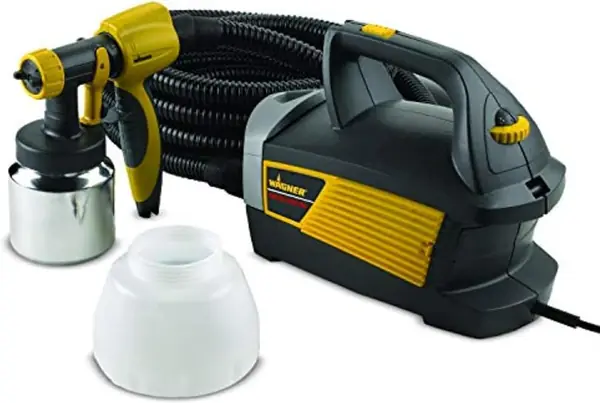
Wagner Control Spray Max HVLP sprayer in yellow and black with metal and plastic cups

Doors and trim

Shop Score 91/100
Hose Length
20 ft
Turbine
Two-stage, 510W
Cups
1 qt metal and 1.5 qt plastic
Spray Pattern
1/2 in to 12 in
View on Amazon

The Control Spray Max splits the work in two. A two-stage turbine sits on the floor or a bench, and a 20-foot hose carries the air to a spray gun that's the only thing in your hand. For cabinets that matters more than it sounds: doors laid flat in a garage, boxes masked in place, and a light gun that lets you get into a face frame without hauling a motor up a ladder.

We like the controls. The pattern adjusts from half an inch up to a foot wide, the pressure dial and the material flow knob are separate, and the two cups — a quart metal and a 1.5-quart plastic — cover everything from one drawer front to a run of doors. What we flag is consistency: when a coat comes out uneven, the fix is almost always in the thinning. Mix to the viscosity cup and spray a test panel.

Where it earns its place beside the airless picks is control at low volume: an even, thin pass you can repeat three times beats one heavy coat that sags at the stile. The same setup covers trim, shutters and furniture, so one purchase carries the rest of the weekend's work.

Worth Noting

  • Slower coverage than an airless sprayer
Our Verdict

Our pick for doors, face frames and trim: a light gun on a long hose, with the pattern control to keep a coat even on a narrow stile.

Check Latest Price
5.

InoKraft NEO Airless Paint Sprayer Kit Best Budget Airless

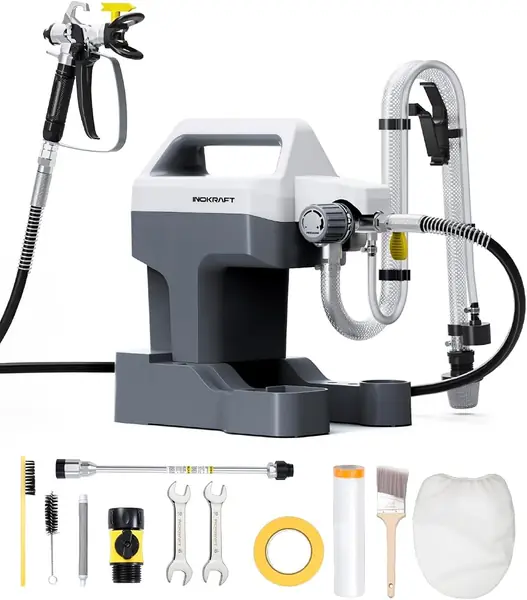
InoKraft NEO airless paint sprayer kit with hose, 515 nozzle and masking film

First cabinet job

Shop Score 90/100
Hose Length
25 ft
Weight
10.1 lb
Maximum Pressure
3000 psi
Max Paint Output
0.26 GPM
View on Amazon

For a first cabinet job, the box is the argument. The NEO arrives with masking film, painter's tape, a 12-inch tip extension, a strainer, a touch-up brush and the flush valve already on the unit — the small things that otherwise turn into a morning at the hardware store.

The machine underneath is a real airless: 3,000 psi, 0.26 gallons per minute, a 25-foot hose, and a suction tube that draws from a 1- or 5-gallon container. At just over 10 pounds, we found it easy to carry in one hand and set on a step stool, which is more than most airless units manage. The Flush-Ease valve is a genuine convenience at the end of the night.

It's still an airless, which means an airless learning curve: the pressure you set and the tip you fit decide the finish, and a wide-open dial on a door face lays down more material than the panel wants. Start low and work up. If this is your first kitchen, spend the difference on a fine-finish tip and a good respirator rather than capacity you won't use this year.

Worth Noting

  • Suction hose keeps a stubborn coil
  • Paint output can run heavier than expected
Our Verdict

For a first kitchen, we like that everything but the paint comes in the box, and that the airless under it is light enough to carry all day.

Check Latest Price
6.

Tilswall 800W HVLP Paint Sprayer Best for Small Batches

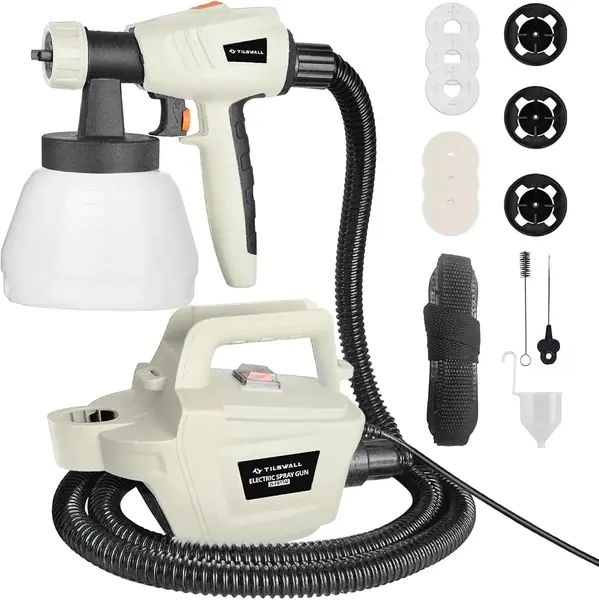
Tilswall 800W HVLP spray gun in white with detachable 1300ml container and air hose

Small batches

Shop Score 89/100
Hose Length
8.2 ft
Motor
800W
Nozzles
1.0, 1.8 and 2.6mm
Container
1300 ml
View on Amazon

Holding a full cup and a motor for an hour is the part of handheld spraying nobody warns you about. Tilswall moves the motor off the gun: the unit sits on the floor or hangs from the shoulder strap, an 8.2-foot hose carries the air, and what's in your hand is the spray head and a 1.3-liter cup.

We like the quick-release nozzle assembly for the same reason — it comes apart for cleaning without a wrench, and the three nozzles (1.0, 1.8 and 2.6mm) with three patterns cover everything from a thin wash coat to a heavier enamel. The 800W motor is the smaller of the handhelds here, so keep the coats light and let them build.

It's a handheld, so treat it as one. Coverage is slower than a turbine or an airless, and light coats are the rule — you're building a finish in three passes rather than one. What it doesn't need is a compressor, a dedicated bench or a spare room, which is why it suits a vanity in a basement or a set of doors on sawhorses in a one-car garage.

Worth Noting

  • Thinning is required before each session
Our Verdict

We reach for it when a vanity or a few doors need spraying in a tight space, and we don't want a compressor or a bench-bound turbine.

Check Latest Price
7.

LESONJOY 1000W HVLP Paint Sprayer Best for A Few Doors

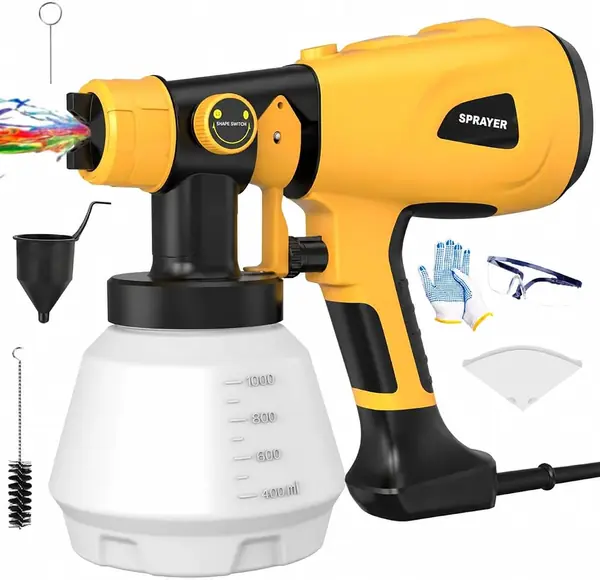
LESONJOY 1000W handheld HVLP paint sprayer in bright yellow with copper nozzles

A few doors

Shop Score 88/100
Motor
1000W
Nozzles
Four copper nozzles
Container
1400 ml
Max Pressure
20 psi
View on Amazon

At the bottom of the price range, the numbers do the talking: a 1000W motor and a 1.4-liter cup, with four copper nozzles and three spray patterns in the box. We read the cup as the useful part. It's the biggest of the handhelds here, so a door and a drawer front don't empty it halfway through a panel.

What we appreciate almost as much is the tear-down. The gun comes apart without tools, and the kit includes the cleaning brush, viscosity cup and filter funnels — three things that decide whether a cheap sprayer gets used twice or goes on a shelf. Set the flow knob low and work in light passes. It won't keep up with a turbine across a full kitchen, but for a handful of doors, a vanity or a set of cabinet boxes, it's a lot of sprayer for the money.

Worth Noting

  • Cabinet paint needs thinning first
Our Verdict

For a handful of doors, we like the biggest cup among the handhelds here, four nozzles, and a tear-down that won't make you dread cleanup.

Check Latest Price
8.

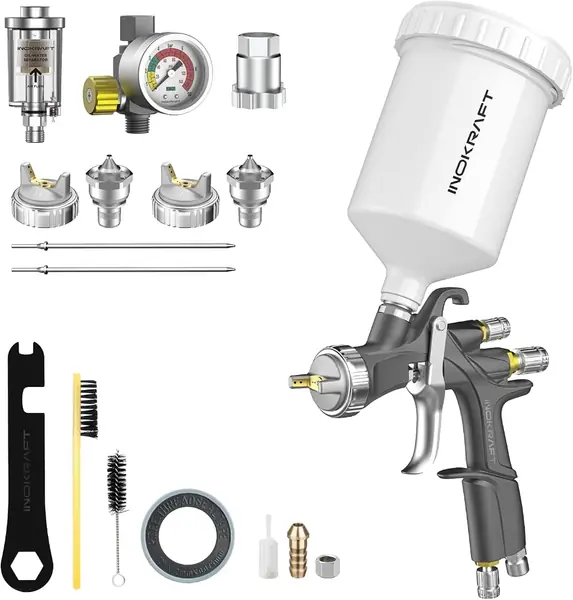
InoKraft D1 LVLP Spray Gun Kit Best for Shop Compressor Owners

InoKraft D1 LVLP spray gun in gray with 600cc cup and nozzle set

Shop compressor owners

Shop Score 87/100
Cup Size
600 cc
Air Source
Requires a separate compressor
Nozzle Sizes
1.3, 1.5 and 1.7mm
Max Air Pressure
50 psi
View on Amazon

The D1 isn't a sprayer in the sense the rest of this list is. It's a gun that borrows your compressor's air, and that single fact decides whether it belongs in your shop: with a compressor already in the corner, it's the least expensive route here to a genuinely fine cabinet finish. Without one, the compressor is part of the purchase and the math changes.

What we noticed first is how little air it asks for. LVLP means low volume, low pressure, and the payoff on cabinets is a fine, controllable pattern with very little material left hanging in the room. The 1.3mm nozzle handles the thinned enamels and waterborne finishes cabinet work calls for, and the kit includes a pressure regulator and an oil-water separator — the two accessories that decide whether a finish comes out smooth or speckled.

It rewards technique more than a turbine does: fluid, fan and air pressure each get a knob, and the difference between a good coat and a dry one can be a quarter turn. Spray a test panel every time you change coating, and keep the air dry — the separator in the kit earns its place on a humid day.

Buy it for the whole kit as much as the gun: three nozzle sets, the regulator, the separator, a 3M cup adaptor, a wrench and a cleaning kit arrive together, so a first-timer isn't hunting fittings the night before a job. Set up properly, it lays a coat as fine as anything here, on a gun small enough to get inside a cabinet box.

Worth Noting

  • Cup-to-gun threads can strip under hand-tightening
Our Verdict

We keep it on the list for woodworkers who already own a compressor: nothing here atomizes finer on so little air, and the extras arrive with it.

Check Latest Price

How We Tested Paint Sprayers for Cabinets

We started with makers who publish their tip and nozzle sizes, since the fan width and the orifice are what you change between a panel and a stile. Then we filtered by feed — a suction tube into a 1- or 5-gallon bucket, or a cup sized for a door and its drawer fronts — and by price against the job. Twelve units made the cut.

Most of the spraying happened in a garage fitted out as a booth: plastic on the walls, a fan pulling air through, a respirator on for every pass. We also worked in a basement and an empty kitchen between tear-out and install, where containing overspray mattered as much as the finish. Doors and drawer fronts came off their hinges and lay flat on sawhorses; frames and stiles got sprayed standing. We ran each coating straight from the can, then thinned, and noted whether it left the gun as fog or spatter, whether it leveled or dried pebbled on a door face, and whether the fan held the width we'd set when we moved from panel to stile.

Between coats we timed the flush and counted refills, since a cup and a bucket are different jobs. We held each gun one-handed at hour four to judge balance and hand fatigue, kept hoses clear of sawhorses and foot traffic, and listened to how much noise each added to a room someone lives in.

Every unit stayed in rotation for the full nine months, so we saw how it handled a multi-week project and the weeks after it, not one afternoon. We checked back on the first doors once they were back on their hinges, looked at drips, runs, and edges that softened under hardware, and set each sprayer's price against a painter's quote for the same kitchen.

How to Choose a Paint Sprayer for Cabinets

Airless or HVLP: Start With the Finish You Want

Airless sprayers force unthinned coating through a tip at high pressure. They're fast, they don't care how thick your cabinet enamel is, and they put a lot of material into the air. HVLP and turbine sprayers carry the coating on a high-volume, low-pressure stream instead: finer droplets, less bounce-back, and a coating that usually has to be thinned to get there. We take a turbine for a furniture-grade finish on doors and an airless for a whole kitchen plus everything after it.

The Tip and Pattern Decide What the Coat Looks Like

The tip that ships in the box is chosen for walls and fences, not cabinet doors — a wide fan that puts down more material than a 20-inch panel wants. Order a fine-finish tip with the sprayer, open the pattern only as wide as the part you're spraying, and test on cardboard before you commit a door. On a turbine the same job falls to the air cap and the fan control: narrow it for stiles, widen it for a panel. Runs at a stile almost always trace back to too much material in too wide a pattern.

Thinning Is the Step That Ruins Finishes

Every HVLP and turbine sprayer here needs the coating brought to a sprayable viscosity, and the viscosity cup in the kit is what makes that repeatable instead of a guess. Too thick and the gun spits and clogs mid-panel. Too thin and the coat runs, and thin coats don't build the durability a kitchen needs. The airless picks skip the step entirely and draw straight from the can, which is a real advantage when your coating is a thick acrylic enamel.

Overspray, Containment and the Room You Spray In

Cabinets get sprayed in garages, basements and occasionally a kitchen with the counters still in it. An airless fogs a room; a turbine puts less into the air, but not none. Hang plastic, mask the boxes and the floor, and move anything with a pilot light out of the space before a solvent coat. A respirator rated for the coating belongs on the tool list, not in the drawer.

Setup and Cleanup Are Part of the Price

Every sprayer here needs a flush at the end of a session and usually between colors, and the ones with a pump and a hose take longer than a cup gun. That's fine if you're spraying a whole kitchen in one push and a nuisance if you're sneaking an hour in after work. Be honest about how you'll actually work, and budget for solvent, rags and a bucket to dump wash water into. A sprayer that's miserable to clean is a sprayer that sits.

Frequently Asked Questions

Final Verdict

For most cabinet projects, we reach for the Graco Magnum X5. It sprays cabinet paint unthinned, draws from the same bucket you mixed in, and gives you a pressure dial to bring the coat down to what a door face wants. Fit a fine-finish tip and it earns its keep on the rest of the house.

If the finish is what you'll be judged on and the budget stretches, the Fuji Semi-PRO 2 lays a flatter coat and leaves less in the air. For one kitchen and no ambitions beyond it, the Project Painter Plus does the same airless job with less capacity and less outlay.