↑↓ navigate ↵ open Esc close All results →

Best Paint Sprayers of 2026

A dedicated paint sprayer transforms the pace of finishing a fence, cabinet run, or exterior wall, trading careful masking prep for the speed of eliminating cut-in brushwork, roller lap marks, and corner brush strokes. Everything hinges on keeping overspray off adjacent surfaces while laying down an even, consistent coat.

Twelve airless, HVLP, and turbine sprayers tackled siding, sawhorse-mounted cabinet doors, and weathered fencing over eight months of shop and yard work. Tip selection and fan-pattern control influenced final smoothness far more than advertised PSI ratings, and any sprayer demanding tedious thinning and straining for standard latex quickly loses its appeal — leaving masking film as a fair trade for crisp, fast finishes across these seven machines.

Our Top Picks

The Best Paint Sprayers

1.

Graco Magnum X5 Best Overall
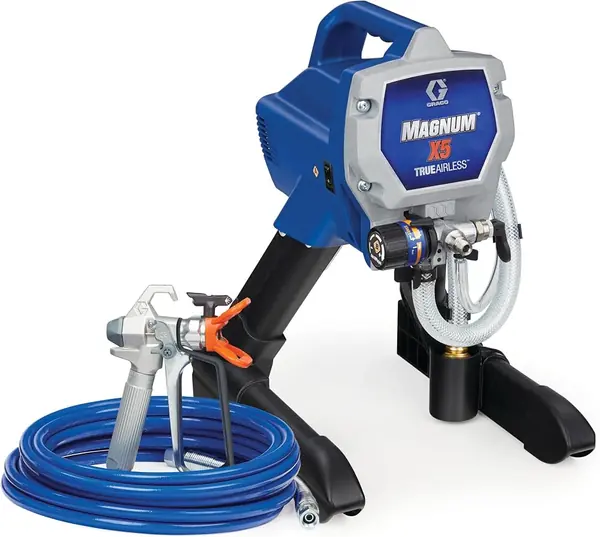
Graco Magnum X5 blue stand airless paint sprayer with metal spray gun and hose

Whole-house exteriors

Shop Score 93/100
Weight
15 lb
Hose Length
25 ft
Maximum Pressure
3000 psi
Project Capacity
Up to 10 gallons
View on Amazon

Ten gallons is the number that matters here. Graco rates the X5 for projects up to that size, which is a fence plus a garage, or the siding on a small house, and it pulls paint directly from a 1- or 5-gallon bucket through a flexible suction tube instead of making you ladle it into a cup. That combination is what earns it the top spot: you set the bucket down, run the 25-foot hose, and the day becomes masking and spraying rather than refilling.

The controls are simple in a way we appreciate on a first airless. Pressure is fully adjustable, so you can turn it down for a door or a set of shutters instead of blasting everything at full tilt, and the RAC IV tip reverses when it clogs rather than leaving you hunting for a replacement mid-wall. At 15 pounds on a stand it's light enough to carry along a ladder line by yourself and small enough to live on a shelf.

An airless is fast because it lays down a wide fan of material, and what that means in practice is that the spraying is the short part of the job. Taping windows, covering siding seams and hanging film over anything you don't want fogged takes far longer than the paint does. That isn't a fault of the machine, and on a fence or a garage wall it's a trade we make happily.

Two practical notes from our time with it. Cleanup is the tax: the PowerFlush adapter hooks to a garden hose and flushes the pump and hose, and it's the last thing you want to do at the end of a long day — do it anyway, then run the included Pump Armor through before it goes on the shelf. And the pump is the part that decides how long an airless lives, so that one-year warranty is worth weighing against a cheaper machine.

Worth Noting

  • Flushing the hose and pump is a chore
  • Pump warranty runs only one year
Our Verdict

For siding, a deck or a long fence, this is the airless we point DIYers to: 3000 psi, adjustable pressure, and unthinned paint straight from the bucket.

Check Latest Price
2.

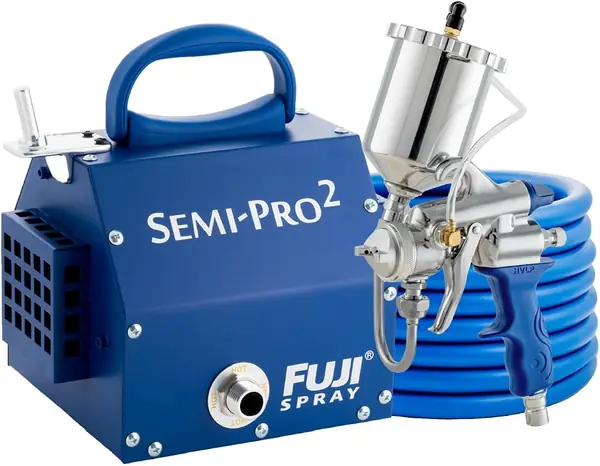
Fuji Spray Semi-PRO 2 Best for Cabinets and Furniture

Fuji Spray Semi-PRO 2 blue metal turbine HVLP system with gravity gun and hose

Cabinets and furniture

Shop Score 92/100
Hose Length
25 ft
Cup Capacity
400 cc gravity
Nozzle Size
1.3 mm installed
Turbine Motor
1400W, two-stage
View on Amazon

The knob on the side of the gun is the whole reason to buy this system. Fuji's M-Model gun is non-bleed and carries a fan pattern control that travels from a tight circle to a wide fan in one turn, so you can keep the spray inside a cabinet face or a drawer front instead of fogging the shop. On a run of doors that control is the difference between a light scuff sand and a full afternoon of fixing runs.

Behind the gun sits a 1400-watt two-stage turbine in a metal case with a gun holder and a 25-foot hose. That's more motor than any handheld here, and it's what lets the system put down heavier material — shellac, acrylic, two-part topcoats — without cutting it to water first. There's no compressor to buy, and the air control valve on the hose lets you knock the pressure back when a full blast would bounce finish off a vertical panel.

We noticed the build before we noticed the results: a stainless nozzle and needle, a gun that feels like a tool rather than an accessory, and a case compact enough to sit on a bench. The verdict we came to is that the premium buys consistency — the same pattern and the same atomization on the fortieth door as on the first.

Its costs are honest ones. The 400 cc gravity cup is small, so a run of doors means refilling, and the turbine is loud enough that hearing protection makes sense in a small shop. Neither shows up in the finish. If your work is siding rather than furniture, this isn't your machine; the X5 covers big flat areas faster and for less money.

Worth Noting

  • Turbine noise is loud in a small shop
  • Small 400 cc cup needs refilling on door runs
Our Verdict

Buy it when the finish matters more than the price — nothing else here lays a flatter coat on a cabinet door, and the noise is the cost of that.

Check Latest Price
3.

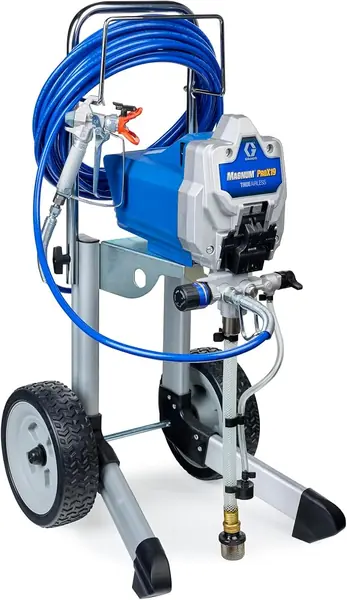
Graco Magnum ProX19 Best for Big and Repeat Jobs

Graco Magnum ProX19 blue and white cart airless paint sprayer with hose and gun

Repeat exterior jobs

Shop Score 91/100
Weight
42 lb
Hose Length
50 ft
Maximum Pressure
3000 psi
Annual Capacity
Up to 500 gallons
View on Amazon

Pumps are what end a sprayer's working life, and Graco built this one to be swapped in place. The ProXChange system pulls the pump out without tools, so a failure costs you the time it takes to fit a replacement instead of a lost day of masking and a rescheduled crew. That single design decision tells you who the machine is for.

Everything else scales with it: fifty feet of hose instead of twenty-five, a 3000 psi stainless piston pump rated for up to 500 gallons a year, an SG3 gun with a swivel at the hose connection, and an InstaClean filter at the pump to catch debris before it ever reaches the tip. We like that filter more than it sounds — most tip clogs begin as grit that came out of the bucket. It's a 42-pound cart the size of a hand truck, so plan on a truck bed or a dedicated corner of the shop.

For a homeowner with one fence and a garage to paint, this is more machine than the job needs; the X5 does that work for less and moves more easily. Where the ProX19 earns its keep is repeat work — a remodeler or property manager spraying several exteriors a season, or a shop that wants one airless to cover built-ins, doors and finish work without renting.

The last thing to know is that a 500-gallon annual rating is a professional workload and the machine asks for professional care: flush it the same day, store it with the included Pump Armor, and keep spare tips on the shelf so a clogged one never ends a morning.

Worth Noting

  • Heavy 42-pound cart needs space and a truck
Our Verdict

The pick for anyone spraying for a living or repainting a whole exterior: the pump swaps without tools and fifty feet of hose reaches the second story.

Check Latest Price
4.

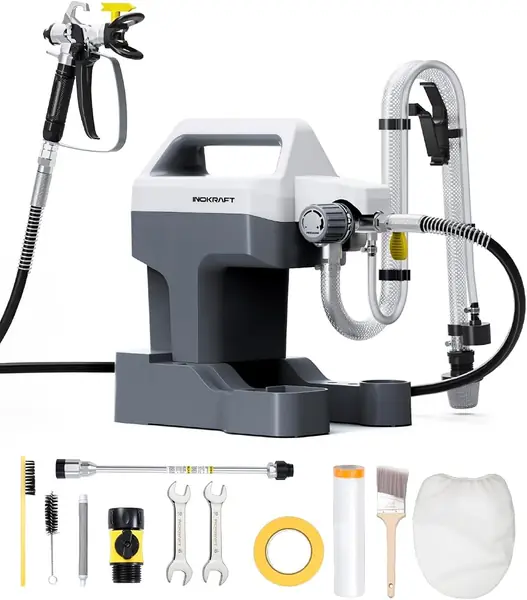
InoKraft NEO Best Budget Airless

InoKraft NEO compact airless paint sprayer kit with hose, nozzle and cleaning tools

First airless setup

Shop Score 89/100
Weight
10.1 lb
Hose Length
25 ft
Maximum Pressure
3000 psi
Flow Rate
0.26 GPM
View on Amazon

Open the box and there's more than a sprayer: masking film, painter's tape, a strainer, a touch-up brush, a cleaning kit and a 12-inch tip extension. Those are the items that turn a first airless purchase into three separate trips to the hardware store, and folding them into one order is a genuinely thoughtful piece of packaging for someone who has never owned one.

The machine underneath is a real airless — 3000 psi, 0.26 gallons per minute, a 25-foot hose and a suction tube that draws from a 1- or 5-gallon bucket. At just over 10 pounds it moves from room to room without a second person, and the Flush-Ease valve takes some of the production out of the end-of-job rinse.

The trade-offs are real. The hose has memory and wants to coil back toward the bucket while you spray, and the gun is the part that feels built to a price — keep the nozzle retention ring snug and treat the tip as a wear item. You're also buying a compact machine: it's happiest on interior walls, ceilings, cabinet boxes and a fence, not on a whole exterior with long hose runs.

Where we land is this. For two rooms, a fence or a first exterior, the NEO does the work of a machine costing a good deal more, and the included prep supplies shorten the learning curve considerably. If you'll be spraying a house every summer, step up to a Graco; if you want a flawless cabinet door, this isn't the tool — an HVLP lays a smoother coat on furniture than any airless will.

Worth Noting

  • Hose has memory and coils while you spray
  • Spray gun feels built to a price
Our Verdict

The first airless we are comfortable recommending to a beginner, because the masking film, tape and strainer that catch everyone out are already in the box.

Check Latest Price
5.

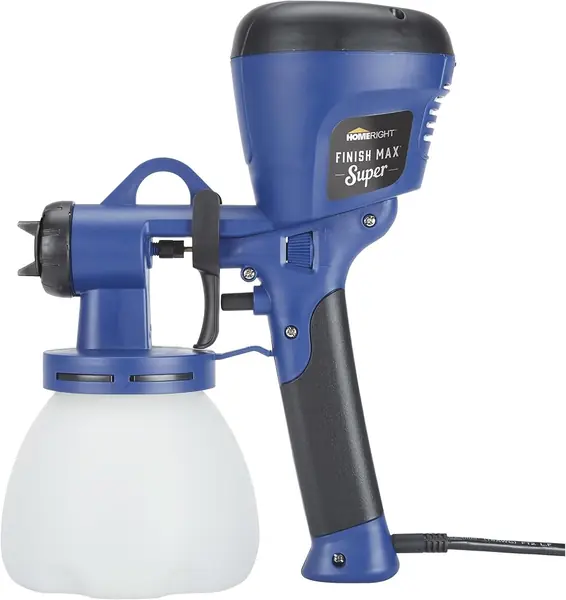
HomeRight Super Finish Max Best Budget HVLP

HomeRight Super Finish Max handheld HVLP sprayer with brass tips and paint cup

Furniture and trim

Shop Score 88/100
Weight
3.3 lb
Cup Capacity
40 fl oz
Included Tips
Three brass, 1.5 to 4.0 mm
View on Amazon

Three pounds is the number that matters. The turbine lives in the body of this sprayer, so there's no hose to drag across a bench and no compressor at the other end of the shop. You fill the cup, point it and spray — and for a cabinet door, a dresser, a run of trim or a set of chairs, that lightness is worth more than any figure on the spec sheet.

The three brass tips — 1.5, 2.0 and 4.0 mm — are what make it useful across a shop's worth of finishes, and two air caps let you choose between a wide pattern for a fence and a fine one for a small panel. We think it's the most sensible first sprayer for someone who builds furniture, because it handles stain, sealer and paint without demanding a compressor and a dedicated spray area.

Thick latex is where it stumbles. Strain the paint, thin it when it's heavy, and keep the gun moving; the spitting and clogging that turns up with full-bodied paint is mostly a thinning problem, and any spatter it leaves costs you a sanding pass. That's the honest boundary of a sprayer this size, and it's why we send people spraying whole walls toward an airless instead.

For everything else, including chalk paint on a dresser, stain on a fence panel and primer on trim, it's the tool we reach for first, and cleanup is confined to the cup and gun — the part of spraying we mind least.

Worth Noting

  • 40-ounce cup needs frequent refills on big jobs
Our Verdict

Our choice for furniture, cabinets and craft work: three brass tips, a turbine in the body and no compressor, as long as you thin heavy latex.

Check Latest Price
6.

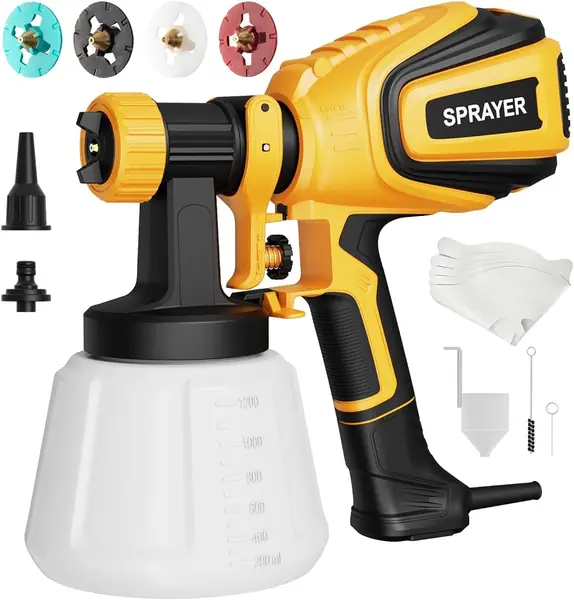
VONFORN VF803 Best for Small Jobs and Touch-Ups

VONFORN yellow handheld HVLP paint sprayer with nozzle set and paint cup

Small jobs

Shop Score 87/100
Weight
3.7 lb
Cup Capacity
1200 ml
Motor
700W
Included Nozzles
Four, 1.0 to 3.0 mm
View on Amazon

Think of it as a sprayer for jobs that fit on a sawhorse: a door, four chairs, a fence panel, a set of cabinet fronts, a radiator. A 1200 ml cup and a 700-watt motor are sized for exactly that, and buying it for a whole house leads to disappointment in both directions — far too many refills, and a motor working harder than it wants to for hours.

We got more than we expected out of the accessories. Four nozzles from 1.0 to 3.0 mm cover everything from a thin stain to a primer, three patterns handle horizontal, vertical and round work, and the dust-blowing joint is a small thing we ended up reaching for on every job — a blast of air to clear sanding dust out of carvings and turnings beats a tack cloth.

Its limits are worth knowing. Thicker latex sprays unevenly through it, so water-based paint gets thinned and tested on scrap first, and a 3.7-pound gun in one hand is fine on a door and tiring on a ceiling. For small work, though, there's a lot to like about the size, the four nozzles and the easy teardown for cleaning.

Set against the HomeRight, this is the lighter and less expensive handheld and the fussier one with heavy paint; the HomeRight's larger brass tip and turbine body push thicker material with less thinning. If your list is short, your surfaces are small and you want to spend the least, this is where we'd point — and it's the least expensive sprayer on this list besides.

Worth Noting

  • Thicker latex sprays unevenly without thinning
  • Tiring to hold through a ceiling
Our Verdict

The sprayer we hand to someone with a door, four chairs and a fence panel to finish — not to anyone planning a whole house.

Check Latest Price
7.

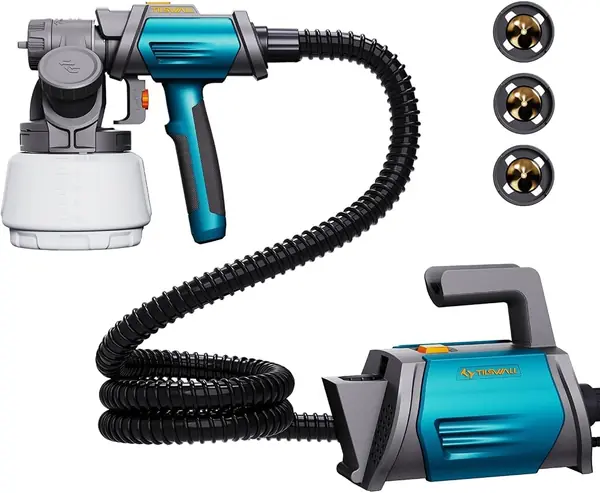
Tilswall Shark 800 Best for Walls and Ceilings

Tilswall Shark 800 blue split-body HVLP paint sprayer with hose and strap

Walls and ceilings

Shop Score 85/100
Weight
6 lb
Hose Length
98 in
Cup Capacity
1300 ml
Motor
800W
View on Amazon

Refilling a cup usually means tipping the whole sprayer over and unscrewing the head. This one has a side-fill port, so you top up straight from a bucket with the gun still in your hand — a small design decision we ended up valuing more than the extra power. The body splits too: the 800-watt unit sits on the floor or hangs from the included shoulder strap while an eight-foot air hose feeds the gun, so your wrist carries the head and the cup rather than the motor.

The rest of the package is aimed at coverage: a 1300 ml cup, four brass nozzles from 1 to 3 mm, three patterns, a flow knob, and a long cord that lets you work a room without hunting for an outlet every ten feet. For ceilings and the top of a wall, that combination is easier on your shoulder than any one-piece handheld here.

Where it doesn't compete is the whole exterior. If you're covering siding or a long fence, an airless lays down a wider fan of material and does it faster than any HVLP can. This is for the inside of the work — ceilings, walls, trim — where the weight of the tool is what limits how long you can keep spraying, and it's the reason it earned a place on this list at all.

Worth Noting

  • Split body adds a hose coupling to clean
Our Verdict

Worth a look if you'll be spraying ceilings and walls for hours, because the motor rides on your shoulder instead of hanging off your wrist.

Check Latest Price

How We Tested Paint Sprayers

We started with the market instead of a shelf: we sorted what's available into airless, HVLP, and turbine machines, then filtered by cup or hopper capacity, tip availability, hose and cord reach, and price, keeping an eye on how much of a buyer's budget would be left over for masking supplies. Twelve machines made the cut, and we ran them for eight months.

Testing happened where painting actually happens. We sprayed bare cedar siding on the back of a house, six-panel cabinet doors laid out on sawhorses in the garage, a weathered fence, porch railings, and a stack of garden chairs. Each machine started on standard latex straight from the can, no thinning and no straining, and we noted whether it clogged, spit, or laid down an even coat — and how many passes it took to cover a wall section a roller would have handled in three.

We timed cleanup from the moment we stopped spraying to the moment the gun was clean and the pump flushed, and noted which parts came apart without a tool. Every unit got carried up a ladder, held overhead, and pulled around a corner by its hose so we could feel where the weight sat and how far the reach really went. We also watched the overspray: how far the mist drifted, how much plastic one wall demanded, and what a season of tips, filters, and storage fluid added to the running bill.

Throughout, we wore respirators rated for the coating, eye protection, and gloves, sprayed with the garage door open or a fan moving air, and never put a hand anywhere near a tip. After eight months, the machines still in rotation were the ones that handled unthinned paint without drama and cleaned up before we lost patience.

How to Choose a Paint Sprayer

Airless, HVLP, or turbine: start with the surface

Airless pumps push unthinned paint through a tip at high pressure, which is why they cover siding, fences and ceilings so quickly and why they fog a room with overspray. HVLP sprayers atomize material at low pressure with a turbine; they're slower over big areas and much better behaved on a cabinet door. A handheld like the HomeRight sits in the middle for furniture and trim, while a two-stage system like the Fuji is the step up for finish work.

The trap is buying one machine for both jobs. Spray a house with a handheld and you'll spend the day refilling; spray a chair with an airless and you'll spend it sanding.

Match gallons, not square feet

Capacity is written in gallons: up to 5 or 10 gallons a project on the Graco DIY airless models, up to 500 gallons a year on the ProX19, and 40 ounces to 1300 ml in the cups on the handhelds. Rather than guess from room count, add up what you'll actually spray in a season — a fence and a garage, or a dozen cabinet doors — and buy for that number.

Cup size is the other half of the same question. A quart is generous for a door and miserable on a wall, and a bucket-fed airless is what you want the moment a job runs past a gallon.

Thinning, tips and an even coat

Whether you thin depends on the machine and the coating. Airless units spray latex unthinned; most handheld HVLPs want heavy paint cut slightly and strained first, and a viscosity cup tells you more than the label does. Tip size does the rest — small tips for stain and lacquer, larger for primer and thick latex.

Then it's technique: keep the spray gun moving at a steady distance, overlap each pass, and test the pattern on scrap before you commit to a door.

Budget for the masking, not just the machine

Overspray is the price of speed. An airless throws a fine mist that settles on everything within several feet, so moving furniture, taping trim and hanging film is the real labor of a spray day — which is why the InoKraft kit including film and tape is more useful than it first looks.

Buy a roll of masking film and a dispenser before the sprayer arrives, and plan on masking longer than you spray. On a small job, that math is exactly why a brush and a mini roller still win.

Cleanup and storage decide whether you use it twice

Paint left sitting in a pump, a hose or a spray gun is what ends a sprayer early, and every machine here flushes with water after latex. Do it the same day, work the rinse through the hose until it runs clear, and pull the tip and screen to clean them separately.

Airless units want storage fluid in the pump — Graco ships Pump Armor with its sprayers — and one spare tip on the shelf saves an afternoon when the first one clogs.

Frequently Asked Questions

Final Verdict

If we were buying one sprayer for a house and a workshop, it would be the Graco Magnum X5. Ten gallons a project, 3000 psi and unthinned paint straight from the bucket are what turn a fence or a set of shutters into an afternoon instead of a weekend, and it's a machine a first-time user can prime without help.

Buy the Fuji Spray Semi-PRO 2 instead if the finish on furniture and cabinets is what you care about, the ProX19 if you spray for a living, and the InoKraft NEO if you have two rooms to cover and want a real airless for the least money.