↑↓ navigate ↵ open Esc close All results →

Best Paint Sprayers for Air Compressors of 2026

An air-powered spray gun only atomizes as cleanly as the compressor behind it allows. Hook up a gun whose CFM demand outruns the tank and output degrades into spitting, uneven coats, and heavy orange peel that takes a full Saturday to sand back — whereas matching air supply to nozzle pressure turns refinishing a bank of cabinet doors into an afternoon job.

Twelve spray guns — gravity-feed, siphon-feed, and a mason-jar setup — ran through eight months of spraying primer, pigmented lacquer, and clear topcoats on both small and large shop compressors. Multiple needle-and-nozzle sizes expanded what a single gun could spray cleanly, while included hardware such as an inline regulator, readable pressure gauge, and spare tips often separated solid value from stripped-down kits.

Long-term keepers also stood apart on practical shop details: cup threads that still engage smoothly after a dozen solvent cleanings, lid gaskets that never weep, and manuals that state realistic starting pressures rather than leaving setup to guesswork — qualities shared by all seven guns ranked below.

Our Top Picks

The Best Paint Sprayers for Air Compressors

1.

InoKraft D1 LVLP Spray Gun Premium Kit Best Overall
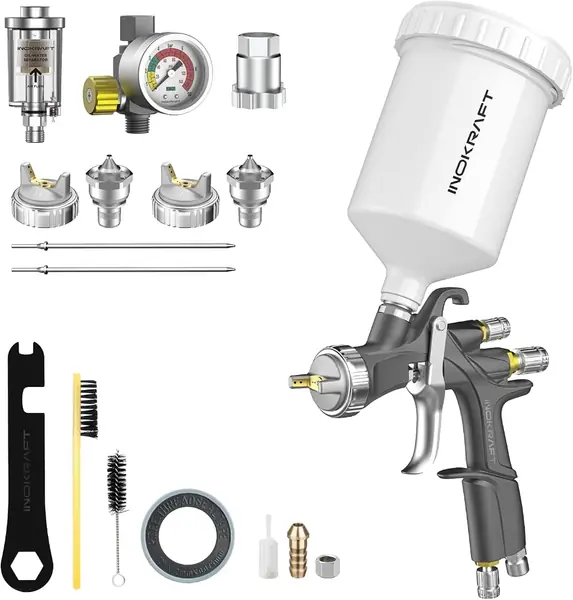
InoKraft D1 LVLP spray gun in gray with 600 ml cup and fitted storage case

Furniture and cabinets

Shop Score 92/100
Cup Capacity
600 ml
Nozzle Sizes
1.3/1.5/1.7mm
Maximum Pressure
50 psi
Weight
3.46 lb
View on Amazon

Everything you need to start spraying shows up in one box: a pressure regulator, an oil-water separator, three nozzle sets, a 3M cup adaptor, a cleaning kit, and a fitted case. That completeness is the first reason we hand this gun to someone finishing their first set of cabinet doors. The separator earns its place quietly — moisture and oil riding down the air line are what leave fisheyes in lacquer and poly, and no other gun here ships with one.

The tip sizes are laid out the way a shop actually works: 1.3 mm for thin topcoats and clear, 1.5 mm for general base and enamel, 1.7 mm for primer and heavier material. We appreciated the one-piece forged aluminum body with its Teflon coating, because a finish gun lives or dies on how easily it gives up dried paint. At 3.46 lb with a 600 ml cup it balances well enough to stay level across a door, and the LVLP design keeps it friendly to a modest compressor.

The cup is the part to treat gently. The threads can strip if you overtighten it onto the gun, and a stripped cup ends the session, so hand-tighten it and don't hang the gun from the cup between passes. Everything else about the fit and finish reads as more expensive than it is.

The 3M adaptor is the detail we keep coming back to: bag liners cut cleanup down to a rinse and let you shoot a second product without scrubbing the cup. Between that and the quick-start guide in the box, even a first spray session has a sequence to follow instead of guesswork.

Worth Noting

  • 600 cc cup runs dry on full face frames
Our Verdict

We recommend the D1 as the default finishing gun here: low air demand, three tips, and an oil-water separator no other gun on this list includes.

Check Latest Price
2.

Critter 118SG Siphon Gun Best for Small Projects

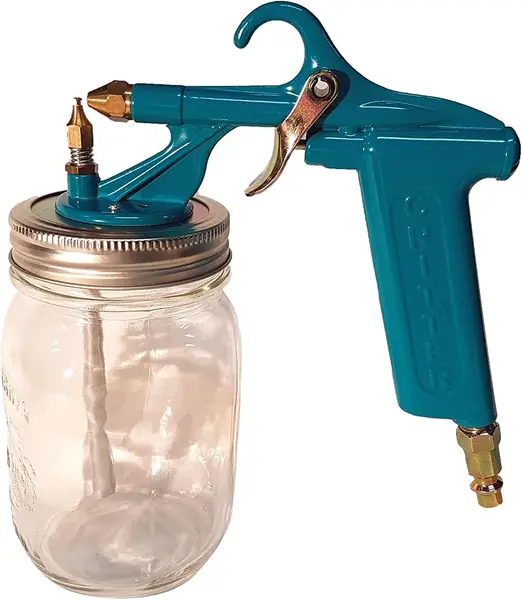
Critter 118SG siphon spray gun with teal zinc-plated body and 16-ounce mason jar

Small finishing jobs

Shop Score 91/100
Cup Capacity
16 fl oz
Pattern
1/2 to 3-inch circle
Feed Type
Siphon
Air Demand
3 cfm at 90 psi
View on Amazon

The paint cup is a 16-ounce mason jar, and that single decision explains why we keep one of these within reach: decant a finish into a jar, screw it on, spray, cap it, and set it on the shelf. Switching from shellac to a water-based topcoat takes seconds, and there is no cup to scrub. Only air passes through the gun body, so cleanup is the jar, the siphon tube, and the tip.

It is a siphon gun running at 3 cfm and 90 psi, which means a small compressor can feed it — a real advantage when your shop air is a portable unit. What it does not have is a fan pattern. The spray is a circle between a half inch and three inches across, so you build coverage by overlapping passes. On a drawer front or a chair leg that is fine; across a four-foot cabinet side it turns into a long, careful dance.

Stains, dyes, lacquer, poly, enamel, and thinned latex all go through it, and thicker material needs more thinning than a fan-pattern HVLP spray gun asks for. Strain anything with solids in it, because the siphon tube is the one place this design can clog. For small work and frequent finish changes it is the fastest tool here; for a run of cabinet doors, a 600 ml gravity gun will save you passes.

Worth Noting

  • Paper jar gasket wears through
Our Verdict

Buy it for stain, dye, and lacquer on small parts, where the jar system and the two-minute cleanup beat every other gun here.

Check Latest Price
3.

AEROPRO R500 LVLP Spray Gun Best Value LVLP

AEROPRO R500 LVLP gravity spray gun in black with 600 cc paint cup

Low-air compressor setups

Shop Score 90/100
Cup Capacity
0.6 liters
Nozzle Sizes
1.3/1.5/1.7mm
Air Consumption
3.0–3.9 CFM
Operating Pressure
2.0–3.5 bar
View on Amazon

Three stainless nozzles — 1.3, 1.5, and 1.7 mm — for substantially less than our top pick. The R500 is the same tip range as the InoKraft without the accessories, and for a shop that already owns a regulator and a separator, that is the smarter buy. It is an LVLP gun rated at 3.0–3.9 CFM and 2.0–3.5 bar, so a small compressor keeps up, and the 600 ml gravity cup matches the top pick's.

We were struck by how little overspray it throws compared with a conventional gun — the soft, low-pressure spray lands where you point it instead of hanging in the air. The two-stage trigger gives you air first and material second, which is how you avoid a blob at the start of a pass, and the Teflon-coated body wipes down quickly. The nozzle and needle are stainless steel, the right material for a gun you clean with solvent every time.

The fluid and air cap connections are where this gun can misbehave: clear coat weeping from the tip mid-panel is the failure to watch for. Seat the nozzle properly and snug it before you fill the cup, and don't leave the gun pressurized between coats. For a hobbyist spraying a motorcycle tank or a set of shop cabinets, that is a manageable habit rather than a dealbreaker.

Worth Noting

  • Ships without a regulator or moisture separator
  • Tip can weep if nozzle is not seated snugly
Our Verdict

We think the R500 is the best spraying value here: the same three tips and a soft, low-overspray pattern for far less than our top pick.

Check Latest Price
4.

TCP Global G6600 HVLP Spray Gun Best for Primer and Heavy Coatings

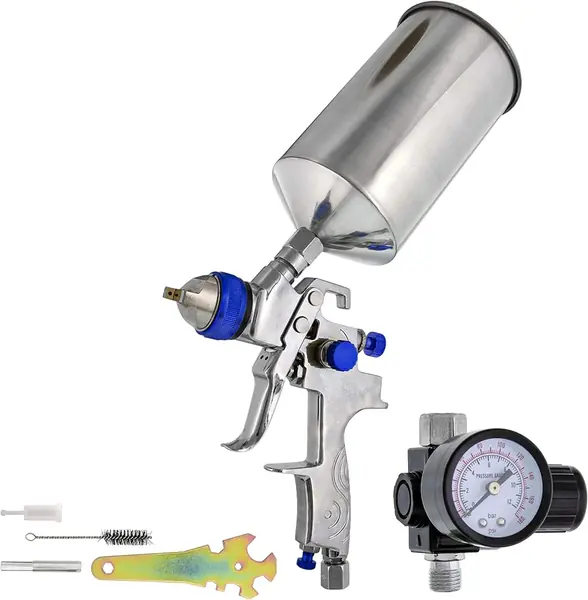
TCP Global G6600 HVLP spray gun in blue and silver with one-liter aluminum cup

Heavy primer coats

Shop Score 89/100
Cup Capacity
1 liter
Maximum Pressure
180 psi
Fluid Tip
1.5mm
Cup Material
Aluminum
View on Amazon

A one-liter aluminum cup and a 1.5 mm fluid tip set the job: this is a gun for primer, single-stage enamel, and high-build material, and the big cup means fewer refills when you are covering a whole dresser. The full baffle head and the three adjustment knobs give you an even pattern with independent control of fluid, fan, and air.

It is heavier in the hand than the LVLP guns here, and a full liter hanging off the top makes that worse — on vertical panels we fill it half way and top up between passes. The cup comes off easily and the gun strips down for cleaning with nothing beyond the included wrench, which is why it keeps coming back out of the cabinet whenever there is primer to shoot.

Where this one earns its spot is the sanding-sealer and primer stages of a project, when a thicker coat and a wide fan save hours of blocking. It is the wrong gun for a thin lacquer or clear topcoat: 1.5 mm is coarse for material that thin, and the 1.3 mm tips on the InoKraft and the AEROPRO lay those down finer.

Worth Noting

  • Cup and lid can split along the seam
Our Verdict

For primer, sealer, and heavy enamel on big panels, we reach for this one: a one-liter cup and a 1.5 mm tip that flows thick material.

Check Latest Price
5.

PNTGREEN H827 HVLP Spray Gun

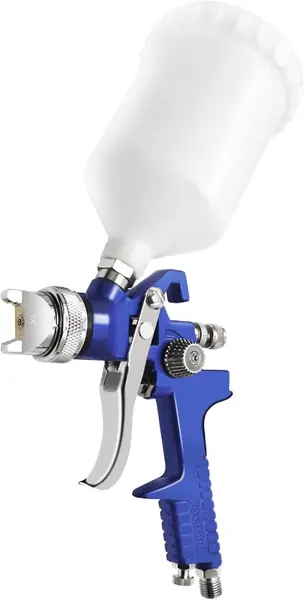
PNTGREEN H827 gravity HVLP spray gun in blue with 600 cc paint cup

First gravity-feed gun

Shop Score 88/100
Cup Capacity
600 CC
Air Consumption
15 cfm
Nozzle Size
1.4 mm
Air Pressure
3 bar (43 PSI)
View on Amazon

Fifteen cfm at 3 bar (43 psi) is the first figure to match against your own compressor's rating, and if you have the air for it, this is the least expensive route into gravity-feed spraying on this list. We keep it in mind for the shop that already runs a big upright and wants a second gun for sealer and primer without spending much.

The 1.4 mm nozzle and 600 cc cup are the standard setup, and the nozzle cap rotates a full 360 degrees so you can match the fan to the direction of your pass. Separate knobs handle fluid, air, and pattern. At 1.5 lb it is the lightest full-size gun here, which you notice halfway through a run of ceiling-height cabinet uppers.

Nothing about it is precious — the fittings are plainer than the LVLP guns and the body has none of their coating — but it atomizes finely and the low price leaves room for a spare tip and a separator. Cleanup is straightforward once the nozzle cap comes off and you flush from the cup side. What it asks in return is air capacity, and if the compressor cannot deliver, the savings disappear into a spoiled finish.

Worth Noting

  • Needs a large compressor for its 15 cfm draw
Our Verdict

We think it is the cheapest way into gravity-feed spraying here, provided your compressor can feed its 15 cfm appetite.

Check Latest Price
6.

ENDOZER 2008 HVLP Spray Gun Set Best for Primer and Clear

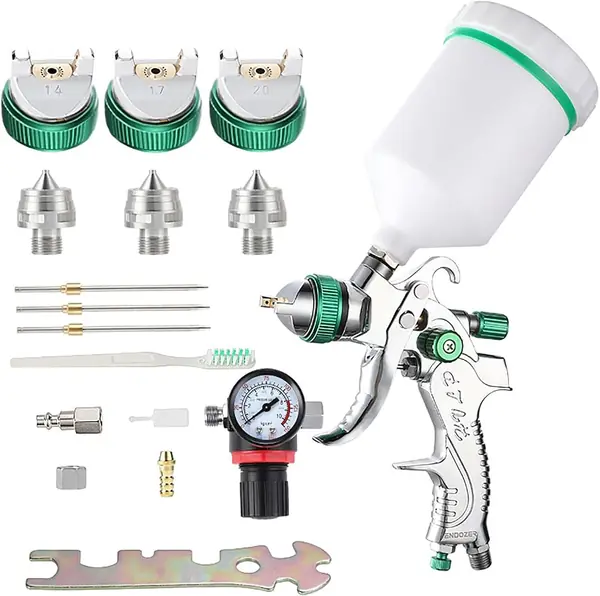
ENDOZER 2008 HVLP spray gun set in green with three nozzles and pressure gauge

Primer and clear

Shop Score 87/100
Cup Capacity
20 oz (600 cc)
Nozzle Sizes
1.4, 1.7, 2.0mm
Weight
2.65 lb
Nozzle Material
Stainless steel
View on Amazon

Tips at 1.4, 1.7, and 2.0 mm cover a whole solvent paint job from base coat to high-build primer, and that spread is the reason to look at this gun rather than a single-tip HVLP at the same money. The 2.0 mm flows primer without thinning; the 1.4 mm handles a base coat or a clear.

In the box you get the three stainless nozzles, a 20 oz (600 cc) gravity cup, a brass 15-hole air cap, a pressure gauge with a quick adapter, and a paint strainer. The gun itself weighs 2.65 lb, light enough to hold with one hand at eye level while you work along a rail.

The trigger is easy to feather and the fan and fluid knobs respond predictably, so holding a consistent pattern across a panel does not wear you out. The cup comes off in one motion, and we had the gun apart and back together in a couple of minutes after a primer session.

Our read is that this is the primer-and-clear gun for a weekend painter working on furniture, a trailer, or a set of shop cabinets. It is not the gun for a production shop or for wall-sized work; when the job needs heavy material and a bigger cup, the TCP Global is the better tool.

Worth Noting

  • No latex paint, per the maker's warning
Our Verdict

Our pick for primer and clear on a small budget: three stainless tips and a gauge for about what a single-tip gun costs.

Check Latest Price
7.

Hotorda H-2000 HVLP Two-Gun Set Best for Occasional DIY Spraying

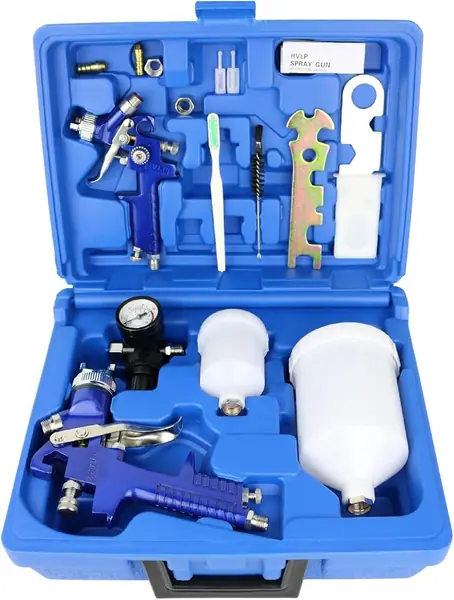
Hotorda two-gun HVLP set in blue with two paint cups and carrying case

Occasional DIY spraying

Shop Score 86/100
Nozzle Sizes
0.8mm and 1.4mm
Maximum Pressure
70 psi
Kit Weight
5.34 lb
Cup Capacities
125 ml and 600 ml
View on Amazon

Two guns, two cup sizes, a locking pressure regulator, wrenches, a cleaning brush, and a blue carrying case — the H-2000 covers ground that the single guns here cannot. The large gun runs a 1.4 mm tip and a 600 ml cup for panels and frames; the small one runs a 0.8 mm tip and a 125 ml cup for edges, jamb touch-ups, and hobby-sized parts.

Both are gravity feed with a 70 psi ceiling, and the regulator lets you set pressure at the gun instead of walking back to the compressor between coats. The case keeps the set together, which matters more than it sounds in a small shop where cups and tips migrate into drawers and never come back.

The trade is refinement. The fluid knob takes a lot of turning before the pattern shifts, so creep up on your setting with a scrap panel instead of dialing by feel — once it is set, it holds. And the small gun is a detail tool rather than a second paint gun, since a 0.8 mm tip sits below the size real paint needs.

Worth Noting

  • Fluid knob needs many turns to adjust the pattern
  • 0.8 mm detail tip is too small for standard paints
Our Verdict

We like it for the hobbyist who wants both a full-size gun and a detail gun without buying two complete setups.

Check Latest Price

How We Tested Paint Sprayers for Air Compressors

We started with spec sheets, not samples: we pulled the stated air demand at working pressure for every gun we could find, then filtered by the nozzle sizes each one offered, how it fed paint, cup size, and what shipped in the box. That narrowed the field to 12 guns, which we ran for eight months in a garage with cross-ventilation and a respirator rated for each coating. Every gun went onto both a small compressor and a large shop unit, with pressure set at a regulator at the gun and kept at or below the maker's maximum inlet pressure.

On each gun we sprayed primer, pigmented lacquer, and clear onto cabinet doors and scrap panels. We swapped from a 1.4mm tip to a 2.0mm between coats and timed the change, then laid down a fan and a round pattern on cardboard to see how wide and how even each one came out; notes on overspray drift and orange peel came from the panels, not the packaging. We checked for leaks at the cup threads and the air cap with soapy water rather than by feel — compressed air never goes near skin.

Cleanup got the same treatment: we flushed each gun with solvent after every session and logged both the minutes and the ounces it took. Durability notes came from the boring end of the job — cup threads after repeated fills, lid seals, and how the needle and air cap looked by month eight. We also wrote down whether the manual gave a starting pressure or left us guessing, and tallied what wasn't in the box, because a regulator or wrench you have to buy separately changes the value.

How to Choose a Paint Sprayer for Your Air Compressor

Match the Gun to Your Compressor's Airflow

The number that matters is your compressor's CFM at 40 psi, not its tank size or horsepower. A gun rated near the top of the 3 to 14 CFM band drains a small tank faster than the pump refills it, and you hear the motor run while the pattern fades. Our LVLP picks, the InoKraft and the AEROPRO, sit at the forgiving end of that range; the PNTGREEN's 15 cfm wants a genuinely large shop compressor.

Look up your pump's rating at 40 psi before you buy, and if you are near the limit, step down to a low-air gun rather than buying the bigger one and hoping.

Choose Tips by Coating, Not by Gun

One tip cannot do everything. A 1.3 to 1.4 mm tip suits thin stains, dyes, and clearcoats; 1.5 mm is the all-round size for base coats and enamel; 1.7 to 2.0 mm handles primer, high-build, and thicker latex; 2.5 mm is for the heaviest material. Kits with three tips, like the InoKraft and the ENDOZER sets, cost little more than buying a second tip later.

The trap is buying a single-tip gun and then thinning primer until it runs, which trades a good finish for a cheap purchase.

Gravity, Siphon, or a Jar on the Gun

Gravity feed puts the cup on top and uses less air to move material, so it wastes less paint and sprays at lower pressure — the right choice for most furniture work. Siphon feed pulls from a jar underneath, which is the Critter's whole idea: decant a finish into a mason jar, spray, cap it, and change colors in seconds.

Cup size trades capacity for weight. A full 600 ml cup is comfortable at the end of your arm; a full liter swings noticeably on a vertical panel, so fill that one part way and top it up between passes.

Budget for What Isn't in the Box

A gun alone does not make a spraying setup. You need a regulator at the gun so you can set pressure where you are standing, and an oil-water separator, because moisture and oil in the line cause fisheyes that only show up after the finish dries. Add a paint strainer, a cleaning kit, and a spare cup or gasket.

Only the InoKraft kit here includes a separator, so price one in on the others before deciding a gun is a bargain.

Cleanup Is Part of the Job

Solvent sits in the gun between coats, so the fastest designs are the ones with the fewest parts: the Critter has no paint passage in the body at all, and the Teflon-coated bodies on the InoKraft and the AEROPRO release dried material with a wipe.

Budget ten minutes at the end of every session, flush with the thinner the finish maker specifies, and never leave lacquer sitting in the cup overnight. The gun that takes an hour to strip is not the bargain it looked like.

Frequently Asked Questions

Final Verdict

The InoKraft D1 is the one we point most people to. It arrives with the regulator and the air-line separator, its three tips cover everything from a 1.3 mm clearcoat to a 1.7 mm primer, and the low-air body leaves room for a modest compressor.

If you already own the air line and want the best atomizing value here, the AEROPRO gives you the same three tips for less. And if your work is small — a chair, a drawer box, a dozen sample boards — the Critter's jar will save you more time than either.