↑↓ navigate ↵ open Esc close All results →

Best Primers for MDF of 2026

MDF faces take a topcoat cleanly, while machined edges drink it: a first coat disappears into the raw fiber, and a second raises a halo of fuzz. Primer bridges that gap by sealing cut edges, stiffening loose fibers so abrasives cut them clean, and giving finish paint a uniform film instead of a porous sponge.

Brushing, rolling, and spraying 16 white primers and aerosol cans across bare, factory-primed, and laminated MDF over six months made clear that base chemistry drives the result more than label claims. Shellac and solvent formulas seal an edge in a single pass but demand steady ventilation, whereas water-based cans handle a cold garage with minimal odor at the risk of lifting edge grain; opacity also varies sharply when a pale topcoat goes over them.

Across full-sheet cabinetry, small trim parts, and pre-finished panels, the seven recommended cans cover the spread of budgets and shop setups based on film sandability, topcoat adhesion, and real-world coverage per quart.

Our Top Picks

The Best Primers for MDF

1.

Zinsser B-I-N Advanced Synthetic Shellac Primer Best Overall
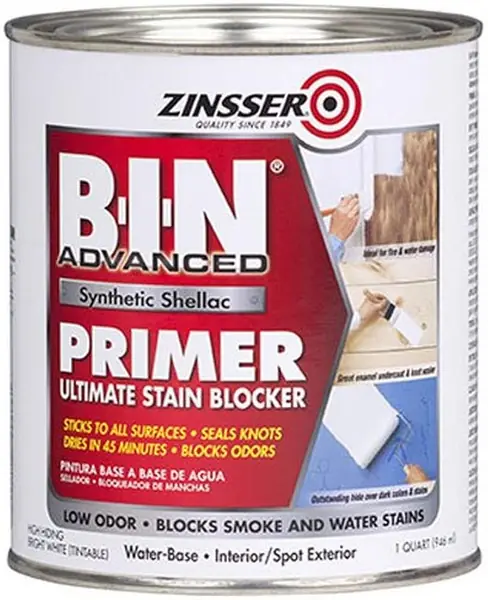
Zinsser B-I-N Advanced Synthetic Shellac Primer in a white one-quart can

Painted MDF edges

Shop Score 95/100
Base
Synthetic shellac
Size
1 quart
Coverage
35 square feet
Dry Time
2 hours
View on Amazon

Run a thumb along a freshly cut MDF edge and you can feel what goes wrong with paint: loose fibers standing up, ready to drink the first coat and dry fuzzy. Two thin coats of this synthetic shellac primer lock them down. It's the one we reach for when a project has edges that will be seen — cabinet doors, shelving, anything routed.

Speed is why it earns the top spot. A quart brushes out fast, the shellac base sets hard instead of staying tacky, and you can sand an edge back to something flat and glassy and move on to the faces without waiting overnight. The bright white hide means dark board or old stain underneath stops mattering after one coat. Keep the coats thin and sand between them with 220-grit; two thin coats flatten faster than one heavy one.

Coverage is the number to plan around. The listed 35 square feet per quart works out to roughly one side of a 4-by-8 sheet, and machined edges and router profiles eat into that quickly, so a run of cabinet doors takes a quart per sheet plus one for the edges. Decant what you need into a small cup instead of repeatedly opening the can for touch-ups.

Worth Noting

  • Costs more than the Rust-Oleum brush-on quart
  • Interior work only with exterior spot priming
Our Verdict

We reach for this shellac primer first on MDF: two thin coats seal fuzzy edges, hide what's underneath, and sand flat without a long wait.

Check Latest Price
2.

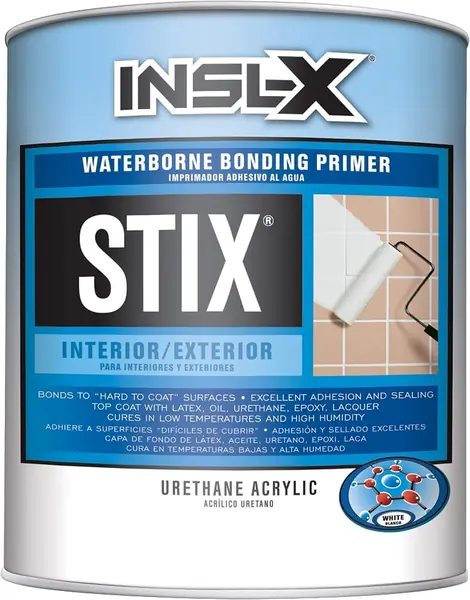
INSL-X Stix Waterborne Bonding Primer Best for Hard-To-Coat MDF

INSL-X Stix waterborne bonding primer in a white one-quart can

Pre-finished MDF

Shop Score 94/100
Base
Acrylic urethane
Size
1 quart
Coverage
75 to 100 square feet
Topcoats
Latex, oil, lacquer, epoxy
View on Amazon

One of the pricier quarts here is also the one that handles the MDF jobs the others can't: factory-primed panels, melamine-faced shelves, and doors with an old coat of gloss paint. Stix is an acrylic-urethane bonding primer, and we keep it for exactly that reason — it grips slick surfaces that a wood primer slides off.

The formula is built to bond to glass, tile, PVC, vinyl, and glossy paint without the heavy scuff sanding a conventional primer needs, and it cures to a hard film. On MDF that matters in two places: the melamine-faced sheet you don't want to sand back to bare board, and a secondhand cabinet door someone painted years ago. It topcoats with latex, oil, lacquer, or epoxy, which makes it the most flexible base coat in this group for a shop that sprays.

Cost is the honest obstacle. A quart runs toward the top of the group, and the 75-to-100-square-foot figure only holds if you spread it thin. For furniture, trim, and cabinet boxes it's the best grip here; on bare MDF, the shellac above gets you to a paintable surface for less.

Worth Noting

  • Second-most expensive quart in this group
  • Peeling has shown up in damp rooms
Our Verdict

We keep Stix for MDF that's already primed, laminated, or glossy, where its grip beats everything else here; on bare board, cheaper picks do the same job.

Check Latest Price
3.

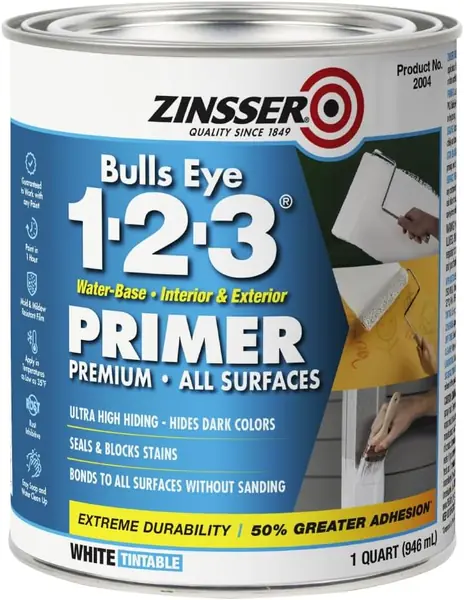
Zinsser Bulls Eye 1-2-3 Water-Base Primer Best Water-Based All-Rounder

Zinsser Bulls Eye 1-2-3 water-based primer and sealer in a white quart can

Full-sheet projects

Shop Score 93/100
Base
Water-based acrylic
Size
1 quart
Coverage
100 square feet
Application Temperature
35°F and up
View on Amazon

Priming a whole sheet of MDF indoors is a chore measured in fumes and cleanup, and Bulls Eye 1-2-3 makes it less unpleasant: water-based, low odor, and it rinses out of a brush under the tap. A quart covers about 100 square feet, close to three sheet sides' worth of face area.

On MDF it behaves like a typical acrylic. The first coat raises the fibers on machined faces and edges, and you knock them back with 220-grit once it's dry; after that it blocks light stains, takes a latex or oil topcoat, and rolls on at temperatures down to 35°F, which matters in an unheated garage in November.

This is our default when the job is large and the room is small. It doesn't close an edge as hard as a shellac primer, so raw edges get a second coat before you sand. Do that and you get a flat, paintable base without solvent fumes in the house.

Worth Noting

  • Adhesion is inconsistent on dense or glossy MDF
Our Verdict

Our pick for big indoor jobs: it rolls on with almost no smell, cleans up with water, and takes either kind of topcoat.

Check Latest Price
4.

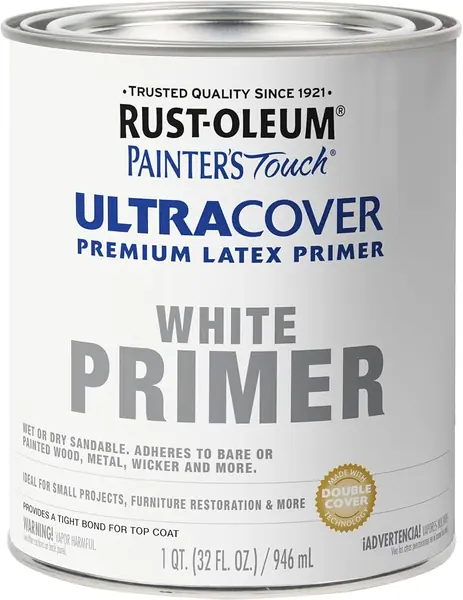
Rust-Oleum Painter's Touch Brush-On Latex Primer Best Value

Rust-Oleum Painter's Touch flat white latex primer in a one-quart can

Shop projects

Shop Score 92/100
Base
Water-based acrylic
Size
1 quart
Coverage
120 square feet
Dry To Touch
30 minutes
View on Amazon

At 120 square feet per quart, Painter's Touch latex primer covers more ground than any other brush-on primer here at a moderate quart price. That combination is why it ends up on shop shelving, jigs, and the backs of panels where the finish only has to be flat and white.

We treat it as a utility primer, and for that job it's hard to beat. On MDF it rolls out thin and raises the fibers on the first pass like any acrylic; sand with 220-grit before the second coat and it levels out fine. What you don't get is the edge sealing of a shellac or the grip of a bonding primer, so a piece headed into the house still gets one of those on its edges.

Worth Noting

  • Two coats needed for a solid white
Our Verdict

We buy it by the quart for jigs, shop shelves, and panel backs: it's an affordable brush-on that covers the most ground here.

Check Latest Price
5.

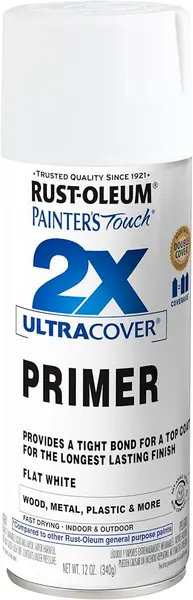
Rust-Oleum Painter's Touch 2X Ultra Cover Spray Primer Best Spray for Edges and Small Parts

Rust-Oleum Painter's Touch 2X Ultra Cover flat white spray primer can

Edges and cutouts

Shop Score 91/100
Base
Oil-based
Size
12 oz
Coverage
12 square feet
Dry To Touch
20 minutes
View on Amazon

A 12-ounce can of Painter's Touch 2X covers about 12 square feet, which sounds like nothing until you're looking at a routed MDF edge with a brush in your hand. For edges, small cutouts, and parts too fussy to roll, this is the can we grab: two light passes seal the fuzz and leave a flat white surface ready for a sanding.

Because it's oil-based, it doesn't raise the fibers the way a water-based primer does, and it dries to the touch in about 20 minutes, so the second coat goes on while the first is still fresh in your mind. Hold the can 10 to 16 inches from the work and keep the passes light — heavy coats pool on a machined edge and drip.

The can is the weak point. The nozzle clogs with paint still inside often enough that we clear the tip after every pass and buy two cans for anything beyond a handful of parts. Don't plan to prime a whole sheet this way, either: at 12 square feet a can, one 4-by-8 side takes three cans and a lot of patience.

Worth Noting

  • About 12 square feet of coverage per can
Our Verdict

Keep a can within reach for edges and small parts: two quick coats seal them fast, though you'll burn through a can on anything bigger.

Check Latest Price
6.

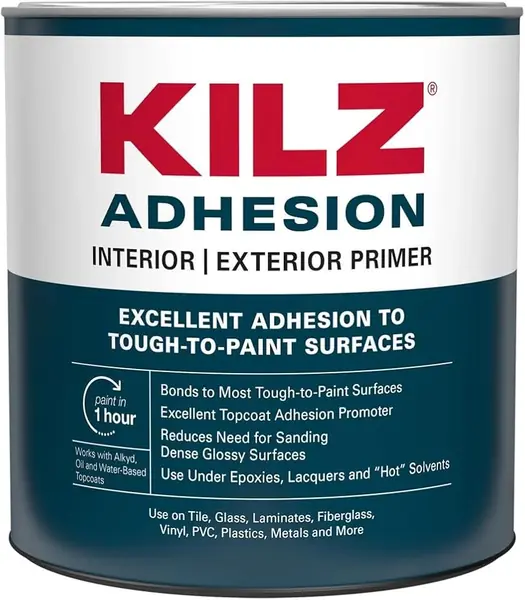
KILZ Adhesion High-Bonding Primer Best for Slick Surfaces

KILZ Adhesion high-bonding white latex primer in a one-quart can

Slick surfaces

Shop Score 90/100
Base
Water-based acrylic
Size
1 quart
Coverage
75 to 100 square feet
Dry To Touch
1 hour
View on Amazon

Not every MDF project starts as bare board. Shelving with a factory finish, doors with a laminate skin, and pieces with an old coat of gloss paint need a primer that grips instead of soaking in, and that's what KILZ Adhesion was built for.

It's a water-based acrylic built around adhesion rather than sealing: it bonds to Kynar, PVC, Formica, vinyl, glass, tile, glazed brick, chalky paint, glossy finishes, fiberglass, and metal, and it takes either a latex or an oil topcoat. A quart covers 75 to 100 square feet, it dries to the touch in about an hour, and it cleans up with water.

Kitchen cabinets, laminate counters, and previously painted trim are where it does its best work. It goes on smoothly, covers in one coat on most jobs, and the low odor means you can work a cabinet box in a basement without clearing the house.

Where it lands for us: on bare MDF it's more primer than the job needs, and the shellac or the water-based all-rounder gets you to a sandable film with less fuss. Keep it for boards that are already sealed, laminated, or painted, where its grip is the whole point.

Worth Noting

  • Peeling has shown up on some finished jobs
Our Verdict

We reach for it when the MDF isn't bare — laminate, factory primer, or old gloss — because its grip is the whole point there; on raw board, other picks get there with less fuss.

Check Latest Price
7.

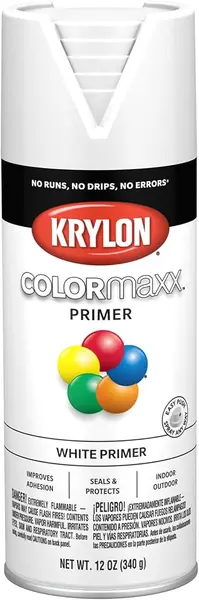
Krylon ColorMaxx White Primer Spray Best for Small Spray Jobs

Krylon ColorMaxx white all-purpose spray primer in a 12-ounce can

Small spray jobs

Shop Score 89/100
Base
Acrylic
Size
12 oz
Coverage
25 square feet
Dry To Touch
10 minutes
View on Amazon

ColorMaxx goes on flat and powdery, almost chalk-white, which is what a sanding primer should look like. What surprised us is the coverage: about 25 square feet per can, roughly double the Rust-Oleum spray primer here.

It's an acrylic spray that dries to the touch in about 10 minutes, so two light coats fit in a single session — recoat inside four hours or after 24, per the can. Cutouts, drawer dividers, and edges too small to roll are its natural work.

Where it earns a place on our shelf is small parts, not show panels. The powdery film wants a 220-grit pass before color, which is fine on cleats and a nuisance on a door face, so we keep it for the first kind.

Worth Noting

  • Spray pattern can go on uneven
Our Verdict

For small MDF parts and cutouts, Krylon ColorMaxx makes sense when one can covers the batch and nothing visible is at stake.

Check Latest Price

How We Tested MDF Primers in a Working Shop

We started with spec sheets, sorting more than forty primers by base chemistry, coverage claims, and whether they came in a quart or an aerosol small enough for a few shelves. We ruled out tinted products, since pigment load changes how a primer behaves under a light topcoat, and narrowed to 16 white primers and spray cans. Testing ran six months, mostly on a 32-square-foot sheet side cut into shelves, cabinet doors, and a set of shop jigs, plus offcuts for edges, routered profiles, and outlet cutouts.

Each quart was measured against a known square footage so we could see how far it actually stretched. We brushed or rolled the edges first, counting passes until the film went uniform and noting where the board drank it in, then compared how opaque each dried white looked against a bare offcut. Dry time was checked by touching a corner every ten minutes, then recoating on the can's schedule against a real shop timetable. Once dry, we ran a palm over cut edges under raking light to catch raised fibers, and sanded with 220 on a block, watching whether the paper clogged or the film powdered cleanly.

Adhesion got a crude but honest test: a utility-knife crosshatch with tape pressed on and pulled, run on bare, factory-primed, and laminated MDF. We topcoated every sample and stacked the parts for a few weeks to see what chipped. Spray cans were judged on fan consistency, spatter, and whether they kept spraying when we tilted them into a cutout.

We worked with the garage door open and a fan running for solvent and shellac, kept aerosols away from the water heater and other ignition sources, and sanded with a shop vac on the sander and a respirator on. We also noted smell and cleanup, because a primer that reeks for two days is a different product from one you forget by dinner.

How to Choose a Primer for MDF

Seal the Edges Before Anything Else

MDF is sawdust and resin pressed into a board, and a cut edge is the rawest part of it: loose fibers that drink coating and dry fuzzy. Two thin coats of primer on the edges, sanded back with 220-grit until they feel closed and glassy, do more for the finished paint job than any topcoat will. The shellac primer above is our fastest route on routed profiles; a bonding or oil-based primer works too. Seal edges before you roll the faces, and never try to close one with a single heavy coat.

Water-Based or Shellac: Match the Base to the Board

Water-based primers are easier to live with — low odor, water cleanup, and the all-rounder here covers a full sheet side per quart — but they raise fibers on MDF faces, so you sand between coats. Shellac and oil-based primers seal with almost no raise and set fast, which is why we keep one for edges and deadline work. None of these are sold as a special MDF formula; you're choosing a base, not a specialty product. Plan the sanding pass and either one works.

Brush, Roll, or Spray: Match the Method to the Part

A 4-by-8 sheet of MDF is 32 square feet per side, and that number decides your method. A quart of brush-on primer covers anywhere from 35 to 120 square feet depending on which one you buy, so a sheet runs one to three quarts; an aerosol covers 12 to 25, so one sheet side eats two or three cans. We roll panels and brush the edges, and keep a spray can for cutouts and small parts. The trap is buying a single can for a whole cabinet and running dry on the second door.

What Primer Won't Fix

Primer seals and builds a surface; it doesn't fill. Dents, machine marks, the slight ridge left by a router, and an edge that has swollen from a damp garage all telegraph through paint, and no primer here fills them — sand flat or use a filler first. Cold shops matter too: the water-based all-rounder here stops at 35°F, and solvent primers need ventilation, so a November session in an unheated garage is a scheduling decision as much as a finishing one.

Frequently Asked Questions

Final Verdict

For painted MDF, the shellac primer is the one we buy. It closes a fuzzy edge in two thin coats, hides whatever is underneath, and sands back flat so the topcoat has an even surface to sit on — and it does that in an afternoon rather than overnight.

If your MDF already wears a factory finish or a laminate skin, spend the extra on the Stix bonding primer instead; it grips surfaces the shellac won't. For a shop full of utility shelving, the cheap Rust-Oleum quart still earns its place on the shelf.