↑↓ navigate ↵ open Esc close All results →

Best Turbine Paint Sprayers of 2026

Paired with the right tip and turbine stage, an HVLP sprayer lays glass-smooth finish across cabinet doors in minutes; mismatched to the coating, it spits orange peel, starves a wide fence panel, or rattles the garage windows with excessive noise. Most finishing headaches trace back to airflow and fluid setup before a drop of paint hits the cup.

Spraying cabinet doors, trim, fencing, and secondhand dressers with seven turbine sprayers over nine months in a ventilated garage underscored how much budget goes beyond the machine itself. Thinning agents, extra coating volume, and cleanup solvent add up quickly, making tool-free cup disassembly and a ten-minute flush-out essential for any sprayer you expect to pull off the shelf again.

Our Top Picks

The Best Turbine Paint Sprayers

1.

Fuji Spray Semi-PRO 2 Best Overall
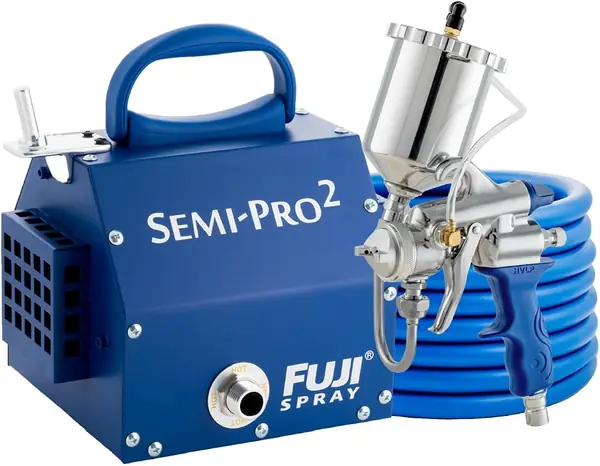
Fuji Spray Semi-PRO 2 blue HVLP turbine system with gravity-feed gun and hose

Furniture and cabinets

Shop Score 93/100
Turbine
Two-stage, 1400W
Cup Capacity
400 ml
Hose Length
25 feet
Maximum Pressure
5 psi
View on Amazon

A handheld sprayer is fine until you have a run of cabinet doors or a stack of trim to finish. That's where the Semi-PRO 2 earns its place for us: a 1400W two-stage turbine and a 25-foot hose separate the power unit from the gun, so the handpiece stays light enough to move through a full pass. We recommend it first for woodworkers who want a professional-looking finish without the bulk of a five-stage machine.

The 5 psi output isn't the highest here, but the M-model gun's fan control and 1.3 mm air cap are set up for the finishes woodworkers reach for: shellac, lacquer, waterborne poly, and thinned enamel. We especially like that the gun is non-bleed, so air moves only when you pull the trigger. That keeps the shop quieter between passes and helps the finish stay clean when you set the gun down.

The 25-foot hose is the practical detail we appreciated most. It lets us park the turbine outside the immediate spray zone and still reach around a table or a cabinet run, and the included air control valve gives another place to trim pressure at the gun. Setup is straightforward, and the system arrives with the turbine, hose, and gun rather than making you chase parts. For a small shop, that combination is a serious step up from a handheld without the cost and bulk of a five-stage machine.

The gun rewards a properly thinned coating, so test your material before you commit to a cabinet face. For furniture, cabinets, trim, and doors, this is the system we reach for first.

Worth Noting

  • Small 400 ml cup needs frequent refills
Our Verdict

We recommend the Semi-PRO 2 as our best all-around pick here for woodworkers who want a professional finish without jumping to a five-stage setup.

Check Latest Price
2.

Wagner Control Spray Max Best Budget Full-Size

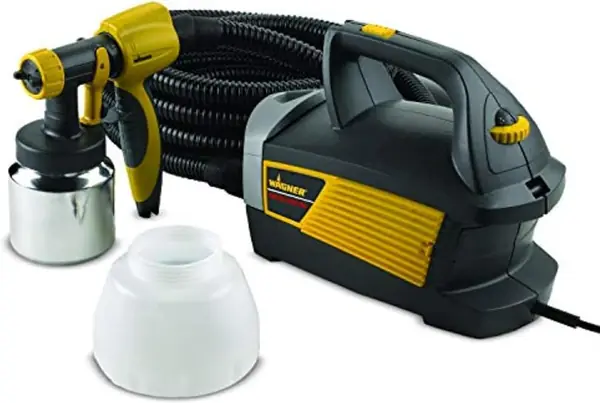
Wagner Control Spray Max yellow and black HVLP sprayer with two cups

Decks and fences

Shop Score 89/100
Turbine
Two-stage, 510W
Cup Capacity
1.5 quarts
Hose Length
20 feet
Maximum Pressure
2.63 psi
View on Amazon

A full-size turbine setup usually means a serious outlay, but the Control Spray Max keeps a separate power unit, a 20-foot hose, and two cups within a budget-minded purchase. That matters if you're staining a fence or spraying a run of cabinet doors and don't want to hold the whole motor in your hand. The two-stage turbine is rated at 2.63 psi, and the spray pattern adjusts from a narrow strip to a wide fan.

We noticed the trade-off as soon as we moved from stain to thicker latex: the Wagner wants the material thinned and rewards a test pass. When we got the viscosity right, it laid down an even coat and covered a lot of ground quickly. The 1.5-quart cup means fewer refills than the handhelds, and the 20-foot hose gives you room to set the turbine aside.

The two cups give you a metal option and a plastic one, and both come apart for cleaning. We appreciated having both a pressure dial and a material-flow adjuster, so you can change the spray without swapping parts. Cleaning is manageable as long as you deal with the gun promptly; leave paint in the nozzle and the next session starts with a clog hunt.

For a homeowner or a woodworker who sprays occasionally, that's a fair exchange: a lower-cost system that asks you to learn its settings and work within its pressure. It won't match the Fuji's refinement on a show-quality cabinet, but it doesn't need to. It's the pick for decks, fences, and primer-heavy projects where speed and value matter more than a mirror finish.

Worth Noting

  • Spray output can turn uneven with thick coatings
Our Verdict

We think the Control Spray Max is the best value here if you want a separate turbine and a long hose for decks, fences, and cabinet doors.

Check Latest Price
3.

Fuji Spray Q5 Platinum Best for Quiet Shops

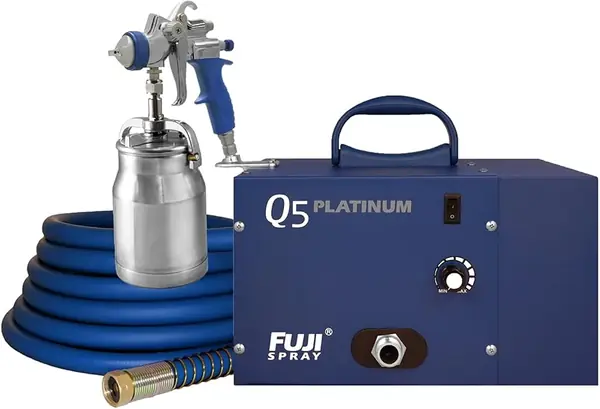
Fuji Spray Q5 Platinum blue five-stage turbine HVLP system with T-70 gun

Quiet shop finishing

Shop Score 88/100
Turbine
Five-stage
Cup Capacity
1 quart
Maximum Pressure
9.5 psi
Weight
39.4 lb
View on Amazon

In a garage shop, a turbine's whine can be the thing that keeps you from spraying after dinner. The Q5 Platinum is the one here built around that problem: Fuji's five-stage turbine has a patented noise-reduction design and a heat dissipation chamber, and it still delivers 9.5 psi. That combination is what separates it from the two-stage systems here.

The extra pressure shows up in the work. Thick waterborne coatings and heavier builds need less thinning than they do through the Semi-PRO 2, and the T-70 gun has the same side-mounted pattern control we like on the other Fuji systems. The 1-quart bottom-feed cup holds a useful amount for cabinet runs, and the 25-foot hose gives you room to move around a bench or a room. The controls are simple enough that switching from a sealer to a topcoat doesn't feel like starting over.

We were struck by how much the quieter turbine changes the experience. It's still a turbine, not a silent compressor, but the noise is less likely to drive you out of the shop or make you reach for hearing protection for every short session. The trade-off is weight: at 39.4 pounds, the turbine case is a two-handed lift and not something you'll want to carry up a ladder. Put it on a cart or a dedicated shelf and the bulk matters less.

For a cabinet shop or a serious home finisher who sprays several times a month, that quiet, powerful combination makes sense. The Q5 is not the system to buy if your work is mostly fences and decks; the smaller Fuji and the Wagner make more sense there. But if your spray area is fixed and you want the least fuss with thick coatings, this is the top of this group.

Worth Noting

  • Premium price limits it to frequent finishers
Our Verdict

For a noise-sensitive shop, the Q5 Platinum is our pick because it pairs the most pressure here with patented noise reduction.

Check Latest Price
4.

Tilswall Shark 800 Best Handheld

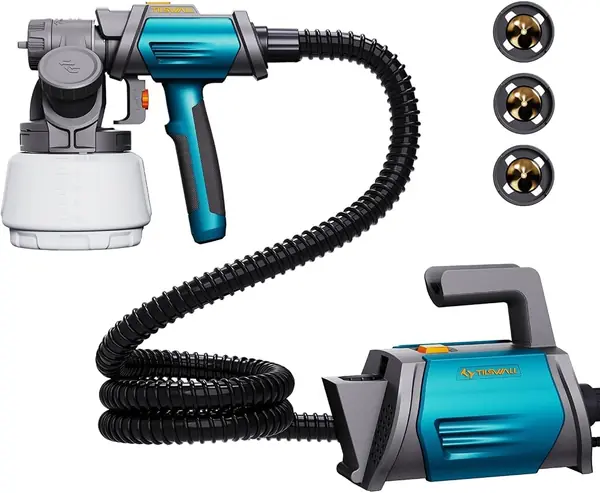
Tilswall Shark 800 blue handheld HVLP sprayer with side-fill cup and strap

Small jobs

Shop Score 85/100
Turbine
800W
Cup Capacity
1300 ml
Hose Length
98 inches
Nozzles
Four brass nozzles
View on Amazon

The Shark 800's side-fill cup is the detail that makes it easy to live with. Instead of unscrewing a cup from the bottom of the gun, you add finish from the side, which is less messy when the cup is already partly full. The split-body design puts the 800W motor in a separate main unit with a shoulder strap, so the handpiece stays light through a long pass.

We found the four brass nozzles and three spray patterns give it more range than most handhelds. A 1 mm tip is fine for thin finishes, while the larger tips handle primer and thicker paint; the flow adjustment lets you back off the material without changing tips. It is still an HVLP sprayer, so thick coatings need thinning and a test panel before you commit to a cabinet door.

The 1300 ml cup is generous for a handheld, and the shoulder strap helps when the cup is full. Cleaning is straightforward because the nozzle and cup come off, and the included needle and brush are useful for the passages. We appreciated the side-fill opening most when topping off between coats; it saves the awkward dance of removing a full cup.

For furniture, doors, shutters, and quick touch-ups, the Shark 800 is the one we choose when setting up a full turbine and 25-foot hose would take longer than spraying. It stores on a shelf, cleans without a bench full of tools, and asks less of your arm than a cup-heavy handheld. If your work is small and occasional, this is the handheld to beat here.

Worth Noting

  • Short 98-inch hose limits reach
Our Verdict

The Shark 800 is our handheld pick when a full turbine case and long hose are more trouble than the job is worth.

Check Latest Price

How We Chose and Tested Turbine Sprayers

We started with a shortlist of roughly 20 turbine sprayers sold in the U.S. and filtered it by turbine stage, tip and fan-pattern options, cup capacity and feed style, hose length, published weight, and price, then bought seven to test. Testing ran for nine months.

Most of that time was spent in a ventilated garage, spraying cabinet doors and drawer fronts with a waterborne finish, a privacy fence with exterior stain, trim, and a pair of secondhand dressers, plus a run of small parts with the handheld unit. A respirator and eye protection went on before the first coat every time, and solvent-based finishes stayed well away from the water heater and its pilot light.

We thinned each coating to the manufacturer's chart and recorded how much thinner it took before the gun stopped spitting, then laid wet coats on vertical panels to see whether the finish flowed out or dried to orange peel. Fan patterns got widened and narrowed mid-pass to check the adjuster held where we set it.

We weighed turbines and guns, ran each cup until it went dry to see where feed faltered, and held a phone's decibel meter at arm's length from the turbine to compare noise. Cleanup was timed from first disassembly to final wipe-down, and we tracked what each machine cost to run — thinner, extra material, replacement tips — against the square footage it covered in a session. The four that made the list held their pattern settings, cleaned up without a fight, and needed the least fiddling between coats.

How to Choose a Turbine Paint Sprayer

Start With the Turbine, Not the Cup

The turbine is the engine, and its stage count and pressure determine how thick a coating it can atomize and how much thinning you'll do. A two-stage system such as the Fuji Semi-PRO 2 is plenty for furniture, cabinets, and trim when you thin properly; a four- or five-stage machine such as the Q5 Platinum gives you more headroom for heavier waterborne finishes and larger jobs.

Don't chase the highest psi alone: gun setup, tip size, and technique decide the finish. If you mostly spray thin lacquers and stains, a two-stage unit is the sensible place to start.

Match the Gun and Tip to the Finish

Gravity-feed cups keep the finish flowing toward the nozzle and are easy to see into; bottom-feed cups hold more and suit bench work. Tip size matters as much as the turbine: a 1.3 mm cap is a good all-around choice for clear finishes and thinned enamel, while larger tips handle primer and thicker paint. A fan-pattern control lets you narrow the spray for trim and open it up for a door.

The Tilswall's four nozzles show the range, but every system needs a test panel before you commit to a cabinet face.

Plan for Reach, Weight, and Noise

A 25-foot hose lets you park the turbine outside the immediate spray zone, which keeps overspray off the motor and gives you room to move around a table. Shorter hoses, like the 98-inch hose on the Shark 800, are fine for small projects but mean you'll drag the base along. Full-size turbines are heavy, so plan a cart or a fixed shelf.

Noise is the other shop constraint: if you spray often in a garage, a noise-reduced turbine is worth the premium.

Budget for Thinning and Cleanup

None of these sprayers turns thick latex into a no-prep material. You'll need a viscosity cup, a supply of the right thinner, and a test board before each material change. Cleaning is part of the job, too: flush the gun and cup as soon as you finish, especially with waterborne finishes, and keep the passages clear with the supplied needle or brush.

Add a respirator, drop cloths, and spare cups to the budget. The cheapest handheld still costs more than its purchase price once you count the finish you'll use to learn its settings.

Frequently Asked Questions

Final Verdict

The Fuji Spray Semi-PRO 2 is our first recommendation for most woodworkers. Its two-stage turbine, pattern-control gun, and 25-foot hose are a sensible match for cabinets, furniture, doors, and trim, and it asks less of your wallet than the five-stage Q5. You do need to thin properly and test the pattern, but that's true of every HVLP sprayer here. If your work is mostly decks and fences, the Wagner Control Spray Max is the better buy; the savings are worth more than the extra refinement.