↑↓ navigate ↵ open Esc close All results →

Best Push Blocks for Table Saws of 2026

Treating a push block as an optional accessory is a common mistake on a first table saw, yet every inch your fingers creep closer to the spinning teeth leaves less margin for recovery. A well-designed block bridges that gap with a high-friction sole that feeds stock cleanly past the blade while keeping knuckles well above and behind the kerf.

Ripping everything from quarter-inch hardwood strips to full plywood sheets with 12 blocks over six months quickly exposed weak designs. Thin foam pads lost traction as soon as fine sawdust coated the sole, poorly placed handles crowded the fence, and narrow bases rocked mid-cut; blocks without quick height or width adjustments ended up sidelined whenever stock thickness changed.

No push block replaces a riving knife or blade guard, and even the eight options covered here split between thin-strip precision, wide-panel control, and multi-piece starter kits built to keep hands clear without sacrificing cut accuracy.

Our Top Picks

The Best Push Blocks for Table Saws

1.

MICROJIG GRR-RIPPER GR-100 Best Overall
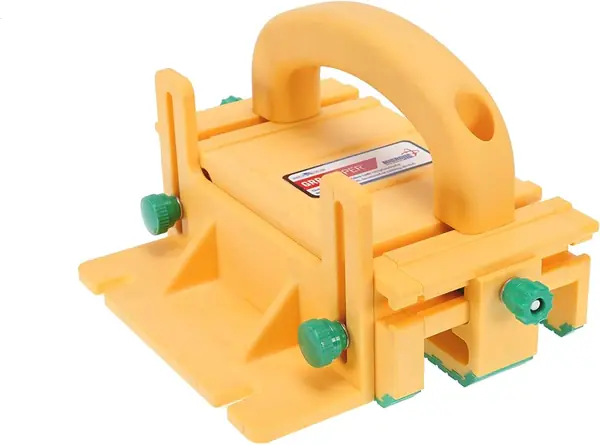
Yellow MICROJIG GRR-RIPPER GR-100 three-legged push block for table saws

Everyday rips

Shop Score 97/100
Weight
16 oz
Minimum Rip Width
1/4 inch
Included
Push block and instructions
Adjustability
Fully adjustable
View on Amazon

The three-legged stance is the defining feature: one leg rides the keeper, one presses the off-cut, and the handle lets you push forward while bearing down and in toward the fence. It adjusts for stock thickness, and the listed cutting range goes down to 1/4-inch strips. The body is compact enough to keep near the saw, and the yellow color is easy to spot.

We reach for it first on narrow rips because it keeps pressure on both sides of the blade without a separate push stick. The grip is strong on clean wood, but it can slick over when sawdust builds up on the green pad; a quick wipe restores traction. The handle is fully adjustable, which helps with different hand sizes and stock thicknesses. We also appreciate that the handle can be set for a comfortable wrist angle.

The pad is the part we watch: keep it clean and replace it when it stops biting, because a glazed surface is the difference between control and a slip. The three-leg design also makes it easy to switch between the keeper and the off-cut without reaching across the blade, which is the part of ripping that still makes us slow down.

Worth Noting

  • Premium price for a single block
Our Verdict

We recommend the GRR-RIPPER GR-100 as the default table saw push block because its three legs control the keeper and off-cut while keeping your hands clear.

Check Latest Price
2.

Milescraft 3406 GrabberPRO Best for Thin Rips

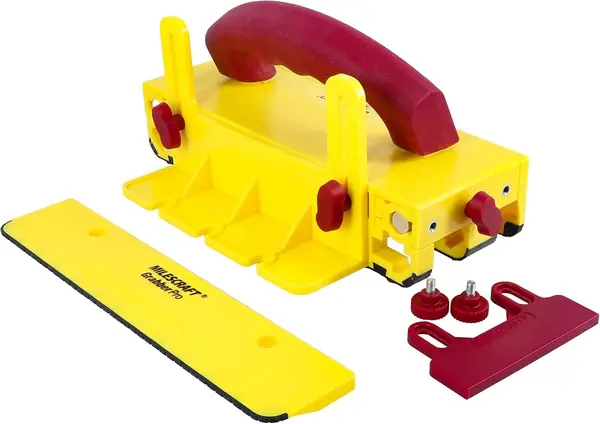
Black Milescraft GrabberPRO push block with four interchangeable legs

Thin strip ripping

Shop Score 96/100
Weight
1 lb
Minimum Rip Width
1/8 inch
Included Legs
Four interchangeable legs
Adjustable Heel
Cut-through design
View on Amazon

Four interchangeable legs set this block apart: you swap in the 1-, 1/2-, 1/4- or 1/8-inch leg to match the cut, and the multi-leg design keeps contact on both sides of the blade. The adjustable heel can be cut through and lowered as it wears. The open design also lets you see the blade and the cut line, which matters when the strip gets narrow.

The body feels heftier than the price suggests, and the handle gives you a solid place to bear down. We found the legs easy enough to change between cuts, and the rubber pads hold clean wood well. Dust is the enemy, so brush them off before a finish cut. The handle is angled to keep your wrist neutral, and the block feels balanced in one hand.

For anyone who rips a lot of 1/8- to 1/4-inch strips, this is our pick over the more expensive GRR-RIPPER. It gives up some of the Microjig's refinement and three-directional handle geometry, but it costs less and reaches thinner stock. We keep it set up for narrow work and reach for the GRR-RIPPER when we want a taller handle. That makes it a strong second block for a shop that already has a do-it-all unit.

Worth Noting

  • Rubber pads lose grip quickly when coated in sawdust
  • Lower handle feels less refined than the GRR-RIPPER
Our Verdict

We like the GrabberPRO for thin strips because its four legs let you set the block as low as 1/8 inch without giving up control.

Check Latest Price
3.

Fulton 5-Piece Push Block Set Best Budget Set

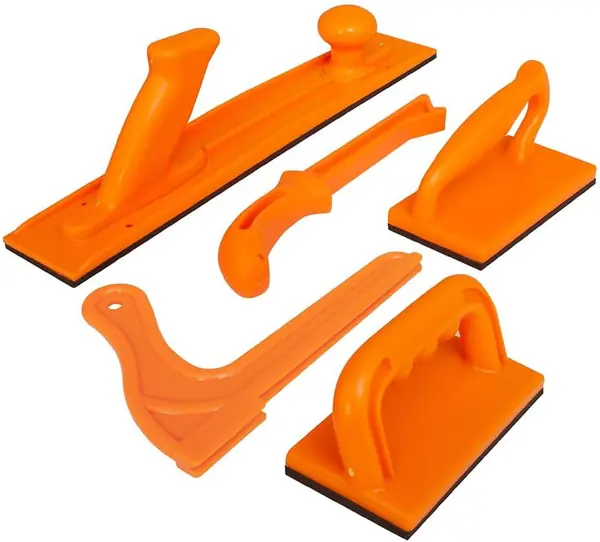
Orange Fulton five-piece push block and push stick set for woodworking

Starter shop safety

Shop Score 95/100
Weight
2.1 lb
Dimensions
6 x 6 x 16 inches
Pad Material
Rubber foam
Set Contents
Five push tools
View on Amazon

The box includes a long push block, two short blocks, a V-style stick and a standard stick, all in safety orange. The blocks use rubber foam pads, and the different shapes let you switch between face jointing, ripping and edge work without hunting for another tool. The long block is the one that stays by the saw, while the short blocks fit smaller work. The parts are lightweight enough to hang on a wall or keep in a drawer.

This is the set we hand to someone setting up a first table saw. The pads grab clean stock well, the handles are comfortable, and the whole kit costs less than most single blocks here. The push sticks are part of the package, but the blocks are the reason to buy it. We also appreciate the high-visibility color when the bench is covered in shavings.

For a beginner or a second shop, the variety is the real value: you get a block for wide stock, a block for smaller pieces and sticks for narrow cuts, all from one purchase. We like keeping the short blocks near the router table and the long block at the saw, so there is always a safe option within reach.

Worth Noting

  • Push sticks feel short for large hands
Our Verdict

If you want push blocks and push sticks in one budget-minded box for a new shop, this Fulton set covers the basics.

Check Latest Price
4.

MICROJIG GRR-RIP BLOCK Best for Wide Stock

Yellow MICROJIG GRR-RIP BLOCK push block with four smart hooks

Wide stock

Shop Score 94/100
Dimensions
9 x 3.5 x 3.5 inches
Grip Surface
Green GRR-RIP pods
Flip Guide
90 degree
Smart Hooks
Four included
View on Amazon

Four spring-loaded hooks drop down at the tail end of a board and retract as the block moves over the middle, so you get a mechanical stop without a separate heel. The green podular pad grips clean wood firmly, and the 90-degree flip guide supports vertical work such as veneer or resawing. The hooks can also be locked in the retracted position when you want a plain pad.

On a table saw, this block sits lower than the GRR-RIPPER, which makes it feel more direct on wide panels and edge cuts. We noticed the difference on long boards: the hooks give you something to push against at the end of the cut, and the offset handle keeps your hand out of the blade path. It is less helpful for very narrow strips, where a taller three-legged block gives us more clearance. The body has a solid, planted feel without being tiring to hold.

We think of it as the second block in a serious shop rather than the only one. It is excellent for jointers and wide stock, and the hooks are the feature we miss when using a plain pad. If your work is mostly narrow rips on the table saw, start with the GRR-RIPPER instead.

Worth Noting

  • Premium price for a specialty block
Our Verdict

We reach for the GRR-RIP BLOCK on wide boards and the jointer because its smart hooks grab the end of the stock and keep it moving.

Check Latest Price
5.

Milescraft 3405 GrabberPLUS Best Lightweight Control

Yellow Milescraft GrabberPLUS push block with retractable locking heels

Quick edge cuts

Shop Score 93/100
Weight
1 lb
Grip Surface
Diamond-grip rubber
Heels
Spring-loaded retractable
View on Amazon

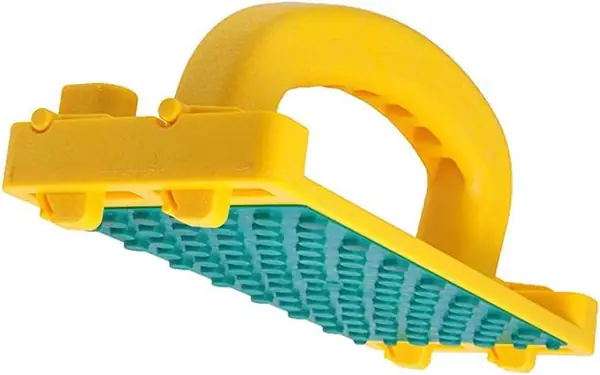
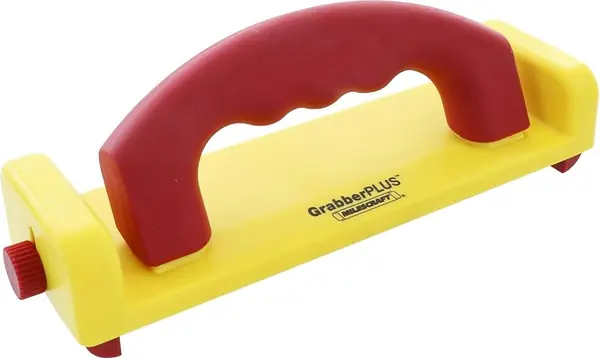
A compact body, a diamond-pattern rubber sole and two spring-loaded heels are the whole idea here: set the block on the stock, let the heels catch the end, and push. We found it the easiest block in this group to grab for a short edge cut or a quick pass on the jointer. The heels retract out of the way when you are not using them, so the sole sits flat on the stock.

The rubber is aggressive enough to hold without being so tacky that it lifts the workpiece when you let go. The tilted handle puts your wrist in a comfortable position and keeps your hand away from the cutter, and the yellow body is easy to spot on a cluttered bench. It is a simpler block than the GrabberPRO, and that simplicity is part of the appeal. The base grabs in every direction, which helps when you are steering a board against the fence.

For a small shop or a second block, this is the one we keep within reach. It is light enough to use one-handed on short stock, and the price is low enough that adding a second for the other side of the blade is reasonable. We reach for it when the cut is short and we do not want to reset a larger block.

Worth Noting

  • No interchangeable legs for thin strips
Our Verdict

We like the GrabberPLUS for quick edge cuts because its sticky diamond-grip base and retractable heels hold small stock without a lot of setup.

Check Latest Price
6.

Hedgehog Push Block Best for Narrow Cuts

Yellow Hedgehog push block with tall offset handle and neoprene base

Narrow cuts

Shop Score 92/100
Weight
5.29 oz
Base
Neoprene non-slip strip
Material
Glass fiber-reinforced nylon
Handle
Extra-tall offset
View on Amazon

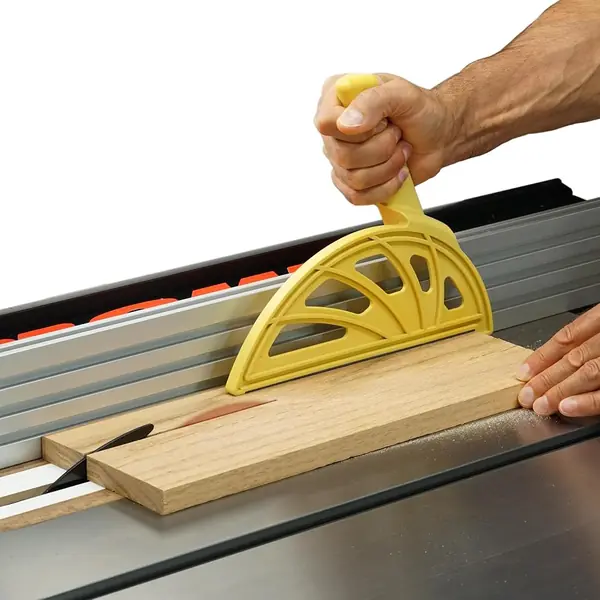
The handle is the story: it sits tall and offset, so your fingers are higher and off to the side of the blade path. We appreciated that on thin rips because we could see the cut line without tilting our hand, and the neoprene strip underneath held clean stock without marring it. The extra height also gives you room to wear a glove without feeling cramped.

The body is molded from glass-fiber-reinforced nylon and feels stiff in the hand, not flexy. The trade-off is less stability on wide panels, and the handle can feel short if you have large hands or a tall auxiliary fence. For narrow cuts, though, the offset is exactly what makes it useful. The narrow footprint lets you keep pressure close to the blade without the block overhanging the off-cut.

It is not the block we choose for every cut, but it is the one we pick when a standard push stick blocks our view. That niche is real: thin rips and detail work are where a tall handle earns its place. We keep it hanging near the saw for those cuts and leave the heavier blocks for wide stock. It is a specialist, not a starter block, and that is fine.

Worth Noting

  • Less stability on wide panels than broader push blocks
  • Handle can feel short for large hands or tall fences
Our Verdict

We keep the Hedgehog around for narrow cuts where its tall offset handle gives us a clearer view and more knuckle room than a low pad.

Check Latest Price
7.

Zebekk Push Block

Black Zebekk push block with adjustable center and rubber base

Budget three-directional control

Shop Score 91/100
Weight
1.8 lb
Base
Non-slip rubber
Assembly
Required
Minimum Cut
1/4 inch
View on Amazon

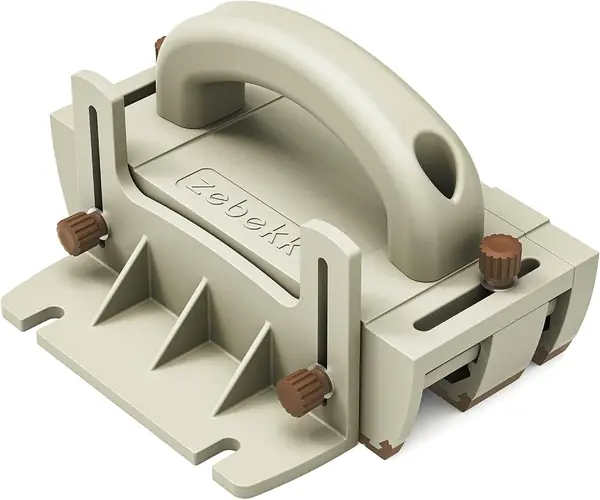
The Zebekk copies the three-directional idea: a main body, a sliding center section, a balance support leg and a rubber base that presses down on the stock. The top adjustment lets you set the block for different cut widths, and the listed capacity goes down to 1/4-inch strips. The handle is plastic but shaped to fill your palm. The included wrench stores easily in a drawer, though it is easy to misplace.

It arrives as a small assembly project, with screws, a handle, a balance leg and a T-handle wrench in the box. We had it together quickly, and the sliding section moved smoothly once adjusted. The rubber base held clean wood well, though it is not the stickiest pad in this group. The assembly instructions are short, and the parts go together in a logical order.

The plastic body has a bit more flex than the Microjig, and the fit and finish is not as refined. That is the trade-off for the lower price. For a DIYer who wants the three-leg control without paying for the name brand, it is a sensible place to start.

We treat it as a budget experiment, not a lifetime tool: if you use it often, the Microjig is the upgrade; if you are testing whether a three-legged block suits your work, the Zebekk tells you for less. That is a fair trade for a second block or a first shop.

Worth Noting

  • Requires assembly out of the box using an easy-to-lose wrench
  • Plastic body flexes more and feels less refined than Microjig
Our Verdict

We think the Zebekk is the budget way to try a three-directional push block, especially if you cut thin strips on a table saw.

Check Latest Price
8.

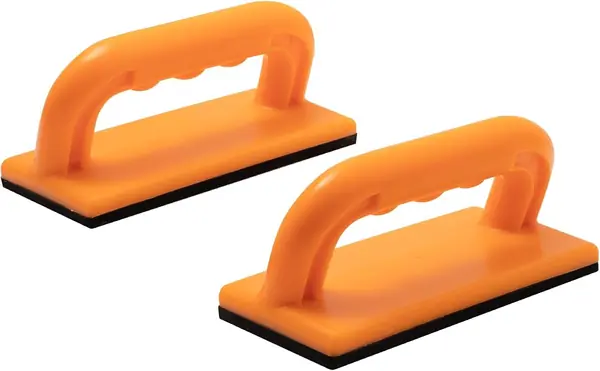
Fulton Safety Push Blocks 2-Pack

Orange Fulton two-pack push blocks with angled handles and rubber soles

Simple two-block setup

Shop Score 90/100
Weight
15.5 oz
Material
Polyethylene plastic
Pack Size
2 push blocks
Sole Size
3 x 6 inches
View on Amazon

Two blocks, broad 3-by-6-inch rubber soles and angled handles: that is the whole pitch. The pair is meant to be used together, one on the keeper and one on the off-cut, and the high-visibility orange makes them easy to find. The handles are offset enough to keep your knuckles clear of the table.

The polyethylene body is thick and stiff, and the pads have enough traction for face jointing or router-table work. We found the angled handles comfortable for downward pressure, and the broad soles stay flat on wide boards. The blocks are light enough to use one in each hand when the cut calls for it. The soles are broad enough that the blocks do not tip easily on a narrow fence.

That simplicity is the point. There are no legs to swap or heels to set, so a beginner can pick one up and use it immediately. The trade-off is that very thin strips still want a push stick or a more specialized block.

We keep a pair near the saw for quick wide cuts and for students who are learning to keep their hands out of the blade path. If you already own a three-legged block, these are a useful second pair; if you want one do-it-all block, spend more on adjustability. The pair is also a sensible gift for a new woodworker.

Worth Noting

  • Lacks adjustable legs for ripping very thin strips
Our Verdict

For a simple block on each side of the blade without paying for adjustable legs, turn to the Fulton two-pack.

Check Latest Price

How We Tested Push Blocks for Table Saws

We started with every push block sold as a standalone tool rather than a giveaway, then filtered by price, the machines each one claims to fit, and whether the maker sells replacement heels or soles. That last check mattered: a grip surface you can't refresh turns into a slick one, and a few blocks were dropped for exactly that. Twelve made it to the bench.

Testing ran six months across weekend shop sessions and the odd late weeknight, the hours when most people actually get to make sawdust. We ripped quarter-inch strips, broke down plywood for shop shelving, and moved each block over to the router table, band saw, and jointer to see whether it stayed comfortable in the hand.

At the table saw we measured how narrow a rip each block could push while its sole still covered the stock, then reset the heel or legs for different stock thicknesses and counted how many turns it took. We let sawdust pile up the way it does mid-project and noted whether the sole kept biting or started to skate, wiping the grip surface clean and reseating it before each new setup.

Handle offset got its own pass — we watched how close knuckles came to the blade path on tall stock and how much a block wanted to tip on wide panels. Each one was weighed, stored on the bench between sessions, and checked for heel wear after the last cut. Cost per useful block, counting included push sticks and spare heels, settled a few close calls. Every block was used with the blade guard and riving knife in place; none of them is a substitute for either.

How to Choose a Push Block for a Table Saw

Start with how it controls the stock

In a rip cut, you need three things at once: downward pressure to keep the stock on the table, inward pressure to hold it against the fence, and forward pressure to feed it past the blade. A single flat pad can do that, but a three-legged block or one with a heel gives you more control without repositioning your hand. We look for a handle that lets you apply all three forces comfortably; if the handle forces your wrist into an awkward angle, you will not use the block for long.

Three-directional blocks such as the GRR-RIPPER are the most intuitive for table saw rips because the legs straddle the blade and keep pressure on both the keeper and the off-cut. A simpler pad is fine for wide stock and edge work, but it asks more of your technique.

Treat grip as a wear item, not a permanent feature

Rubber, foam and neoprene pads all grip best when they are clean. Sawdust glazes the surface, and a pad that felt tacky on the first cut can start to slide after a few passes. We keep a brush or rag nearby and wipe the sole before a finish cut. If the pad is replaceable, buy a spare; if it is bonded to the block, plan on replacing the block when the surface stops biting.

Sticky is not always better. A pad that is too tacky can lift a thin off-cut when you release it, which is its own hazard. The right pad holds the wood without sticking to it, and it does not leave marks on sanded stock.

Match the block to the width of the cut

Narrow rips are where a push block earns its keep. A block rated for 1/4-inch cuts can follow a thin strip past the blade, while a standard pad may be too wide to keep pressure on the off-cut. For repeated 1/8-inch work, look for a block with a small leg or a low profile that fits between the blade and the fence. For wide panels and jointer work, a broader block with heel hooks gives you more surface area and a positive stop at the end of the board.

Do not assume the most adjustable block is the easiest to use. More legs and heels mean more setup, and some blocks feel cluttered in the hand. If you cut the same thickness all day, a dedicated block can be faster.

Decide between one block and a set

A single well-chosen block is usually enough for table saw work. A set makes sense when you also use a router table, jointer or band saw, or when you want a push stick for narrow cuts without switching tools. Sets often include shorter sticks than you might make yourself, so check the handle length against your hand and fence height.

We prefer to spend on a block with a handle and pad we trust, then add a cheap pair or a set later. The safety math is simple: the block you keep within reach is the one that keeps your hands away from the blade.

Frequently Asked Questions

Final Verdict

We keep the MICROJIG GRR-RIPPER GR-100 on the saw because it gives us downward, inward and forward control in one pass, and it handles narrow rips without a separate stick. For most table saw owners, that combination is worth the premium. If your work is mostly 1/8-inch strips, the Milescraft GrabberPRO is the better fit: its four legs reach thinner stock and cost less, though the handle is less refined. Either way, choose the block you will actually keep within reach.