↑↓ navigate ↵ open Esc close All results →

Best Right Angle Drills for Tight Spaces of 2026

Clearance decides whether a right-angle drill earns space in the bag or forces another trip back to the truck. Setting the chuck 90 degrees to the motor lets the tool slip behind face frames, between tight wall studs, and up into soffits where a conventional drill body bottoms out — provided head height and front-to-back depth actually clear the obstruction.

Boring framing holes, driving cabinet fasteners, and holding 11 drills overhead across nine months highlighted a cost quirk easy to overlook: because most sell as bare tools, an existing battery platform dictates total price more than the drill housing itself. Sustained overhead work also turns modest differences in balance and mass into real shoulder fatigue.

Compact 12-volt cabinet drivers sit alongside a heavy two-handed 18-volt joist drill built for large auger bits, giving these seven models coverage from cramped finish carpentry to rough framing.

Our Top Picks

The Best Right Angle Drills for Tight Spaces

1.

Milwaukee M12 2415-20 Right Angle Drill Best Overall
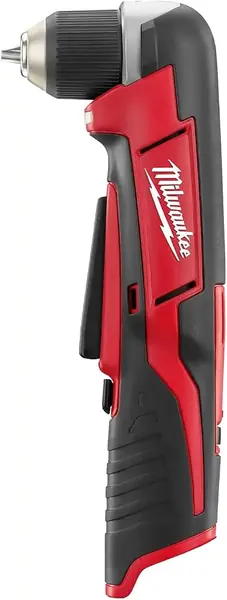
Milwaukee M12 2415-20 cordless right angle drill in black and red, bare tool

Tight cabinet work

Shop Score 93/100
Speed
0-800 rpm
Max Torque
100 in-lb
Tool Weight
2.3 lb
Head Height
3.75 in.
View on Amazon

Pay attention to two numbers: 3.75 inches of head height and 2.3 pounds of tool. That pair is why this drill took the top spot. Squeezed into the corner of a base cabinet or up beside a joist, it points a bit sideways in places where a full-size drill has to turn its whole body, and at just over two pounds it does not wear your arm out during a run of overhead pilot holes. We also like the spindle lock: you can cinch the chuck down one-handed while your other hand holds the workpiece.

The compromise is muscle. At 100 in-lb and a top speed of 800 rpm, this is a screw-driving and pilot-hole tool: it will turn a 1-inch spade bit through pine, but you can hear the motor working for it, and 1-1/4 inches is the listed ceiling in wood. If your tight-space work is mostly 3/4 inch and under, that is a limit you will never feel; if you are boring for pipe, it is the reason to keep reading.

The extended paddle switch is the detail that keeps surprising us. It runs most of the length of the body, so however you end up holding the tool in a blind corner, a finger finds the trigger and you can feather it instead of slamming it on. It ships bare, so budget for M12 packs if you do not have them; if you do, this is a lot of capability for the money.

Worth Noting

  • Low torque by 18-volt standards
Our Verdict

We made this the top pick because a 3.75-inch head and a 2.3-pound body reach into cabinet corners no other drill here does, and it stays comfortable overhead.

Check Latest Price
2.

DeWalt DCD740B 20V MAX Right Angle Drill Best for Fast Drilling

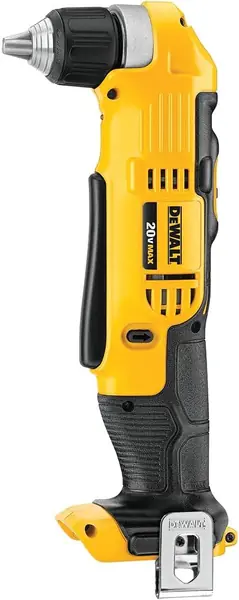
DeWalt 20V MAX DCD740B right angle drill in black and yellow, bare tool

Fast drilling jobs

Shop Score 92/100
Tool Weight
3.3 lb
Front-to-back Length
4.0 in.
Max Speed
2,000 rpm
Speed Settings
2
View on Amazon

Where the Milwaukee trades power for size, this one goes the other way. Two speed ranges, with a top of 2,000 rpm, give the angled chuck real drilling speed, and the difference shows on anything bigger than a pilot hole: the high gear keeps a spade bit cutting instead of chattering. The 3/8-inch ratcheting chuck has a deep hex pocket, so a 2-inch driver bit seats all the way in and the tool gets an inch shorter in the bargain.

For drilling-first work this is the pick. Four inches front to back still fits inside a cabinet, and 3.3 pounds is manageable for the handful of holes most of us bore at an angle, but that extra heft is what 20-volt power costs you, and it is the tool you notice at the end of an afternoon overhead. We reach for it on panels, framing, and runs of 1/2-inch holes; for drawer slides and hinge plates the smaller tools are nicer in the hand.

The multi-grip trigger wraps far enough around the housing that you can squeeze it from the top, the side, or underneath, which matters when the drill is upside down and you are working by feel rather than by sight. It is a bare tool, so it makes sense mainly if the 20V MAX packs are already on your shelf.

Worth Noting

  • Motor can fail under continuous heavy use
Our Verdict

With two speed ranges and a 2,000 rpm top gear, this is the one we reach for when the job is drilling — just respect the motor on long, heavy runs.

Check Latest Price
3.

Bosch PS11-102 12V Max Right Angle Drill Kit Best Articulating Head

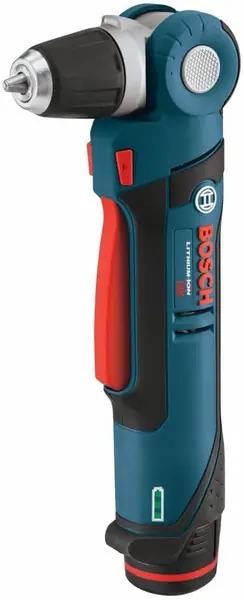
Bosch PS11-102 12V right angle drill in blue with pivoting head and battery

Awkward angles

Shop Score 91/100
Speed
0-1,300 rpm
Max Torque
115 in-lb
Pivoting Head
90 to 180 degrees
Battery Included
2.0 Ah battery and charger
View on Amazon

The head pivots through five positions between 90 and 180 degrees, and that turns one tool into two. Dropped to 90 degrees it is a right angle drill for cabinet corners; stood up to 180 it lines the bit up with the body for straight-on driving. Nothing else here articulates at all, and we used that more than we expected — flipping the head instead of walking back to the bench for a second drill.

The 3/8-inch auto-lock chuck means no key to hunt for in a pouch, and the motor brake stops the spindle the moment you release the trigger. That second part sounds like a spec-sheet nicety until you are driving a row of screws: the bit stops where you left it, so the next one starts from a dead stop instead of spinning.

As a 12-volt tool it sits mid-pack: 115 in-lb and 1,300 rpm will drive 3-inch screws and drill pilot holes, and it will complain if you ask for a 1-inch bore. It is the one drill here that arrives as a kit, with a 2.0 Ah battery and a charger in the box, which is why it sits above the bare tools on price.

Buy it if you are building a first kit and want one drill that covers straight driving and angled work — the battery and charger mean it is a complete tool on day one. If you already own Bosch 12-volt packs, that argument weakens, because you are paying for a battery you do not need.

Worth Noting

  • Short runtime on the included 2.0 Ah pack
Our Verdict

A head that pivots through five positions makes this the most flexible drill here, and it is the only pick that arrives with a battery and charger.

Check Latest Price
4.

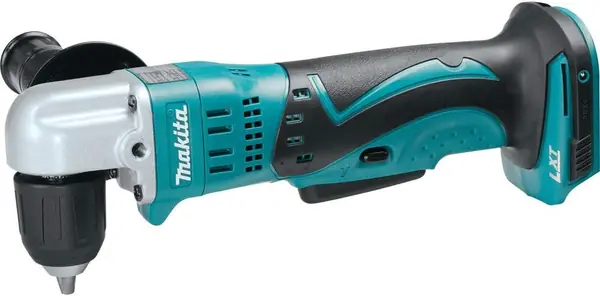
Makita XAD02Z 18V LXT Angle Drill Best for Deep Reach

Makita XAD02Z 18V angle drill in teal with keyless chuck, bare tool

Deep wall cavities

Shop Score 90/100
Speed
0-1,800 rpm
Max Torque
121 in-lb
Tool Length
12-3/8 in.
Angle Head Height
3-1/2 in.
View on Amazon

The first thing you notice is how far this drill gets from your hand. Twelve and three-eighths inches long with a slim 3-1/2-inch angle head, it reaches past a stud, a duct, or a drain line and still leaves your knuckles outside the opening. We used it on holes set well back in a wall cavity, where the compact drills here ran out of tool before they ran out of bit.

The 4-pole motor makes 121 in-lb and turns 0-1,800 rpm in a single range, so you do the gearing with your trigger finger: a light squeeze for a screw, a full pull for a spade bit. The listed capacity is 1 inch in wood and 1/2 inch in metal, which makes a 3/4-inch spade bit through a stud comfortable and pushing past that in hardwood the point where it starts to slow. The 3/8-inch keyless chuck grips hard and swaps bits quickly.

Of the 18-volt angle drills here, this is the one we trust in a deep, blind hole: the length keeps your hands clear of the opening and the torque holds once the bit is buried. It rewards a patient finger rather than a clutch or a second gear, so it is a drilling tool more than a screw-driving one. If your tight work is shallow and frequent, the shorter picks are easier to live with; this one exists for the holes that are genuinely out of reach.

Worth Noting

  • Four pounds with a battery is heavy overhead
Our Verdict

Its 12-3/8-inch length and slim 3-1/2-inch head reach past studs and ductwork that stop the short drills here, and 121 in-lb keeps the bit turning.

Check Latest Price
5.

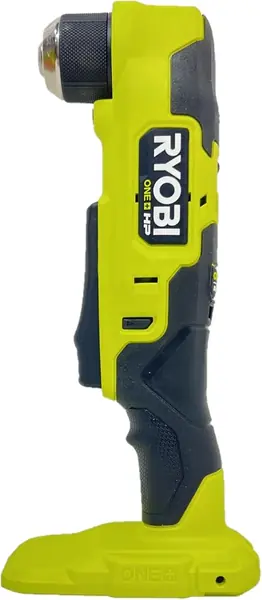
Ryobi ONE+ HP 18V Right Angle Drill Best Value

Ryobi ONE+ HP 18V brushless right angle drill in black, bare tool

Already on ONE+

Shop Score 89/100
Speed
0-450 / 0-1,700 rpm
Max Torque
350 in-lb
Tool Weight
2.9 lb
Front-to-back Length
3.6 in.
View on Amazon

If your bench already has a row of ONE+ batteries on the charger, this is the value pick of the group. The brushless motor makes 350 in-lb, more than any of the 12-volt drills here and more than the Makita, in a body 3.6 inches from chuck to the back of the housing. We expected a homeowner tool and found one that spins a 1-inch spade bit without complaint.

Two ranges, 0-450 and 0-1,700 rpm, cover driving and drilling without much fiddling, and the brushless motor is the reason runtime holds up: it runs cooler and longer than the motors in the cheaper compact tools. At 2.9 pounds it is light enough to hold overhead for a set of cabinet doors, and the speed selector falls under your thumb where you can change it one-handed.

Two things to know before you buy. It is a bare tool, so the price only makes sense if ONE+ packs are already in your shop, though that platform covers more than 260 tools, so the odds are decent. And the warranty stated on the listing is 30 days, which is shorter than the three years DeWalt lists on its drill. For occasional tight-space work in a home shop, neither is a dealbreaker.

Worth Noting

  • Chuck needs a firm twist to seat a bit
Our Verdict

If your shop already runs on ONE+ batteries, this is the value pick: more torque than any 12-volt drill here in a 3.6-inch body.

Check Latest Price
6.

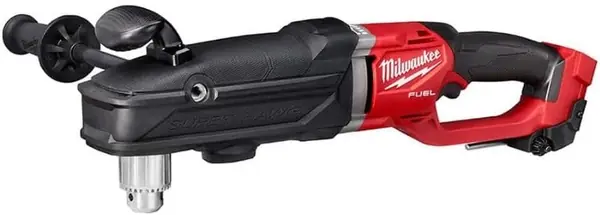
Milwaukee M18 FUEL Super Hawg 2809-20 Best for Big Holes

Milwaukee M18 FUEL Super Hawg right angle drill in red and black with side handle

Big hole boring

Shop Score 88/100
Tool Weight
12.5 lb
Max Speed
1,550 rpm
Speed Settings
2
Chuck Size
1/2 in. keyed
View on Amazon

This is the wrong drill for anything smaller than about an inch. The Super Hawg is a 1/2-inch boring machine built to replace a corded right angle drill, and if your tight-space work is pilot holes and hinge screws, you are paying for capability you will never switch on.

For the work it is built for, nothing else here is close. The brushless motor runs two ranges with a top speed of 1,550 rpm, and Milwaukee rates it at up to 100 2-9/16-inch holes through 6-inch beams per charge on a 6.0 Ah pack. Boring a 2-inch hole through a double top plate, it does not slow or smell hot the way the compact drills do — it cuts and you move to the next one, which is the entire argument for a tool this size.

The all-metal keyed chuck grips a big self-feed or auger bit far more securely than a keyless one, at the cost of a chuck key you have to keep track of. The side handle threads into either side of the housing, and with a 2-9/16-inch bit the reaction torque is not something to fight one-handed.

Worth Noting

  • 12.5 pounds is a lot to hold overhead
  • Wants a 6.0 Ah pack or larger; none included
Our Verdict

A 12.5-pound cordless boring machine that replaces a corded right angle drill for 2-inch-and-up holes — overkill unless that is the work you do.

Check Latest Price
7.

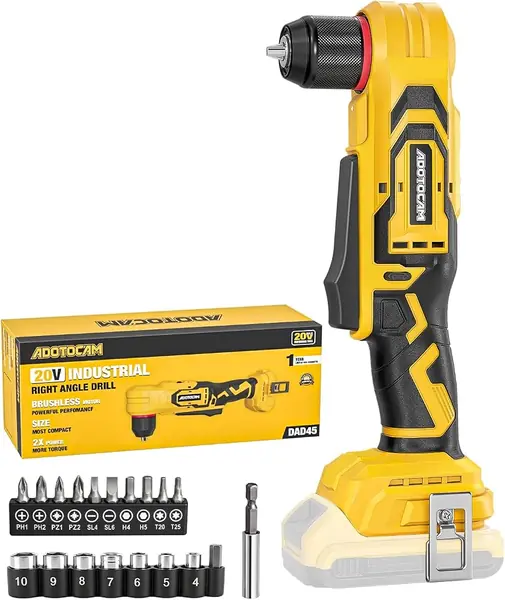
ADOTOCAM Brushless Right Angle Drill Best for DeWalt Battery Users

ADOTOCAM brushless right angle drill in yellow, a bare tool for DeWalt 20V batteries

DeWalt battery users

Shop Score 87/100
Speed
0-500 / 0-1,900 rpm
Max Torque
400 in-lb
Front-to-back Length
3.8 in.
Battery Compatibility
DeWalt 20V MAX
View on Amazon

It costs the least of anything here, and it is not a toy: brushless motor, two speed ranges, a 3/8-inch ratcheting chuck, and an LED. The catch is in the battery it takes — there is not one in the box. This drill is built to run on DeWalt 20V MAX packs, and if you already own a few, that is the whole pitch.

The numbers look strong on paper: 400 in-lb claimed, 1,900 rpm in high range, and 3.8 inches front to back. In the ordinary tight spots — under a sink, inside a cabinet carcass — it drilled and drove without complaint and stayed light enough to hold one-handed. What it does not have is history: this is a young brand without the years of use, the parts network, or the service behind the Milwaukee, DeWalt, and Makita tools here.

Our take: as a second drill for occasional tight work, or a first angle drill for a DeWalt household on a tight budget, it makes sense. As the only right angle drill in a working shop, the unknowns are the gamble, and the Milwaukee bare tool is the obvious step up if you want a known quantity in the same small body.

Worth Noting

  • Short track record and no service history
Our Verdict

The least expensive way to try a right angle drill if you already own DeWalt 20V packs, though the short track record is the risk you take.

Check Latest Price

How We Tested Right Angle Drills

We started by pulling in every right angle drill we could get our hands on, then narrowed with the numbers that decide whether a tool is usable at all: head height, front-to-back length, chuck size and type, and whether it ships as a bare tool or a kit. That left 11 units, from 12-volt compacts to an 18-volt drill built to swing hole saws.

Testing ran for nine months, mostly on a cabinet install, a deck frame, and a garage ceiling we re-ran with new electrical. We measured each head with calipers and slid every tool into the narrow gap behind a face frame to see which ones actually cleared. We weighed each one with its battery installed and noted where that weight sat, because a long body with a pack hanging off the back is a different tool at the end of your arm overhead. With the workpiece clamped down and the side handle installed, we bored 2-1/2-inch holes through framing and drove 3-inch screws until each drill stalled, timing how long the trigger took to build to full speed.

Chucks got their own round: we swapped bits with work gloves on, checked whether a hex bit seated deep enough to stop wobbling, and noted which chucks needed a key. For durability, we ran back-to-back boring sessions and felt the gear head for heat between passes, listening for whine and checking for runout. We also logged runtime per charge and priced the bare tool against the kit version, since the battery is often the bigger purchase.

How to Choose a Right Angle Drill

Find the dimension that is in your way

Compact means different things in different listings, and that is the first trap. Milwaukee quotes head height at 3.75 inches, DeWalt and Ryobi quote front-to-back length at 4.0 and 3.6 inches, and Makita's angle drill is short at the head but 12-3/8 inches long. Those figures are not interchangeable, and a drill that wins on one can lose badly on another.

Inside a cabinet the limit is usually how far the chuck sits from the housing and how tall the head is. In a stud bay the limit is often reach, which is why the long-body tools exist at all. Put a tape on the obstruction before you order and match it to the right number, not to the word compact.

Decide whether you are drilling or driving

Torque in inch-pounds tells you what a drill can bore; top speed tells you how quickly it will do it. The 12-volt picks here run 100 to 115 in-lb, which is plenty for screws and pilot holes and not much fun in a 1-inch hole. The Ryobi's 350 in-lb and the DeWalt's 2,000 rpm second gear sit at the other end of the compact class.

If you drive more than you drill, a low gear and a trigger you can feather matter more than the torque number. If you drill, shop speed and a second range, and accept that a compact body means a smaller motor.

Price the battery, not just the tool

Only one drill here arrives with a battery and charger. The rest are bare tools, and that changes the math entirely: a bare tool on a platform you already own is the cheapest way into this category, and the same tool is expensive if you have to add two packs and a charger. Never compare a bare-tool price with a kit price and call it a bargain.

Platform breadth is the quieter half of the decision. Milwaukee's M12 and Ryobi's ONE+ cover a wide spread of other tools, so a bare drill there keeps earning its keep. A single-tool platform does not.

Weigh it for the position you work in

A right angle drill puts the motor behind the bit, so the mass hangs where you cannot see it. Overhead is where that shows: 2.3 pounds is a different afternoon from 4 pounds, and 12.5 pounds is a two-handed job with the side handle threaded on. On a bench, weight is close to irrelevant.

The other half of the same question is the trigger. A paddle or multi-grip design lets you find the switch with the tool upside down and your head outside the cabinet; a small trigger leaves you hunting for it while the bit sits against the work.

Look at how the chuck holds a bit

Everything here is 3/8 inch except the Super Hawg, which is a 1/2-inch keyed chuck for big auger and self-feed bits. What separates the rest is grip and convenience: a deep hex pocket lets a 2-inch driver bit seat fully and shortens the tool, a spindle lock lets you tighten the chuck one-handed, and an auto-lock chuck skips the key entirely.

Before you buy a bit set, check the shank against the chuck. A 3/8-inch chuck stops at 3/8-inch shanks, so anything bigger needs the 1/2-inch class or a reduced-shank bit.

Frequently Asked Questions

Final Verdict

For most people, the Milwaukee 2415-20 is the right angle drill to buy. It has the smallest head and the lightest body here, backed by the longest record of use, and it does the two jobs that made you search in the first place: pilot holes and screws in places nothing else reaches.

If your work is drilling rather than reaching — cabinet panels, framing, repeated 1/2-inch holes — the DeWalt's 2,000 rpm second gear is worth the extra weight. And if you bore 2-inch holes for a living, skip both and go straight to the Super Hawg; it is the only one here built for that.