↑↓ navigate ↵ open Esc close All results →

Best Rotary Tools for Wood Carving of 2026

Two rotary tools with identical peak rpm ratings can behave like completely different machines on a block of basswood: one carves a smooth spoon bowl, while the other stalls, skates, and scorches the blank. Dependable carving tools hold torque when a burr digs in, slow down gently enough to sand curves without burning streaks into the wood, and spin bits true without collet chatter.

Clamping blanks in a vise, we carved with 12 corded and cordless rotary tools over eight months to separate usable speed control from inflated spec sheets. Lower minimum speeds proved far more valuable than top-end rpm on curved handles, and a tight assortment of genuine burrs and sanding drums beat oversized kits padded with disposable wheels.

Adding a flex shaft also helps reach deep inside bowls and hollows without maneuvering the whole motor housing, giving woodworkers options scaled to both intricate relief work and heavier stock removal.

Our Top Picks

The Best Rotary Tools for Wood Carving

1.

Dremel 4300-5/40 Rotary Tool Kit Best Overall
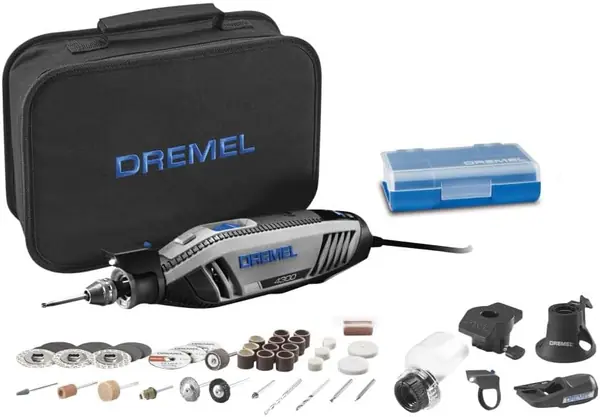
Dremel 4300 corded rotary tool kit in gray with attachments, accessories, and storage case

All-around wood carving

Shop Score 95/100
Included
5 attachments, 40 accessories
Speed Range
5,000–35,000 RPM
Weight
1.2 lb
Chuck
Universal 3-jaw, tool-free
View on Amazon

Electronic feedback is the spec that decides how a rotary tool feels in wood, and both of our corded Dremels advertise it. The 4300 keeps the spindle at the speed you dialed when a burr loads up in a knot, instead of sagging and leaving a polished burn where a cut should be. Its 5,000 to 35,000 RPM range covers a slow sanding pass and a full-speed carbide burr with room to spare.

We reach for the 4300 first because it removes the two things that slow carving down: bit changes and not being able to see the cut. The three-jaw chuck takes every Dremel shank size without a collet or a wrench, so going from a burr to a sanding drum mid-detail takes seconds. The pivot light rotates to throw light into a hollow instead of behind the tool.

At 1.2 pounds it's light for a corded tool, which matters when you're holding a burr against a curve for twenty minutes; the 360-degree grip lets you turn the tool in your hand instead of repositioning your wrist. Five attachments and 40 accessories cover carving, sanding, and sharpening, and everything else in the Dremel accessory line fits. It costs more than anything else in this group, and a carver who only hogs out material can spend less and get what they need.

Worth Noting

  • Corded, so the cord trails across the bench
Our Verdict

Our default for wood carving: it holds speed under a burr, changes bits without a wrench, and stays light enough to steer through detail.

Check Latest Price
2.

Dremel 4000-2/32 Rotary Tool Kit Best for Heavy Stock Removal

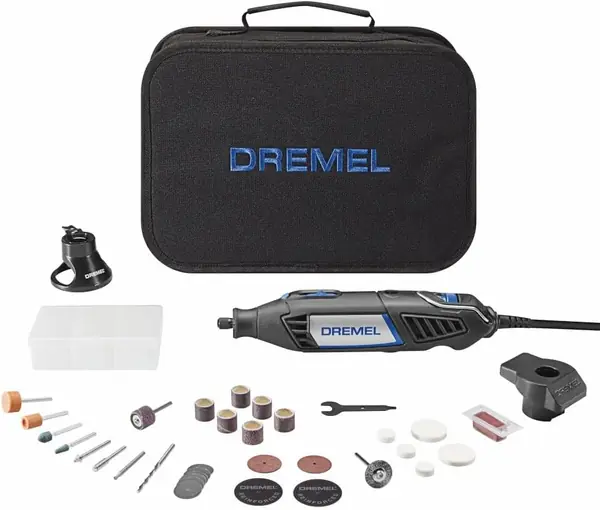
Dremel 4000 corded rotary tool kit in black with two attachments and 32 accessories

Heavy stock removal

Shop Score 92/100
Included
2 attachments, 32 accessories
Speed Range
5,000–35,000 RPM
Weight
3 lb
Motor
1.6 amp
View on Amazon

Same 5,000 to 35,000 RPM as our top pick, a stated 1.6 amps, and less money: on paper the 4000 is the sensible corded Dremel. That extra motor is what you feel when a burr is buried in oak and you want to keep moving instead of letting the tool catch its breath.

The trade-off is mass. At 3 pounds it's more than twice the weight of the 4300, and a long stretch of detail work leaves your wrist complaining. In a deep cut the heft works for you, though, because the tool sits in the wood and stays where you put it instead of skating. The housing is made with more than half recycled plastic, a detail we like even though it isn't why we recommend the tool.

We point people here when a carving starts with roughing out: shaping a bowl blank, clearing waste around a figure, taking down a bandsawn profile. For that work the amps and the weight are the whole point. If your carving is mostly refinement, the 4300's lighter body is worth the difference.

Worth Noting

  • Bit changes need a collet and wrench
  • Only 32 accessories in the box
Our Verdict

For shaping and stock removal we pick the 4000: 1.6 amps, the full speed range, and a steadying weight that suits big cuts more than fine ones.

Check Latest Price
3.

PHALANX P03 Rotary Tool Kit Best Big Kit

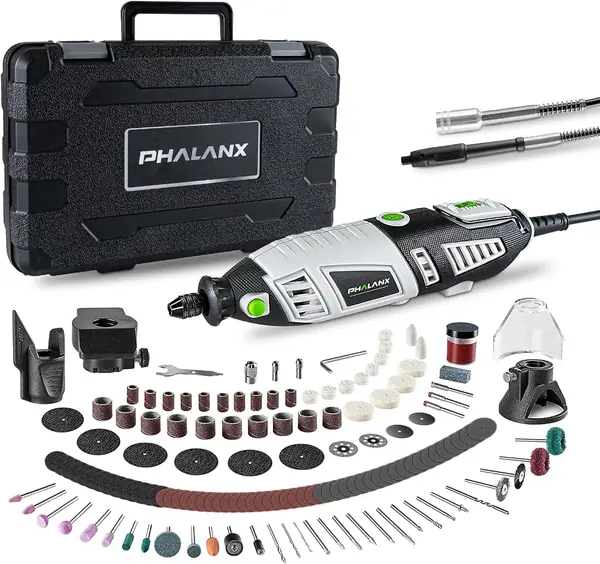
PHALANX corded rotary tool kit with flex shaft, keyless chuck, and 213-piece accessory case

One-box starter kit

Shop Score 91/100
Included
213 accessories, flex shaft
Speed Range
8,000–32,000 RPM
Chuck
Keyless chuck with collets
Speeds
6
View on Amazon

Two hundred thirteen pieces fill the PHALANX case: 20 sanding drums, 80 sanding discs, diamond burrs, HSS cutters, a flex shaft, a drill locator, a shield, and a spare set of carbon brushes. If you're starting with nothing but a block of wood, that inventory is the argument.

The keyless chuck is the part we appreciate most. It swallows anything from 1/8 inch down, so the mixed bag of bits in the case all fit without hunting for the right collet, and swapping one takes a twist rather than a wrench. The flex shaft turns the tool into a pen for working inside a bowl or along a curve, and six speeds from 8,000 to 32,000 RPM give you the high end a burr wants plus a low end slow enough for a sanding drum in pine.

What we can't promise is long service. This is a big accessory count at a modest price, and it's the tool in this group we expect to replace first; the accessories themselves are uneven, with the sanding consumables being the most disposable part. For a beginner who wants to be carving this week, we think that's the right trade.

Worth Noting

  • Flex shaft runs hot in long sessions
Our Verdict

We steer beginners to this one: a keyless chuck, a flex shaft, and 213 pieces that cover carving and sanding.

Check Latest Price
4.

NEU MASTER NRT4335 Rotary Tool Kit Best Value Corded Kit

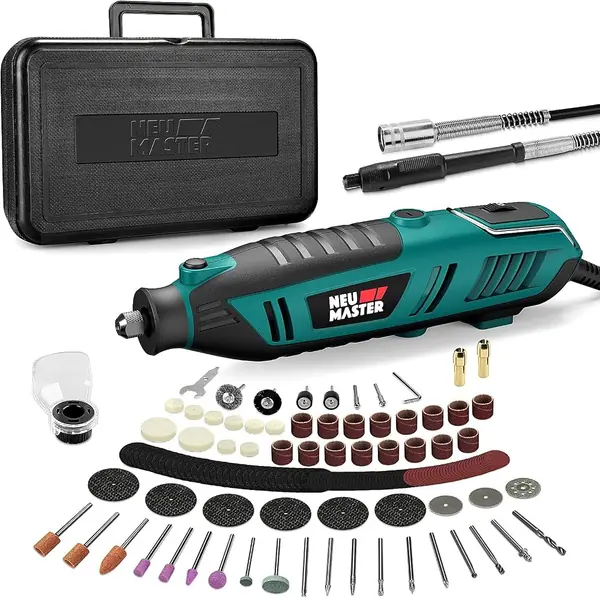
NEU MASTER corded rotary tool kit with flex shaft, clear shield, and 160 accessories

Budget corded shaping

Shop Score 90/100
Included
160 accessories, flex shaft
Speed Range
10,000–35,000 RPM
Power
200 watts
Warranty
2 years
View on Amazon

Ten thousand RPM is the slowest this tool will turn, and that one number explains both what we like and what we don't. A carbide burr wants that speed in wood, so shaping feels like a bargain. A sanding drum wants half of it, and a softwood edge can scorch while you're still hunting for a setting that works.

Above that floor you get 200 watts, six settings up to 35,000 RPM, and a soft rubber body that keeps your hand from going numb during a long session. The 160-piece kit includes a flex shaft, a clear shield, two collets, a collet nut, and a pair of wrenches, and the two-year warranty matches what Dremel gives you.

We like it for the carver whose work is mostly shaping: taking down a blank, clearing waste, texturing a surface. It's the most speed for the least money in this group, and the grip is better than the price suggests. The shield earns its place the first time a burr starts throwing chips.

Worth Noting

  • Bit changes take two wrenches
Our Verdict

If your work is shaping rather than finish sanding, we point you here for the most speed at the lowest price.

Check Latest Price
5.

Fanttik F2 PRO Cordless Rotary Tool Kit Best Cordless

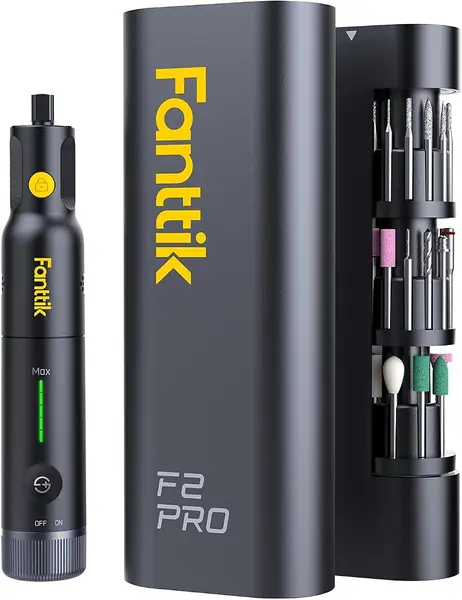
Fanttik F2 PRO gray cordless rotary tool with magnetic accessory hub and aluminum case

Cordless detail work

Shop Score 89/100
Included
55 accessories
Speed Range
5,000–25,000 RPM
Weight
7.76 oz
Battery
4-volt, USB-C charged
View on Amazon

Some carvings don't come to the bench: a burl you picked up on a walk, a chair leg that's still attached to the chair, a piece of driftwood on the porch. That's where a cordless rotary tool stops being a compromise and becomes the only tool that will do the job.

The F2 PRO starts at 5,000 RPM, which is unusual in a body this small and is why we take it seriously for carving rather than just cleanup. Five settings run to 25,000 RPM, and the magnetic hub holding the 55 accessories spins open so you're not digging through a bag for a burr.

USB-C charging and a rear indicator that turns red below 30 percent take the guesswork out of a session, and at 7.76 ounces it's light enough to work one-handed for detail. Twenty-five thousand RPM shapes softwood and runs a burr in a shallow cut; it is not a stock-removal tool and we don't ask it to be.

In a two-tool shop we treat it as the detail and mid-size machine: it reaches the shaping a corded tool can't and sands the parts a corded tool is too clumsy for. If it's your only rotary tool, keep your cuts light and your bits sharp; if you already own a corded Dremel, this is the one that leaves the bench.

Worth Noting

  • Motor bogs in heavy hardwood cuts
Our Verdict

We take this one when the work isn't near an outlet: enough low-speed control for detail, not enough muscle for heavy removal.

Check Latest Price
6.

Fanttik F2 Master Mini Rotary Tool Best for Fine Detail Finishing

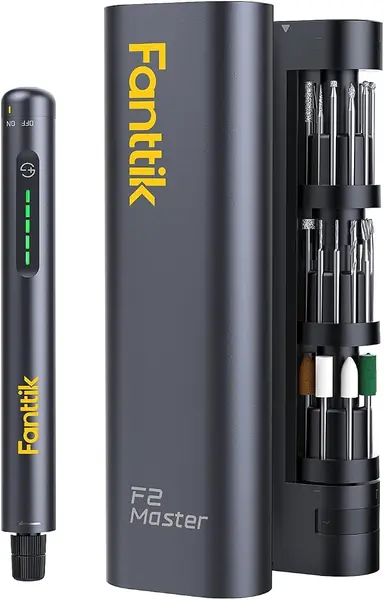
Fanttik F2 Master gray pen-sized cordless rotary tool with magnetic accessory stand and case

Fine detail finishing

Shop Score 88/100
Included
35 accessories
Speed Range
12,000–25,000 RPM
Weight
0.22 lb
Collet
3/32 inch (2.3 mm)
View on Amazon

A pen is the right shape for the last inch of a carving: the inside of an eye socket, the gap between two feathers, a signature on the bottom of a bowl. The F2 Master is built for exactly that, with 0.22 pounds in a body the diameter of a marker and a 360-degree magnetic stand that holds 35 small accessories.

What we appreciate is how little it asks of you. The stand opens with a click, the five-speed button sits under your thumb, and the brushless motor is quiet enough to run at a kitchen table without anyone noticing. The aluminum case shrugs off a toolbox. It won't replace a corded tool for shaping, so we keep it for finishing passes and for signing.

Worth Noting

  • Collet takes 3/32-inch shanks only
  • 12,000 RPM minimum is fast for sanding
Our Verdict

We save this one for the last 5 percent of a carving, where a pen body and a quiet motor beat raw power.

Check Latest Price
7.

HARDELL Mini Cordless Rotary Tool Best for Light Cleanup Work

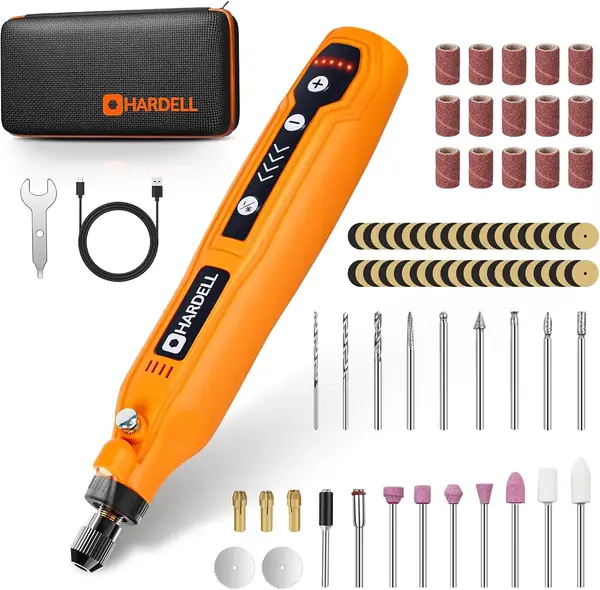
HARDELL orange mini cordless rotary tool with 69 accessories and USB-C charging cable

Light cleanup work

Shop Score 87/100
Included
69 accessories
Speed Range
5,000–18,000 RPM
Weight
4.94 oz
Speeds
5
View on Amazon

Light enough to hold like a marker and slow enough to be forgiving in softwood, the HARDELL is the tool we hand someone who wants to clean up edges and sand small carved pieces without spending much. At 4.94 ounces it disappears in your hand, and the five speeds step from 5,000 to 18,000 RPM.

The kit is more complete than the tool suggests: 69 pieces, three collets covering 1.0 to 2.3 mm shanks, a USB-C port, and a front LED that lights the cut rather than your shadow. We also like that it charges from the same cable as everything else on the bench.

For cleanup, small sanding jobs, and detail in softwood, that lightness is exactly right. It's the right kind of inexpensive tool: small, light, easy to keep charged, and the one we leave sitting out with a drum on it instead of putting it away.

Worth Noting

  • Battery can die with little warning
  • 18,000 RPM ceiling slows stock removal
Our Verdict

We keep it for cleanup and small detail, light in the hand and inexpensive enough to leave loaded with a sanding drum.

Check Latest Price

How We Tested Rotary Tools for Wood Carving

We built the shortlist from spec sheets, manufacturer documentation, and owner reviews, filtering first for the things that actually decide a carving tool: whether the motor is rated for continuous load, how low the speed dial goes, chuck or collet type, weight, and what ships in the kit. Corded and cordless models were both in scope. That left 12 rotary tools, which we ran for eight months.

Testing happened on a garage bench, not a lab. Every blank went into a vise — basswood, walnut, maple offcuts — and we carved spoon blanks, hogged out relief panels, drilled pilot holes, and sanded curves between coats. To judge power under load, we buried a coarse burr in walnut and leaned into the cut, noting whether the tool held speed, recovered, or stalled and burnished the wood. For speed control, we turned each tool to its slowest setting and tried to feather a soft edge without scorching it.

Bit changes were timed, and we watched the tip of each burr at speed to see whether the chuck held it true or let it wobble. We weighed every tool, then carved in 45-minute stretches to see where grip fatigue set in and how well the tool steered along a pencil line. Each kit got sorted — burrs and drums that cut versus filler — and cordless models were run flat mid-project to time runtime and USB-C recharges.

Durability was judged across repeat sessions: switches, chucks, and flex-shaft couplings that loosened, and burrs that dulled after a few panels. Eye protection and a dust mask stayed on at the bench, batteries came out and cords were unplugged before any bit change, and the workpiece was clamped every time. What we ended up with is a sense of which tools still cut cleanly on the tenth session, not just the first.

How to Choose a Rotary Tool for Wood Carving

Power Under Load Comes Before Peak RPM

Every tool here spins fast enough to cut wood. What separates them is what happens when the burr loads up. A motor that sags leaves you pressing harder, which scorches the surface and overheats the bit.

Corded tools with electronic feedback, like both Dremels, hold their setting through a knot. The small cordless models trade that authority for freedom from the cord. If your carving involves real material removal, buy amperage and speed feedback first and count the accessories second.

Match the Speed Range to the Job

Carving burrs want high speed, 20,000 RPM and up, with light pressure. Sanding drums and polishing points want the low end, where 5,000 to 8,000 RPM keeps heat out of the wood. Check the bottom of the range, not just the top: the NEU MASTER starts at 10,000 RPM and the Fanttik F2 Master at 12,000, which is fine for shaping and awkward for finishing.

If you plan to sand as much as you carve, a 5,000 RPM floor is worth paying for.

Chucks, Collets, and Bit Changes

A rotary multi-tool only cuts as well as the bit it's holding. Three-jaw chucks take any shank size and change without a wrench, which is why the Dremel 4300 and the PHALANX are pleasant in the middle of a detailed cut. Collet systems cost less and grip very small bits securely, but every change is a two-wrench job.

Check the shanks of the bits you already own. A fixed 3/32-inch collet, like the one on the F2 Master, rules out standard 1/8-inch burrs entirely.

Corded or Cordless

Corded tools run all day at full power; cordless ones go to the log, the porch, and the chair leg that's still attached to the chair. Nothing about a 4-volt battery matches a corded tool in hardwood, so treat cordless as a complement unless your carving is small.

If you do go cordless, USB-C charging and a visible battery indicator matter more than another fifty accessories.

What's Worth Having in the Kit

Big counts sell tools, and plenty of those pieces are cutoff wheels and polishing felt you'll never touch in wood. Look for burrs, sanding drums in several grits, a mandrel, and a flex shaft, which turns a full-size tool into a pen for reaching inside a hollow. Extra carbon brushes are a good sign the maker expects the tool to stay on your bench.

Frequently Asked Questions

Final Verdict

For most people carving wood with a rotary tool, the Dremel 4300 is the one to buy. It holds speed under a burr, grips any shank without a wrench, and weighs little enough that you can steer it through a long detail session, which are the three things that separate a pleasant carving tool from a frustrating one.

If your work starts with removing a lot of material and you want to spend less, the Dremel 4000 trades the chuck and some refinement for amps and a heavier, steadier body. And if the wood can't come to your bench, the Fanttik F2 PRO is the cordless tool we take.