↑↓ navigate ↵ open Esc close All results →

Best Cordless Rotary Tools of 2026

Fixating on maximum RPM is the classic mistake when buying a cordless rotary tool, since plastic, resin, and fine wood scorch well below top speed. Without a cord tugging your hand off line, a good battery rotary tool handles quick touch-ups immediately—provided the motor holds torque in hardwood and does not quit mid-pass.

Across six months of cutting, grinding, cleaning 3D prints, engraving resin, polishing aluminum, and carving fine details with 12 cordless models, holding speed under load separated capable tools from noisy stallers. Genuine low-end control proved critical whenever bits touched heat-sensitive materials.

Collet compatibility also narrows bit selection, with 1/8-inch and 3/32-inch chucks and quick-change collars varying widely in convenience across these six models selected for real bench performance.

Our Top Picks

The Best Cordless Rotary Tools

1.

Dremel 8250 Cordless Rotary Tool Best Overall
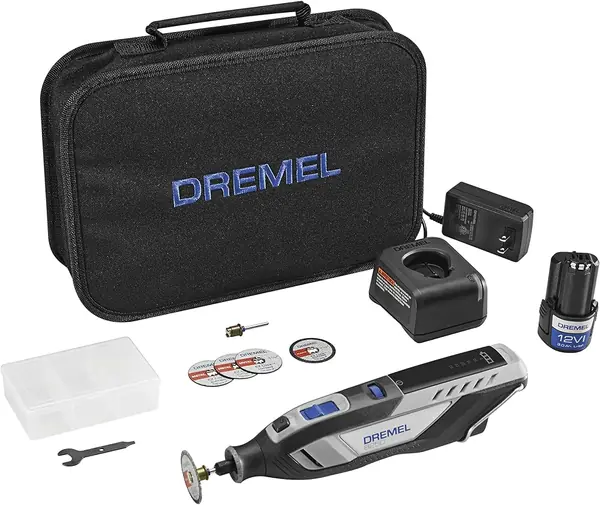
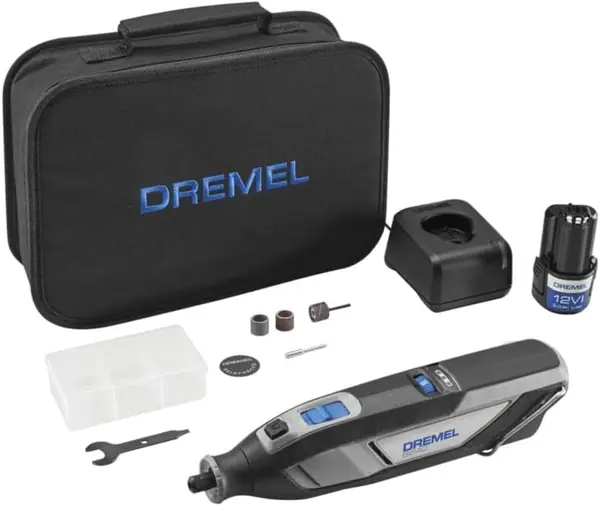
Dremel 8250 black cordless rotary tool with 12V battery, charger, and tool bag

Cutting and grinding

Shop Score 93/100
Speed Range
5,000 to 30,000 RPM
Weight
13.8 oz
Battery
12V 3.0Ah lithium-ion, charger included
Motor
Brushless
View on Amazon

The cut that settled it ran through a scrap of white oak, slow and steady, the way you cut a slot when you care about the edges. The 4V tools in this guide stall and squeal at that; the 8250 held its speed and kept the burr biting. Dremel claims 20% more power than its own corded 4300, and once you lean into a cut that stops sounding like marketing. Carving, grinding a weld bead, cutting a slot for an inlay — the work that makes a rotary tool worth owning in a woodshop needs torque, and this is the tool here with the most of it.

Runtime is the other half of the argument. The 3.0Ah pack is the biggest on any tool here, Dremel rates it at twice the battery life of the older 8220, and we charged it far less often than the pen-style tools. The digital display shows the speed setting and roughly where the charge stands, which we leaned on more than expected — knowing you have a third of a pack left changes when you break for lunch. It also accepts the whole Dremel accessory and attachment line, which is the quiet advantage of staying in this ecosystem.

Heft is the price. At 13.8 ounces before the pack goes on, the 8250 is a two-hand tool for anything precise, and a long engraving session will let you know about it. If your work is mostly fine detail on small parts, the HOTO or the Fanttik will suit you better. The charger is also Dremel-specific — it charges Dremel 12V packs and nothing else — so a second battery is a purchase, not a swap. For bench work where the tool sits down between passes, neither point bites.

What goes wrong, when something does, is the electronics: a tool that stops responding inside its first year. Dremel backs this one with a limited lifetime warranty, so register it the day it lands and keep the receipt in the bag.

Worth Noting

  • 13.8-ounce body tires during long hand-held engraving
  • Charger only works with Dremel 12V packs
Our Verdict

We think the 8250 is the cordless rotary tool to beat: brushless power that keeps up with a corded model and a 3.0Ah pack that lasts. Buy it if you cut and grind, not just polish.

Check Latest Price
2.

Dremel 8240 Cordless Rotary Tool Kit Best Value

Dremel 8240 cordless rotary tool with 12V battery, charger, five accessories, and carry bag

All-around shop use

Shop Score 92/100
Speed Range
5,000 to 35,000 RPM
Weight
1.5 lb
Battery
12V 2.0Ah lithium-ion, charger included
Kit Contents
5 accessories and carry bag
View on Amazon

Step down from the 8250 and you give up two things: the brushless motor and the digital readout. You keep nearly everything else — the same 12V battery platform, the EZ Twist nose cap, full Dremel accessory compatibility, and a top speed of 35,000 RPM that is 5,000 higher than the flagship's.

That trade is why we point most woodworkers here. Breaking an edge, cutting a dowel flush, grinding a chisel bevel after a sharpening session: the 8240 handles all of it without the premium price, and Dremel lists two hours of average battery life — realistic for a morning of intermittent work, less so for continuous cutting.

The 360-degree grip zone is the detail we appreciate most. The body is about two inches across and your hand can sit anywhere along it, which keeps the tool steady when you're following a curve instead of fighting a fixed palm swell. The 2.0Ah pack and the charger are part of Dremel's 12V system, the same one the flagship uses, so a battery bought for another Dremel 12V tool will run this one, and the two-year warranty covers the tool itself.

Worth Noting

  • Chunkier body than the pen-style tools
  • Packs sometimes arrive unable to charge
Our Verdict

The cordless Dremel we recommend to most woodworkers: the same 12V platform and accessory line as the flagship, a higher top speed, and far less money to spend.

Check Latest Price
3.

Milwaukee M12 2460-20 Rotary Tool Best for M12 Owners

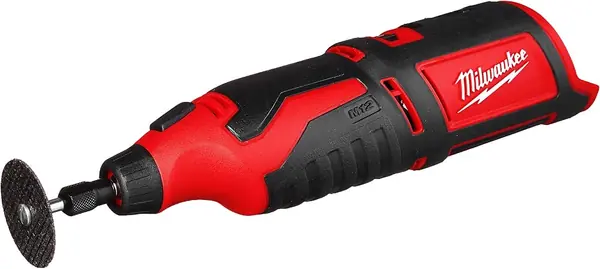
Milwaukee M12 cordless rotary tool in red and black with wrench and cutting wheels

M12 battery owners

Shop Score 91/100
Speed Range
5,000 to 32,000 RPM
Weight
1.3 lb
Collet
1/8 in.
Length
9-1/2 in.
View on Amazon

There is no battery and no charger in the box. That is the deal Milwaukee offers with the 2460-20: it is a bare tool, built and priced for someone who already has M12 packs on the bench. Buy it as a first rotary tool and you are also buying Milwaukee batteries and a charger, which changes the arithmetic considerably. Check the battery situation on the listing before you order.

What you get is serious hardware. The 12V motor turns 5,000 to 32,000 RPM, with a slide switch for power and a separate dial for speed, so you can set a ceiling and still kill the tool with your thumb. There is an LED at the nose, a 1/8-inch collet that takes standard rotary accessories without an adapter, and a 9-1/2-inch body that carries the battery behind your palm.

Balance is what we keep coming back to. The bit end stays light in a way the front-heavy pens do not, the switch is easy to find by feel with the tool running, and the sound is a low, even whine rather than a dentist's drill. Add a five-year warranty and the fact that it eats the same M12 packs as your drill and impact driver, and this is the cordless rotary tool that earns a permanent place in a working bag.

Worth Noting

  • Battery and charger sold separately
  • Not built for heavy cutoff work
Our Verdict

We recommend this bare tool to anyone already on Milwaukee's M12 platform: real power, a five-year warranty, and batteries you already own.

Check Latest Price
4.

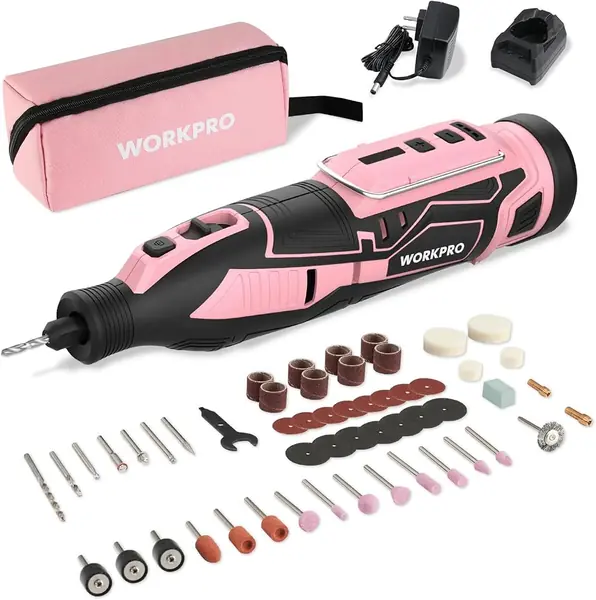
WORKPRO Pink 12V Rotary Tool Kit Best Full Kit

WORKPRO pink 12V cordless rotary tool with 114 accessories in a fitted case

Complete starter kit

Shop Score 90/100
Speed Range
7,500 to 32,000 RPM
Weight
1.4 lb
Battery
12V 2.0Ah lithium-ion
Accessories
114 pieces
View on Amazon

What struck us first is the size. Ten inches long and 1.4 pounds, this is a full-size tool with a taper toward the collet rather than a pen, and it changes how you hold it — two hands on the body for a cutoff, one hand steadying the workpiece. It is also the least expensive route into a 12V cordless rotary tool in this group, and for a first rotary tool that arrives with everything you need, that is a combination worth taking seriously.

The kit is the reason to pick it over a bare tool: 114 pieces, including a universal chuck, two collets, 36 cutoff wheels, 40 sanding papers, and a set of grinding stones, all in a case with trays that keep the small parts where you put them. It is sold in gray as well as pink, which matters if this is going to live on a shelf next to your other tools.

Two things to plan for. The cutoff wheels and sanding bands are the thin end of the kit and hardwood eats them, so order replacements when you order the tool rather than after the first wheel shatters. And the 2.0Ah pack is smaller than the flagship's, so treat a second battery as part of the purchase if you plan long sessions. Everything in the case uses the standard accessory pattern, so Dremel-pattern bits drop straight in.

Worth Noting

  • Speed changes are push-button steps
  • Pack can fail to hold a charge
Our Verdict

The fullest kit here: 114 accessories, 32,000 RPM, and 12V power, which is why we point budget-minded woodworkers to it first.

Check Latest Price
5.

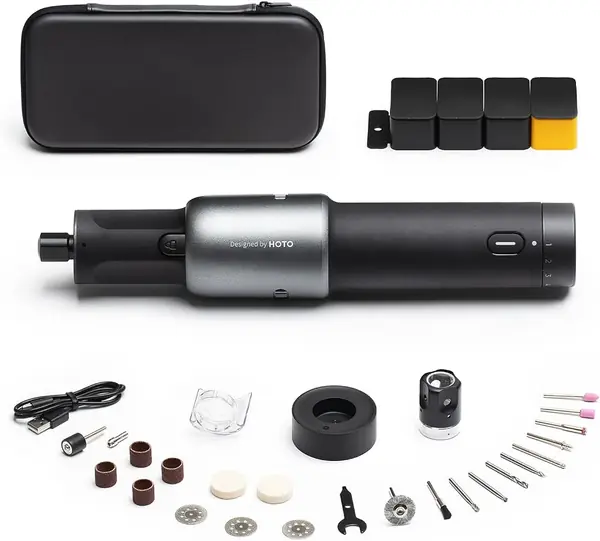
HOTO Cordless Rotary Tool Kit Best Budget Pick

HOTO dark gray cordless rotary tool with 35 accessories, dust shield, and storage bag

Light crafting jobs

Shop Score 89/100
Speed Range
5,000 to 25,000 RPM
Battery
4V lithium-ion, USB-C charging
Accessories
35 pieces
Collet
2.3 mm (3/32 in.)
View on Amazon

It won a Red Dot award, and the design earns it: a slim dark gray cylinder with a seamless speed button, no visible fasteners, and a dust shield that snaps over the bit to keep debris off your hands and the workpiece. The USB-C charging base is the sort of thing you leave out on the bench instead of hunting for a cable every time.

Size is what sold us. It is a 1.19-inch cylinder that sits in the hand like a marker, and the 5,000 RPM bottom of its range is slow enough to work plastic and resin without melting them — exactly where the bigger 12V tools make you nervous. Cleaning up a 3D print, engraving a jig, polishing a small turning: we reached for this one first.

Where it runs out is harder material. Lean on a burr in oak and you can hear the motor lose RPM; HOTO's own recommended uses lean toward 3D prints, models, and light engraving, and that matches what we found. For stock removal, one of the 12V picks is the better buy.

Worth Noting

  • Ships with a 2.3 mm collet only
  • Built-in battery means no mid-project swap
Our Verdict

The one we hand someone who works on small parts: light, quiet, and inexpensive, though it is closer to an engraving pen than to a full-size rotary tool.

Check Latest Price
6.

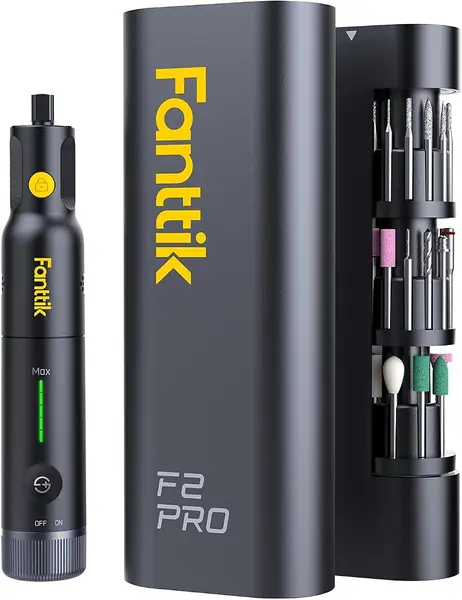
Fanttik F2 PRO Cordless Rotary Tool Kit Best for Detail Work

Fanttik F2 PRO gray rotary tool with 55 accessories in a magnetic aluminum case

Detail carving

Shop Score 88/100
Speed Range
5,000 to 25,000 RPM
Weight
7.76 oz
Battery
4V, USB-C rechargeable
Accessories
55 pieces
View on Amazon

Open the aluminum case and the accessory holder rotates up out of it, 55 bits and wheels standing on a magnetic drum you spin to the one you want. We file that under gimmick until about the third bit change, when it stops being one.

The tool is a slim 7.76-ounce body with a pressure-sensitive button along the top instead of a switch, an LED at the nose, and a rear light that turns red below 30% charge. Five speeds run from 5,000 to 25,000 RPM, and the low end is what makes it useful — plastic, resin, and softwood do not grab and skate the way they do at higher speeds.

Where we reach for it is small work in bad light. The LED sits close to the bit and casts almost no shadow, and the slim body lets you put your eye near the cut, which matters more than raw power when you are engraving a line or cleaning support material off a print. Torque is where it gives ground: lean on a burr in hardwood and it slows, so this is a finishing tool rather than a stock-removal one. Test the button before you load a bit, too — a unit that keeps running after you release it is the failure worth catching early.

Worth Noting

  • Low torque in hardwood
Our Verdict

We like it for quiet, controlled detail work: 5,000 RPM at the low end, a magnetic accessory hub, and 55 pieces in a case that stays organized.

Check Latest Price

How We Tested Cordless Rotary Tools

We started with every cordless rotary tool we could find that had a real following and a published spec sheet, then filtered by the things that decide whether one is worth owning: whether it took a common collet rather than something proprietary, whether its lowest speed was genuinely low, whether it ran on a swappable 12V pack or a built-in USB-C cell, and what came in the box besides the tool. That left 12 units, which we used for six months.

Testing happened where these tools live — a garage bench, a basement workbench, and the table beside a 3D printer. We chucked a burr and pushed it into hardwood to see whether the RPM held or sagged, then backed off to the slowest setting to engrave polystyrene and resin, watching the edges for melting. Eye protection went on before anything spun, and we wore an N95 whenever sanding threw dust.

We changed batteries and bits only with the tool powered down, timing both, because the gap between a quick-change collet and a wrench is the gap between a five-second job and a two-minute one. A kitchen scale gave us the weight of each handpiece, and we ran each tool for a full hour straight to judge balance and how much tingle stayed in our hands afterward.

We also tallied what the kits were really worth — how many cutoff wheels and sanding bands you get, and what replacing them costs — and read the fine print on warranty coverage for motors, switches, and packs. Speed dials were judged on whether a thumb could reach one mid-cut; stepped buttons lost ground there. The picks that made the list held speed under load, stepped down far enough for plastic, and never made a bit change a chore.

How to Choose a Cordless Rotary Tool

Voltage Tells You What the Tool Can Do

A 4V tool and a 12V tool can both spin at 25,000 RPM, which makes the listings look closer than the tools are. RPM is speed; voltage and the motor decide torque, and torque is what gets a burr through hardwood instead of skating across the surface.

In practice, the small tools here — the HOTO and the Fanttik — are detail machines: engraving, plastic, 3D prints, small turnings. The 12V tools cut, grind, and take a cutoff wheel without stalling. Pick by the hardest thing on your project list, not the average.

Low-End Speed Matters More Than Top Speed

Every tool here will spin fast. The question is whether it will spin slowly, because plastic and resin smear if you run them at full tilt. Look for a stated minimum near 5,000 RPM rather than 12,000.

Then look at the control. A dial you can nudge with a thumb mid-cut beats stepped buttons, and a single-speed tool has no answer at all when you move from wood to a plastic part.

Batteries: Swap It or Charge It

The battery question is really a downtime question. Built-in USB-C cells, as on the HOTO and the Fanttik, keep the tool small and inexpensive, but when they are flat you stop working.

Swappable 12V packs — the Dremel kits, the Milwaukee, the WORKPRO — let you carry a spare and keep going, and if you already own tools on that platform the pack costs you nothing extra. For anyone working through a project list rather than one repair, we put the premium on swappable.

Collets Decide Which Bits Fit

Accessories mount through a collet, and the two common sizes are 1/8 inch (3.2 mm) and 3/32 inch (2.3 mm). They are not interchangeable: a smaller shank will not clamp securely in a larger collet, and a 1/8-inch shank will not enter a 3/32-inch collet at all.

The HOTO ships with the smaller size, the Milwaukee with the larger, and the kits here include both or a universal chuck. Before ordering, pull a bit out of your drawer and measure the shank — that one check decides more than any feature list.

Weight, Grip, and Steady Hands

A heavier tool is steadier in a cut and more tiring in the hand, and the spread here is wide, from the 7.76-ounce Fanttik to the 1.5-pound Dremel 8240. Braced against the bench, weight helps; held up to the work for an hour, it does not.

Grip diameter matters as much. A slim body lets you choke up near the bit for control, while a full-grip body wants your whole hand around it. A nose LED and a dust shield are small features that pay off every time the shop lights are behind you.

Frequently Asked Questions

Final Verdict

The Dremel 8250 is the best cordless rotary tool here for anyone who cuts, grinds, and carves: brushless power that holds up in hardwood, the longest runtime of the group, and the whole Dremel accessory line behind it.

Spend less and the Dremel 8240 keeps the 12V ecosystem and adds a higher top speed, which is the pick most woodworkers will be happy with. If your work is small parts and 3D prints rather than stock, the HOTO is the tool that will actually be in your hand.