↑↓ navigate ↵ open Esc close All results →

Best Rotary Tools of 2026

Buying a rotary tool for the accessory count in the box is an easy mistake: cutoff wheels and sanding bands wear out in the first month, while the motor, switch, and chuck determine whether the tool stays useful in year two. When a motor bogs down mid-cut or a bit wanders off a layout line, even a packed carrying case ends up buried on a back shelf.

We ran 11 rotary tools over eight months across 3D-printed parts, stripped screws, hardwood, and metal, testing both the slow speed floor plastic demands and the high-rpm ceiling harder stock requires. Swapping cutters repeatedly also exposed which tool-free chucks and wrench-tightened collets held bits without slipping and which housings kept hands steady twenty minutes into detail work.

Focusing on motor stability under load, switch ergonomics, and battery or cord reliability separates durable bench tools from kits padded out with cheap consumables.

Our Top Picks

The Best Rotary Tools

1.

Dremel 4300-5/40 Rotary Tool Kit Best Overall
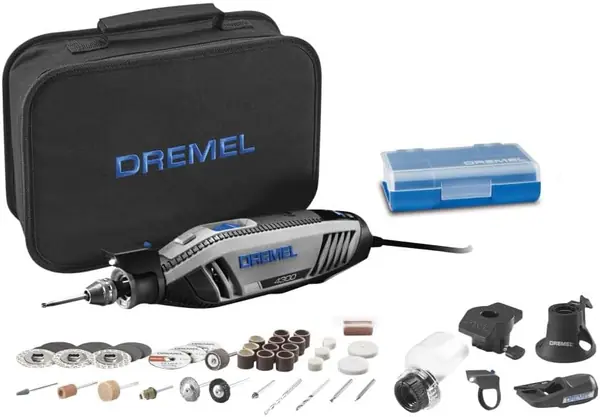
Dremel 4300 corded rotary tool in gray with attachments and accessory case

All-purpose shop work

Shop Score 95/100
Speed Range
5,000 to 35,000 RPM
Weight
1.2 lb
Included
5 attachments, 40 accessories, storage case
Chuck
Universal 3-jaw, tool-free
View on Amazon

The first thing the 4300 does differently is the chuck. It opens and closes by hand and grips every shank size Dremel makes, from 1/32-inch bits up to 1/8-inch cutoff wheels — no collet to swap, no wrench to hunt for. We have chased a collet wrench across a bench mid-project more than once, and a tool that never asks for one changed how often we pick it up.

The motor backs that up. Speed runs from 5,000 to 35,000 RPM with electronic feedback, so the bit keeps turning when you lean into hardwood instead of bogging down at the moment the cut starts to matter. Most work lands in the middle of that dial, slow enough that plastic and resin do not melt and fast enough that a cutoff wheel still has teeth. At 1.2 pounds the body is light enough to hold like a pencil through a long session.

The kit is genuinely useful rather than filler: five attachments including a pivoting light, a shield, a sanding and grinding guide, a cutting guide, and a garden tool sharpener, plus 40 accessories and a storage case. The pivot light is the piece we kept reaching for, because it aims at the exact point where the bit meets the wood — which is where a wandering line usually starts. Treat the accessory count as a sample, since cutoff wheels and sanding bands are consumables you will replace long before the tool. Register it on day one; the two-year warranty is what stands behind the switch and the bearings.

Worth Noting

  • Corded design needs an outlet at the bench
Our Verdict

This is the rotary tool we recommend to most people: a hand-tightened chuck that takes every bit you own, and 35,000 RPM that holds under load.

Check Latest Price
2.

Dremel 8240-5 Cordless Rotary Tool Kit Best Cordless

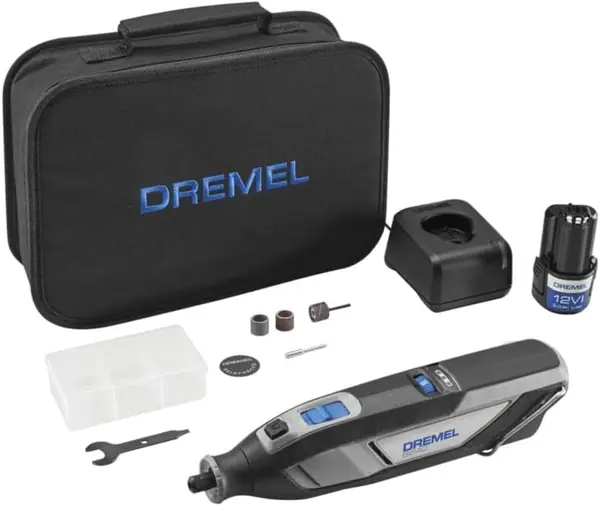
Dremel 8240 cordless rotary tool in black with battery, charger, and carry bag

Cord-free bench work

Shop Score 93/100
Speed Range
5,000 to 35,000 RPM
Weight
1.5 lb
Included
Battery, charger, bag, and 5 accessories
Battery
12V 2.0Ah lithium-ion
View on Amazon

Thirty-five thousand RPM from a battery is the figure that decides this one. The 8240 matches the top speed of our corded pick, so going cordless costs you a cord and nothing else — the speed that makes small cutoff wheels and carbide burrs work is all still there.

We were ready to be disappointed by a 2.0Ah 12-volt pack, and under a real load it holds up: the electronic control keeps the bit turning when you push into a joint. The EZ Twist nose cap is the detail we appreciated most, since a press and a twist releases the collet without a wrench anywhere in sight. A 360-degree grip zone lets you roll the tool to whatever angle the cut demands.

In the box you get the tool, a 2.0Ah battery, a charger, five accessories, and a fabric bag — a working kit rather than a starter assortment, though five accessories means a bit set is your first extra purchase. If your work happens at a bench with an outlet nearby, the corded 4300 buys you a bigger accessory kit and no battery to manage for the extra money; the 8240 is for the jobs that follow you away from the wall.

Worth Noting

  • Body is thick for close-in detail work
  • Battery may not accept a full charge
Our Verdict

We reach for the 8240 when there is no outlet in sight: it matches corded top speed on a 12-volt battery and ships with its own charger.

Check Latest Price
3.

Milwaukee M12 2460-20 Rotary Tool Best for M12 Owners

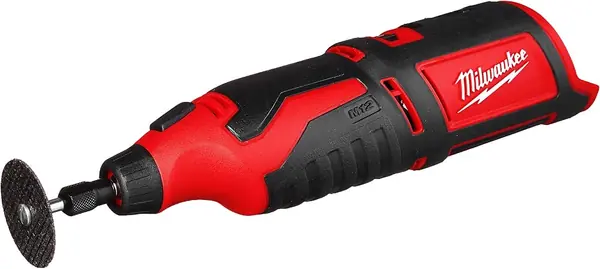
Milwaukee M12 rotary tool in red and black with wrench and cutting wheel

M12 platform owners

Shop Score 92/100
Speed Range
5,000 to 32,000 RPM
Weight
14.4 oz
Tool Warranty
5 years
Collet Capacity
1/8 inch
View on Amazon

Milwaukee built this rotary tool around a battery you may already own, and if there is an M12 charger on your bench, that fact settles most of the decision before you read another specification. The 2460-20 runs 5,000 to 32,000 RPM through a slide switch and a separate speed dial, both workable with gloves on — the arrangement you want when the tool is upside down under a cabinet and your other hand is holding the workpiece.

The 12-volt motor has real torque for its size, and it holds speed in a cut in a way the pen-sized tool here cannot. An LED sits at the business end, the body runs 9-1/2 inches, and the collet takes standard 1/8-inch rotary accessories, so the bits you already own are the bits you will use. Milwaukee covers the tool itself for five years, the longest coverage in this group.

The appeal is specific: a shop already running M12, where a rotary tool sharing batteries with a drill and an impact driver is one less charger to own. That buyer gets the least fuss of anything on this page. Everyone else should start with the Dremel 8240, our cordless pick, which arrives as a complete kit.

Worth Noting

  • Bare tool
  • Collet accepts 1/8-inch shanks only
Our Verdict

We recommend it to anyone already on Milwaukee's M12 platform: compact 12-volt power, glove-friendly controls, and the longest tool warranty here.

Check Latest Price
4.

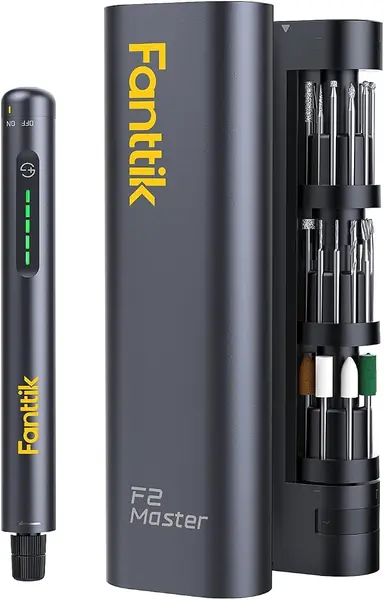
Fanttik F2 Master Mini Rotary Tool Best for Precision Detail Work

Fanttik F2 Master mini cordless rotary tool in gray with magnetic accessory hub and aluminum case

Precision detail work

Shop Score 90/100
Speed Range
12,000 to 25,000 RPM
Included
35 accessories, magnetic hub, and aluminum case
Dimensions
7.09 x 0.79 x 0.79 inches
Collet Size
3/32 inch (2.3mm)
View on Amazon

The measurement that tells you what this is: 0.79 inch across the barrel, roughly the width of a marker. A rotary tool that slim goes places a full-size body bumps into — inside a model fuselage, along the edge of a 3D print, under a hinge plate. If your work is small and fussy, the shape does more for you than the spec sheet does.

The motor is a brushless hollow-cup design, and the payoff is the calmest running of anything we handled in this group — less vibration, less noise, less heat in the hand. Five settings run 12,000 to 25,000 RPM, and the floor is the number worth thinking about: on wood, acrylic, and metal it is fine, but on soft plastics the slowest setting is fast enough to melt a smear where you wanted a clean edge.

Storage is where the design earns its keep. The 35 accessories sit in a magnetic holder that rotates through 360 degrees inside a click-open aluminum case, so the bit you want comes to your thumb instead of being fished out of a bag. Speed is a single integrated button, and a small display shows which of the five settings you are in before you touch material.

Charging runs over USB-C, so a power bank tops it up between sessions, and the whole tool is small enough to stay out on the bench instead of going back in a drawer. It will not replace a full-size rotary tool — it has the control for detail, not the power for hogging out material — and that is exactly the job we keep it for.

Worth Noting

  • 3/32-inch collet only so 1/8-inch bits will not fit
Our Verdict

It is a specialist, and we like it for that: pencil-thin, quiet, and organized, with control for models and prints but not the power for stock removal.

Check Latest Price

How We Tested Rotary Tools

We built the shortlist from specs rather than packaging: corded and cordless tools, tool-free chucks alongside wrench-and-collet setups, and speed ranges that reached both a slow, controllable floor for plastic and a high ceiling for hardwood. From that list we bought 11 rotary tools and lived with them for eight months — on a garage bench, at a kitchen table, and on a half-refinished chair.

Every cut and grind happened with the workpiece clamped and safety glasses on, bits were changed with the tool unplugged or the battery pulled, and every wheel stayed under its rated RPM. To judge speed under load we buried a cutoff wheel in a piece of oak and listened for the motor to hold its revs or sag; we also timed bit changes with a stopwatch, since a tool-free chuck swapped in seconds while a collet-and-wrench setup ran close to a minute.

Cordless tools ran until the battery died mid-cut, then we timed the recharge and priced batteries and chargers separately, because a bare tool is rarely the bargain it looks like. We weighed each one and ran half-hour detail sessions to track vibration, noise, and how the barrel sat in the hand. Working in a dim corner of the shop showed where each light actually landed, a month of worn-out wheels and burrs told us what the kits really cost to feed, and after eight months we compared every switch and motor against our first-day notes.

How to Choose a Rotary Tool

Corded or Cordless

Start with where the tool will be used rather than with the spec sheet. A corded rotary tool holds its speed under load and never asks you to buy a battery, which is why bench work usually belongs to a corded tool. Cordless earns its place on ladders, in vehicles, outdoors, and anywhere a cord becomes a trip hazard.

The trap is the bare tool. A cordless rotary tool with no battery in the box is only a bargain if you already own that brand's packs; otherwise the pack and charger are part of the purchase price. Our cordless pick ships with both, and the bare-tool Milwaukee only makes sense to a shop already running M12 batteries.

Speed Range and Control

RPM does two different jobs. High speed — 30,000 and up — is where small cutoff wheels and carbide burrs work efficiently. Low speed is where plastics, resin, and other heat-sensitive materials survive without smearing. A tool with a 5,000 RPM floor gives you both ends; one that starts at 12,000 is really a detail tool for wood and metal.

Electronic feedback matters more than the top number on the box, because it keeps the bit turning when you lean in. Without it, the motor slows at the exact moment the cut gets hard, which is when wheels break and lines wander.

Chucks, Collets, and Bit Fit

Most rotary accessories use a 1/8-inch shank, the de facto standard across brands. A keyless three-jaw chuck, like the one on our top pick, grips everything from 1/32 inch up to 1/8 inch and changes by hand. A fixed collet is lighter and simpler but ties you to its one size.

The trap sits at the pen-sized end of the market: several mini rotary tools use a 3/32-inch collet, so the 1/8-inch bits that fill most accessory kits will not go in. Check the shank size of the bits you already own before you commit to a body.

The Accessory Count Is Not the Value

A 140-piece kit looks like a bargain until you notice which pieces wear out. Cutoff wheels, sanding bands, and polishing pads are consumables, and you will replace them long before the tool. Buy the body you want and treat the included bits as a sample of what the tool can do.

What changes your work is a real attachment: a cutting guide, a sanding guide, or a work light aimed at the point where the bit meets the material. We would rather have five useful attachments than forty anonymous ones.

Weight, Dust, and Long Sessions

You hold a rotary tool like a pencil, so an extra half pound turns into a tired hand by the end of a session. A 1.2-pound body is comfortable at the bench; a 0.79-inch barrel is comfortable inside a model. If most of your work is fine detail, a pen-format tool or a flex shaft saves your grip.

Plan for the debris as well, because fine dust and sparks go everywhere. Eye protection is not optional, and a light at the work point — the pivot light on the Dremel 4300, or the LED on the Milwaukee — is the feature you will notice most on the first dark cut.

Frequently Asked Questions

Final Verdict

The Dremel 4300-5/40 is the rotary tool we recommend to most people. The hand-tightened chuck removes the small friction that makes people stop reaching for a rotary tool, the 5,000 to 35,000 RPM range handles plastic as happily as steel, and the kit works on the first project.

Buy the Dremel 8240-5 instead if your work happens away from an outlet — it matches the corded top speed and includes its battery and charger. If your bench already runs on Milwaukee's M12 packs, the 2460-20 is the cordless tool that fits your shop, and the Fanttik F2 Master is the one to add once the big jobs are covered.