↑↓ navigate ↵ open Esc close All results →

Best Oscillating Tool Blades for Wood of 2026

An oscillating tool gets into places no other saw will reach: plunging into a door casing, flush cutting a dowel, notching a floorboard without tearing up the run. The blade decides whether that cut comes out clean or ends in smoke. And blade kits are where this category gets sneaky — the count on the box says almost nothing about how many pieces will actually cut wood.

I wrecked a no-name blade on a hallway trim job and have been fussy ever since. We tested 16 blade kits over four months, tallying usable wood blades rather than filler, fitting mounts against several tools, and watching what happened when a cut met a nail. Tooth geometry mattered more than expected: a Japanese-style double-row grind cuts fast and cool where stamped teeth scrape.

The picks cover the spread — small sets for a first kit, bulk boxes for weekend cutters, extra-long blades for deep flush cuts, and assortments that throw in sanding pads. Different jobs, one shared requirement: a blade that sits flat under the clamp and stays sharp to the end.

Our Top Picks

The Best Oscillating Tool Blades for Wood

1.

AMZWEI 16-Piece Japanese Tooth Set Best Overall
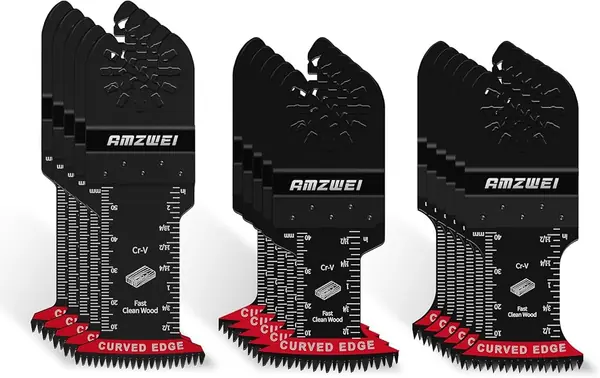
AMZWEI 16-piece oscillating blade set with Japanese-tooth CRV blades and adapters

Everyday wood cutting

Shop Score 95/100
Blade Count
16
Material
Chromium vanadium steel
Adapters
3 included
Blade Mix
Six 34 mm, five 44 mm, five long blades
View on Amazon

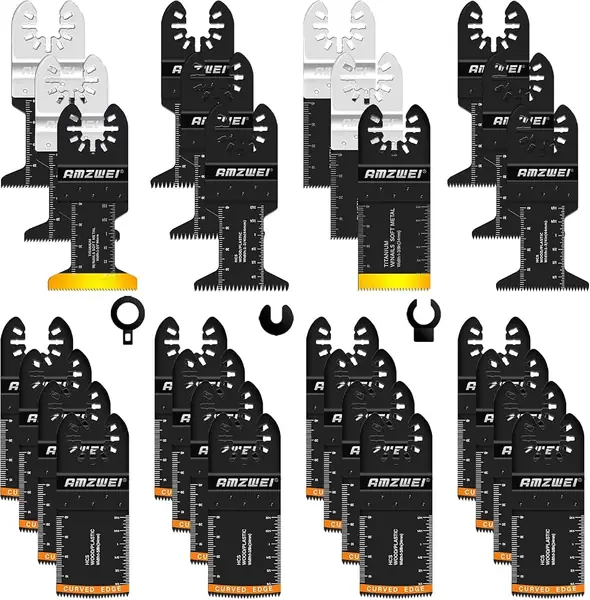
Wood is where an oscillating tool earns its keep, and this is the set we hand to someone whose cutting is mostly wood. The teeth are a Japanese-style, double-row grind rather than the plain stamped tooth in the cheapest kits, so the blade bites on contact instead of skating across a board. Six 34 mm blades cover trim and tight cutouts, five 44 mm blades take wider stock, and five long blades do what a stubby blade cannot reach. For a wood-first set, that mix is closer to what we want than a box of forty identical pieces.

In our testing the long blades earned their place first: undercutting a doorjamb, trimming shims flush, and plunging into a 2-by without pulling it out of position. Chromium vanadium steel is a step up from the plain high-carbon blades on the cheaper kits here, and the curved edge keeps the cut from wandering when you start at an angle. Three adapters come in the box, which is what gets these onto chucks a bare universal mount will not grip.

Starlock tools are the exception — they need Starlock blades and no adapter in this box changes that — so check your tool's mount before ordering. And keep a bi-metal blade nearby for painted trim and reclaimed lumber: these teeth are ground for wood, and one hidden nail will blunt a blade in a single pass.

Worth Noting

  • Small kit at 16 blades
Our Verdict

Our pick for most woodworkers: three blade lengths built around Japanese teeth that cut clean and clear chips, plus adapters that widen the fit.

Check Latest Price

2.

TrivdPro 100-Piece Oscillating Saw Blades Best Value

TrivdPro 100-pack of 1-3/8 inch high-carbon oscillating saw blades

Bulk wood cutting

Shop Score 94/100
Blade Count
100
Material
High carbon steel
Blade Width
1-3/8 inches
View on Amazon

One hundred blades, one shape. That is the whole pitch: a standard 1-3/8 inch high-carbon blade, repeated a hundred times, so you can swap the moment an edge slows down instead of nursing it through the last few feet of trim. For anyone cutting softwood, plywood, and casing all week, that math works out better than it does with any assortment here.

We like it for exactly that reason. There is nothing exotic about stamped high-carbon steel, but a fresh one leaves a clean kerf in pine and plywood, and this is the lowest cost per blade in this group by a wide margin. It changes your habits: the blade that is dragging gets retired instead of pushed.

The maker is straightforward that these are not for hard metal, and a screw or a staple will take the teeth off — worth knowing before you run one along a painted jamb. The box is dense and heavy when it arrives, so plan on moving a hundred blades into a drawer or a case. Universal mount, not Starlock.

Worth Noting

  • Single blade size, no long-reach option
Our Verdict

A hundred identical wood blades at the lowest cost per blade here, and the set we hand anyone who cuts a lot and hates wasting an edge.

Check Latest Price
3.

CONNOO 158-Piece Oscillating Blade Kit Best All-In-One Kit

CONNOO 158-piece oscillating multi-tool blade kit with wood and bi-metal blades

One-box assortment

Shop Score 93/100
Blade Count
158
Material
High carbon and stainless steel
Adapter
C-clip included
Blade Sizes
10 types from 3/8 inch to 3-1/2 inch
View on Amazon

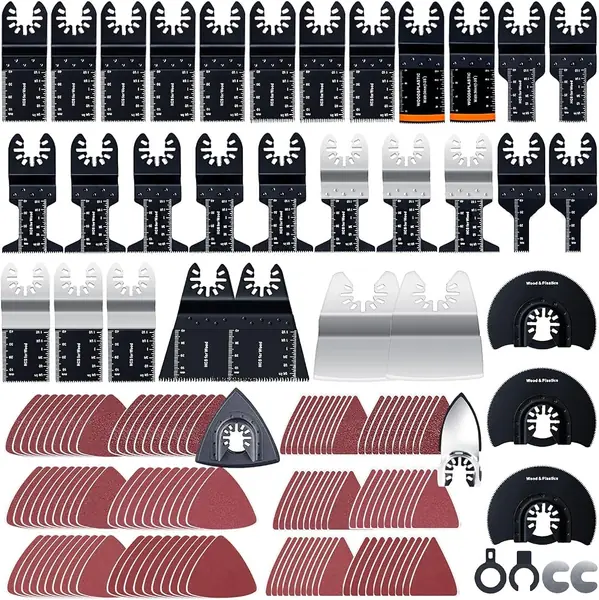
Ten different blade types in one box is the sort of claim that usually means ten ways to pad a count, and this one mostly delivers. The wood lineup alone runs from a 3/8 inch detail blade to a 3-1/2 inch wide blade for flush cuts, with 1-3/8 and 1-3/4 inch sizes in between, plus bi-metal versions of the middle sizes for stock that might have a staple in it.

Sandpaper pads come with it, which is the part people forget: hook-and-loop sheets turn the tool into a corner sander for the inside of a cabinet or a stair riser, and you finish the job without a second purchase. The C-adapter is the other useful inclusion — it is what gets these onto a Dremel MM40 or MM45, chucks that budget kits usually ignore.

What we like most is that it ends the shopping. Trim, flooring, a deck repair, a corner that needs sanding — one box covers it, and a dull blade mid-job means reaching into the same box instead of driving to the store. The 3-1/2 inch blade is the sleeper: it undercuts a door casing in one pass where a small blade needs three.

Worth Noting

  • Will not mount on Starlock or Bosch MX30 tools
Our Verdict

Ten blade types, sanding pads, and a fit list that names what it will not mount on — we recommend it when one box has to cover everything.

Check Latest Price
4.

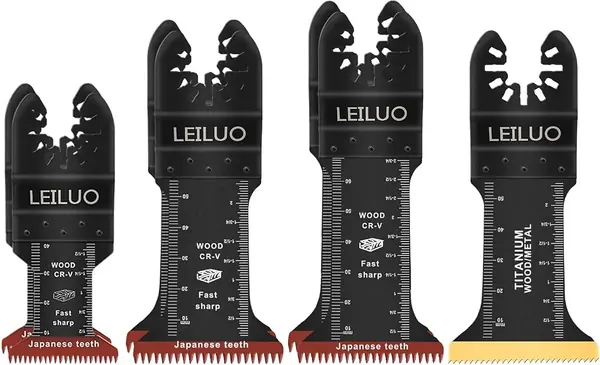
LEILUO 7-Piece Long Reach Set Best for Deep Cuts

LEILUO seven-piece oscillating blade set with long Japanese-tooth blades and adapters

Deep flush cuts

Shop Score 92/100
Blade Count
7
Material
CrV with one titanium bi-metal blade
Long Blades
Two 55 mm and two 70 mm
Standard Blades
Two 44 mm CrV
View on Amazon

Four of the seven blades here are extra-long — two at 55 mm and two at 70 mm — and that reach is the entire reason to buy the set. A standard blade bottoms out in a thick beam or a deep notch; these clear it in one pass, which is the difference between a clean plunge and cutting from both sides and hoping the kerfs meet. Two 44 mm CrV blades handle surface work, and one titanium bi-metal blade is there for the moment your wood turns out to have a nail in it. For the money, we have not found a quicker way to add reach to a kit you already own.

Three adapters come in the box, and the set is honest about being a wood-and-plastic kit: the titanium blade handles the odd nail, not a hinge. Treat the seven pieces as a top-up rather than a fresh start — it is a targeted fix for depth, and the blades you already own still do the flat work.

Worth Noting

  • Edges dull quickly on long runs
Our Verdict

Four extra-long blades in a seven-piece set: we use this to add reach to a kit that already handles the flat work.

Check Latest Price
5.

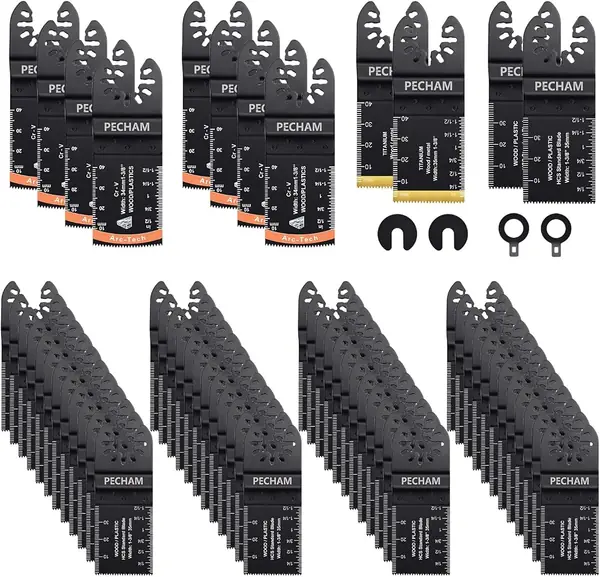
PECHAM 64-Piece Oscillating Blade Kit Best Blade Variety

PECHAM 64-piece oscillating multi-tool blade kit with titanium-coated teeth

Blade variety

Shop Score 91/100
Blade Count
64
Material
High carbon steel, titanium coated
Blade Markings
Inches and centimeters
View on Amazon

Marks on both edges of every blade — inches along one side, centimeters along the other — sound like a spec-sheet afterthought and turn out to be the most useful detail in the box. Instead of eyeballing a plunge depth, you set the blade against the work and read it off. We used it more than we expected on depth-limited cuts, where going a hair too deep means a new piece of trim.

The teeth are titanium-coated, and the maker rates that at 50 percent longer life than bi-metal; we treat it as a claim rather than something we measured, but the coating is there and the arc-shaped edge does cut with less chatter than the flat blades in cheaper kits. The shape lineup is what sets this box apart — several widths and more than one tooth pattern, which is what you want when the jobs change weekly.

It is a big set, and the specialty shapes you never mount are part of the deal with any variety box: you are trading volume for choice. Buy it because you want options on the shelf, not because you need sixty-four of anything.

Worth Noting

  • Craftsman fit is not assured
Our Verdict

The widest spread of blade shapes in this group, with inch-and-metric depth markings we ended up relying on.

Check Latest Price
6.

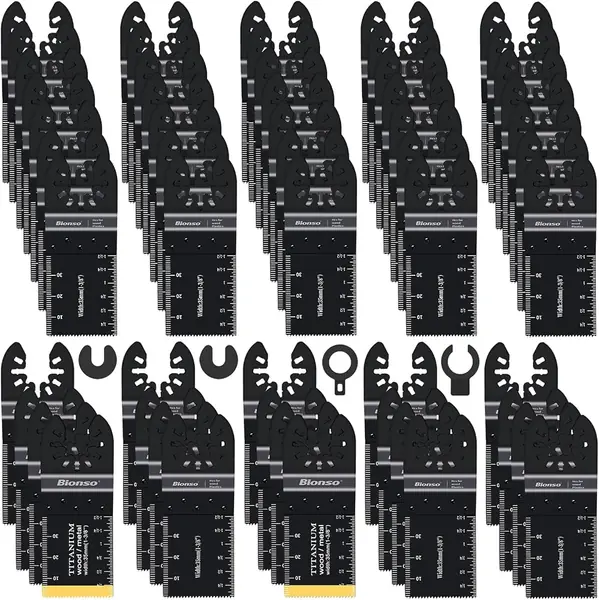
Bionso 55-Piece Blade Set Best for Rough Demolition Work

Bionso 55-piece oscillating saw blade set with wood blades and C-clip adapters

Rough demolition work

Shop Score 90/100
Blade Count
55
Adapters
2 C-clip
Blade Mix
53 wood-plastic and 2 titanium bi-metal
View on Amazon

Fifty-three of the fifty-five pieces are the same 1-3/8 inch wood-and-plastic blade. The other two are titanium-coated bi-metal, and two C-clip adapters finish the set. That is not a knock on the kit — a woodworker goes through standard blades many times over for every specialty shape — but it tells you exactly what you are buying: volume in the size you burn through.

The two bi-metal blades are the ones to save for painted trim and flooring with staples in it, and they are why this box is worth having alongside a wood-only set. Fit is broad — DeWalt, Ryobi, Milwaukee, Rockwell, Makita and most of the common tools — though the C-clip adapters are not optional on every chuck, and Bosch OIS tools are the recurring exception.

Where this one earns its place is rough work — demolition, subfloor patches, trimming out a shed — where you want a fresh blade and do not want to think about what it costs. For finish cuts the tooth geometry on our top pick is a real step up, and this box will not replace it.

Worth Noting

  • Blades dull faster than premium steel
Our Verdict

A big, cheap pile of wood blades we keep for rough work, as long as your tool takes the universal mount.

Check Latest Price
7.

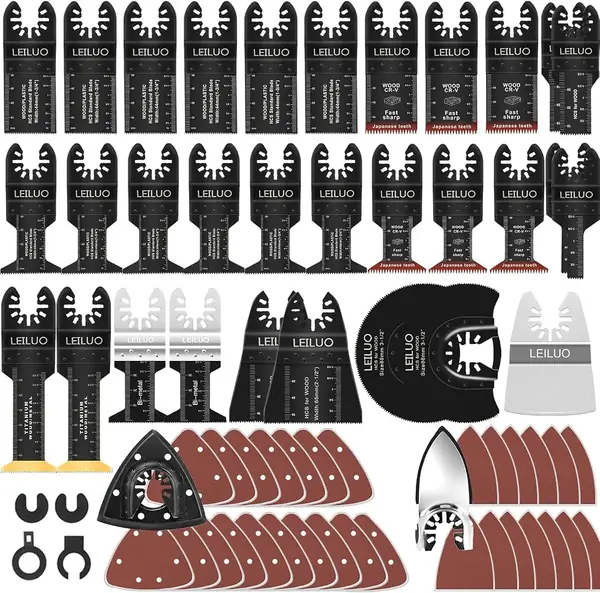
LEILUO 158-Piece Multi-Tool Kit Best for Cutting and Sanding

LEILUO 158-piece oscillating blade and sanding kit with storage bag

Cutting and sanding

Shop Score 89/100
Blade Count
158
Material
Titanium, CrV and high carbon steel
Kit Extras
Sanding pads and storage bag
Long Blade Reach
70 mm
View on Amazon

Most blade kits stop at cutting. This one keeps going — hook-and-loop sanding pads across a full grit range turn the tool into a corner sander, and a zippered bag holds the whole pile so a 70 mm blade is still findable three projects later.

The blades themselves are built for deep work: extra-long CrV Japanese-tooth blades at 55 mm and 70 mm, standard 44 mm blades for surface cutting, and titanium-coated pieces for the jobs where you would rather not find out the hard way about a nail. The Japanese tooth pattern is the one we look for in a wood set — it clears chips instead of packing them into the kerf.

Fit is universal with adapters, and the maker is clear that Starlock tools are out. Dremel users need an adapter of their own, so confirm the mount before you commit.

Where it lands: for a first oscillating-tool purchase or a shop that does a bit of everything, this is a lot of capability in one box. The bag matters more than it sounds — 158 loose pieces in a cardboard box become a drawer of loose pieces, and keeping the long blades separated is what makes them usable.

Worth Noting

  • Sharpness varies from blade to blade
Our Verdict

A cutting and sanding box with long blades and a bag to hold them; we like it as a first kit because it covers more than cutting.

Check Latest Price
8.

AMZWEI 28-Piece Blade Kit

AMZWEI 28-piece oscillating blade kit with mixed wood and metal blades

First blade kit

Shop Score 88/100
Blade Count
28
Material
High carbon steel, titanium, bi-metal
Adapters
3
Blade Types
5
View on Amazon

Twenty-eight pieces, five blade types, three adapters, and the lowest price here for a mixed set. For someone who bought an oscillating tool and has not worked out what they will use it for yet, that breadth is the appeal: wood, plastic, drywall and soft metal all have a blade in the box.

The wood blades are the ones that get used. High-carbon steel, a curved edge the maker says cuts down vibration, and a standard tooth pattern rather than the finer Japanese grind on our top pick — quick enough in trim and cutouts, and not the blade you want for a thick beam.

Fit is universal with three adapters, so DeWalt, Milwaukee, Ryobi and the rest of the common tools are covered. Starlock tools are the exception and need a different blade entirely.

Where we land: this is a starter box, not a woodworker's box. If most of what you cut is wood, put the money toward a set built around wood teeth and long blades, and skip the metal pieces you will never mount.

Worth Noting

  • Blade life is short in hard material
Our Verdict

For a first oscillating-tool purchase we point to this: five blade types, three adapters, and the lowest entry price here.

Check Latest Price

How We Tested Wood-Cutting Oscillating Blades

We started by reading listings the way a shopper does — mount type first, then blade sizes and steel — and set aside any kit whose blades wouldn't fit the tools most people already own without a separate adapter. That left 16 kits, from small first-timer sets to boxes with more than a hundred pieces, which we bought and used for four months. For each one we worked out cost per usable wood blade rather than cost per piece, since that's the number that actually tracks value.

Every kit got sorted on a bench before it got used: we measured each blade, separated the sanding pads and metal blades, and counted how many pieces would genuinely cut wood. Then we put them to work — trimming oak door casings, plunging vent holes in plywood, notching pine for outlets, flush cutting dowels, and slicing through pallet boards with nails buried in them. We timed cuts in 3/4-inch oak plywood and kept going until an edge started burning instead of cutting, which is where sharpness and blade durability show themselves.

Fit got the same treatment. We pulled the battery before every blade change, confirmed each blade sat flat under the clamp, and noted wobble or a blade that needed shimming on quick-release chucks. Depth markings were checked against a ruler, and storage and extras were judged by whether they survived a toolbox. Eye protection stayed on throughout — these blades throw chips, and a tooth can let go when a cut meets a fastener.

How to Choose Oscillating Tool Blades for Wood

Start with the tooth, not the count

The number on the front of the box tells you how many blades you get, not how well any of them cut. Tooth geometry does that: a double-row, triple-ground Japanese-style tooth slices across the grain and clears chips, while the plain stamped tooth on the cheapest blades scrapes, heats, and leaves a fuzzy edge. For trim, cutouts, and anything where the cut line shows, we pay for the better tooth and buy fewer blades.

Rough work flips that. Subfloor patches, demolition, and framing cutouts do not care about a clean edge, so standard high-carbon teeth and a big count are the smarter buy there. Decide which of those two shops you run before you decide how many pieces you need.

Length and shape set the limits of the job

A 1-3/8 inch blade is the workhorse and handles most cutting. A 1-3/4 inch blade is steadier in wide stock, and an extra-long blade — 55 mm to 70 mm — is what reaches under a doorjamb, into a deep notch, or through a thick beam in one pass. Without one, you cut from both sides and hope the kerfs meet.

The trap here is a hundred-piece box of a single standard blade. That is a genuine bargain for flat cutting, and it cannot undercut a casing. Read the size breakdown before the total; a box of oscillating saw blades is only a bargain if the shapes match the cuts you make.

Steel choice decides what a nail costs you

High-carbon steel is the baseline. Chromium vanadium holds an edge longer, and bi-metal or titanium-coated blades survive a nail without shedding teeth. In a wood shop the difference shows up in painted trim, reclaimed lumber, and old flooring, where fasteners hide under the surface.

Multi-material is not the same as nail-rated. If the stock might have staples or finish nails in it, keep a bi-metal blade mounted rather than gambling a wood blade on it — the LEILUO seven-piece set exists largely for that moment.

Check the mount before anything else

Universal fit means most tools, and the exceptions are the ones that ruin an order. Starlock tools from Fein, Bosch, and Makita take their own blades and no adapter changes that. Bosch MX30, quick-release chucks, and Rockwell or Worx Hyperlock tools turn up as named exclusions on otherwise broad kits.

C-clip adapters are what bridge older Dremel and Fein chucks, and several sets here include them. Find your tool on the fit list before you buy; if the listing does not name your tool either way, ask the seller rather than assuming.

Price the blades you will actually use

A 158-piece box of multitool blades and a 16-piece box can cost about the same. The difference is how many of those pieces are wood blades you will mount — the rest is sandpaper, a hook knife, or a shape you will never fit.

Work out the cost per usable wood blade, then think about how fast you dull them. A blade that gives up in a few feet of plywood is expensive at any price, and buying enough that swapping is painless matters more than buying the cheapest box.

Frequently Asked Questions

Final Verdict

Cutting wood is a geometry problem more than a volume problem, which is why the AMZWEI 16-piece set is the one we recommend first: three blade lengths built around a Japanese tooth, and adapters that get it onto older chucks.

If your work is demolition and subfloor rather than trim, the TrivdPro hundred-pack makes more sense — you will never hesitate to change a blade. Either way, check the mount first: a Starlock tool needs a different blade entirely.