↑↓ navigate ↵ open Esc close All results →

Best Metal Cutting Blades for Oscillating Tools of 2026

Drive an oscillating tool into a buried framing nail, bolt, or piece of angle iron, and a standard wood blade stalls, chatters, or strips its teeth in seconds. Getting clean, controlled cuts without burning through a fistful of blades requires both the right tooth alloy and a mount that locks tight to the tool's arbor.

Across five months on tools with Starlock, OIS, and open-back tang mounts, 14 carbide, bi-metal, and titanium-coated blade sets worked through reclaimed lumber full of nails, bolts, and sheet metal while we tracked cut speed, wander, and blades consumed per job. Carbide holds an edge in hardened fasteners yet can chip under side load, whereas bi-metal and titanium-coated teeth flex more forgivingly under heat.

Confirming arbor compatibility comes before choosing tooth chemistry, and the six sets covered here split across hardened metal, wide flush cuts, budget nail-hunting, and bulk shop packs rather than claiming one blade handles every alloy.

Our Top Picks

The Best Metal Cutting Blades for Oscillating Tools

1.

Bosch OSL114C-3 Starlock Carbide Blades Best Overall
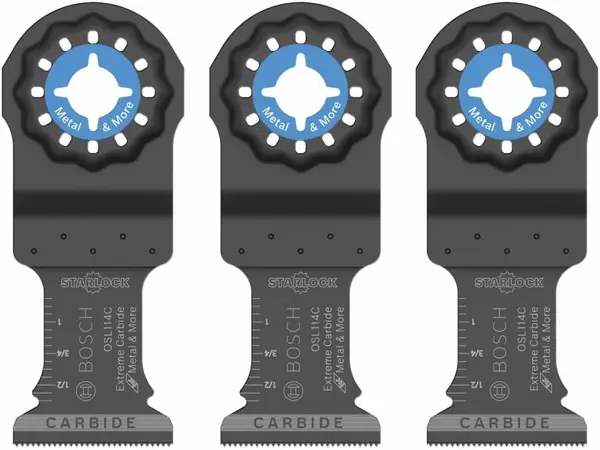
Bosch Starlock carbide plunge cut oscillating multi-tool blade, black, 1-1/4 inch, three-pack

Cutting hard metal

Shop Score 93/100
Pack Size
3 blades
Blade Material
Carbide
Blade Width
1-1/4 in.
Interface
Starlock, OIS compatible
View on Amazon

Three blades for about what a fifteen-piece set of coated blades costs — that is the trade, and we make it every time a cut turns out to be metal. Bosch builds these with carbide teeth rather than a coating over a steel blade, and the teeth keep their shape in hardened nails, screws, and light iron bar where bi-metal starts polishing instead of cutting. The 1-1/4 inch width is the compromise: it slips into a pipe or between a stud and a nail head, but it covers less ground on a long flush cut.

The Starlock mount is the other reason it stays in the kit. The blade seats in three dimensions instead of lying flat on the spindle, which shows up as less chatter and less tendency to walk off the line when you start a plunge cut. Starlock accessories also fit OIS tools, so most older oscillators can run these, and the ejection lever means you are not prying a hot blade off with a screwdriver between cuts.

What settles it for us is the arithmetic of a bad afternoon. Three blades that still cut beat twenty that smear, so a woodworker who hits embedded fasteners a few times a month comes out ahead on the first rusted bolt. If your metal work is nails and soft stock rather than bolts, the bi-metal AMZWEI set covers it for less and lands in the same drawer.

Worth Noting

  • Needs a Starlock or OIS tool mount
Our Verdict

When the cut turns out to be metal, this is the blade we want in the tool: carbide teeth, a mount that stays tight, and a price per blade we accept.

Check Latest Price
2.

EZARC Carbide Oscillating Saw Blades (3-Pack) Best Value Carbide

EZARC carbide oscillating multitool blade set, three black blades with adapters

Bolts and stainless

Shop Score 92/100
Pack Size
3 blades
Cutting Depth
1-3/5 in. (40mm)
Cutting Width
1-3/8 in. (34mm)
Teeth Material
Tungsten carbide
View on Amazon

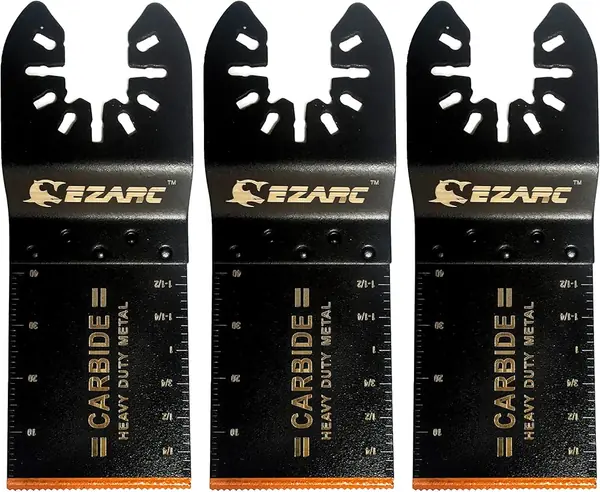
Two adapters come in the box, and for anyone running an older or off-brand oscillator they are the difference between using these blades and returning them. The open-back mount plus the B- and D-style adapters covers most of the tools we expect to see in a shop, and the blade itself is tungsten carbide with 1-3/8 inches of cutting width and a 1-3/5 inch depth — enough to take a real bite out of a rusted bolt instead of skating across it.

Nails, screws, and stainless sheet are where we spend them, and this is the cheapest route to a genuine carbide tooth in this group. What we do not love is how the teeth fail: carbide is hard and brittle, and a blade twisted or levered in a bind can shed teeth in a hurry. Carbide wants a light hand, so keep the tool moving and let the teeth do the work rather than prying with the blade, and one rusted bolt pays for the pack.

Three blades will outlast a fifteen-piece coated kit on a rusted bracket, and that is the whole argument. The price per blade means you can retire one the moment it stops biting instead of nursing it through the last few cuts of a job.

Worth Noting

  • Shorter edge life than our top pick
Our Verdict

We recommend this three-pack to anyone who wants genuine carbide teeth at the lowest price here, provided you let the blade cut and never lever it.

Check Latest Price
3.

AMZWEI 4-Piece TiCN Carbide Blades Best Wide Blades

AMZWEI carbide oscillating tool blades, four black 1-3/4 inch blades with three adapters

Wide flush cuts

Shop Score 91/100
Blade Material
Carbide with TiCN coating
Blade Width
1-3/4 in.
Tool Fit
Open-back tang, 98%+ of tools
Set Contents
Four blades and three adapters
View on Amazon

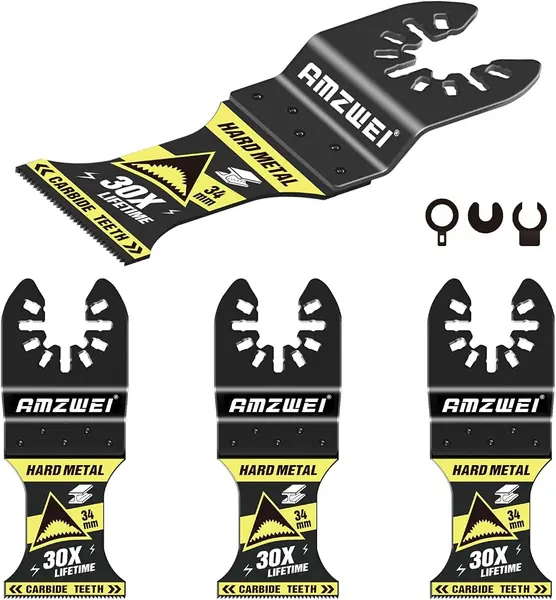
At 1-3/4 inches these are the widest blades in this group, and the width is the reason to buy them: a flush cut through a pipe, a bolt, or the edge of a board goes faster when more teeth are in the cut at once. If you have been making do with a 1-1/4 inch blade and wondering why the tool feels slow, this is the difference.

The teeth are carbide under a TiCN coating, the combination that keeps a blade cutting once it is a few inches into sheet metal. Three adapters ship with the four blades and cover the open-back mounts on DeWalt, Milwaukee, Ryobi, Ridgid, Rockwell, and non-Starlock Bosch tools. We appreciate that they thought about the Bosch crowd in particular, because that is where most universal-fit claims fall apart.

What tips it for us is the mount. When the blade has to go onto whatever tool is on the bench — an old DeWalt, a newer Ryobi, a non-Starlock Bosch — these seat without a hunt for the right adapter, and the extra width is a bonus on top. It is the set we pick when the metal is part of a woodworking project rather than the whole job.

Worth Noting

  • Edge life drops on hardened steel
Our Verdict

The widest blades we tested in this group, with adapters that fit nearly any open-back tool — our choice for shops with mixed tool brands.

Check Latest Price
4.

AMZWEI 10-Piece Bi-Metal Blades Best Budget

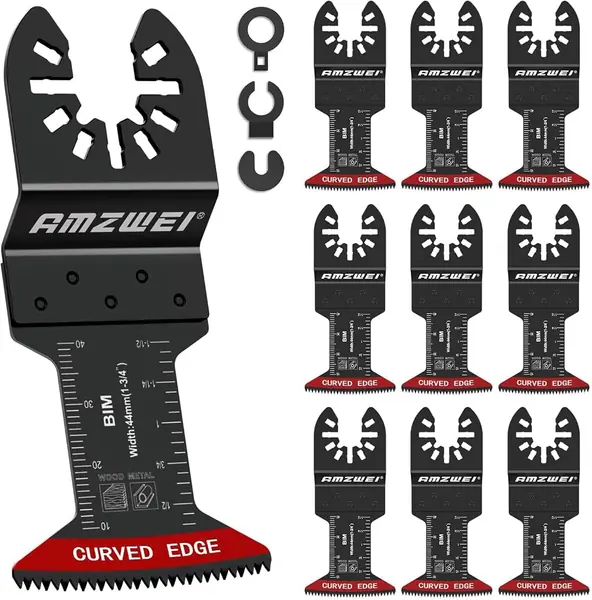
AMZWEI bi-metal oscillating multitool blades, ten black curved-edge blades

Nails and staples

Shop Score 90/100
Pack Size
10 blades
Blade Material
Bi-metal
Compatible Tools
DeWalt, Bosch, Fein, Milwaukee, Ryobi
Blade Edge
Curved edge
View on Amazon

Nails in reclaimed lumber, copper pipe, staples, aluminum trim — the jobs where you are cutting soft metal and half expecting to hit something harder. That is where bi-metal earns its place, and it is why we keep this ten-pack in the drawer. Bi-metal teeth flex instead of shattering, so a blade that catches a nail keeps going instead of losing a corner.

The curved edge is the detail we did not expect to care about. It lets you roll the blade into a plunge cut and start in the middle of a board or a pipe without skating, and it gives a little more control on a long cut where a straight blade wants to wander.

Ten blades for what a couple of brand-name blades cost is the real argument, and it means swapping a blade the moment it starts working hard instead of pushing a dull one and burning the edge. Where it fits is the everyday metal inside a woodworking job: nails, staples, pipe, thin trim. It is the set we hand someone who does a bit of everything and does not want to think about blades.

Worth Noting

  • Not for hardened bolts or thick steel
Our Verdict

We keep this ten-pack for nails, pipe, and staples — the everyday metal in a woodworking project, at a price that makes swapping blades easy.

Check Latest Price
5.

Trivd Frol 15-Piece Titanium Blade Set Best for Mixed Remodeling Cuts

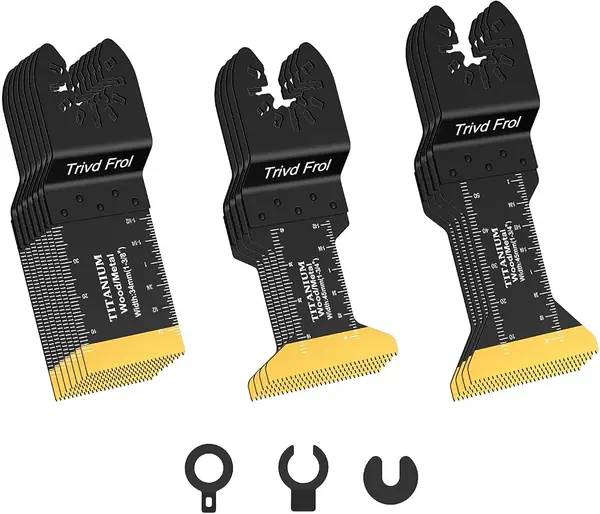
Trivd Frol titanium oscillating saw blade set, fifteen black blades in three sizes

Mixed remodeling cuts

Shop Score 89/100
Pack Size
15 blades
Blade Material
Titanium carbide coating
Compatible Tools
Milwaukee, Makita, Rockwell, DeWalt
Blade Mix
7 at 1-3/8 in., 4 at 1-3/4 in., 4 extended
View on Amazon

Seven 1-3/8 inch blades, four at 1-3/4 inches, and four extended 1-3/4 inch blades: fifteen pieces in three shapes is more variety than most kits at this money, and the extended blades earn their keep when you need to reach past a housing or cut flush along a floor line.

Titanium carbide coating is the claim on the box, and it is worth knowing what that means. It is a hardened surface layer on a steel blade, not a carbide tooth. It slows wear on nails, drywall, and plastic, which makes these a sensible box to burn through on a remodel. It does not make them blades that cut hardened steel, and we do not send them at a bolt.

Where they land for us is the one-of-everything slot: a set to keep in the truck for soft metal, wood, and the occasional nail, at a price where using one up does not sting. Buy it as a consumable box rather than a long-term tool, and you will get your money's worth out of the extended blades alone.

Worth Noting

  • Blades can crack at the mount
Our Verdict

A good box of consumable blades for a remodel, as long as you are cutting nails, drywall, and soft metal rather than steel.

Check Latest Price
6.

Bionso 22-Piece Titanium Blade Set Best for Bulk Consumable Blades

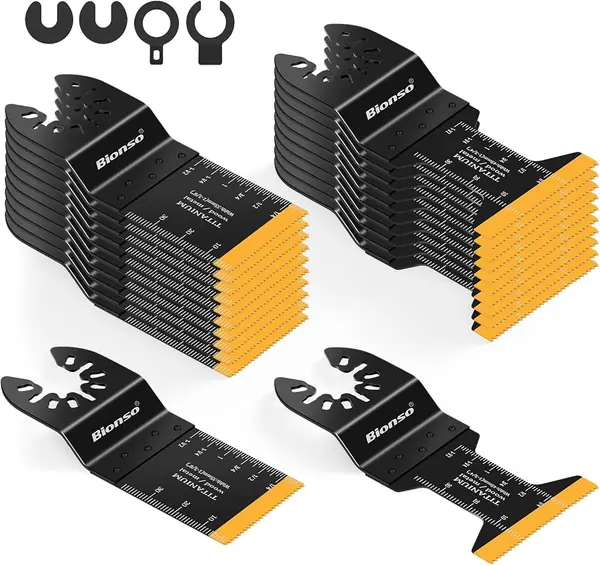
Bionso titanium oscillating multitool blade set, twenty-two black blades in two models

Bulk consumable blades

Shop Score 88/100
Pack Size
22 blades
Blade Material
Titanium-coated M42 steel
Tool Compatibility
Universal interface, 95%+ of oscillating tools
View on Amazon

Twenty-two blades in one box is the pitch, and it is a real one if what you want is a drawer full of blades you do not mind destroying. Two blade models in titanium-coated M42 steel with a universal mount that covers most of the usual suspects: DeWalt, Milwaukee, Ryobi, Makita, Worx, Rockwell, and a long tail of others.

Inside their limits they do fine — demolition, trim, drywall, plastic, the odd nail — and the two models cover flush cuts and plunge work between them. What they are not is a metal-cutting blade, and when steel is the point of the purchase we point people at carbide instead. These are blades you use up.

Fit is the other thing to check, because a blade that will not seat is worthless at any count, so confirm the mount on your own tool before ordering. We call this the consumable box for a woodworker who cuts a little metal now and then and wants twenty-two chances rather than three good ones.

Worth Noting

  • Dulls quickly in metal
  • May not seat on Bosch OIS tools
Our Verdict

We see this as a drawer-filler for wood, drywall, and light metal use, not the set we reach for when the job is steel.

Check Latest Price

How We Tested Metal-Cutting Blades

We began by sorting dozens of listings by tooth material, mount style, width, and pack size, then narrowed the field to 14 blade sets that covered carbide, bi-metal, and titanium-coated teeth. Over five months, those sets stayed in rotation across tools with Starlock, OIS, and open-back tang mounts, including adapters where the package supplied them. We fitted each blade, checked for wobble or poor seating, and noted whether a mid-job change was quick or fussy.

Most testing happened in a garage shop and during a small remodel: pulling buried nails from reclaimed pine, trimming bolts, making flush cuts along angle stock, and starting plunge cuts in sheet metal. We clamped every workpiece and wore eye protection for every cut. We timed repeated cuts in the same scrap, watched whether teeth bit immediately or skated, and noted chatter and wander at the start of a plunge. Blades stayed in rotation until they dulled, chipped, or stopped cutting; we let them cool and used the tool’s ejection lever or a glove before changing them.

Edge life was judged by how the teeth failed, not just how long they lasted: we recorded whether the cutting edge dulled, blued from heat, chipped at the carbide, or snapped under side load. To get at value, we counted how many blades each job consumed and compared that with pack size and the mix of widths in the box. A set scored well only if it fit the tool without slop, cut at a controlled speed, and left enough useful blades for the next job—not simply because it had the highest piece count.

How to Choose Metal Cutting Blades for an Oscillating Tool

Carbide, Bi-Metal, or Titanium Coated

Three labels get used loosely on multitool blades, and they mean very different things. Carbide blades carry sintered carbide teeth on a steel body: hard enough for hardened screws, stainless, and cement board, and brittle enough that a twist can chip a tooth. Bi-metal blades put hardened teeth on a flexible body — they shrug off a nail hit and keep cutting, but they polish rather than cut against hardened steel. Titanium usually describes a coating that slows wear on a steel blade; it does not turn that blade into a carbide blade.

Buy carbide when the metal is the job — bolts, hardened fasteners, stainless sheet. Buy bi-metal when metal is an interruption, like nails in reclaimed lumber or a copper pipe. Buy coated kits for volume, drywall, plastic, and light metal work. If a listing says titanium and never says carbide, treat it as a steel blade.

Check the Mount Before the Blade

Oscillating tools hold blades three ways: the Bosch Starlock 3D interface, the older OIS pattern, and the open-back tang that most universal blades use. Starlock blades also fit OIS tools. Adapter-equipped universal blades cover most of the rest, with Bosch's OIS and Starlock tools being the pairing to check twice.

The trap is the word universal, which means universal among open-back tools, not universal including everything. Look at the mount on your own tool before ordering, and if you run more than one oscillator, favor a set that ships with adapters in the box.

Pick a Width That Matches the Cut

Blade widths run from about 3/4 inch to 1-3/4 inches, and wider is faster only where you have room for it. A 1-1/4 inch blade gets into a pipe, between boards, and into the corner of a cutout. A 1-3/4 inch blade puts more teeth into a flush cut across a board edge or a bolt head. Extended blades add reach past a housing or a floor line.

Match the width to the cut you make most, and if you can carry two sets, keep a narrow carbide set for metal and a wide one for flush work. Buying the widest blade you can find is how people end up unable to start a plunge cut in a tight spot.

Buy for the Number of Cuts

Cost per blade is the number that matters, and a carbide blade costing several times a coated one can still be cheaper per cut. The bigger question is how many you will burn. Twenty-two coated blades carry a renovator through a season of drywall and trim; three carbide blades carry a woodworker through a year of embedded fasteners.

Technique eats blades faster than material does. Let the teeth cut, keep the blade moving through the work, never pry with it, and do not dwell in one spot — heat and side load are what kill an edge. On stainless, dwelling work-hardens the surface and the teeth start skating.

Frequently Asked Questions

Final Verdict

We keep the Bosch OSL114C-3 in the shop because it is the blade that still cuts when the job turns out to be metal, and three of those beat twenty that smear. If a premium carbide blade does not fit the budget, the EZARC three-pack gets you genuine tungsten carbide teeth for less and asks only that you keep the blade moving.

If your metal work is nails and copper pipe rather than bolts, the AMZWEI bi-metal ten-pack is the smarter buy — it takes the hits that ruin a hard tooth and costs little enough to replace without thinking.