↑↓ navigate ↵ open Esc close All results →

Best Grout Removal Blades for Oscillating Tools of 2026

Three square feet into a regrouting job, the blade stops cutting and starts polishing, and the oscillating tool itself was never the problem. Grout removal is slow, dusty work, and the wrong blade turns it into an afternoon of chipped tile edges and burned-out tips. The right blade keeps the joint moving cleanly.

Across four months of testing 16 blades and blade sets on a full bathroom floor, a kitchen backsplash, a shower surround, and scrap tile, kerf width mattered far more than brand. A blade a hair too wide chips glazed edges on the first pass, while one too narrow forces a second run down the same line.

Diamond grit outlasts carbide in sanded grout at the cost of cutting speed, though either edge can wear down before a large room is finished, making pack count as practical as edge material. Both abrasive types and the mounts most oscillating tools use—universal quick-fit, adapters, and Starlock—are represented here, from single repair blades to multi-pack sets for a whole floor.

Our Top Picks

The Best Grout Removal Blades for Oscillating Tools

1.

DEWALT DWA4220 Fastcut Carbide Grout Removal Blade Best Overall
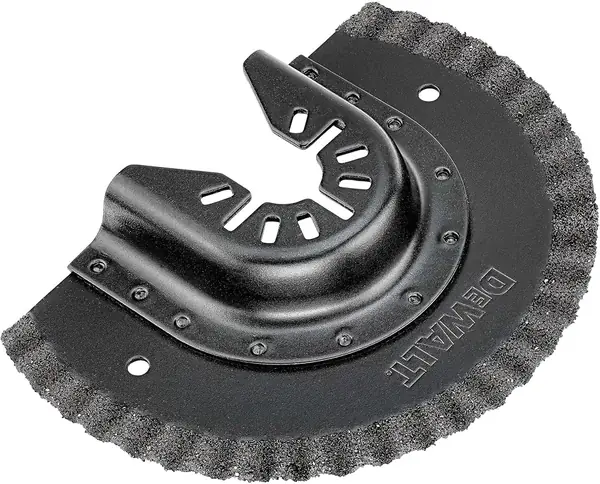
DEWALT DWA4220 carbide grout removal blade for oscillating multi-tools in retail sleeve

Floor grout removal

Shop Score 93/100
Blades Included
1
Cutting Edge
Carbide
Mount
Universal, no adapter needed
View on Amazon

Sanded grout is where a grout blade earns its money, and the DWA4220 is the most aggressive cutter here. DEWALT's carbide edge is coarse and open rather than fine-toothed, so it scrapes material out of the joint instead of burnishing the surface, and it keeps cutting where a finer edge would be polishing tile. The open slots line up with the major tool brands, so there's no adapter to hunt for once you're on your knees mid-job.

This is the blade we recommend to anyone with a floor to regrout. The cut is fast enough that the tool, not the blade, becomes the limit, which is what you want when a whole floor is ahead of you. It does want a strong multi-tool behind it — put it on a lightweight cordless tool and it feels like it's stalling rather than cutting. The aggression cuts both ways, too: this is a heavy-removal blade, not a finishing one.

Against the Dremel below, the trade is precision for speed. The Dremel is a 1/16-inch blade that slips into narrow joints; this one is happiest running along a wider line where it can clear a lot per pass. If your joints are 1/8 inch or larger, or you're cutting out grout around several cracked tiles, this is the pick. A single blade doesn't go far on a room, so put two in the cart before you start.

Worth Noting

  • Aggressive bite can chip soft tile edges
  • Can work loose in some tool mounts
Our Verdict

The blade we recommend first for floor grout: it cuts sanded joints faster than anything else here and mounts on any major tool without an adapter.

Check Latest Price
2.

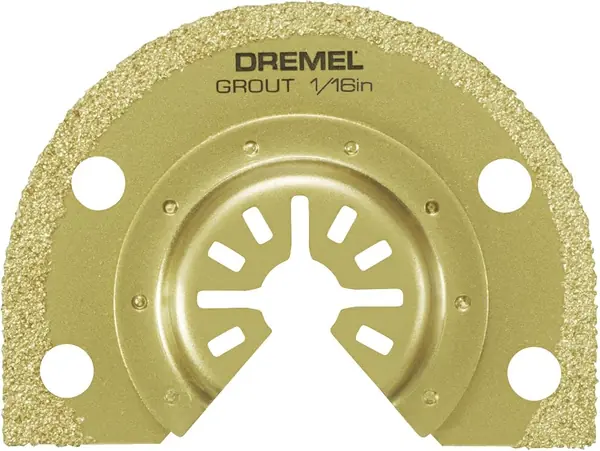
Dremel MM501 1/16-Inch Carbide Grout Removal Blade Best for Narrow Joints

Dremel MM501 1/16-inch carbide grout removal blade for oscillating multi-tools

Narrow grout lines

Shop Score 92/100
Cutting Edge
Carbide
Mount
Universal Quick-Fit
Max Speed
21,000 OPM
Blade Width
1/16 inch
View on Amazon

Grout joints run from 1/16 inch on a backsplash to 3/16 on a big floor, and a blade that's happy in the wide ones will chew the shoulders off the narrow ones. The MM501 is built the other way around. Its 1/16-inch kerf follows a fine joint without riding on the tile face, which is the difference between regrouting a shower and replacing one.

Dremel builds this one around a carbide edge and rates it to run at the 21,000 OPM most oscillating tools put out. In use the cut is quick and controlled, and because the blade is thin you're not leaning on the tool to keep it in the line — leaning is where chipped tiles come from. It leaves a narrow, clean channel, and a thin blade throws less spoil than a wide one, so there's less grit to chase off the tile afterward.

We reach for this one on bathroom walls, backsplashes, and any joint where the tile is expensive to replace. Against the DEWALT above it gives up speed in wide floor lines and gains a lot of control in tight ones, and it costs about the same. If your grout measures 1/8 inch or more, buy the DEWALT instead; at 1/16, nothing else here tracks as well.

Worth Noting

  • 1/16-inch width limits it to narrow joints
  • Doesn't seat securely in every tool mount
Our Verdict

The right blade for tight joints: a 1/16-inch carbide cutter that tracks a narrow line cleanly and leaves the tile face alone.

Check Latest Price
3.

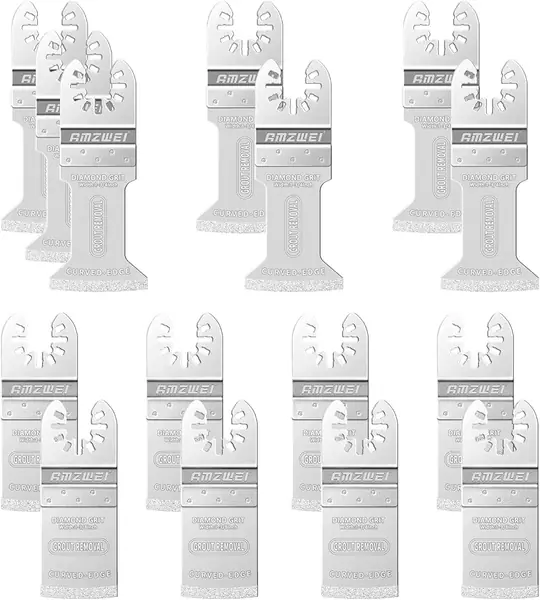
AMZWEI 15-Piece Diamond Oscillating Blade Set Best Multi-Pack Value

AMZWEI 15-piece diamond oscillating multi-tool blade set with curved edge blades

Whole-room grout jobs

Shop Score 91/100
Blades Included
15
Blade Thickness
0.07 in
Adapters Included
3
Blade Lengths
2-3/8 in and 1-3/8 in
View on Amazon

Buying blades by the box changes how you work: you stop rationing the one good blade and swap the moment the edge stops biting. Fifteen diamond blades in two lengths is why this set lands where it does — it's the pack we point at when someone has a whole floor rather than a cracked tile.

The two lengths do different jobs. The 2-3/8-inch blade reaches down into a deep joint; the 1-3/8-inch one grinds along the surface where you want aggression without burying the blade in the tile bed. At 0.07 inch thick they suit standard joints, and three included adapters widen the fit to tools that won't take a plain open-slot blade.

What we like most is the way the kit handles the middle of a job. Fifteen blades means a dull edge is a swap, not a trip to the store, and the curved-edge shape stays controllable in a corner where a straight blade wants to skate. Against the LEILUO six-piece you're paying more for more blades and better adapter coverage — worth it for a floor, overkill for a single repair.

Worth Noting

  • Diamond grit wears down on long jobs
Our Verdict

Our pick for a whole-room job: fifteen diamond blades in two lengths, plus adapters, so wear costs you a swap instead of an afternoon.

Check Latest Price
4.

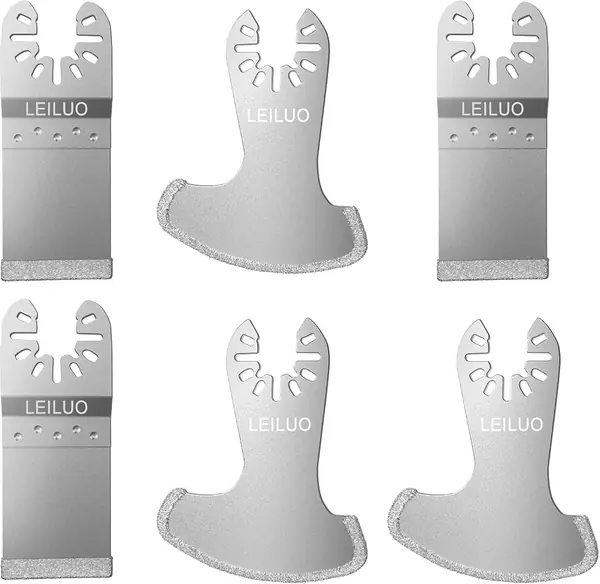
LEILUO 6-Piece Diamond Grout Removal Blade Set Best Budget

LEILUO six-piece diamond grout removal oscillating multi-tool blade set

Small repairs

Shop Score 90/100
Blades Included
6
Cutting Edge
Diamond grit
Mount
Universal quick-release, not Starlock
Blade Thickness
2.0 mm
View on Amazon

The lowest price in this group buys six diamond blades, which is a different proposition from buying one: you can ruin a blade learning the tool and still finish the job.

LEILUO organizes the set around a routine rather than a pile of identical blades — the flat blade takes the straight runs, and the kit is meant to be used at low or medium speed, with light pressure and a slight lateral angle. That instruction is worth more than the blade count. Most people destroy a diamond edge by running full throttle and leaning into the cut, then blame the blade.

At 2.0 mm the blades are thin enough for standard joints, and the quick-release interface covers most major brands. This is the set we hand to someone making a first attempt at grout removal, and the one we keep for small repairs where a fifteen-pack is silly. It won't take the place of the DEWALT on a big floor — six blades is a bathroom, not a house — but it's the cheapest sensible way to find out how your grout behaves.

Worth Noting

  • Will not fit Starlock tools
  • Grit wears through on hard grout
Our Verdict

Six diamond blades for the least money here, with a technique note that will keep them cutting longer than most.

Check Latest Price
5.

XXGO 20-Piece Diamond Grout Removal Blade Set Best for 1/8-Inch Grout

XXGO 20-piece diamond oscillating tool blade set for 1/8-inch grout removal

1/8-inch grout lines

Shop Score 89/100
Blades Included
20
Cutting Edge
Diamond
Blade Thickness
2.3 mm
Best Joint Width
1/8 inch
View on Amazon

Not many accessories tell you where they don't belong. XXGO does: the 2.3 mm blade is built for 1/8-inch grout lines, and the listing says outright that it isn't the right choice for 1/16-inch joints. We like that, because it turns a guess into a decision — measure your joint and you already know whether to buy this set.

For a floor with standard joints, twenty blades is the most efficient thing on this page. Even at the top of this group's price range, the cost per blade drops well below any single cutter here, and you won't stop mid-room to order more. The blades also handle thinset, mortar and plaster, which matters if you're resetting a tile rather than just regrouting one.

Where it lands against the AMZWEI set is width. Both are diamond bulk packs, but XXGO's 2.3 mm blade is aimed squarely at standard floor joints while the AMZWEI blades are thinner and more adaptable. If your floor measures 1/8 inch, that width match is the whole reason to buy it.

Worth Noting

  • Grit wears quickly on hard grout
Our Verdict

A 20-pack built for 1/8-inch floor joints, and honest enough to say so — the efficient buy if your grout measures up.

Check Latest Price
6.

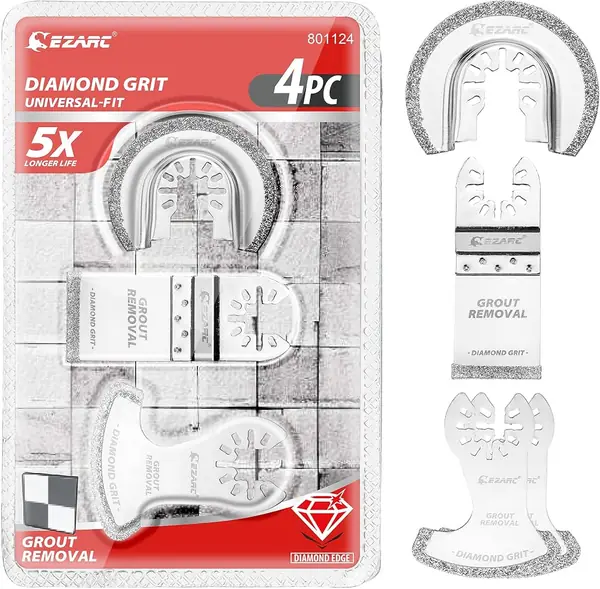
EZARC Diamond Oscillating Saw Blade Set Best for Unknown Joint Widths

EZARC four-piece diamond oscillating saw blade set for grout and mortar

Unknown joint widths

Shop Score 88/100
Blades Included
4
Adapters Included
2
Kerf Options
Three different widths
Smallest Kerf
0.06 in
View on Amazon

Three kerf widths in a four-pack is a hedge, and sometimes a hedge is exactly what a grout job needs: you don't always know what the last person left in the joint until the blade is in it.

We like this set for a first attempt on an unfamiliar floor. The blades are diamond, meant for grout, mortar and soft tile rather than for cutting hard porcelain, and the narrowest option is 0.06 inch — thin enough to start conservative and open a joint up rather than taking a wide bite on the first pass. Two adapters round out the fit.

Four blades won't carry a kitchen floor; for that, the AMZWEI or XXGO multi-packs make more sense. What this pack buys is the ability to try a width, find it wrong, and change approach without feeling like you've wasted the purchase. For a bathroom wall, a backsplash or a handful of tiles, that flexibility is worth more than the extra blades in a bigger box.

Worth Noting

  • Grit can strip off under sustained load
Our Verdict

A flexible four-pack for a job where you're not sure of the joint width — three kerf options to try before committing.

Check Latest Price
7.

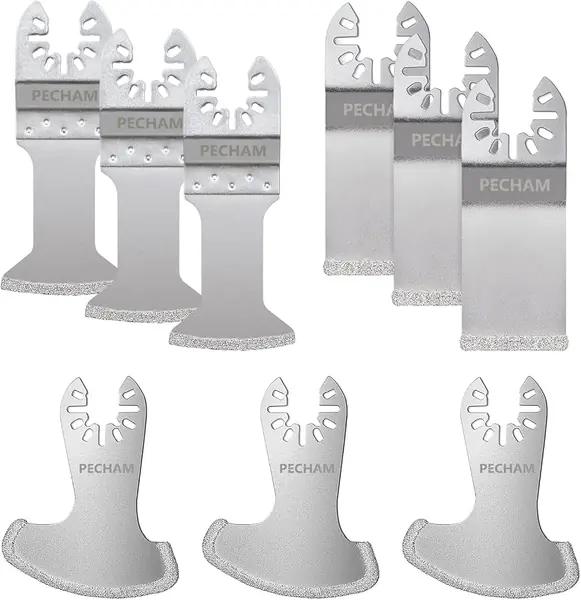
PECHAM 9-Piece Diamond Oscillating Blade Set

PECHAM nine-piece diamond oscillating tool blade set for grout removal

Starter assortment

Shop Score 87/100
Blades Included
9
Cutting Edge
Diamond
Mount
Universal fit
Blade Shapes
Three diamond types
View on Amazon

Nine blades in three diamond shapes is more variety than most grout jobs strictly need, but the shapes are the reason to look at this set. A flat blade with a side-swing design gets into corners a straight blade can't reach, and having several on hand means the right shape is usually already in the box.

This is the set we suggest to someone who hasn't bought grout blades before and doesn't want to guess. It's mid-priced, it fits most major brands, and nine blades will get a bathroom done without a second order. Where it gives ground to the single-blade picks above is consistency — a purpose-built cutter does one thing, and an assortment does several.

Worth knowing before you order: this line is sold in sets from small to enormous, and the listing we're describing is the nine-piece. Check the count and the contents on the page you're buying from, because the price per blade moves a lot between them. As a first box to open on a tiling project, it's the easiest one to get working.

Worth Noting

  • Wears out fast under hard use
Our Verdict

A good first assortment: three diamond shapes and nine blades at a mid-range price, with the corner work covered.

Check Latest Price

How We Tested Grout Removal Blades

We started by sorting the blades sold for oscillating tools by the things that decide whether they work: kerf width, carbide or diamond cutting edge, blade profile, and how the mount fits the tools people already own — universal quick-fit, adapters, and Starlock. From that shortlist we bought 16 blades and sets, from single blades to large multi-packs, and ran them for four months.

Most of the testing happened on a bathroom floor we regrouted start to finish, a kitchen backsplash with tight corners, and a shower surround with narrow lines. For the controlled passes, we cut joints at 1/16, 1/8, and 3/16 inch in scrap tile so each blade met a joint it was meant for. We wore dust masks and eye protection, ran a vacuum at the cut, and reseated every blade in the mount before each pass to check it was locked down.

We timed how long each blade took to clear a set length of joint and counted the linear feet it covered before it stopped biting and started rubbing. A raking light along the tile edge showed chips as they appeared, and we looked at whether the bottom of the joint came out flat or stepped. We noted slop in the mount, whether an adapter was needed and whether it wobbled, and how many blades a full floor ate.

Then we did the math that matters at the register: pack price divided by blades, and again by the feet of grout each pack actually cleared. A cheap single blade that dies halfway through a floor is not the value it looks like.

How to Choose Grout Removal Blades for an Oscillating Tool

Match the Kerf to the Joint Width

Grout lines are not one size, and the blade has to follow the line you actually have. A backsplash or shower wall usually runs 1/16 inch, a floor 1/8 inch, and some large-format floors 3/16. A blade much thinner than the joint wanders and catches tile edges; a blade wider than the joint grinds the tile face itself. Measure one joint with a ruler before you order.

The manufacturers who publish the number are doing you a favor. The Dremel MM501 is a 1/16-inch blade, XXGO's 2.3 mm set is built for 1/8-inch lines and states plainly that it isn't the tool for 1/16, and AMZWEI lists 0.07 inch. If you're between sizes, buy the narrower blade and make two passes down the joint.

Carbide or Diamond

Two different edges do this work. Carbide is a set of teeth that scrapes fast and costs less per blade; it dulls, and its speed makes it easy to chip the shoulder of a soft tile. Diamond is grit bonded to the rim — slower in the cut, longer-lived in abrasive grout, and gentler at the tile edge.

Our rule of thumb: carbide for a bathroom's worth of grout where speed matters, diamond for a floor where you'll be at it for hours and want a fresh edge on demand. Diamond grit is a coating, not a solid edge, which is why the diamond products here come four, six, fifteen and twenty to a pack.

Universal Fit, Adapters, and Starlock

"Universal" on a blade package means the open slots cover the common pin patterns — not that it fits literally every tool. Starlock and StarlockPlus tools hold standard multitool blades with a star-shaped toolless mount and need a Starlock-rated blade; the LEILUO set is the one here that flags that limit. Adapters handle the in-between cases: AMZWEI includes three, EZARC two.

Seat the blade and pull on it before you cut. If it rocks in the mount, it isn't seated, and no adapter fixes a mismatched interface. Check the tool's manual for its mount style if the blade's packaging doesn't name your model.

How Many Blades a Job Eats

The most common buying mistake is one blade for a whole floor. Both edges wear — carbide goes blunt, diamond sheds grit — and a dull blade is what pushes people into leaning on the tool and chipping tile. Buy one blade for a single tile repair, four to six for a bathroom, and a fifteen- or twenty-pack for a floor.

The big packs look expensive on the shelf and are usually the cheaper way to finish a room. They also keep you from stopping mid-job, which matters more than the per-blade math once half the joints are already cleared.

Speed, Pressure, and Dust

Run the tool at low or medium speed with light pressure and let the edge do the cutting. LEILUO publishes exactly that technique with its set, and it applies to every blade here: full throttle and a hard lean are how diamond grit gets stripped and carbide teeth get dulled.

Grout and thinset dust is fine silica, so a dust mask and eye protection are not optional, and a vacuum held near the cut keeps the room workable. Keep the blade square to the joint — levering sideways against the tile edge is how edges chip.

Frequently Asked Questions

Final Verdict

The DEWALT DWA4220 is the blade we recommend to most people: it clears sanded grout faster than anything else here, needs no adapter, and costs about the same as the alternatives. Two situations send you elsewhere. If your joints measure 1/16 inch, the Dremel MM501 is the more controlled cutter. If you have a whole floor ahead of you, buy a diamond multi-pack — the AMZWEI fifteen-piece or XXGO's twenty — and stop interrupting the job for more blades.