↑↓ navigate ↵ open Esc close All results →

Best Router Table Insert Plates of 2026

Every board crossing a router table slides over the insert plate, so even a few thousandths of proud aluminum or phenolic catches stock on the seam and burns the cut. If mounting holes miss your router base or the plate sits slightly loose in the table rebate, no amount of fiddling saves the setup.

Bolting full-size and palm routers onto 12 insert plates across three shop tables over eight months proved one rule above all: measure the table opening and rebate depth before ordering, because an undersized plate never levels properly regardless of leveling screws. Reducer rings proved nearly as vital as plate flatness, since closing the gap around small cutters prevents narrow workpieces from dipping mid-pass.

Pre-drilled plates matched to common bases and blank plates ready for custom hole layouts both work well as long as the plate drops in flush and resists bowing under a heavy motor.

Our Top Picks

The Best Router Table Insert Plates

1.

POWERTEC 71850 Router Table Insert Plate Best Overall
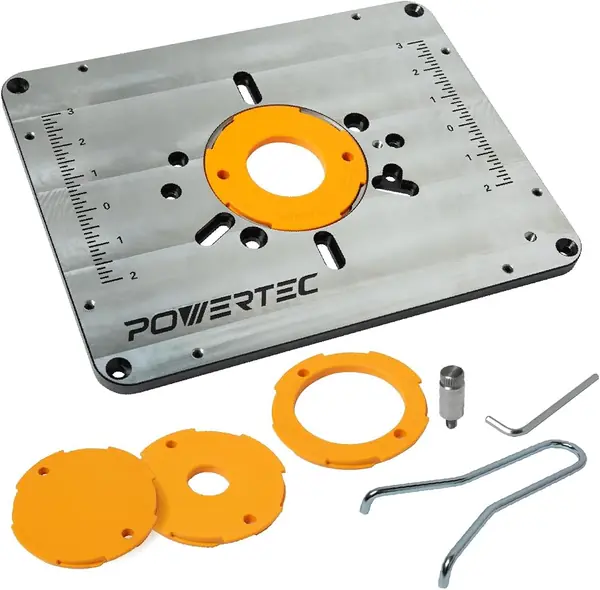
POWERTEC 71850 aluminum router table insert plate with reducer rings and starting pin

Full-size router tables

Shop Score 88/100
Plate Size
9-1/4 x 11-3/4 inches
Reducer Rings
4 (solid, 1", 1-7/8", 2-5/8")
Plate Thickness
3/8 inch
Leveling Points
8
View on Amazon

Four reducer rings, eight leveling screws, a starting pin and the wrench that changes the rings all come in the box with the POWERTEC 71850 — kit that usually arrives as a separate purchase. That completeness, at a midrange price, is why this is the plate we point most first-time table builders to.

The plate is 3/8-inch aluminum, 9-1/4 by 11-3/4 inches, with laser-engraved centerlines running to the bit opening. The ring system is screwless, so swapping the solid ring for the 1-inch, 1-7/8-inch or 2-5/8-inch opening takes a few seconds with the included wrench, and the starting pin gives you a pivot point for curve work when the fence comes off.

Most of what makes an insert plate good disappears once it's bolted down: the surface sits flush, the rings swap without hunting for a tool, and nothing shifts when you set a big bit. The eight adjusters are the part we appreciated most on our own bench. Leveling with four fixed corners means chasing one corner by raising another; with eight points we could bring the surface up in small, separate steps and then leave it alone. The pre-drilled pattern covers the Porter-Cable 690 and 7518 families, the DeWalt DW621 and a long run of Bosch and Makita models, a broader spread than most plates here carry.

Before you order, measure the opening in your table. At 9-1/4 by 11-3/4 inches this is a full-size plate and it wants a cutout made for it — a commercial table with a standard insert opening, or a shop-made top with a rebate for the 3/8-inch thickness. Ours dropped into a standard opening, and the leveling screws brought the surface up flush with the top once it was seated.

Worth Noting

  • Drilling 3/8-inch aluminum for unlisted routers takes care
Our Verdict

We recommend the 71850 as the default full-size plate: plate, four rings, eight leveling screws and a starting pin in one box, for anyone building a table around a common mid-size router.

Check Latest Price
2.

Kreg PRS4034 Precision Router Table Insert Plate Best for Triton Routers

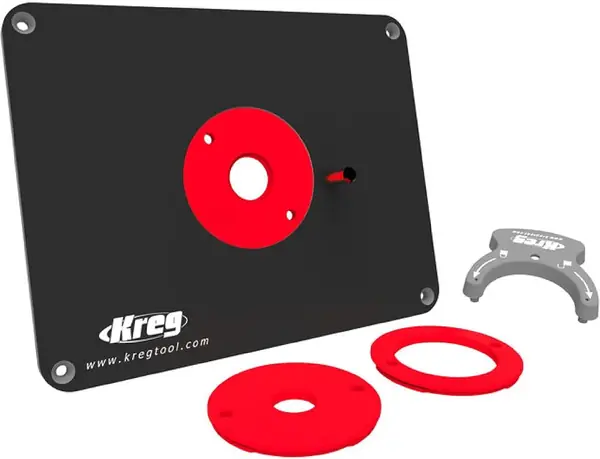
Kreg PRS4034 black phenolic router table insert plate with three Level-Loc rings

Triton router owners

Shop Score 87/100
Material
Compression-molded phenolic
Reducer Rings
3 Level-Loc rings
Plate Thickness
3/8 inch (9.5mm)
Pre-drilled For
Triton MOF001 and TRA001
View on Amazon

For a Triton MOF001 or TRA001, the whole question is whether the holes land, and on the Kreg PRS4034 they do. That pre-drilled pattern, with mounting hardware in the box, is why we send Triton owners here rather than to a blank plate and a drill press.

The plate is 3/8-inch compression-molded phenolic, 9.5mm, black with red printing and centering marks that make it easy to line the base up over the bit opening. Three Level-Loc rings come with it — 1 inch, 1-3/16 inch sized for universal-style guide bushings, and 2-5/8 inch. Phenolic is the material we've come to prefer on a plate: stiff for its weight, flat, and it machines cleanly the one time you do need an extra hole.

What isn't in the box is leveling hardware; the plate, three rings and instructions are the whole kit, so a shop-made opening has to be cut to the plate rather than adjusted to it afterward. On a Kreg table, where the opening is machined to take this plate, that costs you nothing, and the alignment marks plus the pre-drilled holes did the rest for us — the router sat square under the table with no shimming.

Worth Noting

  • Hole pattern fits Triton routers; other bases need drilling
Our Verdict

For a Triton MOF001 or TRA001 owner, this is the plate to buy — the pre-drilled holes land on center, which saves more time than any accessory on this list.

Check Latest Price
3.

SSEHCWAN Aluminum Router Table Insert Plate Best Budget

SSEHCWAN silver aluminum router table insert plate with two red insert rings

Budget table builds

Shop Score 81/100
Material
Aluminum alloy
Plate Size
300 x 235 x 9.5mm
Insert Rings
2
Mounting Hole Spacing
85 x 85mm
View on Amazon

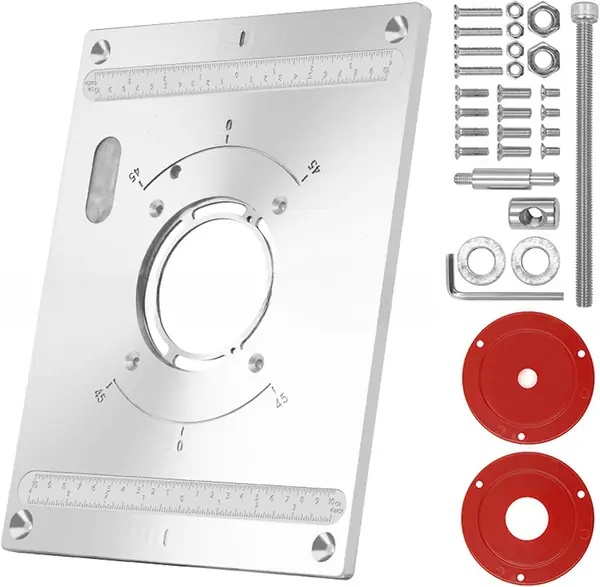
The least expensive full-size plate in this group arrives as a bare aluminum blank: 300 by 235mm, 9.5mm thick, with two red insert rings, a hex wrench, an adjustment lever and a bag of screws. Nothing about it looks expensive, and nothing about the plate suggests it won't do the job.

Mounting is where you do the thinking. The pre-drilled holes sit on an 85 by 85mm spacing, which suits some routers out of the box and means drilling for others, and the four corner sockets plus the center-hole bushing help you line the base up before you commit a bit. On the plate we handled, the edges were sharp enough to catch a shop cloth, so a couple of passes with a fine file before installation is time well spent.

For a shop-made table on a budget, this is the plate we reach for first. The surface is flat, the rings seat, and what you don't spend here goes toward the fence or the lift you'll want later. The 9.5mm aluminum is plenty for a trim or mid-size router; hang a 3-1/2 HP model under it and the support beneath the plate matters as much as the plate itself. It's the value pick in this set, not the last word in refinement.

Worth Noting

  • Limited to two insert rings for bit support
Our Verdict

Our budget pick for a shop-made table: a flat full-size aluminum plate that leaves money for the fence, provided you're ready to drill your own hole pattern.

Check Latest Price
4.

LYHLYA Aluminum Router Table Insert Plate Best for Trim Router Tables

LYHLYA silver aluminum insert plate with four plastic reducer rings for trim routers

Trim router tables

Shop Score 80/100
Material
Aluminum alloy
Plate Size
235 x 120 x 8mm
Insert Rings
4
Mounting Hole Spacing
75 x 68mm
View on Amazon

At 235 by 120mm, this plate is roughly half the width of the full-size plates in this guide, and that's the point of it: a plate built around a trim router and a benchtop top, with a 75 by 68mm hole pattern and four insert rings.

The plate is 8mm aluminum alloy with a printed scale, and it comes with four rings, a pack of fixing screws and a center-hole bushing for alignment. Four rings at this price is the detail we noticed first — a compact table with a small opening gives you support right beside the bit, which is where a palm router leaves the most room for a burn or a snatch.

We like it as the start of a dedicated trim station: bolt on a palm router, cut a shallow rebate in a plywood top, and you have a table for edge profiles and hinge work for very little money. Check the plate against your router base before ordering; at this size, the footprint does as much of the choosing as you do.

Worth Noting

  • Won't span a full-size table opening
Our Verdict

The sensible small-shop buy for a palm router — four rings and a flat 8mm plate for the least money in this group.

Check Latest Price
5.

Garosa 6061 Router Table Insert Plate Best for Palm Router Stations

Garosa anodized 6061 aluminum insert plate for Makita RT0700C palm routers

Palm router stations

Shop Score 79/100
Material
6061 aluminum, anodized
Plate Size
120 x 120 x 8mm
RT0700C Hole Pattern
56 x 45 x 54.3mm
View on Amazon

A 4-3/4-inch square plate won't cover a full-size router table opening, and the Garosa isn't built to. It's 120 by 120mm of 8mm 6061 aluminum with an anodized finish and engraved scale, drilled for palm routers: Makita's RT0700C on a 56 by 45 by 54.3mm pattern, and Dong Cheng, Aoben, KEN, BODA and WORX bases on 70 by 60mm.

The plate is flat, the scale is engraved rather than inked on, and the anodizing holds up to a jig sliding across it, which is more than the price suggests. What it asks in return is care at layout: those three RT0700C figures describe a pattern that isn't rectangular, so only one orientation lines the base up — test-fit the router on the plate before you drill anything. As the heart of a compact trim-router station in a small shop, it's a tidy piece of kit.

Worth Noting

  • Fits palm routers only
Our Verdict

Buy it if you're building a compact station around a Makita RT0700C or a similar palm router, and skip it for anything with a full-size opening.

Check Latest Price

How We Tested Router Table Insert Plates

Before anything got bolted down, we measured the plate openings and rebate depths on the three tables in our shop, then pulled every insert plate whose footprint would drop in — aluminum and phenolic, pre-drilled and blank, from bare-bones to nicely finished. Twelve made the cut and stayed in rotation for eight months.

Each plate went into its rebate dry, and we ran a straightedge and a fingernail across the seam to feel for a lip, then brought it flush with its leveling screws and checked every corner plus the center. We bolted a full-size router to each plate that would take one and pressed on the unsupported middle to see how much it gave, then repeated the test with a palm router on the smaller plates. Holes that missed a router base got noted quickly, and a test cut on scrap told us whether the bit sat centered in the opening or pulled the cut off line.

Reducer rings got the most scrutiny. We fitted the largest ring that cleared each bit, ran stock past the cutter against a fence or over a starting pin with our hands well clear, and watched how close the ring let a narrow offcut get before it tipped into the gap. Throughout, we swapped rings in and out to see whether threads loosened, checked plate edges for dings where stock crossed them, and drilled the blank plates to see how the material behaved under a bit and whether the holes held their size. Finally we set price against the rings, leveling hardware, and finish each plate came with, because a bargain plate that needs rings bought separately isn't one.

How to Choose a Router Table Insert Plate

Start With the Opening, Not the Plate

Two paths lead to a plate: replacing the insert in a commercial table, or cutting a top of your own. Either way the footprint is the first number that matters — a replacement router plate that doesn't match its opening is a project, not an upgrade. Full-size plates are close but not identical, from 9-1/4 by 11-3/4 inches on the POWERTEC to 300 by 235mm on the SSEHCWAN. A couple of millimeters is nothing on a shelf and everything on a rebate, so measure the opening you have or plan to cut to the plate you buy.

Thickness sets the depth of that rebate, and the plates here run from 8mm to 9.5mm. Cut the rebate a hair shallow and let the leveling screws lift the plate flush with the top. Cut it deep and no adjuster saves the joint, because the plate sits below the table and catches every board you feed across it.

Pre-Drilled Holes or a Blank Plate

Every plate here has holes; the question is whether they match your router base. Kreg drills for Triton's MOF001 and TRA001, Garosa drills for palm routers, and the general-purpose plates expect you to drill to your own base — the SSEHCWAN's holes sit on an 85 by 85mm spacing, the LYHLYA's on 75 by 68mm. Buying a pre-drilled plate for a router it doesn't cover gets you a blank plate with extra holes in it.

If you are drilling, center the base over the bit opening with the plate's bushing first, then transfer the holes and drill on a press. Phenolic machines far more easily than 3/8-inch aluminum, so a phenolic plate forgives a layout mistake that an aluminum one will not.

Thickness, Material and the Router You Hang

An insert plate spans an opening and carries the whole router, so stiffness comes from thickness plus whatever sits underneath. A 9.5mm full-size aluminum plate handles a mid-size router without drama; a 3/8-inch plate is the safer span for a 3-1/2 HP model, and even then the rails or corner supports beneath the plate share the load. Phenolic is stiff for its weight, drills cleanly and damps vibration well. Small plates of 120mm to 235mm belong to palm routers, and asking one to span a full-size opening is asking it to sag.

Leveling and Reducer Rings

Leveling screws are how the plate ends up flush instead of proud of the table. Eight adjusters, as on the POWERTEC, let you raise the surface in small separate steps; four corner screws work but make you chase one corner with another. Set the plate with a straightedge across the table and bring the screws up until you cannot slide a fingernail under the edge — honest enough for wood.

Rings are the other half of the feel. The closer the opening sits to the bit, the better the stock is supported and the less tear-out at the exit. Count the rings before you buy and check that the largest one clears the biggest bit you own; a plate with only small rings quietly rules out panel-raising cutters.

Frequently Asked Questions

Final Verdict

The POWERTEC 71850 is the plate we recommend for most builds. Aluminum, 3/8 inch thick, with eight leveling points, four reducer rings and a starting pin included, it covers a full-size opening and a long list of mid-size routers without asking you to buy the accessories separately.

Triton owners should take the Kreg PRS4034 instead — pre-drilled holes that land on center are worth more than any add-on. And if the budget is the binding constraint, the SSEHCWAN gives you the same footprint and a flat surface with the drilling left to you.