↑↓ navigate ↵ open Esc close All results →

Best CNC Router Bits for Wood of 2026

Shoppers often sort CNC router bits by price or carbide grade, overlooking the flute spiral direction that decides whether a board comes off the table glass-smooth or frayed. An upcut spiral evacuates chips cleanly while lifting top-face fibers; a downcut leaves the top surface crisp at the expense of chip clearance; a compression bit seals both faces in one pass at a higher price.

Six months of slab flattening, cutting plywood cabinet parts, V-carving letters, and plunging deep mortises with 14 bits reinforced two rules for newer operators. Always verify a bit's maximum RPM rating against the spindle's top speed before spinning it up, and watch for early burn marks or fuzz, which signal a dulling edge long before a cutter breaks.

Our Top Picks

The Best CNC Router Bits for Wood

1.

Whiteside RD2100 Downcut Spiral Bit Best Overall

Whiteside RD2100 downcut spiral router bit with quarter-inch shank and solid carbide flutes

Everyday CNC routing

Shop Score 94/100
Shank
1/4 inch
Cutting Diameter
1/4 inch
Cutting Length
1 inch
Material
Solid carbide
View on Amazon

Downcut geometry shears the wood downward, so the face nearest the collet — the top face on a CNC — comes off glassy instead of fuzzy. That single behavior is the argument for the Whiteside RD2100, and it is why we load it first for plywood, veneered panels, inlay pockets, and any part where sanding would blur a crisp edge. It measures 1/4 inch in cutting diameter with 1 inch of cutting length on a 1/4-inch shank, ground in solid carbide.

We ran it through Baltic birch, cherry, and hard maple on both a small CNC and a trim router, listening for the rattle that says a shank is not running true. There was none. The bit settles into a cut, stays quiet, and clears chips without packing them into the kerf, and the finish off the tool wanted a light hand-sand rather than a scraper.

One caution we picked up along the way: a downcut spiral pushes chips down into the pocket it is cutting, so closed shapes need a ramp entry and a blast of air between passes. Give it that and the edge quality is worth the small amount of extra setup.

What keeps it at the top of this list is consistency. Nothing about the cut changed across a long afternoon of pocket work — same edge, same chip flow, same finish — and that predictability is what you are paying for in a solid carbide bit at this price. The Amana below is the upgrade when edge life matters more than the outlay; for everyone else this is the one to buy first.

Worth Noting

  • 1-inch cutting length stops short of deep mortises
Our Verdict

This is the bit we keep in the collet for everyday routing: a downcut spiral that leaves a clean top face and holds its edge through hardwood and plywood.

Check Latest Price
2.

BINSTAK Spoilboard Surfacing Bit Best for Flattening Slabs

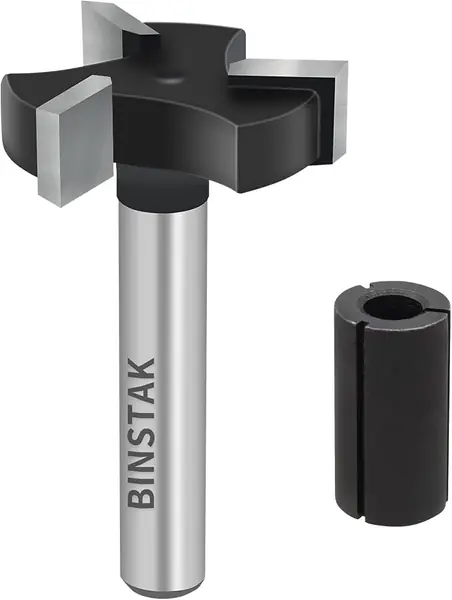
BINSTAK one-inch carbide-tipped spoilboard surfacing bit with quarter-inch shank and three wings

Slab flattening

Shop Score 93/100
Shank
1/4 inch
Cutting Diameter
1 inch
Maximum RPM
18,000
Number Of Flutes
3
View on Amazon

One inch of cutting diameter, three carbide wings, and a 1/4-inch shank: this is the entry point to flattening a slab or truing a spoilboard on a small CNC or a trim router. The bottom-cleaning design puts the tips flat to the work, so a run of shallow passes leaves a surface you can scrape and sand instead of a washboard.

We ran it over glued-up panels and a live-edge slab, taking light passes because a 1/4-inch shank has no business hogging. Faint scallops showed at the overlap — three wings at a slow feed will do that — and it never grabbed or kicked. For the outlay, it answered the question we actually had: does a surfacing bit earn bench space in a small shop? A couple of times a year, yes.

Two things to know before it goes in the spindle. The bit is rated to 18,000 RPM, well under what most trim routers run at their top setting, so turn the speed down and let the width of the cut do the work. And it is a single-purpose cutter — this is for flattening, not for profiling an edge or cutting joinery. Both are easy to live with if flattening is what you bought it for.

Worth Noting

  • Edge life trails the solid carbide spirals here
Our Verdict

The least expensive way to try slab flattening on a small machine, and it does the job as long as you slow the spindle down.

Check Latest Price
3.

FOOS 4-Piece Carving Bit Set Best for Sign Making

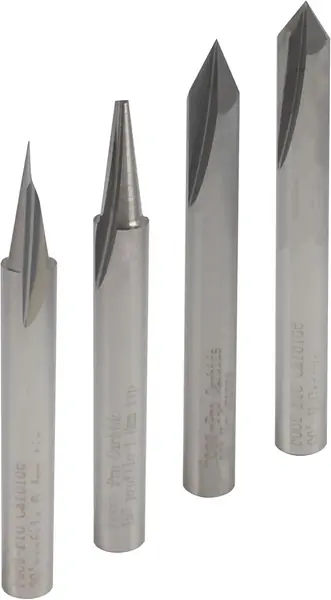
FOOS four-piece carbide carving bit set with 15 to 90 degree tips and quarter-inch shanks

Sign making

Shop Score 92/100
Shank
1/4 inch
Overall Length
2-1/4 inches
Tip Material
Solid tungsten carbide
Included Angles
15, 20, 60 and 90 degrees
View on Amazon

Four bits, four angles: a 15-degree profile cutter, a 20-degree liner, and 60- and 90-degree V-grooves, all on 1/4-inch shanks and 2-1/4 inches overall. That spread is what sign work asks for — a wide V for big letters and borders, the 60 for tighter lettering and inside corners, and the two steep bits for hairlines and cleanup around carved features.

The tips are the story. The V-bits come to a 0.3 mm point and the liner to 0.4 mm, which is what produces a crisp, sharp-bottomed groove instead of a rounded one, and it also makes them the most fragile cutters on this page. We cut pine and walnut signs in shallow passes and got clean lettering with no splintering at the edges, but a deep plunge with one of these will snap a tip before you can back off.

What we appreciate is that the set is honest about its job. It never pretends to be a general-purpose kit — there is no straight bit for clearing waste, so plan on a small end mill or a 1/8-inch upcut to hog out the field before the V-bits come through. Bought for lettering, inlays, and decorative grooves, it earns its shelf space; you are paying for four ground cutters, not one.

Worth Noting

  • No straight bit for clearing waste
Our Verdict

For signs, lettering, and fine carving, this set covers the angles you actually use, and the 60-degree V is the one we reach for most.

Check Latest Price
4.

SpeTool Compression Bit Best for Plywood

SpeTool compression spiral router bit with quarter-inch shank and three-inch overall length

Plywood cuts

Shop Score 91/100
Shank
1/4 inch
Cutting Diameter
1/4 inch
Cutting Length
1-1/4 inches
Overall Length
3 inches
View on Amazon

Plywood punishes ordinary bits. An upcut spiral fuzzes the top veneer, a downcut one tears the bottom, and either way you end up sanding a face you can barely reach. A compression bit fixes that by putting both flute directions on one cutter — up-cut near the tip to clear chips, down-cut above it to shear the top edge — so a full-depth pass leaves both faces clean.

This SpeTool is 1/4 inch in diameter with 1-1/4 inches of cutting length on a 3-inch overall length, 1/4-inch shank, under a TAC coating meant to hold off heat on long runs. In Baltic birch and melamine-faced particle board it produced a top edge that needed no sanding at all, and the bottom came off clean too as long as we cut past the up-cut section.

That is the operating condition, and it is worth internalizing before you buy: the geometry only works when the down-cut flutes are buried in the material, so the cut has to run deeper than the up-cut section and, in practice, be taken in one full-depth pass or a ramp. That is more demanding on a small machine than the multiple shallow passes a plain downcut tolerates.

Get the depth right and it is the cleanest plywood cutter we used — no tearout, no sanding, and the edge held through a long run of cabinet parts without the finish falling off. It costs well under the Amana, which makes it the pragmatic pick for anyone cutting sheet goods every week rather than once a season.

Worth Noting

  • Little benefit on stock thinner than the up-cut flutes
Our Verdict

If you cut plywood and both faces show, this is the bit: a compression spiral that leaves top and bottom edges clean in one pass.

Check Latest Price
5.

Amana Tool Spektra 46202-K Best for Production Work

Amana Tool Spektra 46202-K downcut spiral bit with quarter-inch shank and nACo coating

Production routing

Shop Score 90/100
Shank
1/4 inch
Cutting Diameter
1/4 inch
Overall Length
2-1/2 inches
Coating
nACo nanocomposite
View on Amazon

The nACo coating is why this bit costs what it does: a nanocomposite layer that raises surface hardness and resists heat, which is what actually kills an edge on a long run. Underneath is solid carbide, 1/4 inch in diameter on a 1/4-inch shank with a downcut spiral for clean top edges, in a 2-1/2-inch overall length.

We put it through the same plywood and hardwood cuts as the Whiteside, and the difference showed up late rather than early. The edge stayed crisp well past the point where an uncoated bit starts rubbing, and on melamine and prefinished plywood — where one chip-out scraps the part — that stubbornness is the whole value.

For anyone cutting sheet goods for money, this is the pick: fewer bit changes, a consistent finish, and a cutter that behaves the same on the hundredth part as the first. If you build a few things a season and break a bit every other project, the Whiteside above does the same job for less and you will never wear this one out.

Worth Noting

  • Premium price for a single cutter
Our Verdict

A premium downcut for shops that cut sheet goods all day: the coated edge keeps going long after cheaper bits start burnishing.

Check Latest Price
6.

EANOSIC 4-Inch Upcut Spiral Bit Best for Deep Mortises

EANOSIC extra-long upcut spiral router bit with four-inch overall length and blue coating

Deep mortises

Shop Score 89/100
Shank
1/4 inch
Cutting Diameter
1/4 inch
Cutting Length
2 inches
Overall Length
4 inches
View on Amazon

Two inches of cutting length on a 1/4-inch diameter is a lot of reach, and it is the entire point of this EANOSIC bit: deep mortises, thick glue-ups, and any cut where a standard 1-inch bit runs out of flute before it runs out of work. Overall length is 4 inches, the shank is 1/4 inch, and the carbide carries a blue nACo coating.

Upcut geometry does the opposite of the downcut spirals above — it pulls chips up and out of the cut, which keeps a deep slot clear instead of packing it. That is the reason to want this bit in a mortise: 2 inches down, chip evacuation matters more than what the top face looks like.

Reach has a cost. A cutter this long flexes more than a stubby one, so heavy feeds produce chatter and walls that look like corduroy. We kept the depth of cut conservative and let spindle speed do the work, and the walls came out straight and square to the bed.

It is not the bit for finish work on a visible face, and it is not the bit to learn on — long, thin, and 1/4 inch across is a combination that snaps when you lean on it. But when a job needs the bottom of a 2-inch mortise, this is the one that gets there, and nothing else here does.

Worth Noting

  • Top face needs sanding after upcut passes
Our Verdict

When a job needs to reach the bottom of a deep mortise, this is the bit on the page that gets there — 2 inches of cutting length on a 1/4-inch shank.

Check Latest Price
7.

HQMaster 1/8-Inch Upcut 10-Pack

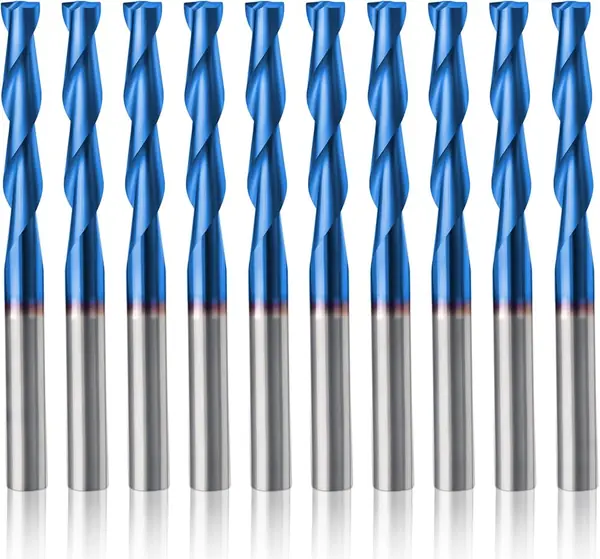
HQMaster ten-piece 1/8-inch shank upcut spiral bit set in a plastic storage case

Small-bit stock-up

Shop Score 88/100
Shank
1/8 inch
Cutting Diameter
1/8 inch
Cutting Length
11/16 inch (17 mm)
Pack Quantity
10 bits
View on Amazon

Ten bits in a plastic case for less than one premium spiral: that is the pitch, and it holds up if your machine takes 1/8-inch shanks. Each is 1/8 inch in cutting diameter and shank, 11/16 inch of cutting length inside a 1-1/2-inch overall length, two flutes, upcut, with a nano blue coating. As a consumable kit for a desktop router, the math makes sense.

We treat them as consumables, which is the right mental model at this diameter: a bit that meets a bad ramp or a climb cut is going to snap, and having nine more in the drawer changes how you feel about that. In plywood, MDF, and small inlay pockets they cut clean and track a toolpath without wandering, and the short flute keeps them stiff enough to behave.

Where they earn their keep is on a small machine running signs, inlays, and light profiling, where a broken bit is a two-minute inconvenience rather than a lost afternoon. Keep the case shut between jobs, keep your feeds honest, and expect to lose the smallest bits first.

Worth Noting

  • Short 11/16-inch cutting length limits stock thickness
  • Snaps on aggressive ramps at 1/8 inch
Our Verdict

A ten-pack of 1/8-inch upcut bits that turns breakage into a shrug — the right buy for a desktop CNC cutting signs and inlays.

Check Latest Price
8.

SpeTool 60-Degree V-Groove Bit Best for V-Carved Lettering

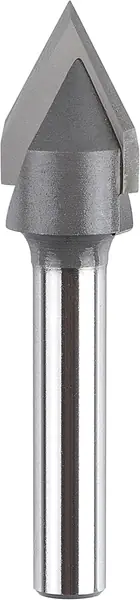
SpeTool 60-degree V-groove router bit with half-inch cutting diameter and quarter-inch shank

V-carved lettering

Shop Score 87/100
Shank
1/4 inch
Cutting Diameter
1/2 inch
Included Angle
60 degrees
View on Amazon

Half an inch of cutting diameter on a 60-degree V is a big cutter for a 1/4-inch shank, and that is what makes it useful: wide, deep V-carves taken in one pass instead of three, with a clean bottom in the groove. It is a carbide tip on a steel body with a 1/2-inch cut diameter and a 1/4-inch shank.

We used it on sign borders and large lettering in oak and MDF, and it cut deeper and cleaner than the small V-bits in the FOOS set — the wide head steadies it in the groove, so it tracks a V-carve without the shimmy you get from a long, thin tip. On bold lettering it saved us a roughing pass.

It is a specialty cutter rather than a first purchase. Sixty degrees suits bold lettering and decorative grooves; wide, open lettering wants the 90-degree version of the same bit, and fine text still wants a sharp point. Keep the passes light, too — there is a lot of cutter hanging off a small shank.

Worth Noting

  • Sold in one angle at a time
Our Verdict

A wide, stable 60-degree V for bold lettering and deep decorative grooves, and a good partner to a set rather than a replacement for one.

Check Latest Price

How We Tested CNC Router Bits for Wood

We started with specs — shank diameter, cutting diameter, cutting length, flute geometry, and carbide grade — and cross-checked them against what working CNC owners say about edge life and value. From that shortlist we bought 14 bits at retail, in the geometries that cover what a small shop actually cuts, and put them into rotation for six months.

The work happened on a benchtop CNC in a garage shop and in a trim router mounted in a table, on weekday evenings and weekend mornings, which is when most of this cutting really gets done. We milled plywood cabinet parts, flattened rough slabs, V-carved lettering into sign blanks, and cut mortises deeper than a standard bit's reach.

Every bit went into a correctly sized collet — a 1/4-inch or the matching 1/8-inch, never a reducer sleeve — and we checked each one's RPM rating against the router's top speed before the first cut. We clamped the workpiece every time and wore eye and hearing protection. At each pass we felt the bit and the cut edge, watched where the chips went, and noted whether the slot packed up or cleared.

Sharpness was the number that mattered most: we counted how many linear feet each bit cut before burn marks and fuzzy edges appeared, then weighed that against what the bit cost. The best ones left an edge that needed almost no sanding off the machine; the weakest left scorch marks in deep passes at speeds the machine could otherwise hold.

How to Choose CNC Router Bits for Wood

Upcut, Downcut, or Compression: Pick by Which Face Must Be Clean

Every spiral bit moves chips in one direction, and that direction is the face that splinters. An upcut pulls chips up and leaves a clean groove bottom with a fuzzy top face; a downcut does the reverse, which is why the Whiteside stays in our collet for anything visible. A compression bit combines both, but only works once its down-cut flutes are buried in the stock. If both faces of your sheet goods show, compression earns its extra setup; if one face is hidden, a plain downcut does the job for less.

Match Shank and Diameter to the Machine You Own

Two shank sizes cover nearly every machine in a small shop: 1/4 inch and 1/8 inch. Match the bit to the collet you actually have — running a 1/8-inch shank in a reducer sleeve works, but reducers are the first thing to slip under load. Diameter also sets the smallest inside corner you can cut, because a 1/4-inch bit cannot leave a 1/8-inch radius. Detail work means stepping down, which is where a pack of 1/8-inch cutters earns its place.

Cutting Length and Reach Against Stock Thickness

You need flute length to spare, but not a lot of it. One inch of cutting length handles 3/4-inch stock with the collet clear of the work; deep mortises and thick glue-ups need something like the 2-inch reach of the EANOSIC. Reach always costs rigidity — a long, thin cutter deflects, so plan on lighter passes and a slower feed. Check overall length against Z travel too: a 4-inch bit needs 4 inches of clearance above the bed before it ever touches wood.

Carbide, Coatings, and What an Edge Is Worth

Solid carbide holds an edge longest, and brazed carbide tips are the cheaper alternative that dulls sooner — the honest trade on a surfacing bit. Coatings such as nACo, TAC, and the nano blue finishes buy heat resistance more than sharpness, and heat is what actually kills an edge. We treat small-diameter bits as consumables and buy them by the pack. For a 1/4-inch spiral doing daily work, a coated cutter like the Amana is the cheaper way to keep cutting.

Feeds, Speeds, and Keeping the Cut Cool

A bit that is cutting makes chips; a bit that is rubbing makes dust and heat. If your cuts come out brown and powdery, the bit is rubbing rather than slicing — raise the feed or drop the spindle speed until the chips get bigger. Respect stated limits, too: the wide surfacing bit here is rated to 18,000 RPM and has no business at 24,000. As a starting rule, keep the depth of cut at or under the bit's own diameter, and halve that on small 1/8-inch cutters.

Frequently Asked Questions

Final Verdict

Start with the Whiteside RD2100. Clean top edges, a quiet cut, and an edge that survives hardwood and plywood make it the bit we reach for first on any job with a visible face, and it is the one purchase here that covers the widest range of work.

Add the BINSTAK surfacing bit for slabs and spoilboards, and the SpeTool compression bit if you cut sheet goods for a living. For deep mortises, the EANOSIC's 2 inches of reach is the difference between finishing the job and ordering a longer bit anyway. Everything else here answers a narrower question, and you will know when you hit it.