↑↓ navigate ↵ open Esc close All results →

Best CNC Router Bits for 3D Carving of 2026

Between a 3D relief that comes off the CNC looking finished and one requiring an hour of hand sanding sits a fraction of a millimeter at the very tip of the bit. A tiny tip radius reaches crisp lettering, eyelashes, and fine detail, yet the slender neck behind it snaps easily if a finishing pass takes too heavy a bite.

Navigating that trade-off across seven months of cutting walnut, maple, and scrap pine with 14 tapered and straight ball nose bits showed that specialty coatings rarely beat sharp geometry for leaving minimal fuzz. Just as important, checking shank diameter against the router's existing collet avoids ordering a taper angle that cannot even be mounted.

At consumable bit prices, keeping two reliable spares on hand beats babysitting one expensive cutter you hesitate to plunge.

Our Top Picks

The Best CNC Router Bits for 3D Carving

1.

SpeTool 5-Piece Tapered Ball Nose Set Best Overall
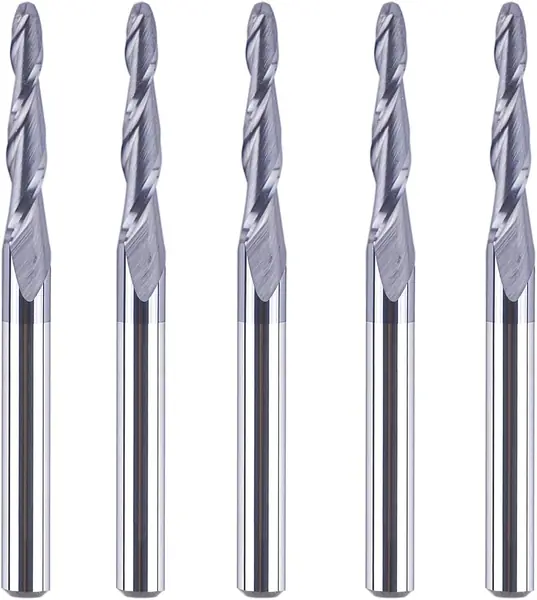
SpeTool five-piece tapered ball nose end mill set with TiAlN coating and 1/8-inch shanks

Fine-detail relief work

Shop Score 92/100
Taper Angle
2.24° single side
Shank Diameter
1/8 inch
Tip Radius
1.0mm (2.0mm diameter)
Bits Per Pack
5
View on Amazon

Five tapered ball nose bits for less than one of the premium cutters here is the arithmetic that got our attention. The geometry is what kept them in the collet: a 2.24-degree taper behind a 1.0mm radius tip, fine enough to pick lettering and the folds in a carved leaf out of the background, and thick enough above the ball that the bit does not whip in the cut.

Tiny tips are where budgets go to die, because a 1mm ball snaps if you plunge it wrong. We have not snapped one, and the edge has stayed sharp through relief after relief in walnut and cherry, which is the judgment that made this our top pick rather than just the cheapest way to get five bits. Panels came off the machine wanting a light hand-sand, not an evening with a detail sander.

Two flutes clear chips quickly in hardwood, and the TiAlN coating earns its keep on long finishing passes where a bare bit cooks. Fifteen millimeters of cutting length is the trade: plenty for shallow reliefs and sign work, not enough to bottom out a deep-carved panel without switching to a longer cutter like the Jiiolioa 3.6-degree. Nothing here is fragile enough to baby, which is a quality we value in a bit that goes where the material is.

Worth Noting

  • 1/8-inch shank needs a matching collet
Our Verdict

We recommend this set to anyone carving reliefs on a machine that takes an 1/8-inch collet: five sharp tapered bits, and the tips last.

Check Latest Price


2.

EANOSIC E242 Tapered Ball Nose End Mill Best for 1/4-Inch Collets

EANOSIC tapered ball nose end mill with 1/16-inch tip and blue nACo coating

1/4-inch collet machines

Shop Score 90/100
Taper Angle
5.4° single side
Shank Diameter
1/4 inch
Overall Length
2-1/2 inches
Tip Diameter
1/16 inch (1/32 inch radius)
View on Amazon

A 1/4-inch shank means this end mill goes straight into the collet most routers and hobby spindles already have, with no adapter sleeve in the stack to add runout to a cutter whose whole job is a smooth surface. On a machine set up that way it is the simplest bit here to put to work, and the 1/16-inch ball on a 5.4-degree taper is the profile we recommend as a first tapered bit.

The rest of the numbers describe a finishing tool: 2 flutes, 1 inch of cutting length, 2-1/2 inches overall, and a blue nACo coating that keeps heat down on long passes. What we noticed is how little sanding the surface wants afterward. The ball leaves an even scallop pattern instead of torn grain, which matters most in oak and plywood, where a dull edge fuzzes the surface and no amount of finish hides it.

Where it stops is depth and fineness. An inch of cutting length covers most sign work and shallow relief; deeper pockets want the longer Jiiolioa 3.6-degree, and hair-fine lettering wants a 1/32-inch tip like the Amana or the YOKISHUN. For everything between those two edges, this is the bit we keep mounted.

Worth Noting

  • Single bit per order, so budget for a spare
Our Verdict

Buy this one if your spindle already has a 1/4-inch collet and you want a single reliable tapered bit for relief and lettering.

Check Latest Price
3.

Amana Tool 46280-K Tapered Ball Tip Bit Best Premium for Ultra-Fine Detail

Amana Tool 46280-K tapered ball tip router bit with 1/32-inch diameter and 1/4-inch shank

Ultra-fine finishing passes

Shop Score 89/100
Taper Angle
6.2°
Shank Diameter
1/4 inch
Flute Count
3
Tip Size
1/32 inch diameter, 1/64 inch radius
View on Amazon

The most expensive bit on this page, and the tip explains it: a 1/32-inch ball with a 1/64-inch radius, ground in the U.S. from solid carbide and finished with Amana's Spektra nACo coating. That is not a general-purpose cutter. It is the bit you mount after the shape already exists and you want the surface to stop needing work.

Three flutes and a 6.2-degree taper put it in different territory from the 2-flute wood bits. It handles acrylic, HDPE, PVC, sign foam, phenolics and composites as readily as hardwood, and it is the one here we reach for when the workpiece is not wood.

Where it earned its price for us was the last pass. Three flutes shear rather than scrape, so the scallop pattern on a finished relief came out shallower and more even than what our 2-flute bits left, and details like hair and small lettering had edges instead of fuzz. That is a real difference, and one you only see once your cheaper bit is already cutting cleanly.

The caution is the tip itself. A 1/64-inch radius is a fragile thing that wants conservative depth per pass and a ramp rather than a plunge, so this is not the bit to rough with; treat it as the final cutter on a toolpath that has already moved the bulk, and the fragility stops mattering.

Worth Noting

  • Highest price in this group by a wide margin
Our Verdict

Worth the premium only if your work stops at the last thousandth of an inch; for everything before that final pass, a cheaper bit does the job.

Check Latest Price
4.

Jiiolioa 1/8-Inch Ball Nose End Mill Best Budget Ball Nose

Jiiolioa 1/8-inch ball nose spiral end mill with 1/4-inch shank and blue coating

Roughing and blending

Shop Score 88/100
Shank Diameter
1/4 inch
Flute Count
2
Cutting Length
1/2 inch
Cutting Diameter
1/8 inch
View on Amazon

Every relief starts as a block that has to go away, and this is the bit for that half of the job. A 1/8-inch ball nose with no taper, a 1/4-inch shank and half an inch of cutting length: plain, stiff, and inexpensive enough that a bad cut is annoying rather than expensive.

We reach for it before the tapered bits come out. The up-cut spiral pulls chips out of a pocket instead of packing them, and the thicker core behind the ball does not deflect on a heavier stepdown the way a 1/16-inch tip will. Running a two-stage toolpath with this one roughing and a tapered bit finishing gave us flatter floors and put a fraction of the wear on the fine bits.

It also does the work nobody photographs: softening a contour that came off the machine faceted, blending a curve into a flat, rounding an edge before finish goes on. At 2 inches overall it stays out of the way on a trim router, and it runs in a handheld plunge router as easily as on the CNC.

Worth Noting

  • Ball leaves scallops a smaller bit has to clean up
Our Verdict

Our pick for the unglamorous half of 3D carving: this ball nose clears material fast and survives the mistakes a fine tip would not.

Check Latest Price
5.

YOKISHUN 6.2-Degree Tapered Ball Nose Bit Best Value Fine-Detail Taper

YOKISHUN 6.2-degree tapered ball nose bit with 1/32-inch tip and 1/4-inch shank

Budget fine-detail carving

Shop Score 86/100
Taper Angle
6.2°
Shank Diameter
1/4 inch
Overall Length
3 inches
Tip Diameter
1/32 inch
View on Amazon

Same 6.2-degree taper, same 1/32-inch ball, same inch of cutting length as the Amana above, at a price that makes the comparison worth spelling out. If you want premium fine-detail geometry without premium money, this is the one we point people to.

Three flutes and the blue nACo coating put it closer to a production bit than the price suggests, and the 3-inch overall length gives you extra shank to hold when you are reaching into a pocket. It cut cleanly for us in red oak and MDF, and the scallop pattern from a finishing pass sanded out with a few light strokes. Chip clearance in MDF, the material that punishes a dull edge fastest, was as good as we expect from three flutes.

What you give up is edge life. A 1/32-inch tip on an inexpensive bit will not hold its edge as long as the premium one, so buy a replacement with the first order and do not plan a production run around a single cutter. For one-off signs and hobby reliefs, that is a trade we make happily.

Worth Noting

  • Shorter edge life than premium bits in production runs
Our Verdict

If the Amana's geometry is what you want but the price isn't, this gets you the same 1/32-inch tip and taper for much less.

Check Latest Price
6.

Jiiolioa 3.6-Degree Tapered Ball Nose End Mill Best for Deep Relief Pockets

Jiiolioa 3.6-degree tapered ball nose end mill with 1/16-inch cutting diameter

Deep relief pockets

Shop Score 85/100
Taper Angle
3.6° single side
Overall Length
3 inches
Cutting Length
1-1/2 inches
Cutting Diameter
1/16 inch
View on Amazon

One and a half inches of cutting length on a 1/16-inch tip is the reason to pick this over the other 1/16-inch bit here. Most tapered bits that fine stop at an inch, and an inch does not reach the floor of a deep relief or the inside of a carved bowl.

The 3.6-degree single-side taper is what makes that reach workable: the diameter grows slowly behind the tip, so the cutter stays slim where it is reaching in, and the solid carbide core still carries the load. Two flutes clear chips fast in the open, and 3 inches overall gives you room to hold it in the collet.

We keep it as the deep-pocket bit. On shallow relief the extra length buys nothing and costs rigidity next to the steeper 5.4-degree EANOSIC, which is stiffer for the same tip size; once a model has a pocket deeper than an inch, the trade flips and this is the one we want in the spindle.

Worth Noting

  • Extra cutting length sacrifices rigidity on shallow reliefs
Our Verdict

Reach is the reason to buy it: 1-1/2 inches of cutting length lets a 1/16-inch tip finish the bottom of a deep relief.

Check Latest Price

How We Tested the Best CNC Router Bits for 3D Carving

We started with every tapered ball nose and straight ball nose bit we could find in the two shank sizes benchtop and hobby machines actually use, then filtered by the things that change a carve: tip radius and cutting diameter, taper angle, cutting length, flute count, coating, and cost per bit. Anything that wasn't solid carbide came off the list, and so did any listing that never stated its tip radius, since a bit you can't measure before you buy is a bit you're guessing with. That left 14 bits, which we ran for seven months.

Testing happened where these bits actually live: a garage shop on weekends, on a small benchtop machine with an 1/8-inch collet and a larger one with a 1/4-inch collet, in walnut, maple, and scrap pine. Every bit cut the same three jobs — a shallow relief heavy on fine detail, a run of lettering, and a deep pocket that pushed it to its usable reach — then took a full finishing pass. Eye protection went on before every cut, and every shank was seated all the way into the collet before the spindle started.

After each pass we ran a fingernail across the surface to feel the scallops the stepover left, then sanded until they vanished and logged the minutes; the finer tips consistently saved the most sanding, which mattered more than any coating. We watched for chatter in the deep pocket, timed how each bit cleared chips at faster feed rates, and kept a cut log of how many linear feet an edge survived before it started tearing end grain instead of slicing it. Cost per bit went into that log too, along with whether a spare came in the pack.

How to Choose CNC Router Bits for 3D Carving

Tip Radius Is the Real Specification

A ball nose leaves a scalloped surface, a series of shallow arcs that a smaller radius makes finer and a larger one makes coarser. That is why the tip, not the shank or the coating, is the first number to read. A 1/16-inch tip handles most relief carving, sign work and lettering; a 1/32-inch tip holds hair-fine detail but adds a lot of passes over the same area.

Our advice is to match the tip to the smallest feature in your model, not to the biggest. If you are carving a 12-inch panel whose finest detail is quarter-inch lettering, a 1/16-inch tip is plenty, and dropping to 1/32 inch mostly adds machining time.

Tapered Ball Nose or Straight Ball Nose

A straight ball nose like the Jiiolioa 1/8-inch is a cylinder with a rounded end: stiff, inexpensive, and good at clearing material and blending a contour. A tapered bit narrows from a 1/4-inch shank down to a small ball, which puts more carbide behind a fine tip and lets it reach places a straight cutter of the same tip size cannot.

In practice we use both on the same job, the straight ball nose for the roughing pass and the tapered bit for the finish. If you are buying one at a time, buy the straight bit first; it does the majority of the cutting and it is the one that survives a learning curve.

Match the Shank to Your Collet

Shanks come in 1/4 inch and 1/8 inch, and the wrong one stops the job before it starts. A 1/8-inch shank will not hold in a 1/4-inch collet, and a reduction sleeve adds a little runout to a cutter that exists to leave a smooth surface.

Check your collet before you order. Most trim routers and hobby CNC spindles ship with a 1/4-inch collet, which is why the EANOSIC and Amana bits drop in while the SpeTool set needs the smaller one. If you are buying 1/8-inch bits, order the collet at the same time rather than planning to work around it.

Flutes, Coatings, and How Long the Edge Lasts

Two flutes clear chips fast in wood and are the default for relief work. Three flutes shear more cleanly and are worth it where the finish matters more than the feed rate or where the stock is harder than wood. Coatings such as nACo and TiAlN are about heat: they keep the edge from cooking during long finishing passes.

Edge life is what you are really paying for at the top of the market. Buy two of whatever finishing bit you settle on, because a dull tip burns the surface and a snapped one stops the job, and neither is something you want to discover mid-carve.

Reach, Cutting Length, and Breakage

Cutting length is how deep the flutes go, and every extra fraction of an inch makes a small tip more likely to deflect or snap. Choose the shortest cutting length that reaches the deepest point in your model: half an inch for shallow signs, an inch for typical relief, an inch and a half only when a pocket demands it.

Then let the toolpath do the rest. Ramp into the cut instead of plunging straight down, keep depth per pass conservative, and do not run a 1/32-inch tip at the feed rate you used for a 1/8-inch ball nose.

Frequently Asked Questions

Final Verdict

For most people carving reliefs on a hobby or benchtop machine, the SpeTool five-pack is what we recommend: five tapered bits with a 1.0mm tip, a taper that keeps them rigid, and the tip durability we trust most in this group. The 1/8-inch shank is the catch, and it is a solvable one, since a collet ordered with the bits settles it.

If your spindle already takes a 1/4-inch collet and you want one bit rather than five, the EANOSIC E242 is the alternative: the same tapered idea at a 1/16-inch tip, no adapter in the stack, and enough cutting length for most sign work.


