↑↓ navigate ↵ open Esc close All results →

Best Slab Flattening Router Bits of 2026

The opening pass across a rough slab reveals everything about a surfacing bit. Held in a rigid sled, a sharp cutter peels long ribbons and leaves a plane flat under a straightedge, while a dull or oversized bite chatters, scorches the grain, and turns milling into an hour of heavy sanding.

Five months of flattening live-edge oak, walnut, MDF, and epoxy pours across both a router sled and a small CNC table with 16 surfacing bits quickly exposed two hard limits. Driving a two-inch cutter on a 1/4-inch shank magnifies every bit of hold-down flex, and spinning a bit rated for 16,000 RPM in a router locked at 22,000 RPM leaves instant burn rings across the slab.

Matching shank size to the router collet, keeping cutter diameter realistic for the motor, and choosing between lower-cost brazed carbide and replaceable carbide inserts determines how smoothly wide tops come flat.

Our Top Picks

The Best Slab Flattening Router Bits

1.

BINSTAK Carbide Insert Surfacing Bit Best Overall
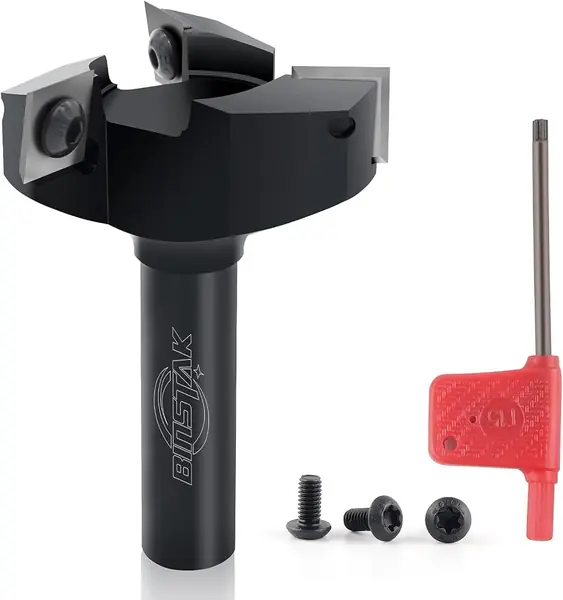
BINSTAK carbide insert spoilboard surfacing router bit with two-inch cutter and half-inch shank

Router sled flattening

Shop Score 94/100
Shank
1/2 in
Cutting Diameter
2 in
Flutes
3
Insert Size
12 x 12 mm, four edges
View on Amazon

Every surfacing bit is a wear item, and the good ones let you renew the edge instead of replacing the tool. This BINSTAK carries three 12 x 12 mm carbide inserts with four usable edges apiece, so a dull cutter becomes a fresh one with a screwdriver. We like that math: a two-inch body on a half-inch shank, with edges that rotate four times before you buy anything new.

In a sled, the two-inch diameter is the part you notice first. Each pass covers a wide band across the slab, so a big top takes a manageable number of runs instead of a whole morning of them, and the half-inch shank keeps that wide cutter from wandering when you take a deeper bite. The three wings throw chips clear enough that we were not stopping every few minutes to dig out a packed gullet.

Mind the speed. The bit is rated to 16,000 RPM, slower than plenty of routers will spin at full dial, so turn it down and let the inserts do the cutting. On walnut and maple it left a surface that needed an orbital pass rather than a belt sander, and the edges of the cut stayed clean where a dull bit would have torn the grain.

Two things to accept before you order. It needs a half-inch collet, which rules out trim routers, and the insert edges wear faster in dense, abrasive woods than in softwood or MDF. Neither is a surprise at this price: you are buying the body once and the edges as you go.

Set against the rest of this group, the SICWOOD covers more width per pass and the SpeTool fits a quarter-inch collet, but neither undercuts this one's balance of speed, stability, and renewal cost. That balance is what keeps it at the top for a router sled or CNC table that can take a half-inch shank.

Worth Noting

  • Needs a half-inch collet
  • Insert edges wear faster in dense woods
Our Verdict

We recommend it to anyone with a half-inch collet: big enough to cover a slab quickly, and replaceable inserts keep it cutting weekend after weekend.

Check Latest Price
2.

Whiteside 6210 Spoilboard Bit Best for Small CNC Machines

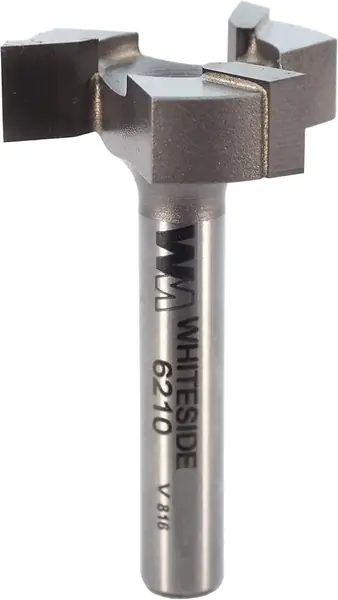
Whiteside 6210 carbide-tipped spoilboard surfacing router bit with one-inch cutter and quarter-inch shank

Small CNC tables

Shop Score 93/100
Shank
1/4 in
Cutting Diameter
1 in
Flutes
3
Cut Length
1/4 in
View on Amazon

One inch is the smallest cutter in this group, and on a compact machine that is the point. Surfacing an 18-inch wasteboard on a benchtop CNC, or working under a gantry with barely any Z clearance, calls for a short bit a quarter-inch collet can hold without complaint. The Whiteside 6210 is built for exactly that job.

What sold us is the edge. The carbide arrives sharp and keeps its bite through MDF and hardwood, and the finish off the three wings is smooth enough that tool marks sand out with a couple of passes instead of a belt sander. It also runs true in a trim router, which is not something we can say for every inexpensive quarter-inch bit we have spun.

The trade-off is speed. A one-inch cutter on a 20-inch slab means a lot of overlapping passes, and you spend at the router the time you thought you were saving at the sander. Feed it in light passes, let the wings clear the chips, and the surface comes off flat and ready for an orbital. On a small machine, that is a fair exchange.

Worth Noting

  • Premium price for a small cutter
Our Verdict

Our choice for benchtop CNCs and trim routers: sharp, smooth-cutting, and small enough to fit a machine with very little clearance.

Check Latest Price
3.

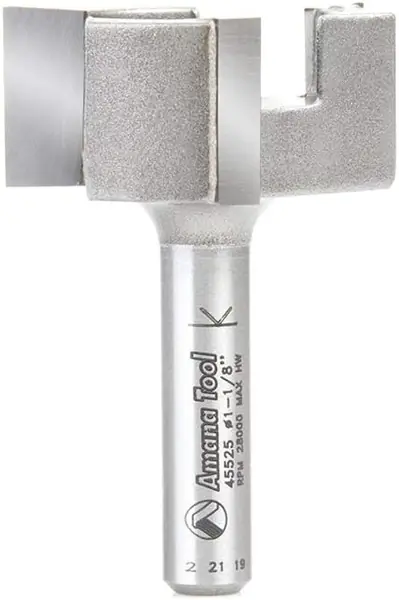
Amana Tool 45525 Surfacing Bit Best Carbide-Tipped Bit

Amana Tool 45525 carbide-tipped flattening router bit with quarter-inch shank and coated cutting edges

Figured wood slabs

Shop Score 92/100
Shank
1/4 in
Cutting Diameter
1-1/8 in
Cut Length
1/2 in
Cutter Type
Carbide-tipped
View on Amazon

When the wood is figured, the last thing you want is a cheap edge chattering across it. We buy the Amana for the cut: carbide tipped, coated to resist pitch and heat, and finished well enough that a slab comes off flat with almost no tearout along the edges of the pass.

In a plunge router it is easy to control, and the half-inch cutting length gives you working depth before the shank starts crowding the collet. We paid close attention to how it handled hard maple and epoxy, since that is where inexpensive bits burn, and it stayed clean through both.

It is a quarter-inch shank, so the cutter needs patience. At a little over an inch wide it removes stock more slowly than the two-inch insert bits here, and a deep, fast pass asks the shank to do work it should not. Two or three lighter passes leave a better surface than one ambitious one anyway.

If your router takes a half-inch collet and your slabs run wide, the insert BINSTAK gets you there faster. If it does not, this is the quarter-inch bit we trust on the cuts that matter.

Worth Noting

  • Premium price for a quarter-inch bit
Our Verdict

We buy it for the edge: coated carbide that leaves figured wood and epoxy clean, provided your router takes a quarter-inch collet.

Check Latest Price
4.

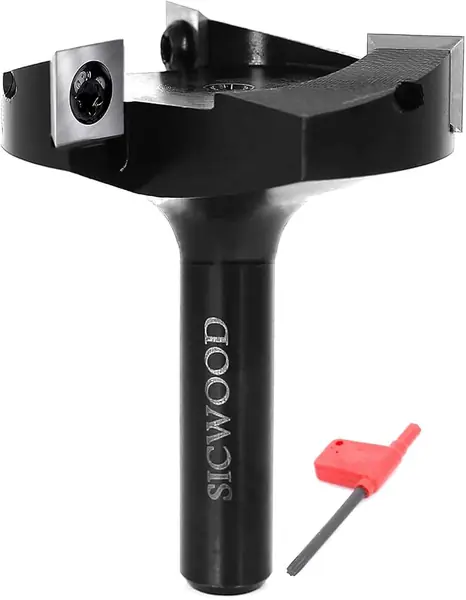
SICWOOD Slab Flattening Bit Best for Wide Slabs

SICWOOD slab flattening router bit with two-and-three-eighths-inch cutter and replaceable carbide inserts

Wide live-edge tops

Shop Score 91/100
Shank
1/2 in
Cutting Diameter
2-3/8 in
Inserts
12 x 12 x 1.5 mm
Max Speed
16,000 RPM
View on Amazon

Wider cutters trade control for time, and at 2-3/8 inches this SICWOOD covers more slab per pass than any two-inch bit here. On a big top, that is the difference between an afternoon and a weekend.

The body arrives heavy and well machined, and the inserts are sharp out of the box. We got clean, chatter-free passes on rough stock and on a cherry slab, with no tearout along the edges of the cut. The 16,000 RPM ceiling is a reminder that this much cutter belongs on a router with real power, run at a sensible speed.

We found that weight is an asset in a rigid sled or on a gantry, where it steadies the cut instead of fighting you, and a liability in a light plunge base. Give it a stout half-inch router and it is the fastest route to a flat top among the bits here that a person can still steer by hand.

Worth Noting

  • Replacement inserts must match pocket depth
Our Verdict

For wide live-edge tops, this heavy 2-3/8-inch insert cutter covers ground fast, provided your sled and router can carry it.

Check Latest Price
5.

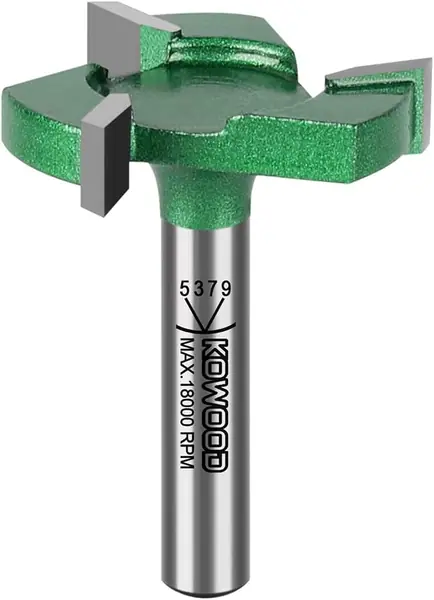
KOWOOD PRO Spoilboard Bit Best Value Quarter-Inch Bit

KOWOOD PRO three-wing carbide-tipped spoilboard surfacing router bit with quarter-inch shank

Compact router setups

Shop Score 90/100
Shank
1/4 in
Cutting Diameter
1-1/4 in
Flutes
3
Cut Length
1/4 in
View on Amazon

A quarter-inch shank with a 1-1/4-inch cutter is the combination that actually works on a compact router: small enough that the motor does not bog down, wide enough to make progress on a slab. The KOWOOD PRO is the bit we hand to someone flattening their first top.

It cuts clean. Through pine and MDF we got an even surface with no burn, and the three wings clear chips well enough that the cut stays cool. No scorch marks means no extra sanding, which is the whole argument for a dedicated surfacing bit. The 1/4-inch cutting length keeps it honest, too: this is a bit for skimming a surface flat, not for taking an inch of twist out of a chainsaw-cut slab.

It is also the least fussy bit here. No inserts to rotate, no screws to lose, just a brazed carbide edge you use until it is done. Compared with the SpeTool insert bit you give up renewable edges, but you spend far less up front and you get the same clean cut in softwood.

Worth Noting

  • Edge life shortens in hardwoods
Our Verdict

The value pick in a quarter-inch shank: it cuts pine and MDF cleanly without burning and asks very little of a compact router.

Check Latest Price
6.

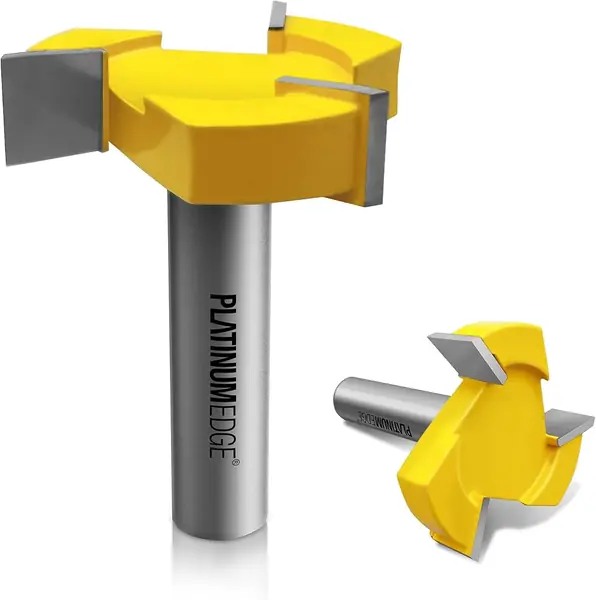
PlatinumEdge Spoilboard Bit Best Low-Cost Two-Inch Bit

PlatinumEdge two-inch carbide-tipped spoilboard surfacing router bit with half-inch shank

Spare and starter bit

Shop Score 89/100
Shank
1/2 in
Cutting Diameter
2 in
Flutes
3
Cut Length
1/2 in
View on Amazon

A two-inch cutter at the lowest price in this group is the whole pitch, and it holds up. The PlatinumEdge is a half-inch-shank, three-wing carbide-tipped bit with a half-inch cutting length, working dimensions that match the pricier bits here.

In a sled it cut flat and clean through pine and plywood with no burning at sensible feed rates, and the half-inch shank held it steady in the cut. We did not fight chatter or tearout, which is not what we expected from the least expensive big bit on the page.

What we cannot tell you yet is how many slabs it survives. That is the open question with any bit at this price, and it is why we treat this one as a second bit rather than the only bit in the drawer.

That is a genuinely useful role. Keep it for the day your good bit meets a hidden nail, for a spoilboard you surface twice a year, or for the first slab you are not sure you know how to flatten. We think it is the least risky way to find out whether this whole approach suits your shop.

Worth Noting

  • Long-term durability on multiple slabs remains unproven
Our Verdict

A cheap, capable spare: it flattens pine and plywood flat on a half-inch shank, and we do not mind risking it on suspect stock.

Check Latest Price
7.

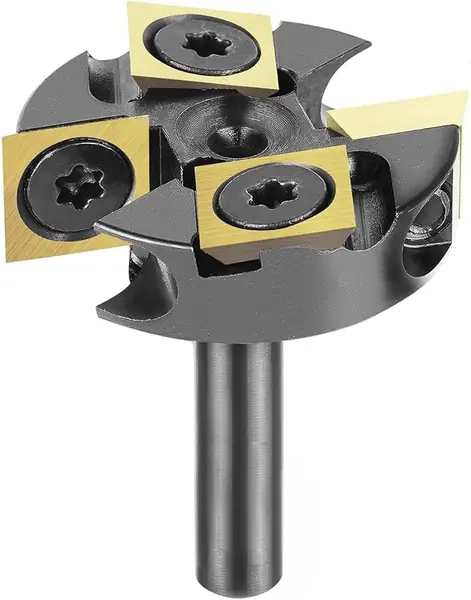
SpeTool W05004 Flattening Bit Best for End-Grain Finishing

SpeTool W05004 insert flattening router bit with quarter-inch shank and coated carbide inserts

End-grain finishing

Shop Score 88/100
Shank
1/4 in
Cutting Diameter
1-1/4 in
Inserts
10 x 10 x 2.2 mm
Cutting Edges
2+2
View on Amazon

The 2+2 insert layout is what sets the SpeTool apart. Two inserts rake the cut and two more clean the bottom, so the floor of the pass comes out flatter than with a simple two-knife design. On end grain, where cheap bits give themselves away, we got a surface with no fuzz and no torn fibers.

Each coated insert takes a fresh edge four times, rotated with a small wrench, which is the argument for an insert bit at this diameter: you keep a sharp quarter-inch cutter without buying a new one every few projects. It spun without noticeable vibration in a compact router, and the cut stayed smooth as the edges wore in.

It wants light passes. A quarter-inch shank driving a 1-1/4-inch cutter will find the flex in a small router, so take the depth in stages and let the geometry do the work. Buy it when the finish on end grain is the part you care about.

Worth Noting

  • Priciest of the quarter-inch bits
Our Verdict

We choose it when the finish matters most: a quarter-inch insert bit whose 2+2 geometry leaves end grain unusually clean.

Check Latest Price
8.

Akylin 3-Inch Flattening Bit Best for Large CNC Gantries

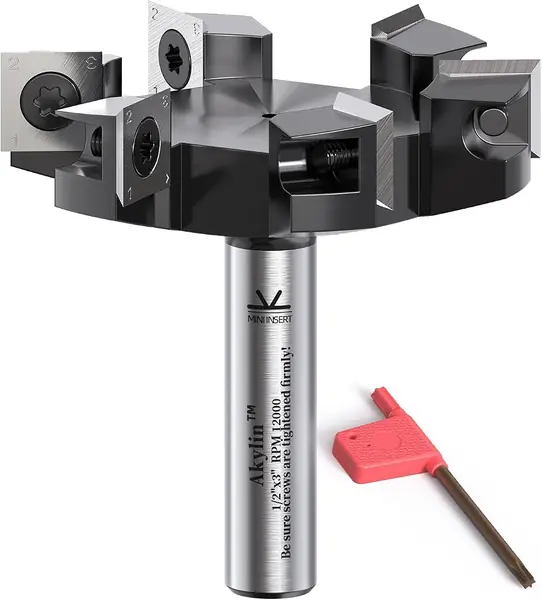
Akylin three-inch six-wing slab flattening router bit with half-inch shank and carbide inserts

Large CNC gantries

Shop Score 87/100
Shank
1/2 in
Cutting Diameter
3 in
Flutes
6
Inserts
14 x 14 x 2 mm
View on Amazon

Three inches of cutter and six inserts put the Akylin in a different class from everything else here. This is a bit for a CNC gantry or a heavy, well-braced sled, not for the trim router on the bench.

The point is time. A three-inch swath cuts the pass count roughly in half against a two-inch bit on a wide top, and the six inserts leave a bottom flat enough to go straight to an orbital sander. The 14 x 14 mm inserts rotate to a fresh edge in a couple of minutes, and the six-insert layout that looked fussy on paper is the part we appreciated most.

The scale is also the catch. This much cutter needs rigidity, and on a light router it will chatter no matter how carefully you set the depth. On a machine that can drive it, the time saved on a big top is real, and the finish shows it.

Worth Noting

  • Too large for a trim router
Our Verdict

We reserve it for rigid machines: three inches and six inserts that flatten a wide top in far fewer passes.

Check Latest Price
9.

BINSTAK 4-Wing Spoilboard Bit Best for First-Time Flattening

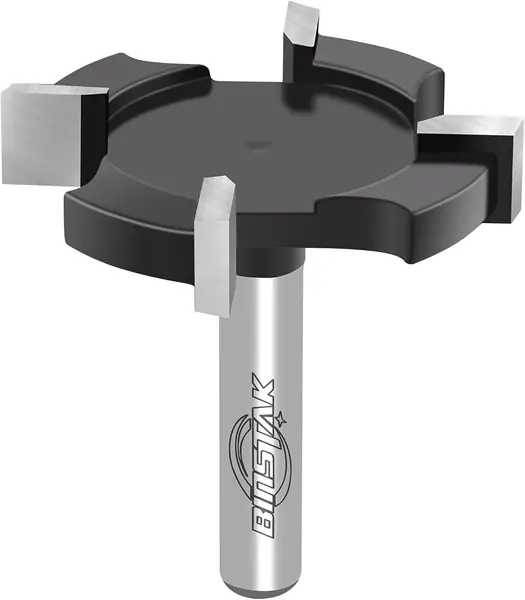
BINSTAK four-wing carbide-tipped spoilboard router bit with one-and-a-half-inch cutter and quarter-inch shank

First-time flattening

Shop Score 86/100
Shank
1/4 in
Cutting Diameter
1-1/2 in
Cut Length
1/4 in
Max Speed
18,000 RPM
View on Amazon

Four wings and a 1-1/2-inch cut make this the widest inexpensive quarter-inch bit here, and in a small sled that is a real advantage: fewer passes from a router that would struggle to spin a half-inch-shank bit this wide.

In pine and MDF it behaved like a bit costing far more. The anti-kickback body kept the cut predictable, chips cleared, and the spoilboard came out flat with a finish that needed little more than a hand sand.

Where it gives ground to the Whiteside is on harder stock. The edge stops feeling new noticeably sooner in oak, and once it dulls the four wings start burnishing rather than cutting, so keep this one for softwoods, MDF, and spoilboards.

As a first surfacing bit, or as the spare you do not mind loaning out, we think it is a sensible deal. It is also an inexpensive way to find out whether your router and sled are rigid enough for this work before you spend real money on an insert bit.

Worth Noting

  • 18,000 RPM ceiling limits router speed
Our Verdict

A sensible first surfacing bit: wide, inexpensive, and easy on a small router, and it leaves a spoilboard flat enough to trust.

Check Latest Price

How We Tested Slab Flattening Bits

We started with every 1/4-inch and 1/2-inch surfacing bit we could find that published a maximum RPM, then cut anything that wouldn't fit a standard collet or carried no speed rating at all. Sixteen made the shortlist, from compact quarter-inch cutters to a three-inch six-wing gantry bit, in both brazed carbide and replaceable-insert designs. We bought them at retail and spent five months with them, so we were testing what actually arrives at your door.

Every bit went into a router sled over the same rough-sawn stock: live-edge oak and walnut with grit still in the bark, an end-grain maple board, a sheet of MDF, and two epoxy pours. The quarter-inch cutters also ran on a small CNC table. Before the first pass we set the router's speed dial against each bit's rated ceiling, put on eye and hearing protection, and took shallow cuts with the slab clamped and the sled locked down. Nothing was run freehand, and nothing was pushed past its stated top speed.

At each pass we watched what came off the cutter, long ribbons versus dust, and checked the surface with a straightedge for ridges and stepover marks. We ran bits until the edge dulled, logging how many slabs it took, whether corners burned during a dwell at the end of a pass, and how much vibration we felt at top speed. Cutting length got its own check: we pushed each bit as deep as its reach allowed and noted when the shank started crowding the collet. On the insert bits we rotated every edge, priced replacements in the sizes the pockets actually take, and counted cost per finished slab rather than sticker price.

How to Choose a Slab Flattening Router Bit

Match the Shank to the Router You Own

A half-inch shank is the right starting point if your router accepts one. It carries a two-inch cutter without the whip a quarter-inch shank shows under the same load, which is why every large bit here uses it. If your only router is a trim or palm model, stay in that lane. No adapter makes a slim shank stiffer, and a wide cutter on a quarter-inch shaft is where chatter and bent bits come from.

That leaves the quarter-inch bits here, which run from a one-inch cutter to a 1-1/2-inch one. Our advice: pick the widest quarter-inch bit your router's power will carry, and take shallower passes than you think you need.

Cutting Diameter Is a Trade Between Speed and Control

A wide cutter covers more slab per pass, and that is the single biggest time saver in flattening. It also multiplies the load. A two-inch bit wants a half-inch collet and a router with real horsepower; 2-3/8 inches and up belongs on a rigid sled or a CNC gantry. On a compact machine, 1 to 1-1/4 inches is the practical ceiling, and the extra passes are the price of a cut you can control.

The trap is buying diameter for its own sake. A router that bogs in the cut leaves scallops, and sanding those out costs more time than the passes you saved.

Carbide Tips or Replaceable Inserts

Brazed carbide is cheaper up front and cannot be renewed; when it dulls, you buy another bit. An insert body costs more and lets you rotate each insert to a fresh edge, usually four per insert, so a wide cutter stays sharp across several slabs for the price of a set of inserts. We reach for inserts when the slabs are big or the wood is abrasive, and for brazed carbide when the budget is tight and the job is small.

The trap sits in the reorder. Inserts are sold by diameter and thickness, and 12 x 12 mm cutters come in 1.5 mm and 2.2 mm versions that will not seat in each other's pockets. Measure the old insert or match the exact size the bit lists before buying spares.

RPM, Heat, and the Burn Marks That Cost You an Hour

Large surfacing bits are rated at 16,000 to 18,000 RPM, well below what many routers will spin at full dial. Running a two-inch cutter flat out generates heat, and heat is what dulls an edge and scorches a surface. Turn the speed down, take a shallower bite, and keep the router moving.

When a cut starts leaving brown streaks, the edge is dull. Sanding burn out of a slab takes longer than rotating an insert or swapping a bit, so treat the first scorch mark as your cue.

Frequently Asked Questions

Final Verdict

For most shops, the BINSTAK insert bit is the one to buy. Two inches of cutter on a half-inch shank covers a slab quickly, and the replaceable inserts mean the edge you are cutting with next year costs a few screws instead of a new tool.

If your router only takes a quarter-inch collet, choose between the Amana for the cleanest edge on expensive wood and the Whiteside for the best fit on a small machine. And if you are still deciding whether slab flattening is for you, the PlatinumEdge two-inch bit lets you try the work without tying up real money.