↑↓ navigate ↵ open Esc close All results →

Best Router Bits for Acrylic of 2026

Acrylic routes cleanly right up until heat builds at the tip, melting shavings onto the flutes and smearing a clear edge into cloudy, gummy plastic. That failure rarely comes from the sheet itself; plastic needs wide chip-clearing flutes that run cool rather than wood-cutting geometry built for oak.

Over five months on handheld routers and a benchtop CNC, we tested 14 acrylic bits to see which edges stayed clear past the first few feet of cut. Shank fit sets the floor for cut quality before flute design even enters the picture, because a 1/8-inch cutter in a loose adapter chatters and scorches plastic regardless of carbide quality.

Different tasks—from perimeter cutouts and edge roundovers to production runs and fine engraving—call for specific flute layouts, yet good geometry leaves acrylic edges smooth enough to skip heavy sanding.

Our Top Picks

The Best Router Bits for Acrylic

1.

SpeTool O Flute Upcut Spiral Bit Best Overall

SpeTool O-flute upcut spiral router bit with 1/4-inch shank and carbide cutter

Handheld router work

Shop Score 90/100
Shank
1/4 inch
Cutting Diameter
1/8 inch
Cutting Length
3/4 inch
Flute Type
Single O-flute, up-cut
View on Amazon

The quarter-inch shank is what puts this bit in our router rather than on a shelf. A lot of acrylic cutters are sold on 1/8-inch CNC shanks, which means a second collet or an adapter sleeve before you can make a cut; this one seats in the collet that came with the tool. Past that it does what an acrylic bit is supposed to do: a single up-cut flute with a wide valley, so the chip leaves the kerf instead of being recut into a gummy line along the edge.

In quarter-inch sheet we got a clean, even edge and no melted buildup on the flute, which is the first thing we check with plastic. The cutter is 1/8 inch across and 3/4 inch long, so it is happiest on curves, cutouts, lettering, and light trimming rather than long heavy straight runs, where a bigger cutter has more bite but also more heat to manage. We also like how readable the single flute is in use: when the feed is right, the chips come off as a steady stream and the note of the cut stays even.

What we respect about it is the neck. An 1/8-inch cutter on a quarter-inch shank has a slim waist, and that waist is what gives way if you lean on the bit, so shallow passes with a steady feed are how we run it, and the edge quality holds as long as the flutes are allowed to clear. Where it stops: it will not hog out a deep groove in one go, and if the job is sheet after sheet, the HQMaster pack below handles that differently.

Worth Noting

  • Sold as a single bit rather than a pack
Our Verdict

Our pick for most acrylic work: the 1/4-inch shank fits a standard router collet, and the single O-flute clears chips instead of smearing them along the edge.

Check Latest Price
2.

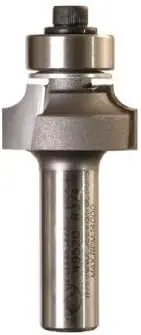
Amana Tool 49510 Corner Rounding Bit Best for Edge Profiles

Amana Tool 49510 carbide-tipped round-over router bit with 1/2-inch shank

Rounding acrylic edges

Shop Score 89/100
Shank
1/2 inch
Cutting Diameter
1-1/8 inches
Radius
5/16 inch
Cutting Height
1/2 inch
View on Amazon

Rounded, not cut, is the short version. The 5/16-inch radius takes a square acrylic edge down to an even round, with a pilot bearing running along the workpiece to set the depth, so the profile repeats wherever you push it. At 1-1/8 inches across it is a substantial cutter, and the 1/2-inch cutting height gives you some margin on thicker sheet.

We reach for this one when a raw sawn edge is going to be seen, because a softened edge reads as finished in a way that sanding alone rarely manages on plastic. It arrived cutting cleanly and stayed that way through a stretch of half-inch offcuts, with the profile consistent from end to end and none of the chatter that shows up the moment a tip or a bearing loses its edge. That consistency is the whole value of a profile bit: you set the height once and every edge after it matches.

Treat it as a finishing tool rather than a replacement for a cutting bit, because something still has to cut the part out before this shapes its edge. The carbide is why we are comfortable pointing people to it as the priciest bit here, since a profile bit lives or dies on how long its edge stays true, and a dull one scars every edge that follows. If your acrylic work is all square-edged panels, this is money you do not need to spend.

Worth Noting

  • Fixed 5/16-inch radius, one profile per bit
  • 1/2-inch shank requires a full-size router
Our Verdict

We recommend it when an acrylic edge will be seen: a carbide round-over that leaves a uniform profile and saves you the hand-sanding.

Check Latest Price
3.

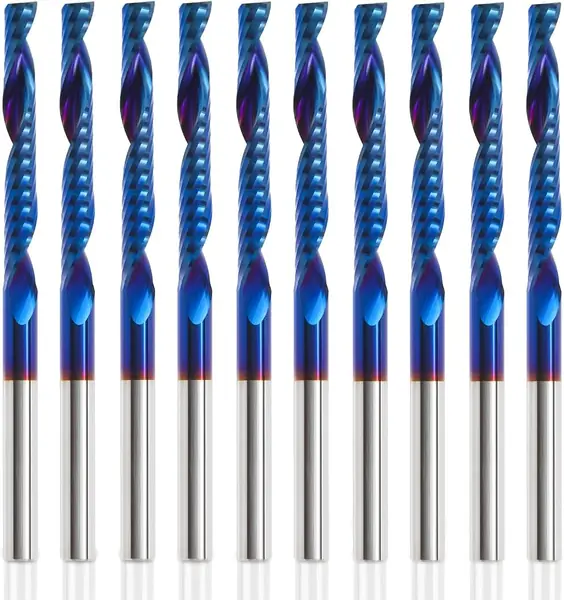
HQMaster O Flute Upcut Router Bit 10-Pack Best Value Multi-Pack

HQMaster ten-pack of 1/8-inch shank single-flute upcut spiral router bits in a case

CNC production cutting

Shop Score 88/100
Shank
1/8 inch
Cutting Diameter
1/8 inch
Cutting Length
1 inch
Pack Size
10 bits
View on Amazon

Ten bits in one case changes the rhythm of a job. A dull edge becomes a swap instead of an order and a wait, which is the whole argument for buying acrylic cutters in packs: on a CNC the bit is a consumable and should be treated like one rather than nursed through its last usable hour.

These are single-flute up-cut spirals on a 1/8-inch shank, with an 1/8-inch cutter and a full inch of cutting length, the longest small cutter here and enough to work through a stack of quarter-inch sheet in a couple of passes. If you already cut plastic on a CNC, the geometry needs no explanation. If you are new to it, the wide flute valley is what keeps chips moving instead of welding to the cutter and dragging along the edge.

We keep a case of these within reach because the edge quality is good enough that we do not save them for rough work: cuts come off clean and the chips clear rather than balling up around the cutter. The thing to plan for is feed. One flute wants a steady hand or a clean toolpath, and anything thicker than a quarter inch gets light passes. Once you accept them as consumables, the arithmetic works in your favor instead of against you.

Worth Noting

  • 1/8-inch shank needs an adapter in a router
Our Verdict

We buy these by the case: ten single-flute O-flute bits that make a dull edge a quick swap on CNC acrylic work.

Check Latest Price
4.

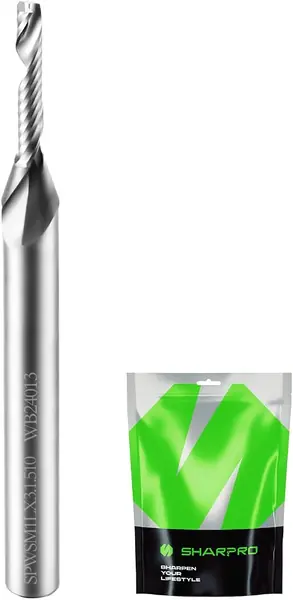
SHARPRO 1/16-Inch O Flute Upcut Bit Best for Fine Detail

SHARPRO 1/16-inch single-flute upcut router bit with 1/8-inch shank

Tight detail work

Shop Score 87/100
Shank
1/8 inch
Cutting Diameter
1/16 inch
Cutting Length
3/8 inch
Overall Length
40 mm
View on Amazon

Half the diameter of everything else on this page is the point, and it is why we keep one within reach. A 1/16-inch cutter turns inside radii that a 1/8-inch bit simply cannot enter: tight inside curves, small lettering, inlay pockets, the details that get skipped because the bit will not fit.

It is sharp, and the polished single flute leaves an edge in acrylic and polycarbonate that we were happy to leave alone, which is not something we say about every small cutter. On plexiglass the chips came off fine and small, the sign that the flute is clearing rather than rubbing. Set against the 1/8-inch bits here, you give up stiffness and speed for the ability to get into places they cannot.

The trade is fragility. A 1/16-inch cutter has very little carbide behind the edge, so a deep plunge or a fast feed is how these bits die, and shallow passes with a light touch are the deal rather than a suggestion. When the job needs to remove material instead of tracing a shape, we put it down and pick up the SpeTool.

Worth Noting

  • 3/8-inch cutting length limits depth per setup
  • 1/8-inch shank needs an adapter in a router
Our Verdict

For detail a 1/8-inch bit cannot reach, we reach for this one: a sharp 1/16-inch O-flute that rewards light passes.

Check Latest Price

How We Tested Router Bits for Acrylic

We built the shortlist from the flute up. Bits with narrow chip valleys, the kind meant for wood, went to the bottom of the pile, and we compared cutting diameter, cutting length, and shank against the job each bit claimed to do. Price came last and only as cost per bit, since a ten-pack of serviceable cutters can beat one expensive bit when the work is repetitive.

Fourteen bits went into the shop for five months. We cut 1/4-inch cast acrylic sheet into sign blanks, jig plates, and a run of display-case panels, alternating between a benchtop CNC and a handheld router mounted in a table. The corner-rounding bits got their own job: reshaping edges already cut on panels too big to re-fixture. Every bit ran in a matched collet, with a 1/8-inch shank going into a 1/8-inch collet or a proper adapter sleeve, on shallow passes with a steady feed, and we wore eye and hearing protection the whole time.

After each pass we looked at the chips — fine snow meant the cutter was clearing, paste meant it was recutting and heading for trouble — and checked how warm the shank felt. Each cutter ran a set number of linear feet so we could feel when it started taking more push to get through the same sheet, which is where edge-holding showed up under load. We held every finished edge against a light for cloudiness and ran a thumbnail along it to catch chatter. An edge that needed sanding or flame polishing to look right got marked down; one that came off the table clean didn't.

How to Choose Router Bits for Acrylic

Start with the flute count

One flute is the plastic standard for a reason. A single O-flute leaves one big valley for chips to ride out of the kerf, so the cutter is not recutting the same shaving until it welds to the flutes. A two-flute straight bit has half the chip room and more friction, which shows up as a gummy, cloudy edge on anything but the thinnest sheet.

If you also cut MDF and plywood, an O-flute handles those too, just with a slower finish than a bit designed for wood. We would rather own one sharp single flute for plastic than one do-everything bit that compromises every material.

Check the shank before the cutter

Plenty of acrylic bits are listed by cutting diameter, which hides the number that decides whether the bit fits your tool. A 1/8-inch cutter on a 1/4-inch shank, like our top pick, drops into a standard router. A 1/8-inch shank is the CNC and trim-router size and needs a matching collet or an adapter sleeve, and our Amana pick uses a 1/2-inch shank that wants a full-size router.

These cutters are often listed as end mills, and the shank figure is the only reliable way to tell what a given listing will actually fit. Read both numbers, because they are not the same measurement.

Decide whether you are cutting out or finishing an edge

Cutting bits do the shape work: spirals and straight bits cut out parts, lettering, and cutouts, while flush-trim and pattern bits copy a template. Edge bits shape what you have already cut, whether that is a round-over softening a square edge or a chamfer breaking it at an angle.

Most acrylic jobs need the first before the second, so buy the cutting bit first and the profile bit when the edge is going to be seen or handled. Nothing is more frustrating than a perfect round-over on a part that is the wrong shape.

Cutting length sets how deep one pass goes

Cutting length is the most depth you can take in a single plunge, and with plastic you rarely want all of it. Long cutters like the 1-inch HQMaster reach through thicker sheet; short ones like the 3/8-inch Sharpro are for shallow detail work in thin stock.

Whatever the length, two lighter passes leave a better edge than one deep one. The bit has less material to heat and more chance to clear it, which matters most on thick acrylic where heat has nowhere to go.

Spend where the edge shows

Our own priority is to save on cutting bits and spend on the profile bit. In a CNC setup the cutting bits are consumables, so a ten-pack of single-flute spirals makes sense because you swap them without thinking about it.

A round-over that only ever takes finishing passes is worth the carbide, since a chipped tip shows up in every edge you cut with it afterward. Buy the cheap one where the edge never gets seen and the good one where it does.

Frequently Asked Questions

Final Verdict

The SpeTool O-flute is the one we put in the collet first. Its 1/4-inch shank works in the router most people already own, and the single flute clears acrylic instead of smearing it, which is most of the battle with plastic.

On a CNC, the HQMaster ten-pack turns a sharp edge into a swap rather than an order. And when the edge itself is the point, a sign face or a shelf or a display, the Amana round-over is worth the premium, because a chipped profile shows in every edge that follows it.