↑↓ navigate ↵ open Esc close All results →

Best Chamfer Router Bits of 2026

Chamfering seems straightforward until a mediocre bit hits hard maple or crosses the exit corner of birch plywood, leaving scorched streaks or splintered edges that force extra sanding. Getting a crisp, uniform bevel takes a sharp factory grind, sufficient cutting height for the full chamfer width, and a shank sized for the collet on hand.

Sixteen chamfer and bevel bits ran for four months through hardwood, plywood, and MDF on both a compact trim router and a router table, using maple scraps to expose dull flutes that softwood hides. Bearing fit, edge retention, and cost per usable cutter separated dependable bits far better than catalog descriptions.

Covering single 45-degree edge breakers as well as multi-angle sets in 1/4-inch and 1/2-inch shanks, the seven options below leave clean bevels without burning the corner.

Our Top Picks

The Best Chamfer Router Bits

1.

Freud 40-104 Chamfer Bit Best Overall
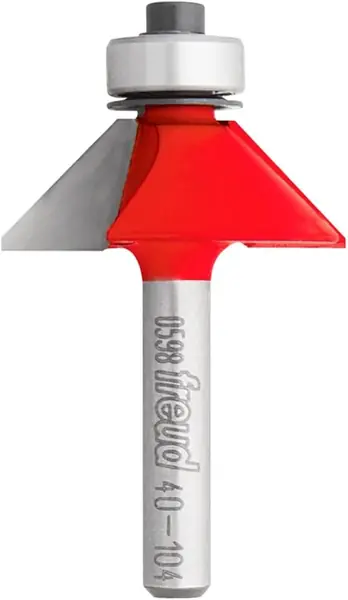
Freud 40-104 carbide-tipped 45-degree chamfer router bit with bearing guide and 1/4-inch shank

Everyday chamfering

Shop Score 93/100
Shank Diameter
1/4 inch
Chamfer Angle
45 degrees
Cutting Height
1/2 inch
Overall Diameter
1-11/32 inches
View on Amazon

Most chamfering is one cut repeated: taking the sharp corner off a shelf, a leg, or a cutting board so the edge reads as finished instead of sawn. The Freud 40-104 is built around exactly that job. Its body measures 1-11/32 inches across and carries a half inch of carbide, enough for a hairline edge break or a full decorative bevel, and the bearing on the end rides the workpiece so the chamfer holds the same width from one end of a board to the other.

That combination is why we hand it to people as the default pick. We especially like that chamfer size changes with bit height rather than with a new bit: lower the cutter for a fine break, raise it for a wide face, and the bearing keeps either one tracking true. The Perma-SHIELD coating is a small thing we have come to appreciate, because pitch does not build up on the cutter the way it does on an uncoated bit, so it wipes clean after a session in pine.

Where it earns its keep is on batches. We set the depth once, run every piece of the same thickness, then reset rather than change bits, which keeps chamfers matched across a set of shelves. The bit cuts plywood and composites as happily as hardwood, so a run of painted cabinet parts does not need a second cutter. Cut a scrap piece of the same stock first: a chamfer that reads right on 3/4-inch pine looks thin on 8/4 white oak.

Worth Noting

  • Only a 1/4-inch shank is offered
  • Single fixed 45-degree angle
Our Verdict

This is the chamfer bit we recommend first: one 45-degree cutter with enough carbide for edge breaks and full decorative bevels on any router with a 1/4-inch collet.

Check Latest Price
2.

Whiteside 2292 Chamfer Bit Best for Trim Routers

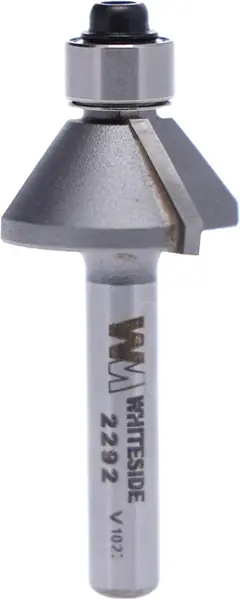
Whiteside 2292 45-degree chamfer bit with 1-inch cutting diameter and 1/4-inch shank

Trim routers

Shop Score 92/100
Shank Diameter
1/4 inch
Chamfer Angle
45 degrees
Cutting Height
5/16 inch
Overall Diameter
1 inch
View on Amazon

A wide cutter in a palm router is more bit than the machine and your hands want, which is why the Whiteside 2292 lives in our trim router. Its cutter measures 1 inch across, narrow enough to pass through the base plate of a compact router, and the 45-degree edge it leaves is clean and even on parts too small to take to a table. We reach for it on small frames, boxes, and drawer parts, where a bigger bit would be all base plate and no view of the cut.

The numbers behind that are modest on purpose: a 5/16-inch cutting height, a 7/16-inch cutting length, and a bearing guide on the nose so the bit can follow a straightedge or a template. The tips are carbide, brazed to a steel body, which is how a bit this small stays affordable while still cutting oak without lifting the grain.

What has surprised us is how often it comes out for work the bigger bits could reach. On a narrow chamfer the smaller cutter gives more control and a better sight line, and the lighter bite means a full-depth pass in softwood does not send the router walking. It has become the bit we leave sitting in the trim router between jobs rather than returning to the drawer.

Worth Noting

  • Chamfer tops out at 5/16 inch
Our Verdict

If your router is a palm or trim model, start here: the 1-inch body clears a small base plate and still leaves a clean, even 45-degree edge.

Check Latest Price
3.

Amana Tool 49400 Chamfer Bit Best for Router Tables

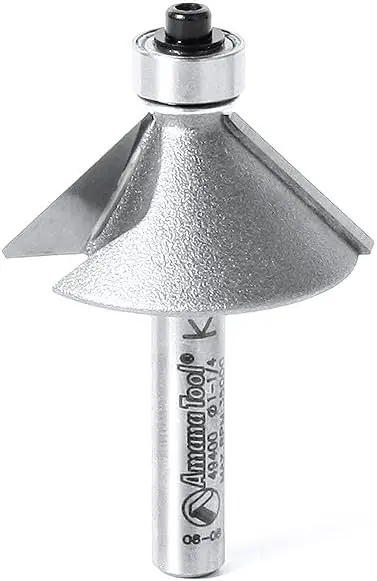
Amana Tool 49400 carbide-tipped 45-degree chamfer bit with 1-1/4-inch diameter and 1/4-inch shank

Router table work

Shop Score 90/100
Shank Diameter
1/4 inch
Chamfer Angle
45 degrees
Cutting Height
1/2 inch
Overall Diameter
1-1/4 inches
View on Amazon

The Amana 49400 costs more than anything else in this guide, and the difference shows up in the cutter: a 1-1/4-inch diameter, a full half inch of cutting height, two carbide tips, and a pilot bearing that carries its own part number so it can be renewed instead of retired.

Amana suggests a router table for this bit, and that is where we ran it, fence set and stock fed against the rotation with hands well clear. Used that way the bevel holds its width across a long board, which is what you need when you chamfer all four sides of a top and the corners have to meet. The cuts came off clean in oak, with little on the end grain that needed sanding.

For a bit that stays bolted in a table and gets used most days, the premium is easy to justify. The pilot bearing is the first part to wear on any guided bit, and one with a listed replacement outlives a cheaper cutter that has to be thrown away when the bearing seizes. Add the larger diameter and this becomes the bit we leave in the table for an afternoon of edge work rather than swapping in and out.

Worth Noting

  • 1/4-inch shank only on a table-oriented bit
Our Verdict

For a bit that stays in a router table and works most days, we think the larger cutter and renewable bearing justify the highest price here.

Check Latest Price
4.

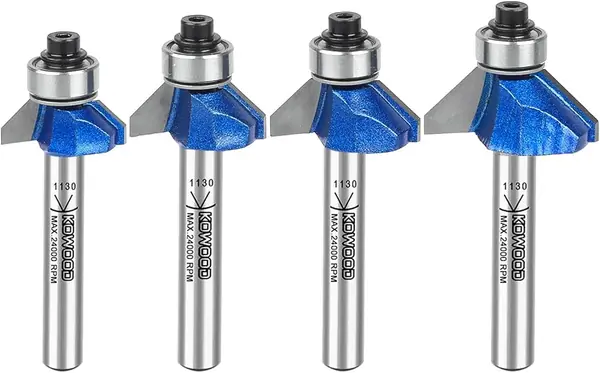
KOWOOD K005 Chamfer Bit Set Best Set for the Money

KOWOOD Plus four-piece 45-degree chamfer router bit set with 1/4-inch shanks and four cutting diameters

Budget-minded starters

Shop Score 89/100
Shank Diameter
1/4 inch
Set Contents
Four 45-degree bits
Cutting Diameters
1/4, 5/16, 3/8, and 1/2 inch
View on Amazon

Sooner or later a project asks for a chamfer wider than the bit in your router cuts, and the choice is to reset that bit and accept a different look or to buy another cutter. The KOWOOD K005 set takes the second path four times over: 45-degree bits with 1/4-, 5/16-, 3/8-, and 1/2-inch cutting diameters, all on 1/4-inch shanks.

We have handled enough inexpensive sets to expect one weak link, and this one has not shown us one. The C3 carbide is sharp out of the box; in oak and plywood the edges came off crisp, with no burn on the end grain and no chatter in a compact router. What we like most is the logic of the set: the small cutters suit narrow chamfers and tight spots, the largest takes wide bevels on a table edge, and you are not paying premium money to learn which size you actually reach for.

The cost is setup time. Every width change means a bit change and a fresh depth setting, so on a run of identical parts a single bit you never touch is faster. We keep the four in their case and treat them as sizes to match to a job: pick the cutter that suits the chamfer, set the depth once, and leave the rest in the box.

Worth Noting

  • All four bits cut the same 45-degree angle
Our Verdict

We recommend this set to anyone who wants several 45-degree chamfer widths without paying premium prices for each one.

Check Latest Price
5.

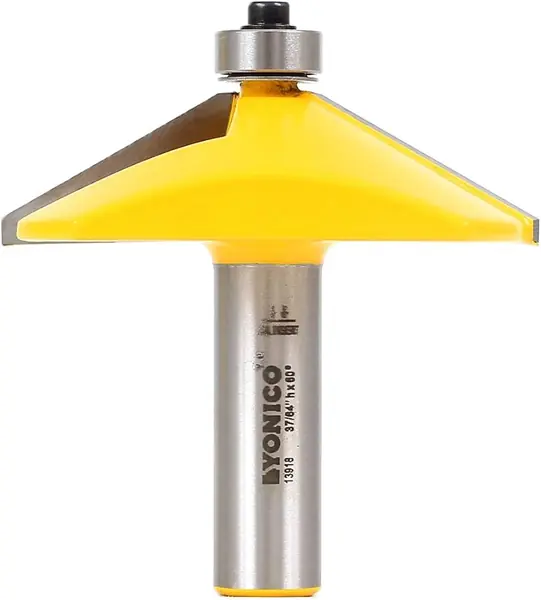
Yonico 13918 Bevel Bit Best for Steep Bevels

YONICO 13918 60-degree bevel edge router bit with 1/2-inch shank and two carbide flutes

60-degree bevels

Shop Score 88/100
Shank Diameter
1/2 inch
Bevel Angle
60 degrees
Maximum Bevel
1 inch deep by 9/16 inch high
View on Amazon

Forty-five degrees is the chamfer most of us picture, but it is not the only bevel worth cutting. The Yonico 13918 is ground at 60 degrees, a steeper face that reads as a shadow line on panel edges and can be paired with itself to form a 120-degree miter joint. It is a two-flute carbide bit on a 1/2-inch shank, and it cuts a bevel up to 1 inch deep by 9/16 inch high.

Where it earns its place is the work a 45-degree bit cannot do: heavier bevels on baseboard and crown, panel edges that want more angle than a standard chamfer, and mitered corners on wide stock. The 1/2-inch shank gives it more to hold onto in a table than the quarter-inch bits here, which matters once the cutter is buried that deep in hardwood.

We keep it for the jobs where a steeper face is the whole point, and it asks for a lighter touch than the 45-degree picks. Sixty degrees puts more cutter in the wood, so two steady passes beat one heavy one, especially in maple and cherry, where a slow feed is the difference between a clean bevel and a scorched one. Worked that way the bevel comes off clean, at an angle the Freud simply cannot produce.

Worth Noting

  • Needs a router with a 1/2-inch collet
Our Verdict

We keep this one for the jobs 45 degrees cannot do: steeper decorative faces and 120-degree miter joints on a full-size router.

Check Latest Price
6.

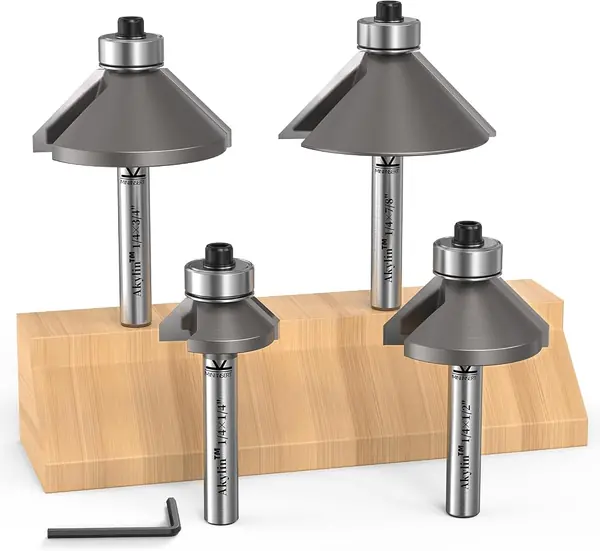
Akylin 4-Piece Chamfer Bit Set Best for Budget Long Bevels

Akylin four-piece 45-degree chamfer router bit set with 1/4-inch shanks and carbide tips

Budget long bevels

Shop Score 85/100
Shank Diameter
1/4 inch
Set Contents
Four 45-degree bits
Bevel Lengths
1/4, 1/2, 3/4, and 7/8 inch
Maximum Speed
21,000 RPM
View on Amazon

Seven-eighths of an inch is a long bevel. The Akylin set reaches it with its largest cutter and starts at a 1/4-inch bevel length on its smallest, with 1/2- and 3/4-inch bits in between: four 45-degree cutters on 1/4-inch shanks, all bearing-guided.

That range is the reason to own it. Half an inch of cutting height covers most furniture edges, but a thick top, a timber mantel, or a chunky leg wants a wider face, and a small bit pushed deeper only gets you so far before the shank starts crowding the cut. Stepping up to the 3/4- or 7/8-inch cutter lets you take the whole bevel in one setup on stock that would otherwise need two passes and a sanding block.

In use they behave about the way the price suggests: sharp, straight-running, and clean on the edge. We ran the 1/2-inch cutter around a thick glue-up and got a crisp bevel with no burn, and the bearings spun free out of the box. Nothing about the set feels like a premium cutter, and on a wide bevel that will be sanded anyway, nothing about that mattered.

Where the set lands for us is as the one to experiment with. A wide chamfer changes the look of a whole top or leg, and cutting it on scrap before committing to good stock is worth something by itself. Once the shape works, the sizes in this box tell you exactly what to look for in a premium bit.

Worth Noting

  • Rated to 21,000 RPM only
Our Verdict

We buy this set for one reason: four bearing-guided bits that reach bevels up to 7/8 inch wide for about the price of one premium cutter.

Check Latest Price
7.

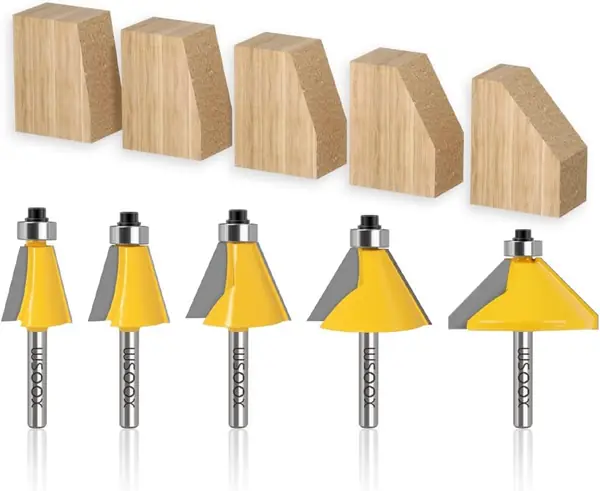
WSOOX 5-Piece Chamfer Bit Set Best for Multi-Angle Work

WSOOX five-piece chamfer router bit set in yellow coating with 1/4-inch shanks

Multi-angle work

Shop Score 84/100
Shank Diameter
1/4 inch
Set Contents
Five bevel bits
Bevel Angles
11.25, 15, 22.5, 30, and 45 degrees
View on Amazon

Five bits, five angles, no duplicates: the WSOOX set runs 11.25, 15, 22.5, 30, and 45 degrees on 1/4-inch shanks, in single-flute carbide with a coating meant to shed pitch. That spread tells you what the set is for. This is a kit for shallow, decorative bevels and multi-sided work, where the angle matters more than the size, and it makes the most sense as a second chamfer set in a shop that already has a good 45-degree bit.

That is a description, not a criticism. An 11.25-degree face is what you want on a box or a lamp base that should look planed rather than routed, and a set that steps up in small increments lets you try angles on scrap and see which one suits the piece. We found the angles accurate enough for decorative work and the edges clean in oak and pine, and the single-flute cutters clear chips fast, which helps in a small router.

Shallow bevels are also the hardest cuts to judge by eye, so we test each angle on scrap before it goes near a finished panel. A 15-degree face catches the light differently from an 11.25, and that difference is the whole reason to own both. It is an argument for a set over a single bit: the choice between angles gets made on the workpiece, not on a spec sheet.

Worth Noting

  • Only one 45-degree bit in the set
Our Verdict

Five angles in one box, and the set we reach for on multi-sided glue-ups and shallow decorative bevels rather than everyday edge chamfering.

Check Latest Price

How We Tested Chamfer Router Bits

We started with more than 40 chamfer and bevel bits sold for trim routers, compact routers, and router tables, then narrowed the field by angle, shank diameter, cutting height, whether the pilot bearing could be replaced, carbide grade, and price per usable cutter. We bought 16 units and tested them for four months in a small woodshop, on cabinet face frames, plywood shelving, MDF trim, and hardwood offcuts.

Each bit was mounted in a trim router and, where its shank and size allowed, in a router table. We seated the shank fully in the collet, left only a few millimeters exposed, and ran every bit within its rated speed; one set carried a 21,000 RPM ceiling and stayed there. We wore eye and hearing protection for every pass. Cuts were made in white oak, maple, plywood, and MDF, and we noted tearout at the exit corner, burning on the edge, chatter, and how much sanding the cut needed.

We checked sharpness out of the box by paring end grain, then ran repeated passes to see how quickly each edge dulled. Bearings were swapped where possible and spun by hand to judge smoothness and guidance. We compared the angle against the intended chamfer, measured how wide a cut the cutting height could take, and figured value as cost per usable cutter, especially for sets. Fit and finish, collet grip, and consistency between bits in a set counted toward quality and functionality.

How to Choose a Chamfer Router Bit

Match the Shank to Your Router

Every bit here cuts an angled edge, so the differences start at the collet. A 1/4-inch shank fits compact and trim routers and most plunge routers with the right collet, while a 1/2-inch shank needs a full-size machine. Buy for the router you actually use: the Whiteside 2292 is a 1-inch-diameter bit on a 1/4-inch shank designed to pass through a small trim router's base plate, and the Yonico 13918 is a 1/2-inch-shank cutter for table work.

Cutter diameter matters as much as the shank. A 1-1/4-inch bit is a lot of cutter for a palm router to swing, and the extra reach buys nothing if you cannot see the cut line. Small router, small bit; table, big bit.

Pick the Cutting Height for the Chamfer You Want

Cutting height is the vertical carbide edge, and it sets the widest chamfer a bit can take. The geometry is simple: on a 45-degree cutter, a cut 1/4 inch deep leaves a face about 11/32 inch across, and a half-inch cut leaves roughly 3/4 inch. The bits here run from 5/16 inch at the small end to 3/4 inch on the largest Akylin cutter.

For 3/4-inch stock and smaller, half an inch of cutting height is plenty. For thick tops, mantels, and timber, buy the reach, because a small bit pushed deeper only gets you so far before the shank crowds the cut.

One Good Bit or a Set

Sets cost less per cutter and cover more ground; single bits cost more and are built around one profile, usually with a bigger carbide edge. We buy a set to find out which size a design wants, and a single bit to cut that size for the next decade.

The KOWOOD K005 gives you four 45-degree diameters and the WSOOX set gives five angles, while the Freud and Amana put the same money into one larger cutter that stays in the router.

Angles, Bearings, and Safe Speed

Forty-five degrees is the standard chamfer and the one to buy first. A 60-degree bevel bit makes a steeper, more decorative face and can form a 120-degree miter, while angles under 30 degrees soften an edge more than they bevel it.

Bearings are what make a chamfer repeatable, since the pilot rides the workpiece or a template and holds the width, and they are also the first part to wear, so a bit with a listed replacement bearing is worth the extra. Check each bit's rated speed against your router's top RPM, and take lighter passes in hard maple.

Frequently Asked Questions

Final Verdict

The Freud 40-104 is the bit we point most people to. A bearing-guided 45-degree cutter with half an inch of carbide covers edge breaks and full decorative chamfers on any router with a 1/4-inch collet, and it does both without a second purchase.

Two requirements change the answer. If your router is a palm or trim model, the Whiteside 2292 and its 1-inch body are easier to control, and if the bit will live in a table, the Amana 49400's larger cutter and replaceable bearing are worth the step up.