↑↓ navigate ↵ open Esc close All results →

Best Straight Router Bits of 2026

A 3/4-inch dado sounds simple until calipers show the plywood is closer to 23/32 inch, and the bit labeled 3/4 inch leaves a groove your shelf rattles in. A straight bit is the plainest cutter in the drawer and the one that decides whether a cabinet goes together square. Mostly, the choice comes down to two measurements: the shank your collet accepts and the groove width you actually need.

We ran a dozen straight bits, singles and sets, for seven months in a basement shop, cutting dadoes in plywood and grooves in red oak and maple. What stuck with us: plywood's glue lines dull an edge faster than solid stock, and a bit that feels sharp out of the box can start scorching within a few dozen linear feet.

The picks below cover both common shank sizes and range from one bit that handles most jobs to sets built around the widths you'll really use. All of them left a flat bottom we didn't have to chase with a chisel.

Our Top Picks

The Best Straight Router Bits

1.

Freud 04-140 Double Flute Straight Bit Best Overall
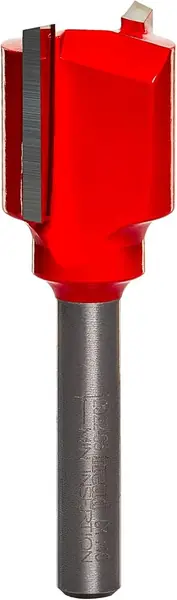
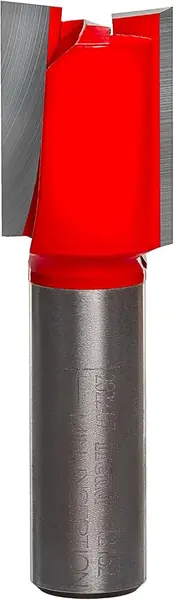
Freud 04-140 double flute straight router bit with 3/4-inch carbide cutter and 1/4-inch shank

General straight routing

Shop Score 93/100
Shank Diameter
1/4 in
Cutting Height
3/4 in
Overall Length
2-1/8 in
Cutting Diameter
3/4 in
View on Amazon

Three-quarters of an inch of cut on a quarter-inch shank is the combination that ends up in most of our routers, and it is why this is the straight bit we tell people to buy first. It matches a shelf dado, it fits a trim router, a plunge router, and a table without hunting for a collet sleeve, and it makes the groove, the rabbet, and the stopped cut in a single pass. We put it through plywood and red oak and got square-bottomed channels with walls flat enough to glue.

Two flutes and Freud's shear-and-hook grind are the reason the cut comes out clean rather than fuzzy. Two cutters balance the bit and each takes a lighter bite per revolution, so there is less vibration in the router and less tearout at the exit edge. The end of the bit is relieved as well, which matters the first time you drop it straight into the work for a stopped dado instead of tipping the router in from the side.

Out of the package the carbide is genuinely sharp, cutting birch plywood instead of burnishing it, and the polished flutes clear chips rather than packing them into the channel. That is the difference between a cut that needs a swipe of sandpaper and one that needs a chisel.

The one thing to know is that bits in this size can snap: it happens on full-depth passes in dense hardwood, or when the router sits still with the cutter buried. Three shallower passes cost you a minute and take most of that risk away, and keeping a spare in the drawer is inexpensive insurance for the width you use most.

Worth Noting

  • Cuts only a 3/4-inch channel; narrower grooves need another bit
Our Verdict

The straight bit we tell most people to buy first: 3/4-inch cut on a 1/4-inch shank, so it fits nearly any router and cuts shelf dados in one pass.

Check Latest Price
2.

Freud 12-152 Eclipse Grind Straight Bit Best for 1/2-Inch Collets

Freud 12-152 Eclipse Grind straight bit with 3/4-inch cutter and 1/2-inch shank

Table router work

Shop Score 92/100
Shank Diameter
1/2 in
Cutting Height
1 in
Overall Length
2-1/2 in
Cutting Diameter
3/4 in
View on Amazon

Same cutter, bigger mount. The 12-152 is the 04-140's heavier sibling: the same 3/4-inch diameter, but on a 1/2-inch shank, with a full inch of carbide and a 2-1/2-inch overall length. That shank is the whole story — more steel between the collet and the cutter means less flex, and less flex means a wall that stays vertical when you bury the bit in a deep dado.

We keep this one in the table router. For a run of shelf dados in 3/4-inch plywood, the extra cutting height and the stiffer shank mean fewer passes per dado and a cleaner exit on the far side. The Eclipse grind is sharpened for plunging, so dropping into a stopped dado is smoother than with a plain straight bit, and the TiCo carbide holds its edge through an afternoon of plywood and MDF.

Measured diameter can come in a hair under the nominal 3/4 inch, which is fine for a groove you are gluing but not for a joint you want tight straight off the cutter. Check with calipers before you build a jig around it, and keep the flutes clean — pitch build-up is the fastest way to turn a good cut into a burnt one.

Worth Noting

  • Needs a 1/2-inch collet; trim routers cannot use it
Our Verdict

This is the one we keep in the table router: the same 3/4-inch cut as our top pick, on a stiffer 1/2-inch shank with more cutting height.

Check Latest Price
3.

Yonico 14323 Undersized Dado Bit Set Best for Plywood Dados

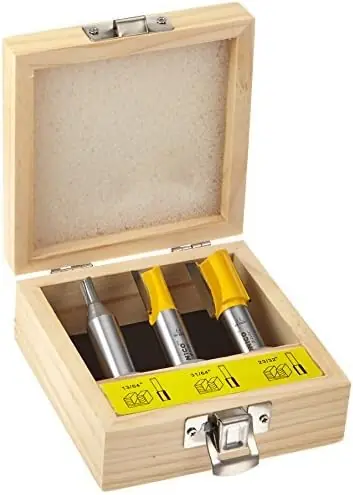
Yonico 14323 three-piece undersized dado bit set in a solid wood storage case

Plywood dados

Shop Score 91/100
Shank Diameter
1/2 in
Bits In Set
3
Storage
Solid wood case
Cut Widths
13/64, 31/64 and 23/32 in
View on Amazon

Plywood is never the thickness printed on the label. A sheet sold as 3/4 inch measures closer to 23/32 inch, sometimes less, so a true 3/4-inch bit leaves a dado that rattles. Yonico's answer is three deliberately undersized cutters — 13/64, 31/64, and 23/32 inch — sized for the plywood sold as 1/4, 1/2, and 3/4 inch, all on a 1/2-inch shank and packed in a solid wood case.

We have come to think of this as the set that saves a project. Bookcases built with these dados go together with a fit tight enough to hold without clamps, and the cuts come off the bit smooth enough that glue-up is the only finishing step. The 1/2-inch shanks keep the cut steady in a table, which is where most of this work happens.

The C3 micro-grain carbide holds an edge through a long run of shelves, though plywood's glue lines are hard on any cutter and this one is no exception. Expect to clean the flutes more often than you would with a bit reserved for solid stock.

Measure your own sheet before you order, because the whole idea only works if the bit matches the plywood in your shop; thickness varies by mill and by batch, and a bit that fit the last sheet may be loose in the next. The wooden case earns its spot on a shelf, though the slots grip tightly enough that you want to pull each bit straight up rather than working it side to side.

Worth Noting

  • 1/4-inch bit too narrow for Baltic birch
  • No true 3/4-inch cutter for solid stock
Our Verdict

Our pick for plywood dados: three undersized bits that fit nominal 1/4-, 1/2-, and 3/4-inch plywood the way it actually measures.

Check Latest Price
4.

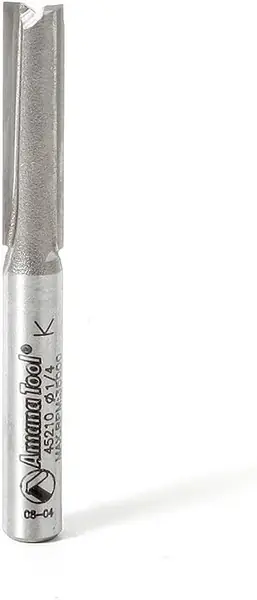
Amana Tool 45210 Straight Plunge Bit Best for Deep Plunge Cuts

Amana Tool 45210 carbide-tipped straight plunge router bit with 1/4-inch cutter and shank

Deep narrow grooves

Shop Score 90/100
Shank Diameter
1/4 in
Cutting Height
1 in
Overall Length
2-1/4 in
Cutting Diameter
1/4 in
View on Amazon

A quarter inch is narrow for a straight bit, and that is the point. The 45210 is 1/4 inch across with a full inch of cutting height, which makes it the bit for grooves deeper than they are wide, for hinge and lock mortises, and for template work in corners a wider cutter cannot enter. Two flutes clear the chips as the cut deepens, so a deep channel does not pack solid.

The 1/4-inch shank means a compact trim router can drive it, and the carbide tip takes plywood, MDF, and solid stock without complaint. Amana grinds these for production work — polished flutes, clean brazing, and a cutting edge that arrives sharp — and in red oak we got smooth walls, a flat bottom, and none of the chatter narrow bits often pick up.

That narrow slot is where we reach for it and where we stop: no width, no adjustability, just a deep clean channel. All that length on only a quarter inch of steel makes for a slender cutter, so keep passes shallow in MDF and dense hardwood and let the bit come to a full stop before you lift the router out of a stopped cut. Buy it for the cuts nothing else here can make, not as your only bit.

Worth Noting

  • Only a 1/4-inch cut width
Our Verdict

For deep, narrow grooves and mortises, this slender 1/4-inch bit is what we reach for, with a full inch of cutting height behind a quarter-inch cutter.

Check Latest Price
5.

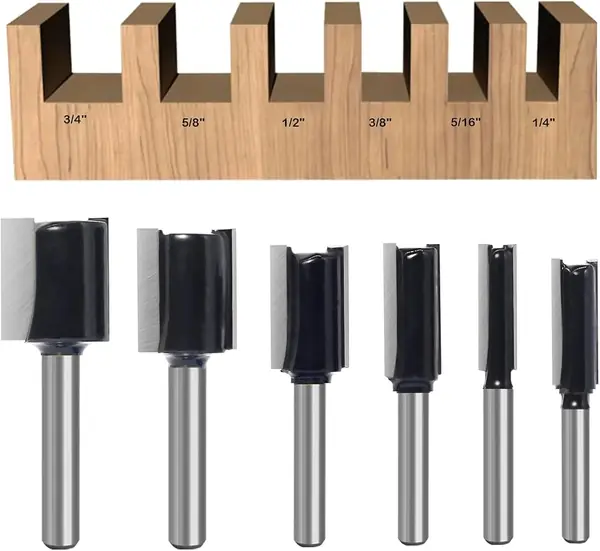
SICWOOD 6-Piece Straight Bit Set Best Budget Set

SICWOOD six-piece straight router bit set with 1/4-inch shanks and carbide-tipped flutes

Starter bit collection

Shop Score 89/100
Shank Diameter
1/4 in
Cutting Height
13/16 in
Bits In Set
6
Cut Diameters
3/4, 5/8, 1/2, 3/8, 5/16 and 1/4 in
View on Amazon

You can spend more on one premium straight bit than this entire set costs, and for a shop still filling out its router drawer the math is hard for us to argue with. Six bits on a 1/4-inch shank, running 1/4, 5/16, 3/8, 1/2, 5/8, and 3/4 inch, cover everything from a picture-frame slot to a shelf dado, and they share one collet.

Every bit carries 13/16 inch of cutting height and two C3 micro-grain carbide flutes, and the finish in pine and poplar is genuinely good: flat bottoms, clean walls, no fuzz. The 3/4-inch bit in particular cuts a dado you can glue without reaching for a second pass.

Where the set shows its price is in abrasive stock and long runs — MDF and plywood take the edge off faster than a premium cutter will, so plan on replacing the width you use hardest before you replace the whole set.

SICWOOD publishes speeds worth writing inside the case lid: 18,000 to 24,000 RPM in softwood, 16,000 to 20,000 in hardwood, and 14,000 to 18,000 in plywood and MDF to keep heat and chip-out down. Each bit sits in its own compartment, which sounds trivial until you have fished a loose bit out of a drawer by the cutter.

Worth Noting

  • 1/4-inch shank limits heavy stock removal
Our Verdict

The set we point beginners to: six 1/4-inch-shank straight bits from 1/4 to 3/4 inch, for less than one premium bit costs.

Check Latest Price
6.

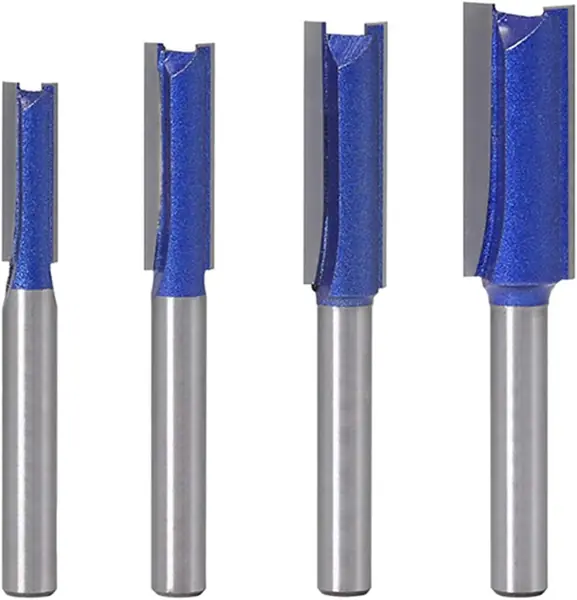
Wolfride 4-Piece Straight Bit Set Best for Small Groove Work

Wolfride four-piece straight router bit set with 1/4-inch shanks and coated steel bodies

Small groove work

Shop Score 88/100
Shank Diameter
1/4 in
Cutting Height
13/16 to 1-3/16 in
Bits In Set
4
Cut Diameters
1/4, 5/16, 3/8 and 1/2 in
View on Amazon

Four bits, 1/4 through 1/2 inch, all on a 1/4-inch shank, and an inexpensive way to put four narrow diameters in the drawer. These are groove bits — inlay channels, hinge slots, small rabbets, slots for a quarter-inch panel — and the sizes step in sixteenths so you can dial in a fit.

Blades are YG6 carbide in 45# carbon steel bodies with a heat-resistant coating that does keep pine resin from building up on the flutes, and cutting heights run from 13/16 inch on the smallest bit to 1-3/16 inch on the 3/8 and 1/2-inch cutters — useful when a groove has to go deeper than the cutter is wide.

Cutting is clean while the edges are fresh, the price keeps the risk small, and for a full run of oak dados we take one of the Freud bits instead. Check that the collet and shank are clean and tight before every run: a small bit in a hurry is where trouble starts.

Worth Noting

  • Range stops at 1/2 inch, so no shelf dados
Our Verdict

We treat this as a cheap way to try four small diameters, though the range stops at 1/2 inch and the bits want light passes.

Check Latest Price

How We Chose and Tested Straight Router Bits

We started by pulling straight bits in both common shank sizes and every cut width from 1/4 inch to 3/4 inch, then narrowed the field to bits with a cutting height that could clear a 3/4-inch panel and a width that matched a real dado. That left twelve bits, singles and sets, which we ran for seven months in a basement shop while building a plywood bookshelf, a run of cabinet boxes, and a workbench with grooves in oak and maple.

Each bit went into a fixed-base router mounted in a table and a small handheld trim router. We checked how far the shank seated before it bottomed out, marked it with a pencil to see how much of it the collet actually gripped, and watched for wobble at speed, since a 1/4-inch shank held by a sliver of collet is a vibration problem waiting to happen.

Then we cut. We measured the plywood with calipers rather than trusting the label, cut dadoes and test-fitted the mating panel, and checked groove width against the bit's stated diameter. Bottoms got checked with a machinist square, walls got inspected for tearout on cross-grain plywood, and we logged burn marks, feed pressure, and whether a bit pulled in the table.

Edge life took the longest: we kept a running tally of linear feet each bit cut in plywood and hardwood and flagged where it began needing more feed pressure or scorching the wood. We also priced sets against buying singles in the widths we used most. Every change started with the router unplugged and the collet fully tightened; every cut ran with eye and hearing protection, push blocks, featherboards, and shallow passes within the rated RPM.

How to Choose a Straight Router Bit

Start With the Shank

A 1/2-inch shank is the stronger choice: more steel, less flex, and a cutter that stays steady through deep passes and long runs in a table. A 1/4-inch shank opens up trim routers, compact plunge routers, and any 1/2-inch collet fitted with a reducer sleeve, and it covers most light work.

The trap is buying the better bit and finding it will not seat. Check your collet before you fall for a cutter. In this group the Yonico dado set and the Freud 12-152 take a 1/2-inch collet; everything else runs on 1/4 inch, so a trim-router-only shop should skip those two and shop the smaller shank.

Choose the Cut Width First

A straight bit cuts the width it is, and no more. A 1/2-inch bit will not make a 3/4-inch dado unless you move the fence and take a second pass, and then you are trusting your setup to line up with the first cut. For cabinets and shelving, a 3/4-inch cutter is the workhorse: one pass, one clean channel. For picture frames, inlay, and hinge slots, the narrow sizes earn their keep.

Buying a set is the inexpensive way to cover several widths at once; buying one very good bit in the width you use most is the cheaper route to a genuinely clean cut.

Measure Your Plywood, Not the Label

Plywood sold as 3/4 inch usually measures around 23/32 inch, and imported stock can run thinner still, which is why a true 3/4-inch bit leaves a dado that rattles. Undersized dado bits solve this by cutting slightly narrow — the Yonico 14323 set cuts 13/64, 31/64, and 23/32 inch for the three common nominal thicknesses.

Check your own sheet with calipers before ordering. Thickness varies by mill and by batch, so a bit matched to the last sheet may not fit this one.

What Two Flutes and Carbide Actually Buy

Flute count is about finish, not speed. Two flutes balance the bit and take two lighter bites per revolution, which leaves a smoother wall and less vibration than a single flute, at a slightly slower feed. Carbide grade matters more than the marketing around it: C3 micro-grain and Freud's TiCo both hold an edge in plywood, whose glue lines dull a cutter fast.

A relieved end, like the one on our top pick, is what lets a bit plunge straight into the work instead of tipping in from the edge — worth having if you cut stopped grooves.

One Good Bit or a Set?

A single 3/4-inch bit is the right first purchase for most people: it handles shelf dados, grooves, and rabbets, and one sharp bit beats six dull ones. Sets make sense in two situations — you are starting from nothing and want to try several widths, or you cut plywood dados regularly and want the undersized sizes ready to go.

Either way, buy the shank your router takes first, then put the savings into a second bit in a different width.

Frequently Asked Questions

Final Verdict

We reach for the Freud 04-140 first, and we suggest you do too. A 3/4-inch cut on a 1/4-inch shank fits the widest range of routers and covers the grooves, rabbets, and shelf dados most of us actually cut, and it does that in a single pass with a square bottom and clean walls.

The exception is worth knowing. If your router takes a 1/2-inch collet, the Freud 12-152 is the same cutter with a stiffer shank and more cutting height. And if the purchase is really about plywood, the Yonico 14323 set fits the sheet you actually brought home.