↑↓ navigate ↵ open Esc close All results →

Best Router Sleds for Flattening Slabs of 2026

Rough-sawn slabs always look flat on sawhorses until a straightedge shows daylight rocking under both ends, and a 30-inch walnut board will not fit any home-shop planer. Two rails, a sliding carriage, and a router flatten wide stock a fraction of an inch per pass—unless rail flex or a binding carriage leaves stepped ridges that no sander can level out.

We assembled and ran 12 router sleds over eight months to flatten white oak, walnut, and reclaimed elm slabs inside a two-car garage. Rail rigidity and a genuinely flat workbench underneath the jig influenced finished flatness far more than brand markings or anodized finishes.

Short benchtop rails suit smaller cutting boards while long spans handle full-length dining slabs, with height-adjustment designs split between setups built to lock once and mechanisms tuned for quick step-downs on every pass.

Our Top Picks

The Best Router Sleds for Flattening Slabs

1.

Sloson Router Sled, 48 Inch Best Overall
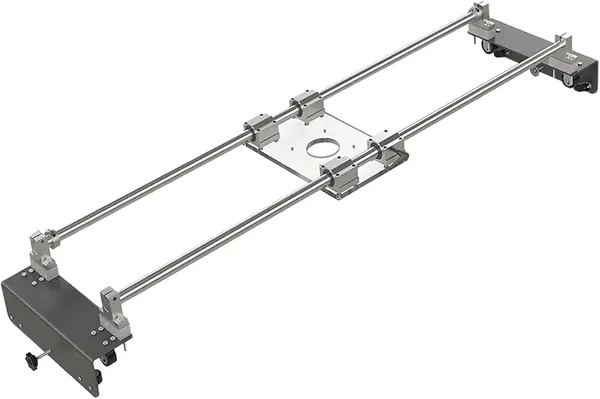
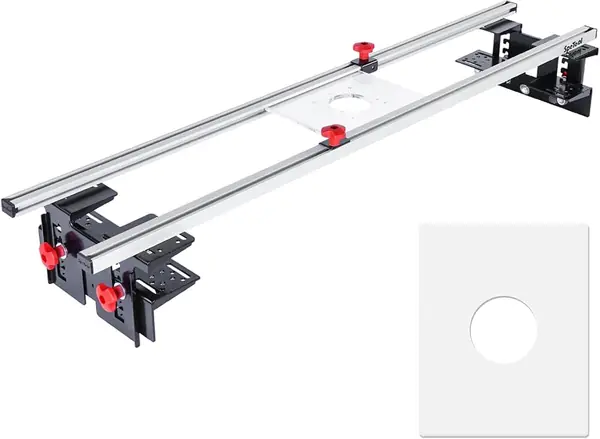
Sloson 48-inch router sled with steel rails, aluminum L-carriages and height-adjustable sliding blocks

Wide slab flattening

Shop Score 85/100
Weight
27.8 lb
Rail Span
48 inches
Guide Rails
20 mm steel
Router Fit
Most fixed-base routers
View on Amazon

Twenty-millimeter steel is the first thing worth knowing about the Sloson, because the rails are what decide whether a flattening pass comes out flat or scalloped. Steel at that diameter resists bending better than the lighter aluminum several sleds here use, and the L-shaped carriages riding it are aluminum, with sliding blocks that set height and let you work in both directions across the slab.

We recommend it as the default for a first slab-flattening setup. Forty-eight inches of rail covers most tabletop and bench stock, the height adjustment copes with thick cookies, and the box arrives with the tools needed to assemble it, including a drill bit for opening up the acrylic mounting plate. If a project runs longer than the rails, the design takes longer straight runners, so 48 inches is not a permanent ceiling.

Height is set with spacer blocks, and here is the detail the listing buries: the twelve blocks in the kit are all the same thickness, so a fine change means adding or pulling a block rather than swapping in a thinner one. It holds a setting well once you have stacked it, but dialing in depth is slower than the preset bracket on the SpeTool.

The acrylic plate is pre-drilled for most fixed-base routers, and the screws holding it are the one soft spot — plain fasteners that can work loose over a long session. Locking nuts from the hardware bin solve that for good. At 27.8 pounds the sled is a two-hand lift rather than a permanent bench fixture, and it stows on a shelf between projects.

Worth Noting

  • Height spacer blocks all come in one size
  • Arrives fully disassembled for a complete build
Our Verdict

We recommend the Sloson first: the steel rails stay straight under a big router and the kit covers most slab sizes without a premium price.

Check Latest Price
2.

SpeTool 48 Inch Router Sled Best Value

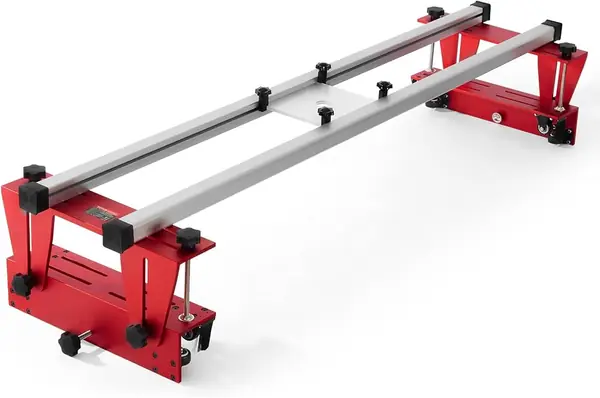
SpeTool 48-inch router sled with anodized aluminum rails, height lift bracket and two router plates

Frequent depth changes

Shop Score 84/100
Rail Span
48 inches
Guide Rails
6061 aluminum
Router Plates
Pre-drilled and blank
Height Settings
Five preset heights
View on Amazon

Depth changes on the SpeTool happen in clicks rather than stacks. A base-and-lift bracket carries five preset heights, so moving from a thick cookie to a thin panel is a matter of dropping the carriage a notch instead of rebuilding a shim stack. We think it is the strongest value in this group — 48 inches of anodized 6061 rail, two router plates and four clamps in one box, at a price near the bottom of what we tested.

The four rollers are the part we watched closest. They carry the assembly across the rails and are only as good as the surface beneath them; a chip under a wheel shows up as a dip in the finished face, which is why the directions suggest adding small brushes ahead of the rollers to sweep the path. We cleared the rails between passes and the carriage ran smooth and level.

Assembly asks for patience. The hardware is sound and the pre-drilled plate takes a common fixed-base router, with a blank plate along for anything unusual, but the printed directions are thin, and some kits arrive with bolts too short to pull the rails down to the lift plate. Forty-eight inches is the working span here — there is no longer rail in the line, so a slab past that means repositioning.

Worth Noting

  • Roller paths need sweeping to stay smooth
  • Directions are thin for first-time assembly
Our Verdict

Our value pick: preset depth settings and two router plates make it the easiest of these to live with if you change depth often.

Check Latest Price
3.

VEVOR Router Sled, 64 Inch Best for Long Slabs

VEVOR 64-inch router sled in silver and red with aluminum rails and four rail limit clamps

Long slabs

Shop Score 83/100
Weight
32.7 lb
Rail Span
64 inches
Material
6061 aluminum alloy
Height Adjustment
0-5.5'' / 0-135 mm
View on Amazon

Long stock is where the VEVOR makes its case. The rails run 64 inches, so a dining-table glue-up or a live-edge bench gets surfaced in one run rather than three, and the reverse locking carriage lets you switch between the length and the width without unclamping the whole rig. That is 16 more inches of travel than the 48-inch sleds here give you.

We liked what the extra reach costs. The rails are 6061 aluminum over 2 mm thick, the rollers run on bearings rather than bushings, and a small brush beside each one sweeps chips as you go — details we expect on a pricier sled. The acrylic mounting plates are the weak link; they can crack, so check them before a session and take the screws down snug rather than tight.

Height runs from 0 to 5.5 inches, enough for a thin panel or a thick cookie, and four rail limit clamps pin the rails to the bench. Two things to plan for: the frame is 32.7 pounds, and it wants a flat, level table underneath, because the sled follows your bench as much as your slab. A table that rocks telegraphs straight into the cut.

Worth Noting

  • Acrylic mounting plates can crack
Our Verdict

We point long-slab work at the VEVOR: 64 inches of rail, a 5.5-inch height range and a price below every other full-size kit here.

Check Latest Price
4.

Woodhaven Planing Sled 3000 Best for Smaller Slabs

Woodhaven Planing Sled with 36-inch aluminum Ultra Track rails and a NoDrill router plate

Smaller slabs

Shop Score 82/100
Warranty
Lifetime
Rail Size
36 inches long, 3 inches tall
Router Plate
NoDrill quick-attach
Max Slab Width
27 inches
View on Amazon

Twenty-seven inches of cross-rail span is the number to start with, because the Woodhaven 3000 is the smallest-capacity sled here and the only one that expects you to build part of it. That span covers a cutting board, an end-grain glue-up or a bench-seat blank comfortably. A full-size live-edge top means repositioning the slab and blending a second set of passes.

What the capacity trade buys is a serious rail: 3-inch extruded aluminum Ultra Track carrying a phenolic carriage, with a NoDrill plate that clamps to a fixed or plunge base and comes off again without permanently modifying the router. You supply 3/4-inch plywood cross members, which set the working height, and the matched upshear planing bit is sold separately, so price the whole setup before you commit.

We recommend it for the shop that flattens small and mid-size stock often and wants a sled still square years from now; the lifetime guarantee is real reassurance at this price. Set-up is about an hour of careful squaring, and until those plywood cross members are cut and screwed down nothing about the rig is fixed — which is also why it breaks down and stores flat between jobs.

Worth Noting

  • You supply and fit your own plywood cross members
  • 27-inch span needs repositioning on wide slabs
Our Verdict

We like the Woodhaven where 27 inches is enough: the Ultra Track rails and NoDrill plate are the best-finished hardware in this group.

Check Latest Price
5.

Woodpeckers Slab Flattening Mill, Small Best Premium Pick

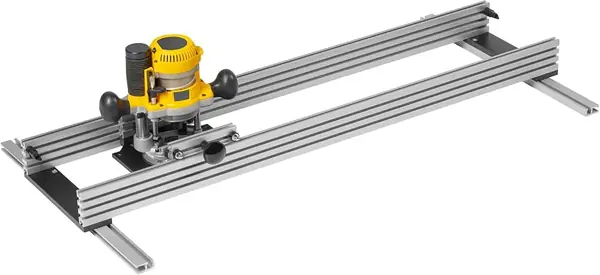
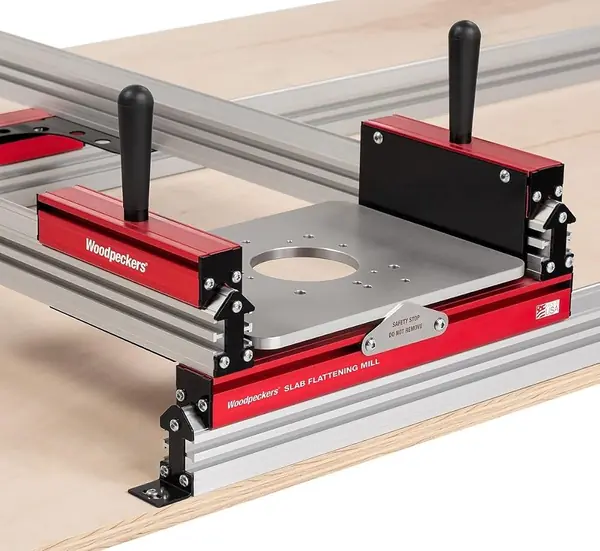
Woodpeckers Slab Flattening Mill with 64-inch rails, router sled and four clamping dogs

Production slab work

Shop Score 81/100
Weight
53 lb
Rails
Two 64-inch rails
Capacity
24 x 48 inches
Dust Port
Optional, sold separately
View on Amazon

This is the most expensive sled here by a wide margin, and after running it we can see where the money went: the rails, the carriage and the four clamping dogs are machined and finished to a standard nothing else in this group touches. We recommend it where slab work is the job rather than the occasional weekend project.

There is no height adjustment on the mill itself, and that is the trade for the rigidity. Depth comes from the router, so a plunge base with fine adjustment does the work that spacer stacks do on the Sloson, and a router with a fussy depth stop is the wrong partner for this mill.

The Small model takes a 24-by-48-inch slab, and extension rails let you grow the mill instead of replacing it. The optional dust port bolts to the carriage and rides beside the exit point of the shavings, turning a chip storm into a shop-vac hose. At 53 pounds it is a fixture rather than something you tuck onto a shelf, so measure the bench before it arrives.

Worth Noting

  • No height adjustment on the mill
  • Heaviest sled here at 53 pounds
Our Verdict

Our premium pick, for the shop where slab work pays: nothing else here is machined this well, and the extension rails let it grow.

Check Latest Price
6.

Rockler Benchtop Slab Flattening Jig Best for Benchtop Work

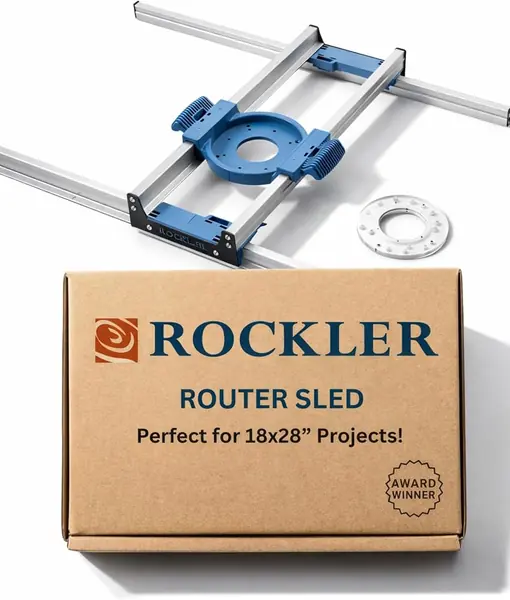
Rockler benchtop slab flattening jig with aluminum base rails and plastic router carriage

Benchtop work

Shop Score 80/100
Weight
15.6 lb
Design
Benchtop
Base Rails
Extruded aluminum
Router Mounting
Pre-drilled acrylic plate
View on Amazon

Benchtop is the operative word for the Rockler. The base rails screw down to a bench or shop stand, the whole kit weighs 15.6 pounds, and it is sized for cutting boards, small slabs and resin blanks rather than a six-foot live-edge top. If your flattening happens in end grain and charcuterie boards, that is not a limitation to work around — it is the point of the design.

Two aluminum cross rails ride the base rails on a reinforced plastic carriage with low-friction pads, and safety catches keep the carriage from running off the end. We noticed that catch the first time we pushed the carriage past the edge of a board, and it is the sort of small thing that separates a kit from a pile of extrusions. The pre-drilled acrylic plate takes a common fixed-base router, and slots in the rails let you square the assembly to your bench.

Where it falls down is sheer size. The frame is built for bench-sized stock, so a full-size slab would have you repositioning far more often than a 48-inch sled, and the rails cannot be stretched to cover it. Set-up is a bench-side job with the hardware in the box, and the jig is light enough to lift onto a shelf when the bench is needed back.

Worth Noting

  • Carriage can stick while sliding
Our Verdict

We recommend it for cutting boards and benchtop work, where its short frame stays rigid and easy to square.

Check Latest Price

How We Tested Router Sleds

We started with spec sheets, not samples: we compared rail spans and rail materials, height-adjustment designs, router mounting options from pre-drilled plates to blanks to clamp-on mounts, and current pricing, then narrowed the field to a dozen sleds that represented each approach. Over eight months we assembled and ran all 12 in a two-car garage shop, flattening white oak, walnut, and reclaimed elm slabs.

Assembly came first. We built each sled from the box, timing it and noting where the instructions skipped a step or contradicted the hardware in the bag, then checked how flat a bench each one really needed by setting it on a surface we knew was out of level and shimming until it stopped rocking. Before every pass we clamped the slab to the bench and the rails in place, no exceptions.

Then we cut, with eye and hearing protection on for the long runs. Using a heavy fixed-base router and a flattening bit matched to its collet, we took pass after pass across the same slabs, watching the carriage for bind at the ends of the rails and laying a straightedge on the finished surface to catch dishing. We changed depth settings dozens of times to count the steps and see whether anything drifted, and we swept sawdust off the rails and rollers between passes to see where chips collect.

At the end of eight months we rechecked rail play, fastener tightness, and how much slop had worked into each carriage, then weighed and moved every sled to judge whether it was worth leaving set up. Value came last: the least expensive sled we kept cost less than the most expensive one we dropped.

How to Choose a Router Sled

Match the Rail Span to Your Slabs

Rail span is working width, so start there. The 48-inch sleds here — the Sloson and the SpeTool — cover tabletop and bench stock and suit most shops. The VEVOR runs 64 inches for long glue-ups, the Woodhaven 3000 stops at 27 inches, and the Woodpeckers Small takes a 24-by-48-inch slab.

The trap is thinking rail length equals usable room. Whatever the sled spans, you need clear bench in front of and behind the workpiece for the carriage to travel, so a 64-inch sled can want eight feet of wall. Measure the longest clear run in your shop before you buy the longest rail.

Judge the Rails, Not the Finish

Every sled here is aluminum or steel, and the difference shows up mid-pass. A router hanging a wide flattening bit off a carriage puts real load on the rails; if they deflect, the bit dips and leaves a hollow you chase with a sander. Steel at 20 mm on the Sloson, the VEVOR's 2 mm-plus 6061 extrusion and the Woodhaven's 3-inch Ultra Track are the figures to compare.

Thicker rail is also heavier rail, and that is the honest trade. A stiffer frame is worth the extra pounds in a fixed shop and worth thinking about if the sled has to come down off a shelf every time.

Decide How Often You Change Depth

Depth control separates these kits more than any other feature. The SpeTool's five-preset bracket is a click. The Sloson's spacer blocks are all one thickness, so a fine change means adding or pulling a block. The VEVOR adjusts across a 5.5-inch range, and the Woodpeckers mill has no adjustment at all, leaving depth to the router.

Flattening one slab a month makes blocks perfectly workable. Surfacing cutting boards in batches is where presets earn their keep, because every depth change is one you make with the router running and the clock going.

Plan for Chips and a Flat Bench

A sled rides on whatever sits under it, and it carries sawdust along for the ride. Debris under a roller or carriage lifts it slightly and cuts a dip, which is why the VEVOR ships brushes beside its rollers and the SpeTool directions tell you to keep the wheel path clear.

The bench matters just as much. A table that rocks tilts the rails, and a tilted rail cuts a tapered slab no amount of sanding fixes. Level and shim the bench before the first pass, not after you have found the taper.

Weigh Setup and Storage Against Convenience

These kits run from 15.6 pounds to 53 pounds, and that range decides whether a sled lives under the bench or permanently on it. The Rockler screws to a benchtop at 15.6 pounds; the Woodpeckers mill at 53 pounds is a fixture you build the shop around.

Budget set-up time too. The Woodhaven needs plywood cross members you cut and square yourself, and most kits ask for an hour of assembly before the first cut. A sled that stays assembled gets used; one that lives in a box does not.

Frequently Asked Questions

Final Verdict

The Sloson is the sled we recommend first. Twenty-millimeter steel rails, usable height adjustment and a box of assembly tools cover the widest range of slab work at a midrange price, and that combination is what most shops actually need.

If depth changes constantly, the SpeTool's preset bracket is faster and cheaper. If your slabs run long, buy the VEVOR and its 64 inches of rail. If they never exceed 27 inches, the Woodhaven's Ultra Track rails and lifetime guarantee are the better long-term buy.