↑↓ navigate ↵ open Esc close All results →

Best Dado Router Bits of 2026

A sheet of 3/4-inch plywood is almost never 3/4 inch thick. Cut a nominal dado and you get a joint that rocks, a gappy shoulder, and a cabinet that racks. Fixing that takes a bit sized to the sheet you actually bought, which leaves a drawer full of nominal-size straight bits sitting idle the moment you start building casework.

Trusting the fraction printed on the package is an easy habit to break once you test-fit grooves across real sheet goods. Over six months of cutting dados, grooves, and shelf joints with 14 straight bits and sets in both full-size and compact trim routers, carbide life proved more telling than the first pass—what separated the top bits was how cleanly they still sheared on the hundredth cut.

From a single shelf dado to a full cabinet run, these six bits and sets cover the widths plywood projects actually demand in the two shank sizes home routers accept, judged on joint fit rather than catalog specs.

Our Top Picks

The Best Dado Router Bits

1.

Yonico 14323 Undersized Plywood Dado Bit Set Best Overall
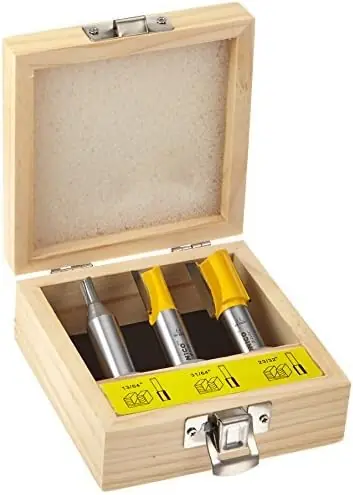
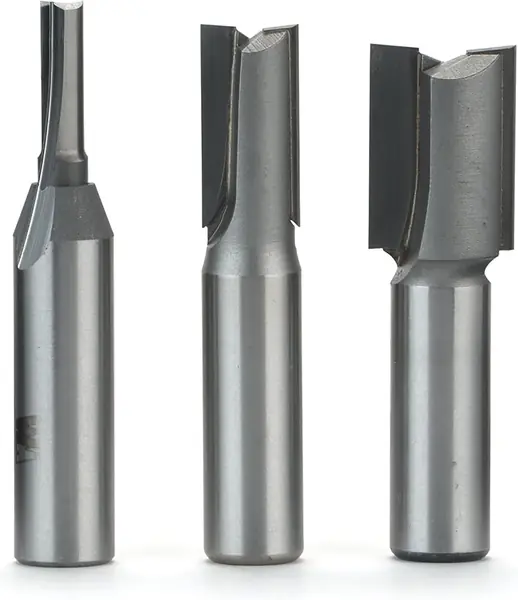
Yonico 14323 three-piece undersized plywood dado bit set with wooden storage case

Plywood cabinet dados

Shop Score 93/100
Shank
1/2 inch (1/4-inch version also sold)
Bits In Set
3
Bit Widths
13/64, 31/64, and 23/32 inch
Cutting Heights
1/2, 3/4, and 1 inch
View on Amazon

Plywood is thinner than the number printed on it, and the Yonico 14323 is built around that fact. The three bits measure 13/64 inch for stock sold as 1/4 inch, 31/64 for 1/2 inch, and 23/32 for 3/4 inch — undersized on purpose, so a groove closes on a plywood edge instead of gaping around it. We made it our top pick because those three widths cover nearly every carcase joint a home shop cuts, and because the fit arrives glue-ready without shimming.

Cutting heights of 1/2, 3/4 and 1 inch let the widest bit take a full shelf dado in one setup, and the carbide edges bit cleanly through plywood and MDF for us with no burning. This version ships on 1/2-inch shanks; the same set is sold with 1/4-inch shanks, and we think that is the one to order if your router only takes the smaller collet. The wooden case keeps the three bits labeled and apart, though they sit deep enough that you tip them out rather than fish for them.

Chipping is the thing to manage. Cross-grain cuts in plywood can fray along the exit edge, and scoring the line with a knife or taping it before the cut keeps the tearout to almost nothing. Do that and the joints come out tight enough to assemble dry, check for square, and then glue.

Worth Noting

  • 13/64-inch bit is too narrow for true-size 1/4-inch stock
Our Verdict

We recommend it as the default dado set: three undersized widths that fit real plywood, at a price that leaves room for clamps.

Check Latest Price

2.

Whiteside 470 Plywood Dado Set Best Premium Set

Whiteside 470 three-bit plywood dado set with one solid carbide and two carbide-tipped bits

Premium plywood joinery

Shop Score 92/100
Shank
1/2 inch
Bits In Set
3
Bit Sizes
7/32" x 3/4", 31/64" x 1", 23/32" x 1"
Cutter Material
Solid carbide and carbide-tipped
View on Amazon

The Whiteside 470 is the most expensive set here, and the money lands in the cutting edges rather than the case. Three bits: a 7/32-inch solid carbide bit for 1/4-inch plywood, and carbide-tipped 31/64 and 23/32 bits for 1/2-inch and 3/4-inch sheet goods, all on 1/2-inch steel shanks. Cutting heights run 3/4, 1 and 1 inch, which is enough for a full-depth shelf dado without flipping the panel.

We noticed the difference the moment the big bit touched cabinet-grade plywood: the walls came out glassy and the joint was tight enough to hold itself together while we checked it for square. Thick carbide on a rigid shank is why — there is almost none of the shimmy you feel from a light bit in a deep cut. When a joint is going to be seen, this is the set we reach for.

Only the small bit is solid carbide; the other two are carbide-tipped on steel bodies. That is a sensible place to save, since the wide bits do the forgiving cuts, but it makes them the ones to watch for a dull edge first. Everything arrives in a fitted wooden case that keeps the edges off each other in a drawer.

Worth Noting

  • Requires a 1/2-inch collet
  • Loose fit on true-size or sanded plywood
Our Verdict

Buy this set when a visible joint has to be tight and your router takes a 1/2-inch collet; the money goes into thicker carbide and sizing that matches cabinet-grade plywood.

Check Latest Price
3.

Whiteside RU2100 Upcut Spiral Bit Best Spiral Bit

Whiteside RU2100 1/4-inch upcut spiral router bit with solid carbide cutting edges

Deep 1/4-inch grooves

Shop Score 91/100
Shank
1/4 inch
Cutting Diameter
1/4 inch
Cut Type
Upcut spiral
Cutting Length
1 inch
View on Amazon

Cutting a deep groove with the Whiteside RU2100 is unusually tidy. The upcut spiral drives chips up and out of the channel instead of packing them into the far end, so the second pass starts on a clean floor rather than on a nest of shavings. It measures 1/4 inch in diameter with a 1-inch cutting length and a 2-1/2-inch overall length, which leaves plenty of shank above the collet when the bit is buried.

The helix is the point. A straight bit scrapes its way along; a spiral shears, and the wall it leaves on the side away from the router is smooth enough that a glued panel looks machined. The top face is the trade-off — the upward action can lift fibers on plywood, so score the line or back the cut with scrap when that surface shows. In hardwood we got cool, clean cuts at a steady feed, with no burn marks to sand out.

Width is the limitation. A quarter inch is a quarter inch, so a 3/4-inch shelf dado means three overlapping passes and careful indexing — if that is most of your work, the Freud 04-140 or one of the sets here is the better buy. For drawer bottoms, back panels, splines and shop jigs, where a single 1/4-inch groove does the job, it is the bit we keep in the collet.

Worth Noting

  • Upcut spiral can lift top-face plywood fibers
  • Quarter-inch width requires multiple passes for wide dados
Our Verdict

Our pick for clean, deep 1/4-inch grooves: the upcut spiral throws chips clear and shears the walls smooth.

Check Latest Price
4.

Freud 04-140 Double Flute Straight Bit Best Single Bit for Shelf Dados

Freud 04-140 3/4-inch double flute straight router bit with 1/4-inch shank

3/4-inch shelf dados

Shop Score 90/100
Shank
1/4 inch
Cutting Diameter
3/4 inch
Overall Length
2-1/8 inch
Flutes
2
View on Amazon

Most shelf dados are 3/4 inch wide, and the Freud 04-140 cuts exactly that in one pass. Two flutes ground on shear and hook angles slice rather than scrape, and the relief behind the cutting edge lets you plunge straight into the middle of a panel instead of easing in from an edge. The 1/4-inch shank drops into just about any router we have handled, including the compact models that will not take a 1/2-inch set. Of the single bits here, it is the cheapest way to a common dado.

Plywood is where the arithmetic gets awkward. A true 3/4-inch cut in 23/32-inch sheet goods leaves a groove slightly wide, which is exactly why the undersized sets on this list exist; save this bit for solid stock, or for dados you plan to shim and glue. In pine shelving and oak it cut square and clean for us and never felt like too much bit for a mid-size router. Keep passes shallow in hardwood — around an eighth of an inch — and the flat bottom registers against a straightedge with no chatter.

Worth Noting

  • Edges can chip in plywood
Our Verdict

For 3/4-inch shelf dados in solid stock, this is the bit we hand people: one pass, one shank size, no set to sort through.

Check Latest Price
5.

SICWOOD 6-Piece Straight Router Bit Set Best Budget Set

SICWOOD six-piece straight router bit set in sizes from 1/4 to 3/4 inch

Beginner router setups

Shop Score 89/100
Shank
1/4 inch
Bits In Set
6
Cutting Height
13/16 inch
Cutting Diameters
3/4", 5/8", 1/2", 3/8", 5/16", 1/4"
View on Amazon

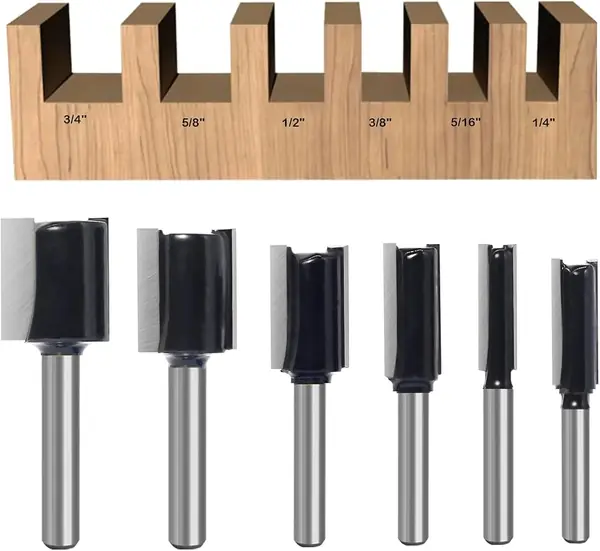
Six bits, six widths, one small box: the SICWOOD set runs 3/4, 5/8, 1/2, 3/8, 5/16 and 1/4 inch on 1/4-inch shanks, each with a 13/16-inch cutting height and two C3 carbide flutes. Every bit comes in its own slotted container, which is more organization than we expected at this end of the price range, and the whole set costs less than one premium bit.

We think of it as a first set, and a good one: pine, poplar, MDF and sheet goods are all within reach, and the range covers hinge gains, inlay channels and quick grooves without stopping to hunt for another bit. The smaller diameters reward a light touch. Keep passes shallow and speed up — roughly 18,000 to 24,000 rpm in softwoods, down around 14,000 to 18,000 in plywood and MDF — and the edges stay crisp instead of burning their way through.

Worth Noting

  • Nominal widths cut loose dados in plywood
Our Verdict

A sensible first set for softwoods and shop projects, provided you understand these are nominal widths rather than plywood widths.

Check Latest Price
6.

Amana Tool 45210 Straight Plunge Bit Best for Repeated 1/4-Inch Grooves

Amana Tool 45210 carbide-tipped straight plunge router bit with 1/4-inch shank

Repeated 1/4-inch grooves

Shop Score 88/100
Shank
1/4 inch
Cutting Diameter
1/4 inch
Cutting Height
1 inch
Overall Length
2-1/4 inch
View on Amazon

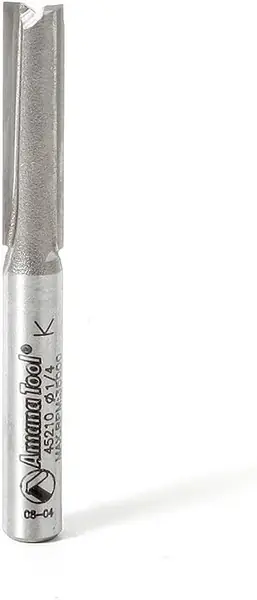
A 1-inch cutting height on a 1/4-inch bit is more than most straight bits offer, and it is the reason to look at the Amana Tool 45210: you can sink a deep groove for a spline or a sliding panel without the collet chasing the work surface. Overall length is 2-1/4 inches, the shank is 1/4 inch, and the cutting edges are carbide tipped on a steel body.

It is a straight bit, so it scrapes the walls rather than shearing them the way a spiral does. In softwood and MDF the difference is small; in plywood the spiral leaves the cleaner wall and this one wants a light final pass. What the straight geometry buys is predictability — no helix pulling at the router, no chip stream fighting the dust hose, just a flat-bottomed groove that measures what the bit says it will.

Production work is where it earns its keep: tall edge, simple geometry, an easy cut to repeat. Set the depth, run the groove, reset for the next piece. It suits a shop that cuts the same channel over and over; a set makes more sense for a one-off bookcase.

Worth Noting

  • Single 1/4-inch width only
Our Verdict

Worth buying when you cut the same 1/4-inch channel all afternoon and want a tall cutting edge to repeat it with.

Check Latest Price

How We Tested Dado Router Bits

We built the shortlist from the straight bits and small sets sold in the two shank sizes home routers accept, filtering first by whether the maker published an actual cutting diameter and cutting length — several didn't — and then by whether the width was sized for real plywood or only for nominal stock. We kept single bits in the mix alongside sets, since a set isn't automatically the better buy. That left 14 bits and sets, tested over six months.

Most of the work happened in a garage shop: cutting dado stacks in cabinet sides and shelf dados in cabinet-grade plywood, then test-fitting each groove with offcuts from the same sheet and checking the joint with a caliper. We ran every bit in a full-size router and in a compact trim router to feel for vibration and control, and we watched which face of the plywood blew out — the one that shows, or the one that doesn't.

Durability got the long test: repeated runs through plywood and hardwood, with notes on when a bit started to burn, when the edge stopped shearing cleanly, and how much force it took to push the router through. We weighed what each set actually delivers, because six bits are poor value if only two widths match the sheets you buy. Sharpness was judged by the cut, not by feel — a bit that feels keen can still tear out the top veneer.

Every bit change happened with the router unplugged and the bit at a dead stop, and we wore eye and hearing protection for every cut. Passes stayed shallow, within each bit's cutting length, with hands well clear of the cutter. The bits still in rotation after six months are the ones we'd buy again.

How to Choose Dado Router Bits

Match the Bit to the Sheet, Not the Label

Sheet goods sold as 3/4 inch usually measure 23/32 inch or less, and 1/2-inch stock runs closer to 31/64. That is why undersized dado sets exist — the Yonico 14323 and the Whiteside 470 are ground to those narrower numbers. A nominal 3/4-inch bit is the right tool for solid stock and for true-size Baltic birch, which is milled to its stated thickness. Read your sheet with a caliper before ordering and buy for that number rather than the label.

One warning: batches differ. A set that fits this month's plywood can run a hair tight or loose on the next lift, so cut a test groove in scrap from the same sheet before you commit a whole bookcase to it.

Check Your Collet Before Anything Else

Bits come on 1/4-inch and 1/2-inch shanks, and the difference decides more than fit. A 1/2-inch shank is stiffer, which matters in deep cuts and wide bits; a 1/4-inch shank is what compact and trim routers take, and that is where many home shops start. Some routers ship with both collets, many take only one.

Look at the collet or the manual before you shop. If yours is 1/4-inch only, the Freud 04-140 and the Whiteside spiral here will run and a 1/2-inch dado set will not, no matter how good the price looks.

One Width or Three: Single Bits vs Sets

A single bit makes sense when your dados are one size — shelf carcases in 3/4-inch plywood, drawer bottoms in 1/4 inch. A set makes sense when both appear in the same project, which is most cabinet work. Count the widths you actually cut in a year, then compare the price of the bits individually against the set.

Our rule of thumb: two or more widths in regular use means buy the set, and one width means buy the best single bit you can afford.

Straight, Upcut, or Downcut Spiral

A straight bit is the generalist: flat bottom, simple geometry, the lowest price for a given width. An upcut spiral shears the walls and throws chips out of the channel, which makes it the better choice for deep grooves, though it can lift fibers at the top surface. A downcut spiral reverses that, leaving a clean top face in veneer and laminates while packing chips into the cut.

Decide which face will be seen before you buy. If the top of a shelf shows, cut with a spiral that leaves the top clean or score the line first; if the joint is hidden, the extra cost of a spiral buys you speed and chip clearance more than appearance.

Depth, Passes, and Speed

Cutting length sets the deepest groove the bit can take in one setup, and no bit wants to remove the whole depth at once. Take an eighth to a quarter inch per pass, and let the bit cut rather than forcing it.

Speed matters as much: roughly 18,000 to 24,000 rpm in softwoods, 16,000 to 20,000 in hardwoods, and 14,000 to 18,000 in plywood and MDF, where the slower speeds keep the edges from burning. Unplug the router before every bit change.

Frequently Asked Questions

Final Verdict

The Yonico 14323 is the set we point most woodworkers toward: three undersized widths that match real plywood, a full-depth cutting edge on the big bit, and enough left in the budget for clamps. If your router takes a 1/2-inch collet and the joints will be on show, the Whiteside 470 buys noticeably thicker carbide and a tighter fit.

Working in solid stock, or cutting one 1/4-inch groove again and again? The Freud 04-140 knocks out a 3/4-inch shelf dado in a single pass, and the Whiteside RU2100 leaves the cleanest walls of anything here in a narrow channel. Both cost less than a set and do that single job better.