↑↓ navigate ↵ open Esc close All results →

Best Edge Banding Router Bits of 2026

Edge banding is the last trim pass on a cabinet and the first edge a hand checks, leaving zero room to sand away torn melamine or scorched laminate. What separates a dependable flush-trim bit from a frustrating one often hides beneath the carbide: a bearing that drags scores the very panel face it is supposed to ride safely along.

Fixed-speed trim routers can also exceed a bit's rated rpm ceiling without warning, turning bearing quality and speed limits into primary safety checks during six months of running 16 bits on plywood shelves, melamine cabinet sides, and a laminate countertop. Accounting for top bearings suited to pattern work, cutting lengths matched to actual banding thickness, and edge life past the first set of shelves keeps the trim line crisp.

Our Top Picks

The Best Edge Banding Router Bits

1.

Freud 42-104 Bearing Flush Trim Bit Best Overall

Freud 42-104 bearing flush trim router bit with 1/2-inch cutter and 1/4-inch shank

Everyday edge banding

Shop Score 93/100
Shank
1/4 inch
Cutting Diameter
1/2 inch
Cutting Length
1 inch
Bearing Diameter
1/2 inch
View on Amazon

A full inch of cutting length is why this Freud lives in our router table. That is more carbide than most banding calls for, and it buys two practical things: enough cutter to trim thick PVC or wood banding in one pass, and somewhere to move the bit once the first half inch starts to dull. If you are banding cabinet parts for the first time, start here.

The 1/2-inch cutter and the matching 1/2-inch bearing are the other half of the story. Because the bearing is the same diameter as the cut, the bit trims flush and the body behind it cannot foul the panel. We ran ours in a palm router for small shelves and in a table for door edges, and the cut came off smooth enough to sand rather than file. Burn is the thing to manage: a steady pass leaves a clean shoulder, while stopping mid-panel scorches a mark into the banding that no amount of sanding will take out.

Freud grinds its own carbide fine and coats it so glue and pitch do not build up the way they do on a bargain bit. Against the Yonico below it gives up the upcut shear; against the CMT it is the simpler bit and the cheaper one. What settles it for us is range — banding, laminate, and light pattern work from one bit you can leave in the router.

Worth Noting

  • Bearing screw can work loose under load
Our Verdict

For most edge banding jobs we reach for this Freud first: a full inch of carbide clears thick banding, the 1/2-inch bearing rides the panel face, and it costs less than most bits here.

Check Latest Price

2.

CMT 807.128.11 Flush Trim Bit Best for Finished Faces

CMT flush trim router bit with Delrin bearing and 1/4-inch shank

Laminate and melamine

Shop Score 91/100
Shank
1/4 inch
Cutting Diameter
1/2 inch
Cutting Edges
2, SinterHip carbide
Bearing Material
Non-freezing Delrin
View on Amazon

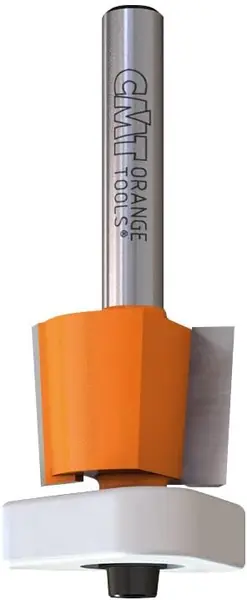
A bearing that seizes does not just stop guiding — it drags, and the ring it leaves across a laminate face does not sand out. CMT's answer is a Delrin bearing: a hard polymer that spins freely, runs cool, and will not score the surface it rides on. On melamine shelving and laminate faces, that is the difference between a finished edge and a re-cut one.

Where it earned its place with us was a run of melamine shelves, where the face has to come out of the wrapping unmarked. The two SinterHip carbide edges are ground for MDF and laminates rather than for solid wood, and the 1/2-inch cutter trims standard 0.5 mm and 1 mm banding without complaint. The bearing is the part we kept noticing: no freeze, no drag, no painter's tape along the panel.

It is a sheet-goods bit first. The geometry is aimed at MDF, melamine, and plastic laminate; for thick PVC coil on a door edge, the Freud or the Yonico is the better fit. Where the panel wears a factory finish you cannot touch up, that trade is an easy one to make.

Worth Noting

  • Costs more than our top pick
Our Verdict

The CMT is the one we choose when the panel face has to stay unmarked: a Delrin bearing that runs cool against melamine and laminate instead of dragging or seizing.

Check Latest Price
3.

Yonico 31204q Upcut Flush Trim Bit Best for Thick Banding

Yonico 31204q top-bearing upcut flush trim bit with 1/2-inch solid carbide cutter

Thick edge banding

Shop Score 87/100
Shank
1/4 inch
Cutting Diameter
1/2 inch
Cutting Length
1 inch
Cut Geometry
Top bearing, upcut
View on Amazon

Upcut sounds like a catalog word until you watch it work. The spiral lifts shavings out of the cut instead of packing them under the banding, and on 2 mm and 3 mm PVC that is the difference between an edge you sand and an edge you scrap. The cutter is a solid carbide sleeve welded to a hardened steel core, so it behaves like a solid carbide bit without the solid carbide blank behind it, and it is the one we keep for thick banding on panels we cannot replace.

The 1-inch cutting length matches the Freud's, and the top bearing rides the finished face and leaves the cut in plain view, which matters when you are trimming a door edge you have already sanded. On oak-veneered plywood we got a clean top edge on the banding — the spot where a dull cutter shows itself first — and the polished sleeve kept chips moving instead of welding them to the bit.

It is a specialist and it behaves like one: a single 1/2-inch cutter, no radius, no second diameter. If your banding comes off a coil at 0.5 mm, the Freud will do everything you need. If you are edging Baltic birch with 3 mm PVC every week, this is the bit that earns its keep.

Worth Noting

  • The priciest bit in this group
Our Verdict

On thick banding this Yonico is the bit we want: an upcut solid carbide cutter that shears through 2 mm and 3 mm stock without tearing the show face.

Check Latest Price
4.

Junreox 4-Piece Flush Trim Bit Set Best Budget Set

Junreox four-piece flush trim router bit set with bearings and 1/4-inch shanks

Budget setups

Shop Score 86/100
Shank
1/4 inch
Cutting Diameter
1/2 inch
Max Speed
24,000 RPM
Cutting Lengths
15/32, 25/32, 31/32, 1-1/2 inch
View on Amazon

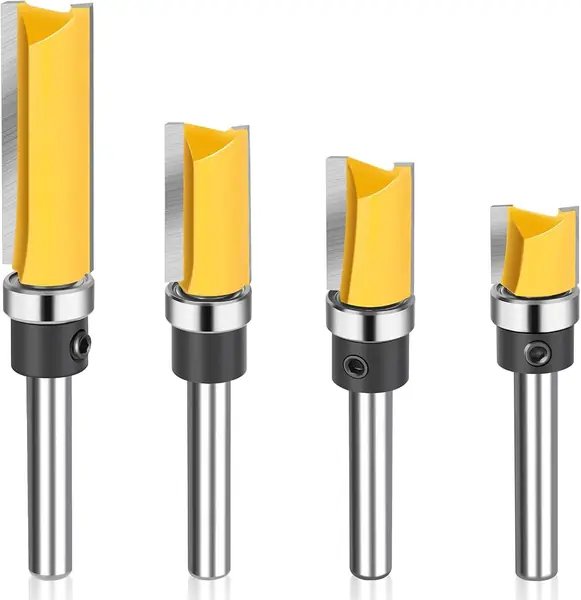
Four bits arrive with cutting lengths of 15/32, 25/32, 31/32, and 1-1/2 inches, all 1/2-inch cutters on a 1/4-inch shank. The range is the whole point: match the cutter to the banding instead of adapting your technique to one length. A short cutter suits 0.5 mm melamine tape on a shelf; the long one keeps the bearing well clear when you are flushing 2 mm PVC on a door.

Cut quality surprised us for the money. The edges are heat-treated tungsten steel rather than the micrograin carbide on the Freud and CMT bits, so we expected to fight tear-out on particleboard; instead the banding trimmed clean and the bearings ran true straight out of the box. What you give up shows later, on end grain and dense MDF, where a finer carbide edge holds its keenness longer.

Treat it as a starter set or a drawer of spares. The 24,000 RPM ceiling printed on the packaging is lower than a fixed-speed trim router will spin these, and that is the number to respect — over-speed is how bearings die and banding burns. For a first cabinet project, or a shop trimming a few different thicknesses a month, four lengths in one box is the easiest way to start.

Worth Noting

  • All four bits share one 1/2-inch diameter
Our Verdict

Four bits in one modestly priced box make this the set we hand a beginner, or keep as spares for banding of several thicknesses.

Check Latest Price
5.

Freud 41-502 Radius Laminate Trim Bit Best for Laminate Countertop Edges

Freud 41-502 radius laminate trim bit with 1/16-inch round-over and 1/4-inch shank

Laminate countertop edges

Shop Score 85/100
Shank
1/4 inch
Cutting Diameter
1/2 inch
Cutting Length
3/8 inch
Edge Radius
1/16 inch
View on Amazon

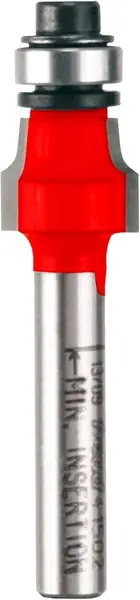
Nobody wants to spend an evening with a file on a countertop edge. This Freud trims the laminate overhang flush and rolls a 1/16-inch radius onto the edge in the same pass — the profile that used to take longest by hand, done at feed speed.

Where it earns its keep for us is countertop runs and cabinet refacing, where the edge is the first thing a hand finds. Both cutters are Freud's TiCo carbide under the Perma-Shield coating, and the bearing is shielded so contact cement does not pack into it, the failure that turns a trim bit into a scraper. Give it a table and a steady feed; the short cutter loads up fast if you linger in one spot.

Judged as what it is, a finishing bit for laminate work, it is excellent value: two cutters, a shielded bearing, and an edge that comes off the router needing nothing. That brief is narrow, which is why it sits here rather than at the top — but for refacing, where the openings and face edges are all laminate and the radius reads as a factory detail, nothing else on this page finishes the job.

Worth Noting

  • Rounded edge only, never a square flush cut
  • 3/8-inch cutter suits laminate, not thick banding
Our Verdict

We keep this one for laminate countertops and refacing: it routs the overhang flush and eases the edge in a single pass, and no other bit here does that.

Check Latest Price

How We Tested Edge Banding Router Bits

We started on paper, narrowing the field to flush-trim and laminate bits with a bearing, a 1/4-inch shank that fits a trim router, and cutting lengths spanning the banding thicknesses people actually buy. Sixteen of those came into the shop for six months, where they trimmed overhang on plywood shelves, melamine cabinet sides, and a laminate countertop edge.

Each bit got the same run. We measured its cutting length against the banding on hand, since a long cutter on thin banding gives up control. Before mounting we spun the bearing by hand, seated the shank fully, and checked the bearing hardware, then trimmed a full shelf edge and looked at the top of the banding for fuzz and chip-out and at the panel face for bearing marks. Laminate passes were watched for burn, and we backed off the feed until the scorch stopped.

Sharpness and durability were tracked across repeated passes rather than a single test cut. We noted the point where a cutter started pulling instead of shearing, how the carbide looked and cut near the end, and how many edges a bit held before we wanted a fresh cutter or a replacement bearing. Spindle speed stayed at or under each bit's rating every time, and eye and hearing protection stayed on, because these bits throw chips, laminate shards, and banding offcuts.

Value came down to how many clean edges a bit delivered before it dulled, which is also where the bearings separated the field.

How to Choose an Edge Banding Router Bit

Match the Cutter Length to the Banding

Edge banding runs from 0.5 mm tape to 3 mm PVC, and the cutter has to be at least as tall as the banding with a little room to spare. A 1/2-inch cutting length covers nearly everything you will meet; a full inch of carbide, as on the Freud 42-104 and the Yonico, trims thick stock in one pass and leaves you somewhere to move the bit as it dulls.

The trap is buying a laminate trim bit — a 3/8-inch cutter sized for a laminate skin — and expecting it to square up PVC banding. It will trim the overhang on a countertop beautifully and run out of cutter on a 2 mm door edge.

The Bearing Sets the Cut and the Risk

The bearing rides the face you have already finished, so it decides both what the cut looks like and what can go wrong. Steel is the norm and works, but a dry bearing can seize when a cut gets hot or gluey, and a seized bearing drags a mark straight across the panel that no sanding will lift.

A polymer bearing, like the Delrin one on the CMT, runs cooler and will not score the surface. Whatever you buy, keep a spare bearing in the drawer; a cheap part should not be what ends a countertop project.

Diameter, Shank, and the Router on Your Bench

Cutting diameter is a stability question more than a capacity one: 1/2 inch gives the bearing a broad surface to register on and keeps the bit from chattering in the cut, which is why it is the default for banding.

Shank is the fit question. Every bit here uses a 1/4-inch shank, which drops into palm routers, trim routers, laminate trimmers, and any full-size router with a reducing collet. A 1/2-inch shank is stiffer and needs a bigger machine, so buy for the router you own rather than the one you plan to buy.

Feed, Speed, and Burn Marks

Nearly every scorched edge comes down to dwell. A cutter that stops moving in the banding burns the PVC and the panel face behind it, and the mark does not sand away. Take a thick overhang down in one steady pass rather than two hesitating ones, keep the router moving along the edge, and let the bearing set the depth instead of your hands.

Watch the RPM rating too: the Junreox set is capped at 24,000, and a fixed-speed trim router will spin past that. On a variable-speed machine, dial back for laminate, which burns sooner than wood banding does.

Frequently Asked Questions

Final Verdict

We start with the Freud 42-104. An inch of carbide and a 1/2-inch flush cut cover banding, laminate, and light pattern work in a trim router, and it costs less than most of the bits here.

Add the CMT when the panel face cannot be sanded, the Yonico when the banding gets thick and the panel behind it is expensive, and the Junreox set when you want several cutter lengths before committing to one.