↑↓ navigate ↵ open Esc close All results →

Best Flush Trim Router Bits of 2026

Shoppers often judge a flush trim bit by its carbide edges, yet the small pilot bearing does the real steering. That bearing rides the template edge and decides whether the cutter tracks the line cleanly or climbs into the grain—leaving torn fibers or a visible step along a banded panel or curved workpiece.

Over five months of running 16 bits and sets through plywood, MDF, and plastic laminate, bearing condition ruined more test passes than dull carbide ever did, especially once a bearing ran dry or developed play. Geometry dictates the rest: top-bearing bits require the template on top, spiral flutes shear cleaner faces while pushing chips one way, and multi-bit sets handle inside radii a single diameter cannot clear.

None of these cutters belong in metal, and every bit has a maximum rpm ceiling that needs checking against the router's no-load speed before the first pass.

Our Top Picks

The Best Flush Trim Router Bits

1.

Freud 42-104 Bearing Flush Trim Bit Best Overall

Freud 42-104 bearing flush trim router bit with 1/2-inch carbide cutter and 1/4-inch shank

Template trimming

Shop Score 93/100
Shank Diameter
1/4 inch
Cutting Length
1 inch
Cutting Diameter
1/2 inch
Bearing Diameter
1/2 inch
View on Amazon

One inch of carbide on a half-inch cutter is the figure that sold us. That is enough cutting edge to trim 3/4-inch stock with the pattern underneath and the bearing riding the template, and enough to stack a template, a workpiece, and a backer on a router table without the collet crowding the work. Plenty of bits give you half that edge.

We kept this one in the trim router through a run of plywood cabinet parts, and the edge it left needed a light pass with 220 and nothing more. The bearing is the same half-inch diameter as the cutter, which matters more than it sounds: there is no offset to account for, so the pattern you cut is the pattern you get, and a template you have squared stays square on the finished part.

What we appreciate about Freud's better bits is the fit rather than the marketing: the bearing spins free, the shank runs true in the collet, and the Perma-SHIELD coating keeps resin from building up and scorching an edge on plywood. Run it through softwood, hardwood, and plywood and the cut stays clean across all three, which is more range than most of us ask of one bit.

If you want one bit to start with, this is the one. Buy a second while you are at it: a spare in the drawer beats a mid-project trip to the store, and this is the bit that will be in the router most of the time.

Worth Noting

  • Edge life trails the spiral bits in constant use
Our Verdict

We recommend this one first for pattern work: a 1-inch cutting length that covers 3/4-inch stock, a bearing matched to the cutter diameter, and a price that leaves room for a spare.

Check Latest Price

2.

Whiteside RFT2100 Spiral Flush Trim Bit Best for Clean Finishes

Whiteside RFT2100 spiral flush trim bit with quarter-inch upcut cutter and double bearings

Clean finish cuts

Shop Score 92/100
Shank Diameter
1/4 inch
Cutting Length
1 inch
Cutting Diameter
1/4 inch
Flute
Upcut spiral
View on Amazon

Set this beside the straight-flute Freud and the difference is in the edge. The upcut spiral slices the grain instead of chopping at it, and on cross-grain plywood and hardwood that shows up as an edge you finish with a light hand-sand rather than a block and patience.

Two ball bearings stacked at the tip share a load that a single guide takes on its own, and the quarter-inch cutter with a 1-inch cutting length is the size that does most template work. Three inches of overall length gives you enough bit to get the guide over a thick pattern on a router table without running out of shank.

It is solid carbide rather than a brazed tip, and the cut reflects it: quieter, cooler, less of the whine that tells you a bit is working harder than it should. Chips come up and out of the cut instead of packing in behind the bearing, which is why a plywood edge comes off the router nearly finished.

The cost is the whole argument against it: several times the price of the Freud, for a single bit rather than a set. When the edge you are trimming is the one people will look at, we think that is the best money in this guide.

Worth Noting

  • Guide bearings wear first under constant use
Our Verdict

Buy this when the trimmed edge is the finished surface: the upcut spiral leaves template work almost sanding-free, and we think it is worth the premium for furniture and veneered parts.

Check Latest Price
3.

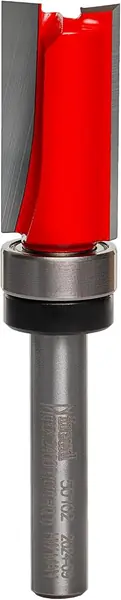
Freud 50-102 Top Bearing Flush Trim Bit Best Top-Bearing Bit

Freud 50-102 top bearing flush trim router bit with half-inch cutter and quarter-inch shank

Face-mounted templates

Shop Score 91/100
Shank Diameter
1/4 inch
Cutting Length
1 inch
Cutting Diameter
1/2 inch
Overall Length
2-5/8 inches
View on Amazon

Every flush trim bit solves a template problem, and this one solves the version where the pattern sits on top of the work: sign lettering, shallow cut-outs, and any job where the template is screwed to the face of the panel. The bearing rides above the cutter, so the guide never has to reach past the edge of the stock to find the pattern.

The 1-inch cutting height and 2-5/8-inch overall length are the numbers to check against your setup. One inch of carbide trims 3/4-inch material with room to spare, and two flutes clear chips quickly in softwood and plywood; the TiCo carbide holds its edge in hardwood without the burn marks that come from pushing a dull bit too slowly.

We reach for this one when the pattern has to be followed on the face rather than the edge, and it turns a one-off jig into a repeatable part. Fast enough for a run of parts, and still a template specialist rather than an all-rounder.

Worth Noting

  • Long body needs clearance under a small router base
Our Verdict

The one to buy when the template is screwed to the face of the work rather than slipped underneath, which makes it our pick for lettering, inlays, and cut-outs.

Check Latest Price
4.

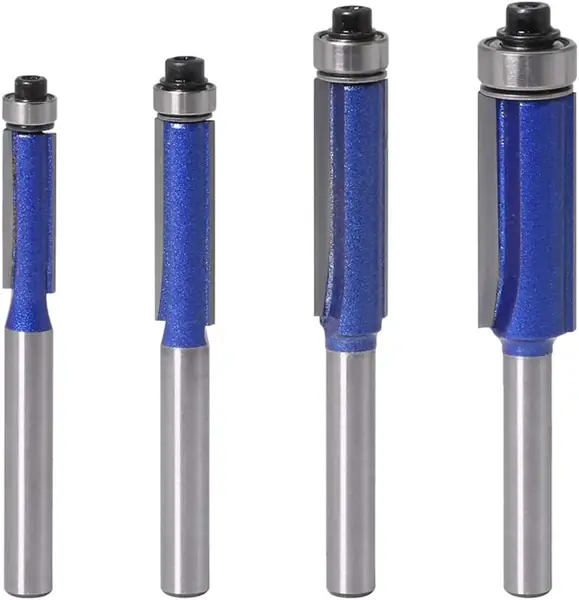
LU&MN 4-Piece Flush Trim Router Bit Set Best Set

LU&MN four-piece top-bearing flush trim router bit set with quarter-inch shanks and four diameters

Starter set

Shop Score 90/100
Shank Diameter
1/4 inch
Cutting Length
1-3/16 inches
Number Of Bits
4
Cutting Diameters
1/4", 5/16", 3/8", 1/2" inches
View on Amazon

Four top-bearing bits on one quarter-inch shank, at 1/4, 5/16, 3/8, and 1/2 inch, all with a 1-3/16-inch cutting length. This is the set we hand someone buying their first bits, before they know which size their templates will want, because it covers the range without guessing.

The sizes each do real work. A quarter-inch cutter gets into tight inside curves and small lettering; the half-inch bit handles straight runs and wide sweeps; 5/16 and 3/8 split the difference when a template's radius will not take the big bit. Every one is top-bearing, so the pattern rides above the work, which is the setup that makes most sense on a router table.

Solid carbide, two flutes, and a coating that keeps resin from building up on plywood and MDF. The half-inch bit did the bulk of our trimming, and what we liked was how little tear-out it left where the grain ran out on a plywood face.

The compromise is how long the edges last: this is a set for weekend work and for learning, not for feeding a cabinet shop. On the cut itself we found nothing to complain about, which is more than we expected for the money.

Worth Noting

  • Edge life on hardwood is the weak spot
Our Verdict

The set we hand anyone still building a template kit: four top-bearing sizes from 1/4 to 1/2 inch, solid carbide cutters, and a price that keeps a spare bearing in the drawer.

Check Latest Price
5.

CMT 807.128.11 3-in-1 Flush Trim Bit Best for Laminate

CMT 807.128.11 laminate flush trim bit with orange coating and white triangular Delrin guide

Laminate trimming

Shop Score 89/100
Shank Diameter
1/4 inch
Cutting Length
1/2 inch
Cutting Diameter
1/2 inch
Bearing
Delrin triangular guide
View on Amazon

Wood glue and contact cement are what kill ordinary bearings. The guide on this CMT bit is Delrin, a slick plastic that glue will not stick to, and the triangular profile puts more surface against the template, so it rides the pattern instead of digging into it. For laminate work that is the whole point.

The rest of the bit is built for the same job: a half-inch cutter with two chrome-carbide edges, a shear angle that slices laminate instead of chopping it, and a coating CMT calls Orange Shield to keep chips moving. On plastic laminate and aluminum laminate it leaves an edge that needs far less filing than a straight bit gives you.

The guide is the part to watch. It is plastic, it takes the wear, and it is held by a small screw, so check that it is seated and snug before a run rather than after a spoiled piece of laminate.

If your trimming is laminate, this is the bit to own. It handles glue-covered templates that would seize a steel bearing, keeps a wide slick guide against the pattern instead of a steel wheel that scratches it, and turns three separate laminate problems into a single pass. Three functions in one bit sounds like marketing until the guide stays clean through a whole countertop.

Worth Noting

  • 1/2-inch cutting length is limited to thin stock
Our Verdict

Own this if you trim laminate: the plastic Delrin guide shrugs off contact cement that seizes a steel bearing, and the shear cutter saves most of the filing.

Check Latest Price
6.

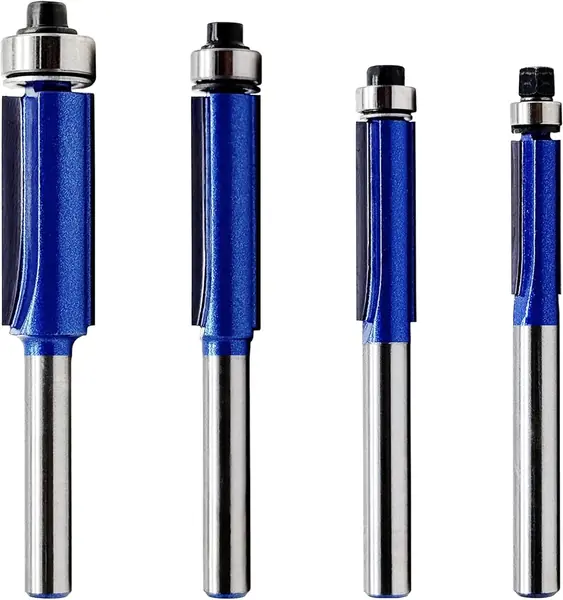
Wolfride 4-Piece Flush Trim Router Bit Set Best Budget Set

Wolfride four-piece top-bearing flush trim router bit set with quarter-inch shanks in a plastic box

Budget size range

Shop Score 88/100
Shank Diameter
1/4 inch
Cutting Lengths
13/16", 1-1/16", 1-3/16", 1-3/32"
Cutting Diameters
1/4", 5/16", 3/8", 1/2"
Max RPM
18,000
View on Amazon

Four diameters on one quarter-inch shank, with cutting lengths running from 13/16 inch up past an inch. The spread is the useful part: a short cutter for tight curves and shallow trim, a longer one for thicker stock, without a second purchase.

The cutters are carbide on a hardened body with anti-kickback geometry, and the top bearing rides a pattern on the face. These are not bits you buy for edge life; they are the set we hand a beginner who needs four sizes before knowing which one will earn its keep, and the one we keep for jobs where a chipped edge costs a bit rather than a day.

What we appreciate is that Wolfride publishes a ceiling at all: the set is rated to 18,000 rpm, and most routers run around 22,000. A variable-speed machine lets you dial down to the rating and use these as intended; a fixed-speed trim router will over-speed them, so check your router before you buy.

Worth Noting

  • 18,000 RPM limit makes fixed-speed trim routers too fast
  • Budget carbide prioritizes low cost over long edge life
Our Verdict

The budget set that covers the most sizes, as long as your router has a speed dial: four diameters and four cutting lengths for less than most single bits here.

Check Latest Price
7.

Whiteside RFTD2100 Downcut Spiral Flush Trim Bit Best for Finished Face Work

Whiteside RFTD2100 downcut spiral flush trim bit with quarter-inch cutter and double bearings

Finished face work

Shop Score 87/100
Shank Diameter
1/4 inch
Cutting Length
1 inch
Cutting Diameter
1/4 inch
Flute
Downcut spiral
View on Amazon

Same bit as the upcut Whiteside above, shearing in the other direction, and for veneered plywood, laminate, or shop-made edge banding that direction is the reason to buy it. A downcut spiral shears downward, so the show face comes off clean instead of fuzzed, and the edge needs little beyond a light sand.

The quarter-inch cutter and 1-inch cutting length match its upcut sibling, with the same double bearings at the tip and 3 inches overall. Trimming red oak edge banding, the joint was one you had to look for. The trade is chip clearance: a downcut bit packs chips into the cut, so a slow, steady feed matters more here than it does with the upcut.

It is a specialty, and priced like one. Most of us do not need both spirals, and if the answer is one, the upcut is the all-rounder. The shop that keeps two does it because the finished face decides which way the grain lifts, not because one cuts better than the other.

Worth Noting

  • Guide bearings can work loose with use
Our Verdict

For veneered plywood and edge banding where the show face is up, this downcut spiral is the bit that keeps that face clean enough to finish straight off the router.

Check Latest Price
8.

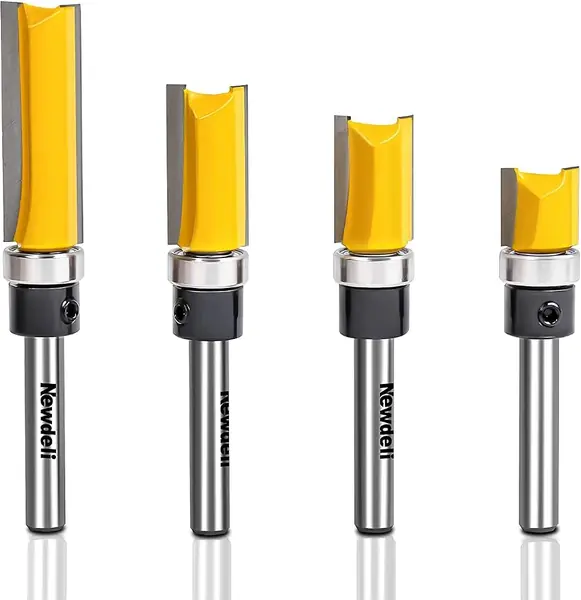
Newdeli 4-Piece Pattern Flush Trim Router Bit Set

Newdeli four-piece bottom-bearing flush trim router bit set with quarter-inch shanks in a plastic box

Varying stock thickness

Shop Score 86/100
Shank Diameter
1/4 inch
Number Of Bits
4
Cutting Lengths
3/8", 3/4", 1", 1-1/2"
Bearing Position
Bottom
View on Amazon

Four bits, one cutting diameter, four cutting lengths: 3/8, 3/4, 1, and 1-1/2 inch. That is a different idea from the usual multi-size set. Instead of covering diameters it covers stock thickness, so a laminate edge and a thick glue-up get the same cutter profile with only the depth of stick-out changed.

Bottom bearings on all four mean the template goes under the work, which is the setup most of us use with a handheld router. In our hands the long bits wanted a slower feed to stay clean, and the short ones were the pleasant surprise: the 3/8-inch cutter handles trim rings and thin edging where a full-size bit is too much tool. For occasional trim work it earns its place in the drawer.

Worth Noting

  • One cutting diameter only, so no sizing range
Our Verdict

A sensible buy if your trimming spans thin edging and thick glue-ups: four depths at one diameter, so the template offset never changes between jobs.

Check Latest Price

How We Tested Flush Trim Router Bits

We started with a list of about 40 flush trim bits and sets, then narrowed it using specs a shopper can actually check: bearing position, cutting length against a typical template-plus-workpiece stack, cutting diameter against the radius being followed, shank size, and whether the maker publishes a maximum rpm. Sixteen went to the bench, and they stayed there for five months.

They were used the way a flush trim bit actually gets used — trimming cabinet parts and curved rails against a plywood template, flush-cutting laminate on a countertop, cleaning up edges on MDF. Before every session we seated the shank at least three-quarters deep in the collet, checked the bearing by hand for play, and matched each bit's rated rpm to the router's no-load speed.

To judge the cut itself, we compared edges on cross-grain hardwood, plywood, and MDF, counting tear-out at the exit corner and running a thumb along the edge to feel for a step where the bearing met the template. Upcut and downcut spirals were run on the same panel so we could see which face each one marked.

Bearing life got as much attention as the carbide, since the guide is what fails first: we logged how many passes each one made before it turned rough or started to wobble. We timed bit changes, checked how each set's sizes fit the collet and whether you could find the one you wanted, and weighed a set's price against how many of its sizes a normal project would use. Nothing but wood, MDF, plywood, or laminate went near them, and no bit was run above its rating.

How to Choose a Flush Trim Router Bit

Bearing Position Sets the Whole Setup

Every flush trim bit is a cutter with a guide bearing, and the bearing's position decides which side of the work the template goes on. A bearing at the tip runs the pattern underneath, the standard setup with a handheld router and the arrangement the Freud 42-104 is built around. A top-mounted bearing turns the bit into a template bit for patterns screwed to the face of the work, which is what you want for sign lettering and cut-outs.

Flip either bit into a router table and the geometry turns over, so work out the setup you will actually use before you order. If you trim in both orientations, a bit with bearings at both ends covers you, but expect to pay for the extra hardware.

Cutting Length Has to Clear Your Stack

Cutting length is the carbide below or above the bearing, and it has to cover your workpiece plus whatever template and backer you stack with it. One inch handles 3/4-inch stock with room for a quarter-inch template, which is why the Freud 42-104 is our default. Half-inch cutters like the CMT are for laminate and thin edging, not for solid stock.

Longer is not automatically better. A 1-1/2-inch cutter on thin stock puts more bit in the cut than the job needs and is harder to keep steady, so buy the shortest cutter that clears the work you actually do.

The Bearing Fails Before the Carbide Does

A dull edge leaves a rough surface; a bad bearing ruins the piece. A guide that seizes or works loose will burnish the template edge and can pull the cutter into the pattern, and that happens at every price. Check that the guide spins free and its retaining screw is snug before each run, and keep resin and glue off it.

Bearings are cheap and take a minute to swap, so keep two spares in your size in the drawer. Note the inside and outside diameter before you order replacements, since a bearing a few thousandths off the cutter leaves a step on every pass.

Flute Geometry Buys You the Finish

Straight two- and three-flute bits are the default: fast, affordable, and clean enough on plywood and softwood. An upcut spiral like the Whiteside RFT2100 shears the grain and clears chips, and that is the difference between an edge that needs sanding and one that mostly does not. A downcut spiral reverses the direction, protecting the show face on veneer and edge banding at the cost of chip clearance.

Spiral geometry costs several times a straight bit. Spend up when the trimmed edge is a finished surface, and stay with a straight bit for construction-grade cut-outs.

Shank, Speed, and Whether to Buy a Set

Nearly every bit we recommend runs a 1/4-inch shank, which suits compact trim routers and full-size routers with a 1/4-inch collet; check the collet you own before ordering. Then check the bit's maximum rpm against your router. Most routers turn around 22,000 rpm, and a set rated to 18,000 needs a variable-speed machine you can dial down.

On sets: four sizes for about the price of one good bit is a genuine bargain if you are still collecting templates, and waste if you only ever trim 3/4-inch stock against a single pattern. Buy the one size you need first, then fill in with a set once you know what your work asks for.

Frequently Asked Questions

Final Verdict

The Freud 42-104 is the template bit we point most people to: a full inch of carbide, a bearing matched to the cutter, and a price that makes a spare painless. Step up to the Whiteside RFT2100 when the trimmed edge is the finished surface and sanding it is the last thing you want to do.

If you are still collecting patterns, the LU&MN four-piece set covers the sizes for about what one good bit costs. If the work is laminate over contact cement, the CMT earns its place the first time a steel bearing would have seized.