↑↓ navigate ↵ open Esc close All results →

Best Jointing Router Bits of 2026

A tongue-and-groove joint looks straightforward until assembly reveals a cabinet rail sitting a hair proud of the stile. By glue-up, being a few thousandths off center or out of square is already baked into the parts. Squarely ground cutters with predictable micro-adjustment turn that guesswork into repeatable joinery.

Across nine months of routing oak, pine, and plywood with 12 bits and matched sets, price proved a poor predictor of out-of-the-box sharpness. What really changed shop workflow was how each set handled adjustment — stacked shims on some, threaded collars on others — and shank diameter, which settles whether a bit even mounts in a compact router.

From frame-and-panel doors and back-panel rabbets to biscuit slots and dovetail clamp tracks, the seven selections ahead proved their accuracy at the router table rather than on paper.

Our Top Picks

The Best Jointing Router Bits

1.

Freud 99-036 Adjustable Tongue & Groove Bit Set Best Overall
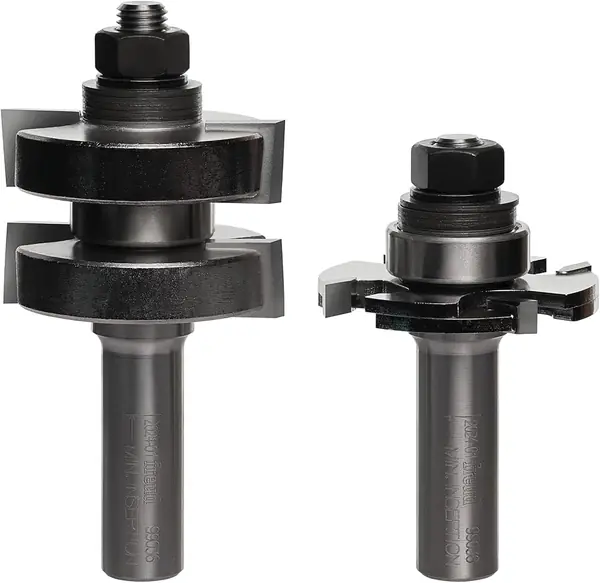
Freud 99-036 adjustable tongue-and-groove router bit set with silver coating and shims

Cabinet door joinery

Shop Score 94/100
Shank Diameter
1/2 inch
Stock Range
1/2 to 1-1/4 inches
Groove Depth
7/32 to 3/8 inch
Adjustment Increment
.002 inch
View on Amazon

The shim stack is the reason this set covers so much ground: the spacers adjust in .002-inch steps, so the same pair of cutters handles stock from 1/2 to 1-1/4 inches and grooves from 7/32 to 3/8 inch deep. The opposing shear angles are aimed at the top and bottom edges, where tear-out shows first, and the 1/2-inch shank gives the set a stable footing in a table-mounted router.

We recommend it first for shaker-style doors and paneled projects because the adjustment is repeatable once you find the setting. On test cuts, the appeal was not just a tight tongue-and-groove fit but the ability to match a plywood panel or a thicker solid-wood panel without changing bits. The Silver I.C.E. coating is a practical bonus, since pitch buildup is one of the things that shortens a session at the router table.

The learning curve is real: the shims are small, and the first setup takes a few test cuts to confirm the fit. We think that is a fair trade for the range, but it is why this set suits someone who will use it more than once. If you only need one fixed 3/4-inch tongue-and-groove cut, a simpler two-bit set is easier to live with.

Worth Noting

  • Carbide edges can chip with hard use
Our Verdict

For most woodworkers building shaker doors or paneled projects, this is the set we recommend first because the shim adjustment makes a precise, repeatable fit across a wide range of stock.

Check Latest Price
2.

Freud 32-504 Rabbeting Bit Set Best for Rabbets

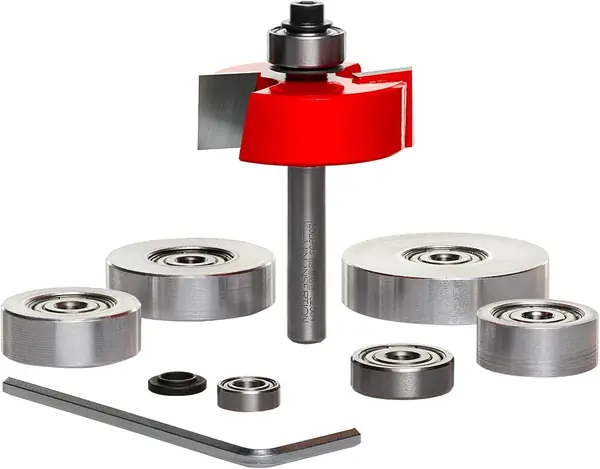
Freud 32-504 rabbeting router bit set with interchangeable bearings and a wrench

Cabinet back rabbets

Shop Score 93/100
Shank Diameter
1/4 inch
Included Components
Interchangeable bearings and wrench
Maximum RPM
16,000
Rabbet Depth Range
1/8 to 1/2 inch
View on Amazon

The interchangeable bearings are the whole point of this set, and they are why we reach for it when a rabbet has to match a back panel or a drawer bottom. The bearings let one bit cut depths from 1/8 to 1/2 inch, and the 1/4-inch shank fits compact and trim routers that cannot take a 1/2-inch bit.

The cuts we got were clean in plywood and hardwood, and the bearing changes were quick enough that we did not dread switching depths. The set includes a wrench, which matters more than it sounds when the screw is recessed. For cabinet backs and drawer bottoms, that range covers most of what a small router is asked to do.

The 1/4-inch shank is the boundary: it is happy in a trim router and fine for shallow rabbets, but it is not the bit we choose for hogging out deep cuts in hard maple in one pass. Keep the end screw clear of the work and the support, because it can wear against them. If you need a 1/2-inch shank for heavier work, this is not the set.

Worth Noting

  • Small bearings and screws are easy to misplace
Our Verdict

If your rabbets need to match cabinet backs, drawer bottoms, or different panel thicknesses, this is the set we reach for because the interchangeable bearings change depth in seconds.

Check Latest Price
3.

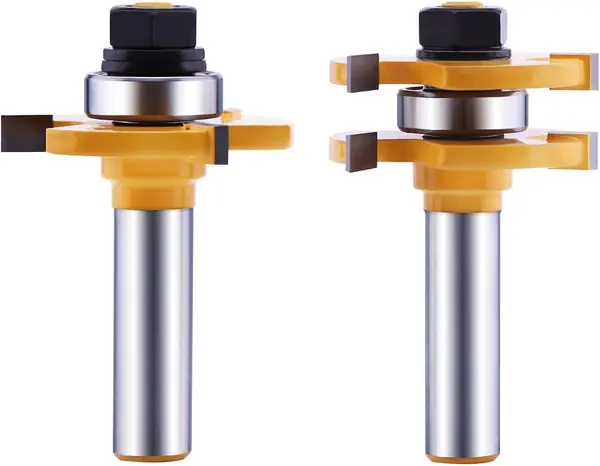
Yonico 15221 Tongue & Groove Router Bit Set Best for 3/4-Inch Stock

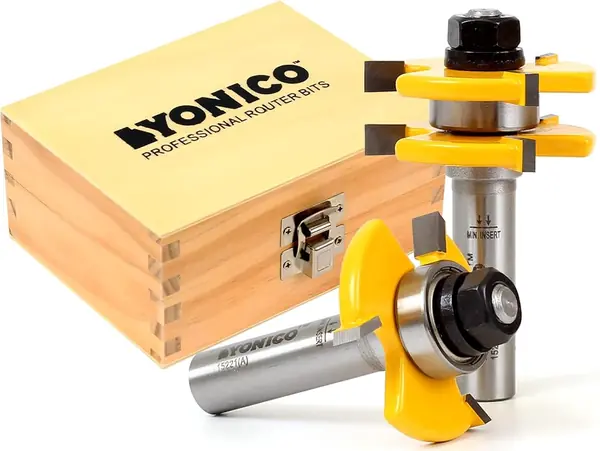
Yonico 15221 two-piece tongue-and-groove router bit set with wooden storage box

3/4-inch stock projects

Shop Score 92/100
Shank Diameter
1/2 inch
Stock Capacity
Up to 3/4 inch
Included Components
Two bits, shims, and wooden box
Tongue Dimensions
1/4 inch thick x 1/2 inch deep
View on Amazon

The 3/4-inch stock ceiling is exactly where many cabinet and panel projects start, and this two-bit set is built for that lane: it cuts a 1/4-inch tongue at 1/2-inch depth in stock up to 3/4 inch thick. The 1/2-inch shanks give it more stability than the 1/4-inch sets, and the matched cutters are meant to be used in a table-mounted router.

We liked the wooden box and the extra shims, which make the set feel more organized than a pair of loose cutters. The bits produced clean shoulders in pine and poplar, and the simple two-bit layout is easier to repeat than a multi-piece shim stack. Joint alignment still takes practice, because the bits are not self-indexing.

We recommend it for someone who wants a dedicated 1/2-inch-shank tongue-and-groove set for 3/4-inch stock and does not want to fiddle with a multi-piece shim stack. It is less flexible than the Freud set for thicker stock, and the fit takes a little tuning, but the simpler layout is easier to repeat for a run of cabinet parts.

Worth Noting

  • Edges may dull after long production runs
Our Verdict

Buy this two-bit set if you work mostly 3/4-inch stock and want a straightforward 1/2-inch-shank tongue-and-groove cut without a shim stack to manage.

Check Latest Price
4.

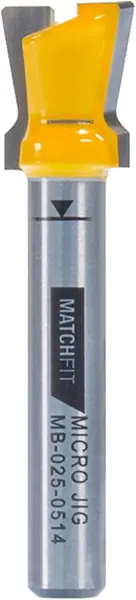
MICROJIG Matchfit Dovetail Router Bit Best for Dovetail Clamp Systems

MICROJIG Matchfit dovetail router bit with 14-degree profile and 1/4-inch shank

Matchfit clamp grooves

Shop Score 91/100
Shank Diameter
1/4 inch
Material
Carbide
Depth Guide
3/8 inch
Dovetail Profile
14 degrees by 1/2 inch
View on Amazon

The 3/8-inch depth line on the bit body is the detail that makes this dovetail bit feel purpose-built: it gives you a visual target for Matchfit clamp grooves, and the laser-cut safety line shows how far to bury the shank. The 14-degree, 1/2-inch profile has rounded corners at the top and bottom, which is meant to reduce tear-out and reinforce the groove edges in plywood.

We recommend it for anyone already using the Matchfit system because the bit and clamps are designed as a pair. The rounded edges left clean grooves in our test cuts, and the down-shear geometry helped clear chips. It is not a general dovetail jig bit, and it will not replace a traditional dovetail set.

The value is tied to the system: if you do not use Matchfit clamps, a standard dovetail bit is a better use of money. The bit is also a single-purpose cutter, so it earns its place only if you cut these grooves regularly. That is a narrow lane, but within it the bit is clean and predictable.

Worth Noting

  • Premium price for a single-profile bit
Our Verdict

For Matchfit clamp users, this is the dovetail bit we recommend because the rounded profile and depth line make clean, repeatable grooves with less sanding.

Check Latest Price
5.

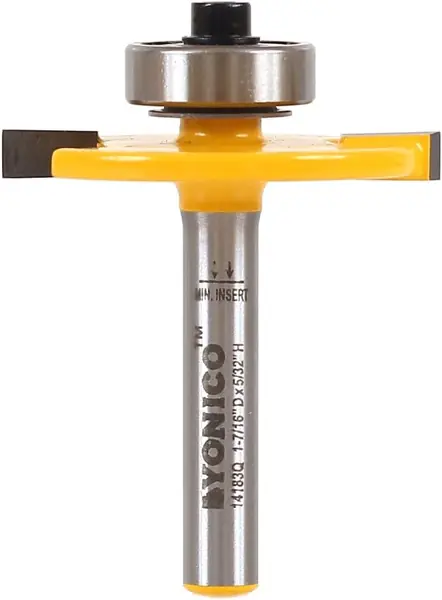
Yonico 14183q Biscuit Joint Router Bit Best Biscuit Joint Bit

Yonico 14183q biscuit joint router bit with 1/4-inch shank and carbide cutter

Biscuit joint slots

Shop Score 90/100
Shank Diameter
1/4 inch
Biscuit Size
#10
Cutter Depth
13/32 inch
Blade Material
C3 micro-grain carbide
View on Amazon

The 13/32-inch cutter depth is the number that matters here: it cuts a #10 biscuit slot slightly deeper than the biscuit so there is room for glue and swelling. That makes this a router-table alternative to a dedicated biscuit joiner, and at the budget end of the bits here, we think it is an easy one to justify. We also like that it does not require a dedicated machine.

The 1/4-inch shank suits compact routers, and the bit cuts clean slots in oak and plywood. It is short and easy to control, but we still prefer a router table or a straight edge for repeatable slots, especially when the workpiece is narrow. For a small shop, that setup is simple enough.

We keep it in the drawer for small cabinet and furniture parts where a biscuit adds glue surface without a lot of setup. The carbide edge held up through our test cuts, and the simple depth control makes the bit feel less fussy than a full joiner. If you already own a biscuit joiner, this is redundant; if you do not, it is a low-cost way to add that joint to router work.

Worth Noting

  • Only cuts #10 biscuit slots
Our Verdict

This is the bit we suggest for adding biscuit joints at the router table without buying a dedicated biscuit joiner, as long as you only need #10 biscuits.

Check Latest Price
6.

LU&MN Tongue and Groove Router Bit Set Best Budget 1/4-Inch Shank Set

LU&MN two-piece tongue-and-groove router bit set in a plastic storage case

Budget compact-router projects

Shop Score 89/100
Shank Diameter
1/4 inch
Cut Type
Tongue and groove
Number Of Bits
Two
Included Storage
Plastic case
View on Amazon

The two-bit kit is the appeal: one tongue bit, one groove bit, both on 1/4-inch shanks, in a plastic case that fits a compact router drawer. For a beginner or someone adding a few shaker-style panels, that is a low-risk way to try tongue-and-groove work without buying a multi-piece set.

The bits cut smoothly in softwood and plywood, and the anti-kickback design is a sensible touch on a small shank. The Teflon coating is there to keep pitch from building up, which helps when you are making several passes. The case is the weak point: the latch and the tight slots make it more annoying than it needs to be. The bits are not as refined as the Freud set, but they are sharp and the cuts were clean enough for painted cabinet parts.

We recommend it as a budget starter set for light projects, not as a production bit. The 1/4-inch shank is the real boundary, and it will not enjoy thick hardwood or deep passes. For a beginner, that is a fair trade at the budget end, and the matched pair is easier to set up than buying two separate bits.

Worth Noting

  • Durability is inconsistent under heavy use
Our Verdict

For a compact router and occasional shaker-style projects, this budget set cuts clean tongue-and-groove joints, though it asks for light passes and a little fit tuning.

Check Latest Price
7.

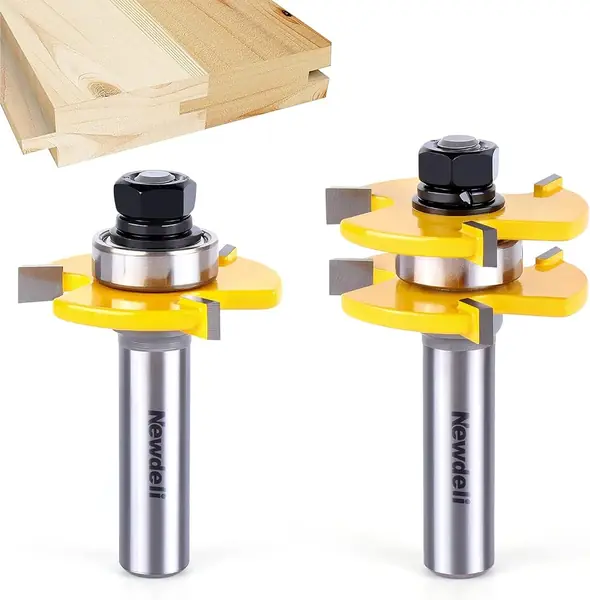
Newdeli Tongue and Groove Router Bit Set

Newdeli two-piece tongue-and-groove router bit set with 1/2-inch shanks and washers

Occasional 3/4-inch joinery

Shop Score 88/100
Shank Diameter
1/2 inch
Stock Capacity
3/4 inch
Cutting Depth
1/2 inch
Tongue Thickness
1/4 inch
View on Amazon

The 1/2-inch shank at a budget price is the unusual combination here: most inexpensive tongue-and-groove sets come on 1/4-inch shanks, but this one gives a full-size router more to hold onto. It is sized for 3/4-inch stock and a 1/2-inch cutting depth, with a 1/4-inch tongue.

The set includes adjustment washers, and the 3-teeth T-shape cutters are meant to be tuned by removing spacers. We found the cut clean in oak and plywood, and the anti-kickback design is welcome on a bit this size. The finish is good for the money, not premium, and the setup takes a few test cuts to get the fit you want.

The 1/2-inch shank is a plus, but it does not turn this into a production cutter. Keep the feed steady and the passes light, especially in hardwood, and check the nut before each run. For a home shop, that is normal care rather than a special burden.

We recommend it for a home shop that wants a 1/2-inch-shank tongue-and-groove set for 3/4-inch stock without paying premium money. It is not the set for someone who needs the last word in fit or a long production run, but for occasional cabinet parts and paneling, it covers the job.

Worth Noting

  • Needs test cuts and nut checks before runs
  • Not suited for heavy production routing runs
Our Verdict

This is a sensible budget choice for a 1/2-inch-shank router and 3/4-inch stock, with adjustment washers for fit, but it is not the set for daily production work.

Check Latest Price

How We Tested Joint-Making Router Bits

We started with every joint-making bit we could find — tongue-and-groove sets, rabbeting sets, dovetail and biscuit cutters — and sorted them by joint profile, shank diameter, stock range, and price, so the shortlist ran from single budget bits to sets with interchangeable bearings and shims. From that we bought 12 at retail and worked them for nine months.

Every bit went into a router table on the same stock: 3/4-inch white oak and pine for cabinet and furniture parts, half-inch plywood for back-panel rabbets. We set the router to the speed printed on each bit's label, wore eye and hearing protection, seated every shank to the marked depth or at least two-thirds of the collet, and used push blocks and light passes on narrow stock and deep cuts.

The first cut told us most of it. We watched whether end grain came up glassy or furry, whether plywood veneer tore at the exit, and whether a slow feed scorched the shoulders. Calipers gave us the real tongue thickness; a dry fit showed whether the tongue sat centered and the shoulders met flush, which is the difference between a door that hangs square and one that racks. Then we reset each bit from scratch and cut again to see whether the second joint matched the first.

Adjustability we measured rather than took on faith — shim stacks against threaded collars, and how far a quarter turn actually moved the cutter. Durability came from linear feet in oak, with an ear out for vibration or a change in pitch, a hand-spin of the bearings afterward, and a close look at the carbide edges for chipping. Value was the last thing we judged, weighed against cut quality and setup time.

How to Choose Jointing Router Bits

Start With the Joint Profile

Joinery bits split into families, and each family solves a different problem. Tongue-and-groove sets align panels and cabinet parts; rabbeting sets cut the recesses for cabinet backs and drawer bottoms; biscuit bits cut slots for oval biscuits; dovetail bits cut the angled grooves for dovetail clamps or jigs; rail-and-stile sets build framed doors with a panel groove. A general-purpose straight bit can remove material, but it is not a substitute for the profile that makes the joint fit.

Buy for the joint you make most, then add a second profile only when a project demands it. A tongue-and-groove set will not cut a true dovetail, and a 14-degree dovetail bit made for Matchfit clamps is not a traditional dovetail jig cutter. That sounds obvious until you are staring at a project plan with three different joints and one router.

Match the Shank to Your Router

Shank diameter is a compatibility decision before it is a performance one. A 1/2-inch shank needs a router with a 1/2-inch collet, and it gives a large cutter more support; a 1/4-inch shank fits compact and trim routers and is the practical choice for lighter cuts. If you own both sizes, we prefer 1/2-inch shanks for wide tongue-and-groove and rail-and-stile work and 1/4-inch shanks for small rabbeting and biscuit bits.

Check the collet, not the label on the bit. A 1/2-inch shank does not fit a 1/4-inch router, and a reducer is not a substitute for the right collet. The shank also has to be inserted deep enough to the marked line or at least two-thirds of the collet; a short grip can bend a bit, especially in a small router.

Check Stock Range and Adjustment

Tongue-and-groove sets are sold by stock thickness and cutting depth, and those numbers are the ones that decide whether the set fits your project. A set rated for 3/4-inch stock may just cover 3/4-inch material, so leave a little room if you work with thicker panels or plywood that runs oversize. Rabbeting sets use interchangeable bearings or cutters to change depth; shim-based tongue-and-groove sets adjust in small increments for a tighter fit.

Adjustability is worth paying for when you build doors or panels with changing thicknesses. The Freud 99-036 adjusts in .002-inch steps across 1/2- to 1-1/4-inch stock, which is why it earns our top pick; the Freud 32-504 uses bearings to move from 1/8- to 1/2-inch rabbets. If your stock is fixed, a simpler two-bit set can be easier to repeat.

Judge Cut Quality, Balance, and Setup

Clean edges come from sharp carbide and a geometry that controls tear-out, but balance matters just as much. A bit that vibrates or runs out of true is not a bargain, no matter how clean the first test cut looks. We pay attention to anti-kickback designs, shear angles, and whether the bit feels stable at the router's normal speed. We also look for setup aids: a depth line, a wrench, clear shims, and instructions that explain the first cut.

Budget sets can cut well, but they are less forgiving of heavy passes and thick hardwood. If you plan to run cabinet parts all weekend, spend for a 1/2-inch shank and a cutter that stays sharp; if you are making a few panels, a budget set with light passes can be enough. Keep a test piece and record the setting that gave you the fit you want.

Frequently Asked Questions

Final Verdict

For most woodworkers, the Freud 99-036 is the jointing bit set we recommend first. Its shim adjustment covers a wider range of stock than the simpler two-bit sets, and the opposing shear angles give you a cleaner start on shaker doors and paneled projects. It asks for test cuts, but the fit is repeatable once you find the setting.

If your work is mostly rabbets, the Freud 32-504 is the better buy because the interchangeable bearings change depth quickly. If you are working 3/4-inch stock on a 1/2-inch-shank router, the Yonico 15221 is the simpler path. Buy for the joint you build most, and add a specialty bit only when a project calls for it.