↑↓ navigate ↵ open Esc close All results →

Best Lock Miter Router Bits of 2026

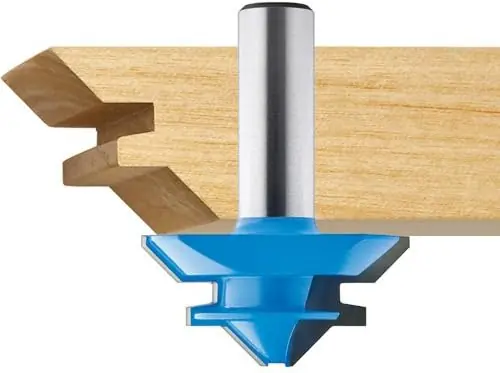
A lock miter produces one of the cleanest corners in cabinetmaking — two interlocking 45-degree profiles hide end grain completely while adding mechanical glue surface — yet it is also one of the quickest joints to go sideways. A tiny error in bit centering or fence height leaves the miter gaping open, and mismatched cutter geometry can make you blame your setup for hours before realizing the bit itself is fighting the stock.

Over eight months of routing drawer boxes, mitered frames, and speaker cabinets in hard maple, walnut, poplar, and pine across 12 bits, two structural choices came first: shank diameter for your router collet, and whether one versatile bit covers your typical 1/2- to 3/4-inch stock or a three-bit matched set saves setup frustration.

Once the fence is dialed in, the seven options ahead deliver the two traits you cannot tweak out at the table: profiles that pull flush and carbide edges that hold up in dense hardwood.

Our Top Picks

The Best Lock Miter Router Bits

1.

Freud 99-034 Lock Miter Bit Best Overall
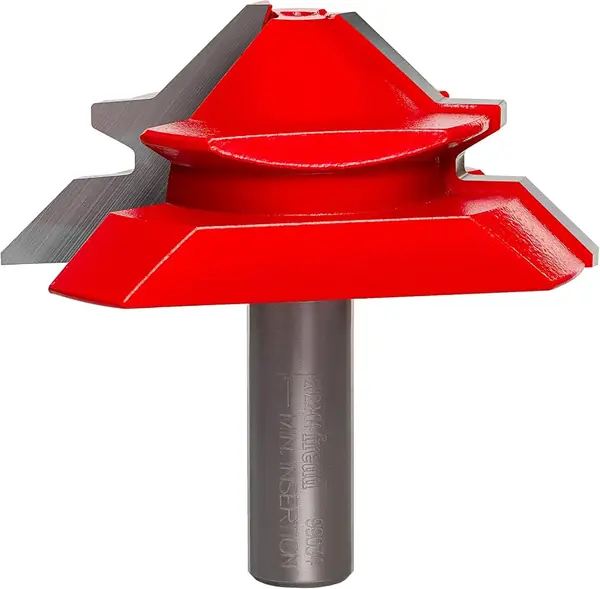
Freud 99-034 lock miter router bit with 1/2-inch shank and carbide cutters

All-around joinery

Shop Score 87/100
Shank
1/2 inch
Stock Range
1/2 to 1 inch
Cutting Diameter
2-3/4 inches
Carbide Height
1-5/32 inch
View on Amazon

One bit, both halves of the joint, and a stock range that runs from 1/2 inch to 1 inch — that's the case for the 99-034 before you ever turn it on. You cut one board flat on the table and the next standing on edge, and the profiles meet. A 2-3/4-inch cutter with 1-5/32 inch of carbide on a 1/2-inch shank is serious tooling, and it's built to cover a whole range of thicknesses rather than one panel.

What we came away with is that this bit argues least with the wood once it's set. The mass steadies it, cuts come off smooth in oak and maple, and the interlock seats with a light push instead of a fight. Softwoods still want a slower feed and a light first pass; run it hard and the finish roughens. Sharpness is the other thing we noticed — it cuts clean from the first board, with none of the warm-up some cheaper carbide needs.

Setup is a full procedure, not a five-minute adjustment. The center of the bit has to meet the centerline of the board both horizontally and vertically, so mark a board, bring the fence and height to the mark, then fine-tune on scrap until the miter line closes without a step. The printed guidance won't carry you through that, so keep the first good setup block you make and label it with its thickness.

Where it earns its keep is the long haul: a shop that builds boxes, frames and cabinet parts in more than one thickness buys this one bit and stops shopping for lock miters altogether. That's the trade — you pay once, and you don't buy a second bit when the next project calls for 1-inch stock.

Worth Noting

  • Premium price for a single bit
Our Verdict

We recommend the 99-034 to anyone who wants lock miter joints to come off the table clean and will run a big cutter at reduced speed in a router table.

Check Latest Price
2.

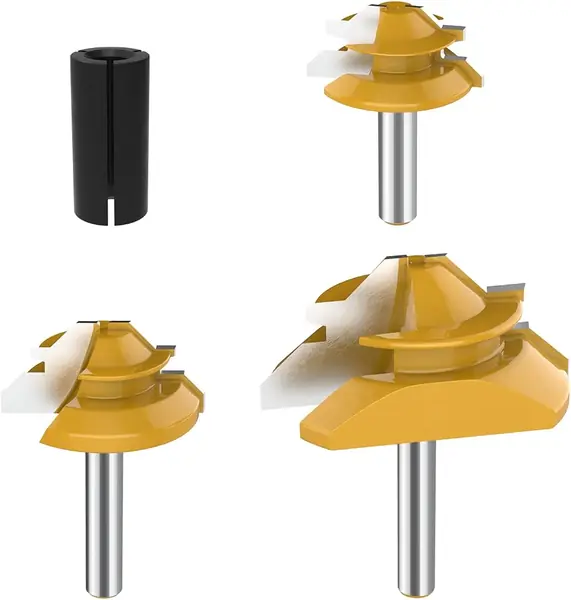
MNA 45-Degree Lock Miter Bit Set Best Set for the Money

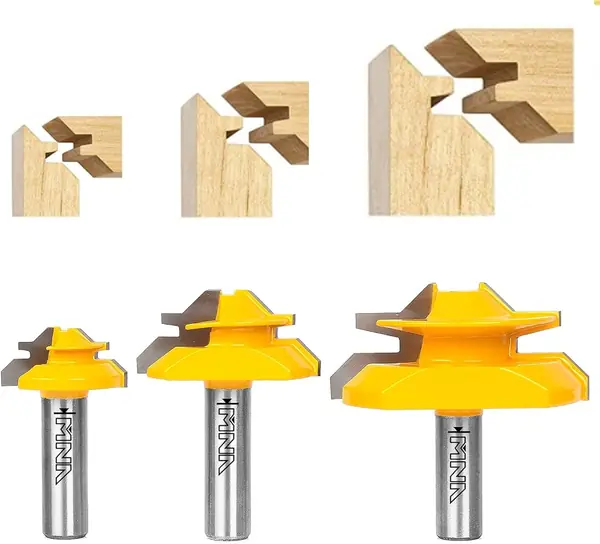
MNA three-piece lock miter router bit set with 1/2-inch shanks and carbide cutters

Multi-thickness box work

Shop Score 86/100
Shank
1/2 inch
Number Of Bits
3
Cutting Heights
1/2 in, 3/4 in, 1 in
Cutter Material
C3 carbide
View on Amazon

Three bits on 1/2-inch shanks, cut for 1/2-inch, 3/4-inch and 1-inch heights. The logic of a set is that each stock thickness gets a bit machined for it, so you aren't stretching one cutter to the edge of its range and then fighting the fence to compensate.

Cut quality is the honest variable. These arrive sharp enough to leave a clean shoulder in pine and poplar, and the interlock closes properly when the height is right — but hardwood is the test, and tear-out on red oak and cherry is the failure to watch for. Take a scrap pass in your actual stock, and take a light final pass rather than one heavy one.

Setup is a real procedure. The set includes a centering method — find the carbide corner that marks the middle of the bit, align it to a marked centerline in both directions, then fine-tune the fence with sample cuts — and that last step is the one that eats the evening. Expect your first session to produce more firewood than furniture.

One thing to weigh before you buy: three bits mean three setups, and a shop that only ever cuts 3/4-inch panels gets nothing from the extra two. What tips it for us is the range of work it opens up — a drawer side and a cabinet panel each get a profile cut for their thickness, and the 1-inch bit is there for thick panels without a second purchase.

Worth Noting

  • Edge quality trails premium bits on hardwood
Our Verdict

Buy this set if your projects move between stock thicknesses and you want those options without paying premium prices for a single cutter.

Check Latest Price
3.

Whiteside 3362 Lock Miter Bit Best for Hardwoods

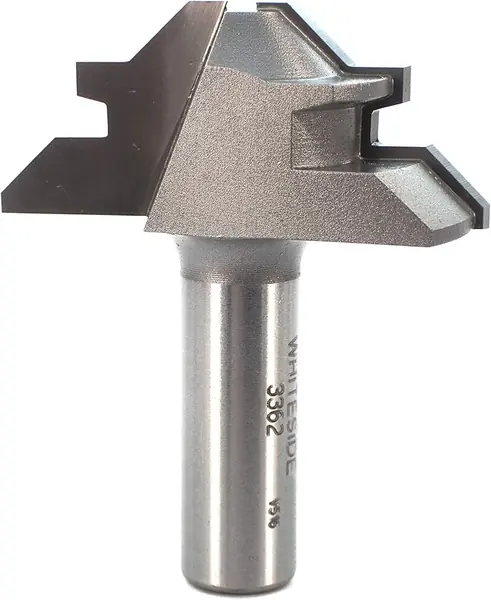
Whiteside 3362 lock miter router bit with 2-inch diameter and 1/2-inch shank

Hardwood box joints

Shop Score 85/100
Shank
1/2 inch
Stock Range
1/2 to 3/4 inch
Cutting Diameter
2 inches
Overall Length
2-3/8 inches
View on Amazon

Two inches of cutter on a 1/2-inch shank, rated from 1/2 inch to 3/4 inch of stock. Set beside the Freud's 2-3/4-inch diameter, the smaller head is the whole story: less steel spinning, less load on the router, and a bit that comes up to a working speed on a mid-sized table without complaint.

The cut is clean in white oak, red oak and cherry, and the bit is rated for composite stock as well as solid wood, so plywood drawer parts aren't off the table. The locking profile seats squarely and stays put while clamps come on, which is what you want from a joint that is mostly glue surface.

Setup is still trial and error — the joint has to close without a step in either direction, and finding that height is the work — but we found less to fight here than with the bigger cutters: the smaller diameter is easier to control through the cut and quicker to bring into line. If your work sits between 1/2 inch and 3/4 inch, this is the premium bit we reach for before the Freud.

Worth Noting

  • Stock range stops at 3/4 inch
Our Verdict

Choose the 3362 if your work stays between 1/2 and 3/4 inch and you want premium carbide without the biggest cutter on the table.

Check Latest Price
4.

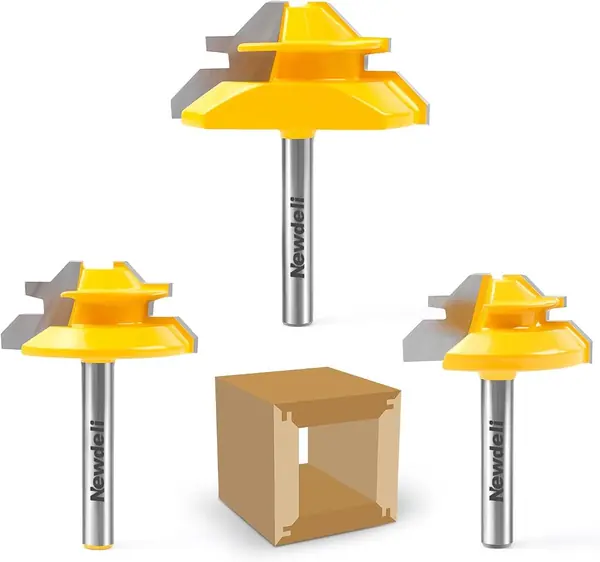
Newdeli 45-Degree Lock Miter Bit Set Best 1/4-Inch Shank Set

Newdeli three-piece lock miter router bit set with 1/4-inch shanks and carbide blades

Compact routers

Shop Score 84/100
Shank
1/4 inch
Number Of Bits
3
Cutting Heights
1/2 in, 5/8 in, 3/4 in
Blade Material
C3 micrograin carbide
View on Amazon

For a router with a 1/4-inch collet, this is the set we start with: three bits cut for 1/2-inch, 5/8-inch and 3/4-inch heights, matched so you pick the profile that fits the board instead of pushing one cutter across a range it was never machined for. The carbide is C3 micrograin, the bodies carry an anti-kickback design, and the coating keeps resin from building up on the flutes.

One thing the maker is clear about: this set is for a table-mounted router or a desktop engraving machine, not a handheld router. That's the right call for a lock miter anyway, since the joint needs a fence and a steady feed, but it does mean a compact router has to live in a table to use these.

The setup procedure is the part that decides whether the set earns its place: mark a centerline, bring the bit's center to it in both directions, then sneak up on the fence with scrap until the miter line closes clean. Once that's done the corners come out square and the interlock holds the boards in line while you clamp. Three heights mean three setups, so label a setup block for each and keep them with the set.

Worth Noting

  • Table-mounted routers only
  • Thin setup documentation
Our Verdict

If your router only takes 1/4-inch bits, this is the set we start with — three sizes, table-mounted work, and joints that close squarely once the height is right.

Check Latest Price
5.

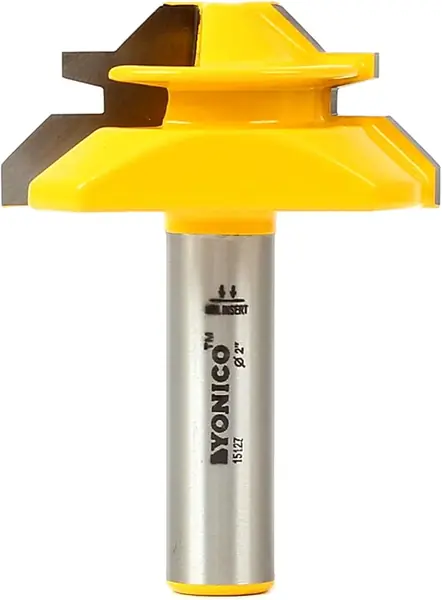
Yonico 15127 Lock Miter Bit Best Budget Single Bit

Yonico 15127 lock miter router bit with 1/2-inch shank and two carbide flutes

Budget 3/4-inch work

Shop Score 83/100
Shank
1/2 inch
Stock Range
5/8 to 3/4 inch
Cutter Material
C3 micrograin carbide
Flutes
2
View on Amazon

One 1/2-inch-shank bit for 5/8-inch to 3/4-inch stock, with two C3 micrograin carbide flutes and a coating that keeps pitch and sawdust from sticking. It's the least expensive single bit here, and for a shop that mostly works 3/4-inch panels, that's the whole appeal.

Setup is the price of admission. Bring the bit's center to the board's centerline, set the fence, cut scrap, adjust, repeat — and then keep that block, because you'll want it every time you come back to the bit. Expect a long first session and quick ones after that. Feed it steadily when you do cut; rushing the pass is where the finish suffers.

Value is the reason it's here: the cuts in hard maple come out clean once the height is right, and the price leaves room for a spare. What it won't do is composites — the maker rates it for natural woods and specifically not MDF or plywood — so plywood cabinet parts are somebody else's job. For solid stock at 3/4 inch and a first lock miter setup, we're comfortable pointing a beginner here.

Worth Noting

  • Rated for 5/8- to 3/4-inch stock
  • Not for MDF or plywood
Our Verdict

We point budget-minded shoppers to the 15127 when they need one bit for 3/4-inch solid stock and can give an evening to the setup.

Check Latest Price
6.

Rockler 45-Degree Lock Miter Bit Best for Thin Stock

Rockler 45-degree lock miter router bit with 1/2-inch shank and anti-stick coating

Thin-stock boxes

Shop Score 82/100
Shank
1/2 inch
Stock Range
3/8 to 3/4 inch
Cutting Diameter
1-3/4 inches
Cutting Height
3/4 inch
View on Amazon

3/8 inch is where most lock miter bits stop being useful, and it's where this one starts: rated from 3/8 inch to 3/4 inch of stock, with a 1-3/4-inch cutter and a 3/4-inch cutting height. For drawer boxes, small boxes and anything built from thin material, that lower end is what earns it a place here.

Setup is quick for a lock miter. Rockler sells a setup block for this bit separately, and with it the height is a moment's work rather than a session of test cuts; without it, the small diameter is still easy enough to bring into line on scrap. Either way, the setting you land on is repeatable, which is the part that matters.

In hard maple the joint comes out strong and square, seats fully under clamps, and holds the two pieces in line while you tighten. It's the smallest cutter in this group, and on a light-duty table that translates into a feed you can control without wrestling the board through.

Worth Noting

  • Setup block sold separately
  • Limited to 3/8- to 3/4-inch stock
Our Verdict

We reach for the Rockler bit when the stock is thin — drawer boxes and small boxes — where the 3/8-inch rating and the quick setup do the most good.

Check Latest Price
7.

ROOCBIT 45-Degree Lock Miter Bit Set

ROOCBIT three-piece lock miter router bit set with 1/4-inch shanks and coated bodies

Starter 1/4-inch set

Shop Score 81/100
Shank
1/4 inch
Number Of Bits
3
Cutting Heights
1/2 in, 9/16 in, 3/4 in
Coating
Heat-resistant Teflon
View on Amazon

Three bits on 1/4-inch shanks, cut for 1/2-inch, 9/16-inch and 3/4-inch heights, with alloy steel bodies, an anti-kickback design and a heat-resistant Teflon coating. The set carries a one-year replacement offer, which is worth knowing at this price.

This is the low-cost route into a 1/4-inch set, and we treat it that way: the coating does keep resin off the flutes, the three heights cover the thin-to-standard range most small-shop projects call for, and the bits cut a joint that closes properly once the height is right. They aren't in the same class as the premium cutters here; for occasional box and frame work, that's a trade worth making.

Plan on making your own setup aid. Work out the height on scrap, then cut a block from the same stock, label it and keep it in the case with the bits — with three sizes, you'll be glad you did. Do that once per thickness and the set stops being fiddly.

Worth Noting

  • Cutting heights stop at 3/4 inch
Our Verdict

A sensible first lock miter set for a 1/4-inch router, and the one we suggest when three sizes matter more than premium carbide.

Check Latest Price

How We Tested Lock Miter Bits in a Working Shop

We shortlisted every lock miter bit machined for stock in the 1/2- to 3/4-inch band, then filtered by shank size, cutting diameter, and whether the bit sold alone or as a matched set of three. Duplicates and bits whose range missed that band came off the list before any wood was cut. Twelve bits made it into the shop.

Testing ran eight months of weekend and evening work — drawer boxes for a kitchen run, mitered frames, a set of speaker cabinets — in hard maple, walnut, poplar, and pine. Every bit went into a table-mounted router, never freehand, with the shank seated fully and a hair of clearance below the collet, and every pass ran behind push blocks and featherboards at reduced speed.

Setup got the most attention, because that's where these bits separate. We centered each cutter on scrap, dialed fence height in small increments, and counted how many test cuts it took before a corner closed flush. We also noted what came in the box for instructions, which for most was close to nothing, and how long a workable setup took without help. Then we ran the same profile on hardwood and softwood and watched the exit corner for tear-out, the shoulder for burning, and the cut for fuzz that needed sanding.

We glued up every joint that closed and broke the corner apart with a mallet to see whether the wood failed or the glue line did. Over the months we tracked edge life by linear feet of hardwood cut, listening for a change in pitch and watching for burnished cuts that mean the carbide is dulling, and we checked shank and collet for runout and vibration under load. Bits that needed three setups to cover ground a set covered in one lost points on value.

How to Choose a Lock Miter Router Bit

Match the Bit to the Stock You Actually Cut

Every lock miter bit is machined for a thickness range, and that range is the first thing to check. The Freud 99-034 and the MNA set span 1/2 inch to 1 inch, the Whiteside 3362 stops at 3/4 inch, the Yonico 15127 starts at 5/8 inch, and the Rockler bit reaches down to 3/8 inch. Buy for the stock you use most, not for the widest range advertised.

A bit working at the very top of its range gives you less margin when you set the height, so a cutter whose middle covers your common panel thickness is easier to live with than one stretched to its limit. Cut a test joint on your own board before the first project; the seller's range describes what the bit can do, not what your particular stock will do.

Shank, Diameter, and What Your Router Table Can Handle

Every bit here cuts a large profile, and nearly every maker specifies a table-mounted router: the Freud, Yonico and Newdeli are all table-only, and a lock miter needs fence control you can't hold freehand. A 1/2-inch shank is the sturdier choice for a cutter over 2 inches across; the 1/4-inch sets exist for compact routers and reward light passes.

Slow the router down for a cutter this size, insert the shank fully but don't bottom it out in the collet, and keep a push block between your hands and the bit. Take the cut in more than one pass. If a trim router is all you own, the 1/4-inch Newdeli set is the realistic route rather than a big 1/2-inch cutter on a small machine.

Setup Is Half the Purchase

Setup is where lock miter joints are won. The center of the bit — the point marked by a carbide corner — has to meet the centerline of the board both horizontally and vertically, so mark a scrap board, bring the fence and height to the mark, cut, and adjust.

Then cut a setup block from the same stock, label it with its thickness, and keep it. That block is why Rockler's separately sold setup jig is worth considering, and it's also why a shop-made one works just as well: it turns a long adjustment into a short one every time you come back to the bit.

One Bit or a Set of Three?

A single bit that spans your range means one setup and one purchase; a three-bit set gives each thickness a profile cut for it, at the cost of learning three setups. Sets suit a shop cutting boxes in several thicknesses — the MNA set is the one we point to on a budget — while a shop that lives at 3/4 inch does better with one good bit.

You'll also see these sold as glue-joint lock miter bits, which describes the interlocking profile rather than a different tool. Either way, check the stock range and the shank size on the listing you're buying; those two lines decide more than the rest of the page.

Frequently Asked Questions

Final Verdict

The Freud 99-034 is the bit we recommend to most shoppers. One cutter spans 1/2-inch through 1-inch stock, the carbide is sharp from the first pass, and the joints come off the table clean enough to head straight for glue. The trade is price and mass, and a router table absorbs both.

If the budget is tighter, the MNA three-bit set covers the same thicknesses for a fraction of the cost. If your work lives in 3/8-inch stock, the Rockler bit reaches where the others can't.