↑↓ navigate ↵ open Esc close All results →

Best Router Bits for Mortises of 2026

Inside a blind mortise, all four walls display every flaw of the cutter that milled them—tearout, stepped floors, and packed chips cannot simply be sanded away in a narrow pocket. Bit geometry determines whether a joint goes together accurately off the router before glue ever comes out.

Routing bench mortises, sheet-good dadoes, and door-jamb hinge pockets across red oak, hard maple, and plywood with 14 bits over four months separated quick initial sharpness from lasting edge retention. A cutter that leaves glassy walls on mortise ten and burns on mortise forty costs more in wasted stock than a tougher bit up front, while diameter, cutting length, and shank size still have to match both the tenon and the router collet.

Choosing straight, upcut spiral, or bearing-guided cutters matched to pocket depth keeps chips clearing steadily and walls smooth enough to assemble straight off the jig.

Our Top Picks

The Best Router Bits for Mortises

1.

Whiteside RU2100 Upcut Spiral Bit Best Overall

Whiteside RU2100 upcut spiral router bit with 1/4-inch shank and solid carbide flutes

Small hardwood mortises

Shop Score 95/100
Shank Diameter
1/4 inch
Cutting Length
1 inch
Cutting Diameter
1/4 inch
Cutter
Solid carbide upcut spiral, 2 flutes
View on Amazon

A mortise asks a router bit to do something awkward: plunge straight down into the wood, then sweep sideways with nowhere for the chips to go. The upcut spiral on this Whiteside solves the second half of that problem, because the flutes lift waste up and out of the slot as the bit turns. A one-inch-deep pocket in white oak stops packing and burning halfway down.

That chip flow is why we keep this one in the collet whenever a job calls for a 1/4-inch mortise. The walls come off the bit clean, with far less of the fuzzy end grain you end up sanding out of a slot cut by a straight-fluted bit, and the floor is flat enough to glue. The upcut geometry also leaves its crispest edge on the face away from the router, so flip the workpiece and that's the side you show.

The dimensions are the practical part. A 1/4-inch cutting diameter suits small joinery, stopped slots, and clearing waste between bored holes; the 1-inch cutting length gets deeper than most furniture work asks; and the 2-1/2-inch overall length leaves room to clear a bushing or a template. On a quarter-inch shank, it drops into the trim router or palm router you probably already own.

Solid carbide at this diameter is brittle, so shallow stepped passes are the way to run it — which is how you approach a mortise with any quarter-inch bit. And an upcut spiral will fray the top face of veneered plywood, since it shears downward on the far side; cut against a backer board when the show face is a veneer.

Worth Noting

  • Only one cutting width, so wider mortises need overlap passes
Our Verdict

We make this our default for 1/4-inch mortises: the upcut spiral lifts chips out of deep pockets and leaves walls clean enough to glue without much cleanup.

Check Latest Price

2.

SpeTool 1/2-Inch Upcut Spiral Bit Best for Deep Mortises

SpeTool upcut spiral router bit with 1/2-inch shank and solid carbide flutes

Deep wide mortises

Shop Score 92/100
Shank Diameter
1/2 inch
Cutting Length
1-1/4 inches
Cutting Diameter
1/2 inch
Cutter
HRC55 solid carbide upcut spiral, 2 flutes
View on Amazon

A half-inch shank barely deflects, which is why a cutter this size can bury a 1-1/4-inch cutting length in white oak without the chatter that makes a quarter-inch spiral walk off the line. We think that rigidity is the real reason to pay for this one instead of stacking passes with a smaller bit.

The cutter is solid carbide, ground as a two-flute upcut spiral, and it behaves the way that geometry should: waste climbs out of the pocket instead of packing at the bottom, the floor comes out flat, and the sidewalls need little more than a light sanding. Deep work is where it earns its keep — most furniture mortises fit inside that 1-1/4-inch length without an extension collet, and a slot that would take three overlapping passes with a quarter-inch bit needs fewer here.

Treat the listed half inch as nominal. Measure yours and cut a test mortise before you commit a tenon to it; a bit that runs under size changes how the joint closes, and that is the kind of thing worth finding out on scrap rather than on the finished rail. Beyond that, this is the simplest bit in the group to use well: set the depth stop, clear the chips, and it does the rest.

Worth Noting

  • Requires a router with a 1/2-inch collet
  • The most expensive bit in this group
Our Verdict

If your router takes a 1/2-inch collet, this is the bit we hand someone cutting deep mortises — rigid, long enough for furniture joinery, and clean in hardwood.

Check Latest Price
3.

SICWOOD 6-Piece Straight Bit Set Best Budget Set

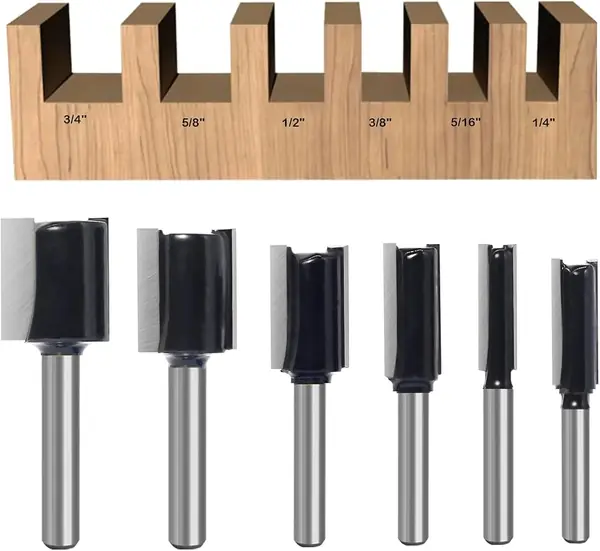
SICWOOD six-piece straight router bit set with 1/4-inch shanks and carbide-tipped cutters

Starter mortise set

Shop Score 89/100
Shank Diameter
1/4 inch
Bit Count
6
Cutting Height
13/16 inch
Cutting Diameters
1/4 to 3/4 inch
View on Amazon

Six bits for roughly the price of one small spiral is the pitch here, and for plenty of shoppers it is the right trade. The set runs from 1/4 inch up to 3/4 inch in diameter, which covers the widths you actually meet when you are fitting hinges, cutting stopped slots, and clearing waste between bored holes for a mortise.

We like it as the starter set that doesn't feel like a compromise on finish. The two-flute carbide cutters leave a planed-looking surface at a moderate feed rate, and each bit comes in its own little holder — trivial until you are hunting for the 3/8 inch in a drawer of loose tooling.

What you aren't getting is the spiral geometry of our top pick. Straight flutes cut a flat-bottomed slot perfectly well, but they push chips ahead of the cutter instead of lifting them, so deep mortises need more clearing between passes. For hinge work and the occasional slot, neither matters much.

Two more things to plan around. The 13/16-inch cutting height is the depth ceiling for the whole set, and these are carbide-tipped rather than solid carbide — a brazed edge on a steel body, which is how the set lands at this price and the main reason we treat it as a first set rather than a lifetime one. The 1/2-inch and 5/8-inch bits are the ones that will do your mortising; the biggest is really a dado cutter and the smallest are for cleaning corners.

Worth Noting

  • 13/16-inch cutting height caps mortise depth
  • Straight flutes clear chips less efficiently than spirals
Our Verdict

The set we point beginners to: six carbide-tipped straight bits that cover hinge widths and mortise sizes for less than one premium spiral.

Check Latest Price
4.

Yonico 14955q Straight Bit Best for Wide Mortises

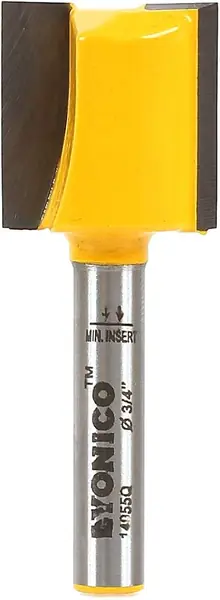
Yonico 14955q straight router bit with 3/4-inch cutting diameter and 1/4-inch shank

Wide shallow mortises

Shop Score 88/100
Shank Diameter
1/4 inch
Cutting Length
3/4 inch
Cutting Diameter
3/4 inch
Cutter
Two-flute C3 micro-grain carbide
View on Amazon

Three-quarters of an inch is the width that makes a mortise look deliberate — a chunky, architectural slot for a leg-and-rail joint or a sliding-door stile. This straight bit cuts it from a 1/4-inch shank, and the cutting length matches the diameter at 3/4 inch, so you get a square-walled pocket as deep as it is wide. In this group it is the least expensive route to a wide, square-bottomed slot, and that is the reason we keep one on the shelf.

The C3 micro-grain carbide leaves a smooth floor in soft maple and plywood, and two flutes clear well enough at moderate depth. A limited lifetime warranty covers it, which is more backing than any other bit in this group states.

Run it the way you run any wide bit: passes no deeper than half its diameter, chips cleared between each one, and the router held flat so the floor stays true. Do that and the finish off the cutter is good enough to go straight to glue-up on a painted piece.

Worth Noting

  • 3/4-inch cutting length limits mortise depth
  • Large cutter on a small 1/4-inch shank
Our Verdict

For a wide, clean-bottomed mortise on a budget, we keep this one around: 3/4 inch in both directions and a shank that fits a trim router.

Check Latest Price
5.

Yonico 14169q Hinge Mortise Bit Best for Door Hinge Pockets

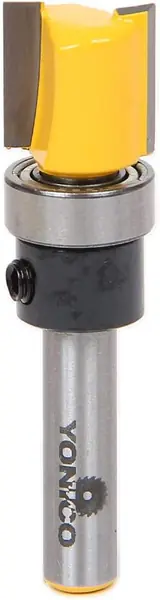
Yonico 14169q hinge mortise router bit with 1/2-inch cutter and shank bearing

Door hinge pockets

Shop Score 87/100
Shank Diameter
1/4 inch
Cutting Length
1/2 inch
Cutting Diameter
1/2 inch
Guide
Shank-mounted bearing
View on Amazon

A bearing on the shank is what separates this bit from a plain straight cutter, and it is the reason to own one if you hang doors. The bearing rides the edge of a hinge template, so the cutter can only go where the template lets it — every pocket comes out with the same footprint and the same depth as the last.

Half an inch in both diameter and cutting length is sized for a standard hinge leaf, and the flush-trim geometry registers the bit off the template rather than off your hands. Clamp the template, set the depth stop, and clear the waste in a couple of light passes.

We were struck by how little there is to adjust, which is the whole appeal of a template bit: the tooling does the layout work. Before each run, check that the screw holding the bearing is snug — that bearing is what keeps the cut on the template, and a loose one will let the bit wander into the door.

Worth Noting

  • Half-inch cutting length suits shallow cutouts only
Our Verdict

We keep a bearing-guided bit like this for hanging doors, where the template sets the pocket and the bit repeats it exactly.

Check Latest Price

How We Tested Mortise Router Bits

We started by pulling every bit we could find in the diameters, cutting lengths, and shank sizes that suit mortise work, then sorted them by cut geometry: straight, upcut spiral, and bearing-guided. We filtered by maximum RPM rating against the fixed-speed routers in our shop, checked each shank against a collet we actually own, and kept a spread of prices so a budget set had to compete with single bits. Fourteen bits made the shortlist.

Testing ran four months, on mortises in red oak and hard maple, dadoes in plywood, and hinge pockets cut into a door jamb — shanks seated fully in the collet, collet tightened before every run, eye protection on. Each bit ran at or below its stated maximum RPM; where a wide cutter was rated under the top speed of a fixed-speed router, it went into a variable-speed machine instead.

We checked the walls and floor of each mortise with a square and under raking light, looking for taper, tearout, and a floor that wasn't flat, and we watched how chips cleared — whether they left the pocket on their own or packed in and needed blowing out mid-plunge. The bearing-guided bit ran along a jamb face, where we confirmed the bearing rolled freely and left no mark.

Sharpness we judged by feel and sound on the first mortise of each session; edge life we counted in linear feet of oak, noting when a bit began burning instead of slicing. Every bit stayed in rotation the full four months, and we re-cut the same joints at the end to see which edges had dulled. Value came down to cost per usable width: a set that covers a spread of widths beats two singles only if the edges hold.

How to Choose Router Bits for Mortises

Start With the Cut Geometry

Three shapes do most mortising. A straight bit is the least expensive and cuts a flat-bottomed slot, but its flutes push waste ahead of the cutter rather than lifting it, so a deep pocket needs clearing between passes. An upcut spiral — a spiral bit, in most catalogs — pulls chips up and out and leaves its crispest edge on the face away from the router. A bearing-guided hinge bit follows a template instead of your pencil line.

It is tempting to assume an upcut spiral gives you a tear-out-free top face, and it doesn't: the shearing action that cleans the bottom of the slot is the same one that frays veneer on top. Use a backer board, or a downcut bit, when the show face is a veneer. When the walls will be visible in solid stock, the spiral is worth the extra.

Match Diameter and Cutting Length to the Joint

Cutting diameter is the mortise width and cutting length is the depth ceiling; no technique gets you past either one. A 1/4-inch diameter is the workhorse for small joinery, a 1/2-inch matches a door hinge leaf, and 3/4 inch is the size for chunky leg-and-rail work. Length matters as much: half an inch is a hardware pocket, three-quarters covers most shallow furniture joints, and an inch or more gets into deep stopped mortises.

Treat the marked diameter as nominal, too. Make a test mortise and fit the actual tenon before you cut tenons to a number stamped on a bit, because a cutter that runs slightly off its marked size changes how the joint closes.

Fit the Shank to the Router You Own

A 1/4-inch shank fits trim routers, palm routers, and nearly every plunge base sold for a home shop; a 1/2-inch shank needs a matching collet, usually on a larger fixed-base or plunge machine. The bigger shank resists deflection, which is what lets a long cutter bury itself in hardwood without chattering or walking off the line.

If you are weighing a quarter-inch spiral against a half-inch one, buy the shank your router accepts and add a second collet only when the work is deep and repetitive. Buying the bit your machine cannot hold is the one mistake here that no technique fixes.

Edge Life Comes Down to Heat

Router bits rarely wear out from acreage; they die from heat. A cutter that rubs instead of slicing, or one recutting its own chips, loses its edge fast, and a scorched mortise is usually the warning. Solid carbide puts the most carbide behind the edge; the carbide-tipped bits in budget sets braze a smaller carbide edge to a steel body, which is what keeps the price down.

Either will cut plenty of mortises if you keep the cutter working, clear the chips, and check the maximum RPM on a wide bit. Big-diameter cutters are often rated well below what a fixed-speed router spins, and over-speeding is how edges come off.

A Set or a Single Bit?

One good spiral is the answer when every mortise you cut is the same width and you cut them often; you learn its feed and you replace it when it dulls. A set answers a different question — several widths for hinge leaves and different stock thicknesses, plus small sizes for cleaning up corners.

We treat a set as coverage and a single spiral as the bit that does the important joinery. For occasional hinge work and a few slots a year, a set is enough; for regular mortising in hardwood, buy the spiral first and fill in widths later.

Frequently Asked Questions

Final Verdict

For most shops the Whiteside RU2100 is the bit to buy first. A 1/4-inch upcut spiral handles the stopped mortises and slots that furniture joinery actually calls for, it clears its own chips, and it runs in whatever router you already own — which is why it is our top pick.

Step up to the SpeTool half-inch spiral only when your router takes a 1/2-inch collet and the work is deep and repetitive; that is where the extra rigidity earns its price. If you hang doors, add the bearing-guided Yonico and let a template set the pocket.