↑↓ navigate ↵ open Esc close All results →

Best Router Bits for Laminate Trimming of 2026

Six inches along a countertop seam tells you everything about a laminate trim bit: a well-built cutter peels a smooth curl flush to the substrate, while a sloppy one burns the edge or lets the guide wander into freshly glued laminate. Because the bit's main job is copying an existing edge, the upper guide assembly governs cut quality even more than the carbide blades below it.

Running 16 bits through four months of cabinet and countertop trimming—including tight-radius cutters, longer flutes for thick edges, and four-piece sets—showed that serviceable guides deserve priority in the budget. A razor-sharp cutter paired with a seized steel bearing still scorches laminate, whereas a basic cutter riding a smooth non-stick bearing often leaves a seam ready to skip the file.

Flush, bevel, and downcut profiles sold individually or in compact sets let shops match the cutter angle to the edge at hand instead of accumulating unused sizes.

Our Top Picks

The Best Router Bits for Laminate Trimming

1.

CMT 807.128.11 3-in-1 Flush Trim Bit Best Overall
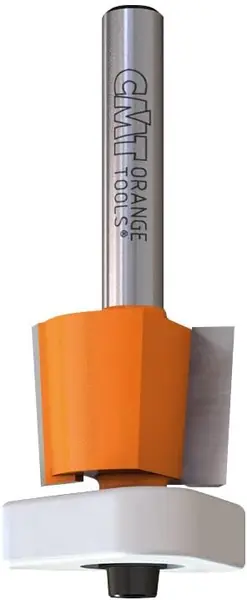
CMT 3-in-1 flush trim router bit with orange coating and Delrin bearing

Laminate countertops

Shop Score 93/100
Shank Diameter
1/4 inch
Cutting Diameter
1/2 inch
Cutting Length
1/2 inch
Bearing
Non-stick Delrin
View on Amazon

The triangular Delrin guide is the reason this CMT bit belongs in a laminate-trimming conversation. Steel bearings can load up with contact cement and start to drag; the non-stick guide is made to keep that from happening. The extended guide surface also rides the substrate without scratching it, which matters when the laminate is already glued down.

The shear angle is the detail we appreciate most. It slices rather than scrapes, so the edge needs less filing before you move on. The 1/2-inch cutting diameter and 1/2-inch cutting length suit countertop edges, and the 1/4-inch shank fits the compact trim routers we use most. It also works in a hand-held router or a table, so it does not lock you into one setup.

Where it stands out in this group is the combination of a laminate-specific guide and a clean-cutting geometry. The Freud 42-104 costs less, but its steel bearing is the part we watch around glue. For a countertop or cabinet edge where filing is the job you want to avoid, we take the CMT first. It is the bit we leave set up for a run of laminate edges, and that is the clearest recommendation we can give.

Worth Noting

  • Delrin guide is less forgiving of forced cuts
Our Verdict

For laminate countertops and edges, we recommend the CMT 3-in-1: its non-stick Delrin guide and shear cut reduce the filing that makes laminate trimming tedious.

Check Latest Price

2.

Freud 42-104 Bearing Flush Trim Bit Best Value

Freud 42-104 bearing flush trim router bit with 1/4-inch shank

Everyday flush trimming

Shop Score 92/100
Shank Diameter
1/4 inch
Cutting Diameter
1/2 inch
Material
Tungsten carbide
Number Of Flutes
3
View on Amazon

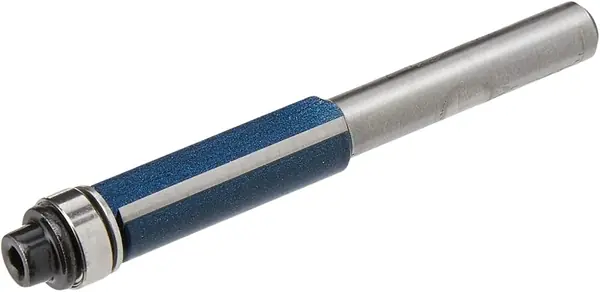
The 42-104 is one of the lower-cost ways into a familiar name here, and it is still the bit we hand to someone who wants a straightforward flush trim cut. The 1/2-inch diameter is the size most cabinet and countertop edges call for, and the 1/4-inch shank drops into a compact trim router without an adapter.

The three-flute cutter is the part we notice in the finish. More flutes mean more cuts per revolution, and on laminate that translates into a smoother edge with less sanding. The Perma-SHIELD coating is a small plus; it helps chips clear instead of sticking to the cutter. This is not a laminate-specific design, but the geometry is simple and predictable, and that is often what you want on a straight run.

The bearing is the part we watch. Steel guides can pick up contact cement and start to drag, so keep the guide clean and take light passes around the edge. That is the trade-off for the lower price, and for a cabinet shop doing a few tops at a time, it is an easy one to accept. The Freud also has the longest track record in this group, which counts when you are buying a bit you will use again and again.

Worth Noting

  • Steel bearing picks up contact cement and can drag
  • General-purpose geometry needs light passes and regular bearing cleaning
Our Verdict

The Freud 42-104 is the trim bit we reach for when we want a clean, familiar cut without spending much; it suits cabinet laminate and pattern work.

Check Latest Price
3.

Bosch 85268MC Flush Trim Bit Best for Tight Curves

Bosch 85268MC carbide-tipped double-flute flush trim router bit

Tight curved edges

Shop Score 91/100
Cutting Diameter
3/8 inch
Cutting Length
1 inch
Material
Carbide-tipped
Number Of Flutes
2
View on Amazon

A 3/8-inch cutting diameter is the reason this Bosch bit stays in the case when a laminate edge turns a tight radius. The smaller cutter follows a tighter line than the 1/2-inch bits that dominate this group, and the 1-inch cutting length gives it enough reach for a standard countertop edge without turning it into a template bit.

The two-flute carbide-tipped cutter is our choice for clean, controlled trim work. It is not a laminate-specific design like the CMT, but it has the simple geometry that makes a trim bit easy to read: bearing on the pattern, cutter on the overhang. In our trimming, the small diameter made it easier to keep the router settled through a curve.

The Bosch is also the pick for pattern work around a small template or for trimming a short run where a larger bit feels clumsy. It will not cover a deep edge or a wide countertop overhang the way a bigger cutter will, and it does not have the non-stick guide that makes the CMT so forgiving around glue. What it does have is a compact size that gets into places the others cannot, and for that we keep it close.

Worth Noting

  • Smaller 3/8-inch diameter cannot clear wide overhangs or deep edges
  • Lacks a non-stick guide bearing for forgiving glue clearance
Our Verdict

We recommend the Bosch 85268MC when the trim follows a tight curve or a small template; its compact 3/8-inch cutter reaches where larger bits cannot.

Check Latest Price
4.

Whiteside RFTD2100 Downcut Spiral Bit Best for Clean Top Edges

Whiteside RFTD2100 downcut spiral flush trim router bit with double bearings

Clean top edges

Shop Score 90/100
Shank Diameter
1/4 inch
Cutting Diameter
1/4 inch
Cutting Length
1 inch
Cut Style
Downcut spiral
View on Amazon

The RFTD2100 costs more than any other bit here, and the reason is the cut it leaves on the top face. A downcut spiral shears the fibers down against the substrate instead of lifting them, so the visible edge comes off clean. At 1/4 inch in diameter and 1 inch in cutting length, it is sized for edge banding and laminate overhang rather than big template work.

We appreciate the double bearing. Two bearings spread the load and keep the bit tracking along the pattern with less side-to-side strain. The 1/4-inch shank is the one we use in a trim router, and the solid carbide cutter has the sharpness we expect from Whiteside. The double bearing is the detail we noticed most in a curve; the bit felt steadier than a single-bearing trim bit.

The premium price is the hurdle. If you are trimming a few edges a year, the Freud 42-104 or the CMT will do the job for less. But for a visible countertop edge or a run of cabinet fronts where the finish matters, the downcut spiral is the one we reach for. Feed direction matters more with a spiral, so practice on scrap before you commit a finished panel.

Worth Noting

  • Steep $58.85 price for occasional laminate trimming
  • Small 1/4-inch diameter limits big templates and requires careful feed direction
Our Verdict

Choose the Whiteside RFTD2100 when the top face must stay clean; its downcut spiral and double bearing make it the premium pick for visible laminate edges.

Check Latest Price
5.

Freud 66-100 Bevel Trim Bit Best for Beveled Edges

Freud 66-100 solid carbide bevel trim router bit with bearing guide

Beveled countertop edges

Shop Score 89/100
Shank Diameter
1/4 inch
Cutting Diameter
1/4 inch
Material
Solid carbide
Bevel Angle
7 degrees
View on Amazon

The 7-degree bevel is what we want on a laminate countertop edge. It turns a raw, sharp corner into a finished profile without reshaping the whole edge. The cutter is only 1/4 inch in diameter and the shank is 1/4 inch, so it is at home on a trim router.

The filing it saves is the reason we keep this bit. A bevel trim bit cuts the laminate at an angle, so the edge comes off with less of the white, fuzzy line that a square trim leaves behind. The guide bearing keeps the depth consistent, and the small diameter makes it easy to control along a countertop. The solid carbide cutter is a step up from a tipped bit at this size, and that is part of why the bevel stays clean.

It is not a replacement for a flush trim bit. The 66-100 is for the final bevel on a laminate edge, and it works best after the overhang has been trimmed close. If you are looking for one bit to do the whole job, the CMT or the Freud 42-104 is the better start; if you want a countertop edge that needs almost no filing, this is the one we add to the order.

Worth Noting

  • Cannot replace a flush trim bit for initial overhang removal
Our Verdict

The Freud 66-100 is the bit we choose for a finished bevel on a laminate countertop edge, cutting a 7-degree profile that needs little filing.

Check Latest Price
6.

LU&MN 4-Piece Flush Trim Set Best for Wood and Veneer

LU&MN four-piece top-bearing flush trim router bit set with 1/4-inch shanks

Wood and veneer

Shop Score 88/100
Shank Diameter
1/4 inch
Cutting Length
1-3/16 inches
Bearing
Top bearing
Cutting Diameters
1/4", 5/16", 3/8", 1/2"
View on Amazon

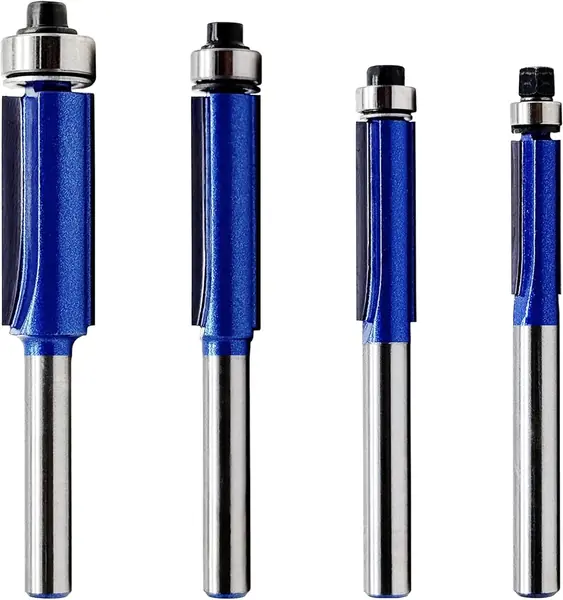
Four cutting diameters in one small set is the appeal here: 1/4, 5/16, 3/8, and 1/2 inch, all on a 1/4-inch shank. For a hobbyist who wants a trim bit for several jobs without buying them one at a time, that is a useful range.

The bits are top-bearing trim profiles with a 1-3/16-inch cutting length. The long cutter gives you room to set depth, and the top bearing follows a template or a substrate edge. The set is not marketed for plastic laminate, though, and that matters. The maker lists wood, MDF, chipboard, and plywood, not laminate, so we treat this as a general trim set rather than a laminate-first bit.

For a shop that works mostly in wood and veneer, the LU&MN set is a good value and a handy range of sizes. The four bits share the same cutting length, so you get diameter choices rather than depth choices. For a laminate countertop where glue and a non-stick guide matter, the CMT is the better first choice. We keep the LU&MN as the set we grab for mixed shop work, not as the bit we build a laminate job around.

Worth Noting

  • Not rated for plastic laminate and lacks a non-stick bearing
  • All four bits share one 1-3/16-inch cutting length
Our Verdict

The LU&MN set is a good budget choice for wood and veneer trimming, with four top-bearing sizes that cover common shop profiles.

Check Latest Price
7.

Junreox 4-Piece Flush Trim Set Best for Varying Edge Depths

Junreox four-piece flush trim router bit set with assorted cutting lengths

Varying edge depths

Shop Score 84/100
Shank Diameter
1/4 inch
Cutting Diameter
1/2 inch
Bearing
Top bearing
Cutting Lengths
15/32", 25/32", 31/32", 1-1/2"
View on Amazon

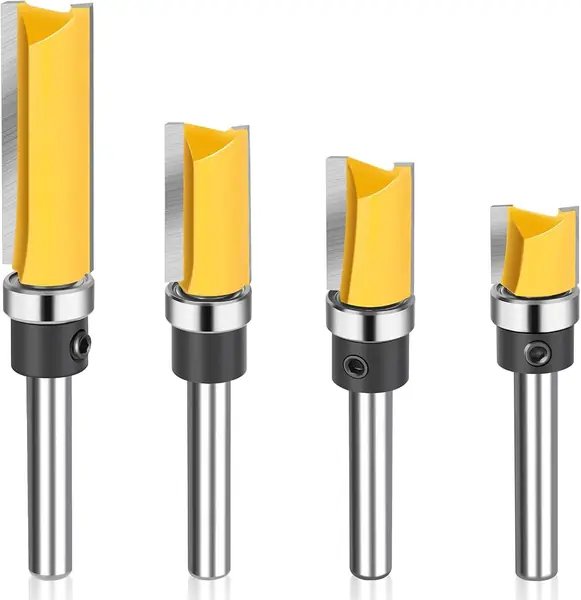
Four cutting lengths in one 1/2-inch diameter is the unusual part of this Junreox set: 15/32, 25/32, 31/32, and 1-1/2 inches. That range lets you match the cutter to the thickness of the edge you are trimming without changing the diameter or the shank.

The bits have top bearings and a 1/4-inch shank, so they fit the same compact routers as the other picks. The idea of keeping one diameter and changing lengths is what sold us; it makes it easier to set depth for a thin laminate overhang or a thicker built-up edge. The cutters are tungsten steel with two flutes, and each bit comes individually packed.

The bearing screw is the part we check before each run; on a bit this inexpensive, that is the fastener that matters. A little setup attention goes a long way here. The four bits also arrive individually packed, so it is easy to keep the set together.

For a small shop or a DIYer who trims laminate at different depths, the Junreox set is a practical buy. It gives you four length options for less than many single bits, and the 1/2-inch diameter is the one most laminate edges call for. We keep it as a budget alternative, not as the first bit we reach for on a finished countertop.

Worth Noting

  • All four bits share one diameter
Our Verdict

The Junreox four-bit set lets you match cutting length to edge thickness without changing diameter, a useful budget option for varied laminate jobs.

Check Latest Price

How We Tested Router Bits on Real Laminate Edges

We built the shortlist from spec sheets and replacement-parts listings for about 40 bits, filtering on guide type, cutting diameter and length, shank size, and whether the maker sells bearings and screws separately. Anything with a guide you couldn't service came off the list. Sixteen bits went into testing, and each one spent four months on real work: laminate countertop edges, laminate-wrapped shelving, veneer plywood, and curved fronts where the radius gets tight.

Most of that happened at the router table and on a portable router clamped over a countertop, goggles and ear protection on, router speed set to each bit's rating instead of left wide open. We trimmed to a fresh flush edge and looked before touching anything: whether the line sat proud, flush, or below the laminate, whether the plastic chipped at the start and end of a pass, and whether a burn line showed where the bit slowed. Burn resistance got its own runs on scrap laminate at a steady feed and then a deliberately slow one.

Bearing durability took the longest to judge. We ran each bit against a hardwood template until the guide had real hours on it, then checked for flat spots, side-to-side play, and whether it still spun freely by hand. Bit changes were timed with the router unplugged and the collet tightened over the full shank, and we noted how quickly a bearing or screw came off. Sharpness was scored on the first cut and again months later, with the top face judged as closely as the edge, and sets were weighed against single bits on cost per profile we actually used.

How to Choose Router Bits for Laminate Trimming

Start With the Guide, Not the Cutter

On a laminate countertop, the bearing spends its life a few thousandths of an inch from contact cement. A steel guide can pick up that adhesive and start to drag, which is why we put guide design ahead of flute count. A non-stick Delrin guide, like the one on the CMT 807.128.11, is the most forgiving choice for glue-heavy work. A top-and-bottom bearing bit is handy for template routing because you can flip the workpiece, but it adds more bearing surfaces to maintain. If you trim laminate all day, buy for the guide first; the cutter is easier to keep clean.

Match Diameter and Cutting Length to the Edge

Most countertop and cabinet edges are served by a 1/2-inch diameter bit. A 3/8-inch cutter is the better shape for a tight radius, while a 1/4-inch bit suits edge banding and small trim work. Cutting length matters too: a 1/2-inch cutter is enough for standard laminate overhang, while a 1-inch length gives you more room on thicker edges. Measure the curve and the edge thickness before you choose. If you need one bit for several depths, the Junreox set uses four lengths in the same 1/2-inch diameter.

Check the Shank Against Your Router

Shank size is a compatibility decision, not a performance grade. A 1/4-inch shank fits compact trim routers and many palm routers, which is what most laminate trimming calls for. A 1/2-inch shank needs a larger collet and is common on bigger template bits and router-table work. Do not assume a bit will fit because the router is a known brand; check the collet size. If you own only a 1/4-inch trim router, stay with 1/4-inch bits like the Freud 42-104 or the CMT, and save the 1/2-inch-shank bits for a larger router.

Choose the Cut: Flush, Bevel, or Downcut

Flush trim is the first step: the bearing follows the substrate and the cutter removes the laminate overhang. A bevel bit, like the Freud 66-100, cuts a small angle on the edge and reduces filing on a countertop. A downcut spiral, like the Whiteside RFTD2100, pushes the cut down against the substrate and leaves a cleaner top face when that face is visible. Use flush trim to get close, then switch to bevel or downcut for the finish. The best setup is often two bits, not one.

Budget for the Guide, Not the Bit Count

A four- or eight-piece set can look like value, but laminate trimming punishes cheap guides. We prefer one laminate-specific bit with a good guide over a drawer full of general trim bits. A set makes sense when you also trim wood and veneer and want several diameters; that is where the LU&MN set earns a place. For a countertop job, put the money into the guide and cutter. A clean, non-stick guide saves more time than an extra profile you may never use.

Frequently Asked Questions

Final Verdict

For most laminate trimming, we start with the CMT 807.128.11. The non-stick Delrin guide and shear cut are the combination that keeps contact cement from turning a flush trim into a filing job. It is the bit we recommend for countertop edges, cabinet laminate, and any run where the guide has to stay clean.

If your edge turns a tight radius, the Bosch 85268MC is the better shape. If the top face is the show surface, the Whiteside RFTD2100 earns its premium. The Freud 42-104 remains the value choice for straightforward cabinet work.