↑↓ navigate ↵ open Esc close All results →

Best Router Bits for Sign Making of 2026

A V-bit doesn't carve lettering so much as draw it, and the point angle decides the stroke before you ever touch a feed rate. A 20-degree point leaves a hairline outline; a 90-degree bit scoops a wide, shallow trough for bold numerals. Shopping by piece count gets that backwards, because a ten-bit set that misses your angle is ten bits you won't reach for.

We cut 14 V-bits and sets through four months of house numbers, shop signs, and small plaques in MDF, maple, and oak, on a router table, a trim router, and a desktop CNC. I check shank fit before anything else these days — an 1/8-inch bit is a desktop-CNC tool, not something a trim router will hold. With the angle and the shank right, clean shoulders and letters that don't fuzz at the edge follow.

Each pick earned its spot the same way: how it cut, how long the edge held, and what a replacement costs when it dulls. These aren't the cheapest bits in their size — they're the ones we kept loading.

Our Top Picks

The Best Router Bits for Sign Making

1.

FOOS Engraving CNC Router Bit Set Best Overall
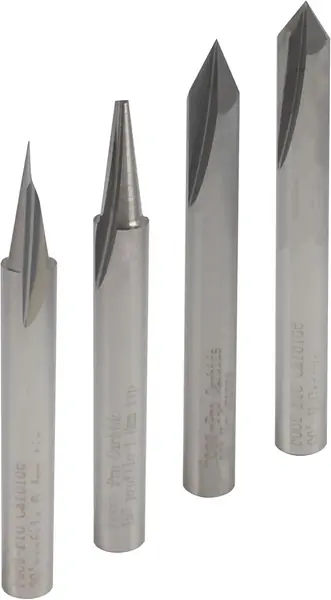
FOOS solid carbide V-groove router bit set with four bits and 1/4-inch shanks

All-around sign carving

Shop Score 93/100
Shank Diameter
1/4 inch
Cutter Material
Solid carbide
Bits Included
4
V-groove Angles
15, 20, 60, and 90 degrees
View on Amazon

Four angles in one box is the argument for this FOOS kit, and it is why we treat it as the default for sign work. The 15- and 20-degree bits handle letter interiors and tight corners; the 60- and 90-degree bits open into the wide, shallow V-carves that make up the body of a letter. Bought as singles, four bits come to roughly the same money, and you spend an evening choosing angles instead of carving.

All four cutters are solid carbide on a 1/4-inch shank, so they drop into the trim, palm or table router already on the bench, and they hold up in hardwood, softwood, MDF, plywood, acrylic and two-color engraving laminate. The 60- and 90-degree bits carry three flutes, and the extra cutting edge shows on the shoulder of the groove — cleaner walls and less fuzz to sand off an MDF letter.

The 15-degree point is the one to slow down for. It cuts the sharpest inside corner in the kit and it will not tolerate the depth of pass the 90 takes in hard maple, so run the detail work in two light passes and let the bit do the work.

Where the kit stops is relief: there is no round-nose bit here, so if your signs lean on carved backgrounds, pair it with the Yakamoz set or add a round nose separately. For lettering, outlining and bevels, the four angles are enough to finish a sign without opening another box.

Worth Noting

  • Uncoated flutes load up on resinous pine
Our Verdict

We recommend this kit to almost any sign maker: four carbide angles on a 1/4-inch shank cover fine lettering and wide V-carves without buying singles.

Check Latest Price

2.

SpeTool 90 Degree V-Groove Router Bit Best for Bold Lettering

SpeTool 90-degree carbide V-groove router bit with 1/2-inch cutter and 1/4-inch shank

Bold lettering

Shop Score 91/100
Shank Diameter
1/4 inch
V-groove Angle
90 degrees
Cutting Diameter
1/2 inch
Number Of Flutes
2
View on Amazon

A 1/2-inch cutting diameter on a 90-degree V makes this SpeTool bit a different tool from the pointed bits in this guide. It cuts wide and shallow — the stroke that reads as bold block lettering across a sign face, or as a chamfer along an edge — rather than the fine interior of a lowercase letter.

Bold lettering and long bevels are where we reach for it. The two-flute carbide cutter is welded onto the body and runs stable at router speed, leaving clean walls in hardwood, plywood and MDF, and at 0.64 ounces it does not make a trim router feel nose-heavy when you are following a line by hand.

Ninety degrees is one of four versions: the same bit comes in 45, 60 and 120 degrees with the same 1/2-inch cutter, so a narrower, deeper groove is one order away. The 90 sits in the middle of that range and suits most sign lettering, which is why it is the one in our router.

Worth Noting

  • Edge life is shorter in hard oak
Our Verdict

We keep this single bit for bold, wide lettering; it makes a clean shallow V-groove and asks little of your budget.

Check Latest Price
3.

Yakamoz V-Groove and Round Nose Router Bit Set Best Budget Set

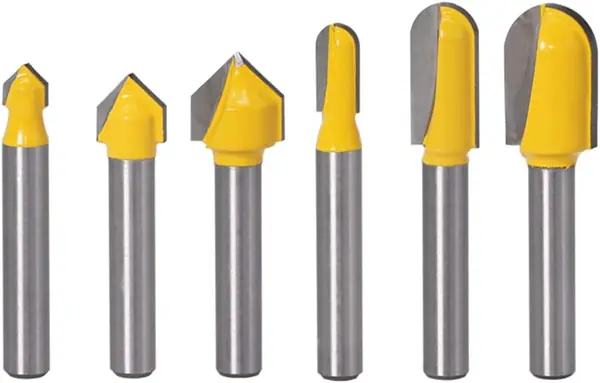
Yakamoz six-piece V-groove and round-nose router bit set with 1/4-inch shanks

Budget starter set

Shop Score 89/100
Shank Diameter
1/4 inch
Cutter Material
C3 micro-grain carbide
Pieces Included
6
V-groove Cutting Diameters
1/4, 3/8, and 1/2 inch
View on Amazon

Six bits for less than our top pick is the short version, and for a first sign it is money well spent. Three 90-degree V-grooves with 1/4-, 3/8- and 1/2-inch cutting diameters take lettering from small to block, and three round-nose bits in matching sizes carve the relief and plaque work a V-groove cannot do.

C3 micro-grain carbide, anti-kickback shoulders and a teflon coating add up to a set that behaves better than its place in the price order suggests. The coating is what we appreciated most: MDF and resinous pine shed chips instead of smearing them along the groove, and the shoulder machined into each bit limits how much the cutter can grab in a heavy cut.

What the set does not have is a fine angle. Every V here is 90 degrees, so the inside of a small letter or a tight serif is out of reach — that is the Jiiolioa's job. For house numbers, farmhouse signs and router-carved plaques, the range is plenty.

Worth Noting

  • Only 90-degree V-grooves, no fine angle
Our Verdict

For a first sign project on a tight budget this is the set we point people to: three V-grooves and three round noses, all in carbide.

Check Latest Price
4.

Jiiolioa 20 Degree V-Point Router Bit Best for Fine Detail

Jiiolioa 20-degree solid carbide V-point router bit with 1/4-inch shank

Fine letter outlines

Shop Score 88/100
Shank Diameter
1/4 inch
Cutter Material
Solid carbide
Point Angle
20 degrees
Overall Length
2 inches
View on Amazon

Twenty degrees is the sharpest point in this group, and it is what makes the Jiiolioa bit the one we pick up when a letter has to be traced rather than hogged out. It outlines a shape, follows a pencil line, and reaches into a corner where a 90-degree V simply does not fit.

One solid-carbide cutter on a 1/4-inch shank, two inches overall, with a single flute to clear the chips. The length matters: it gives you reach across a wide blank without the router body crowding the line you are following. The listing also mentions stainless steel, aluminum and brass; we have kept ours to wood, MDF and plastic, which is where a 1/4-inch router bit belongs.

It cuts straight through hardwood without wandering off the line, and the edge held up over repeated outline passes on the same blank. Paired with the FOOS 60-degree bit or the SpeTool 90 to clear the field after the outline, it is the combination we use for lettered signs.

Worth Noting

  • Slow for hogging out large letters
  • Single bit, no spare in the pack
Our Verdict

Our pick for outlining letters and cleaning up tight corners; the 20-degree point cuts where wider bits cannot reach.

Check Latest Price
5.

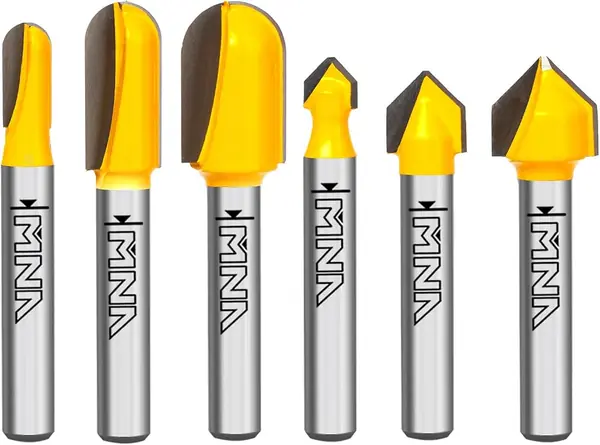
MNA 90 Degree V-Groove and Round Nose Set Best for Casual Sign Crafts

MNA 90-degree V-groove and round-nose router bits with 1/4-inch shanks and carbide edges

Casual sign crafts

Shop Score 86/100
Shank Diameter
1/4 inch
Cutter Material
C3 carbide
V-groove Angle
90 degrees
View on Amazon

Sign making is right there in the name of the MNA set, and on paper it reads correctly: a 90-degree V-groove and round-nose bits, C3 carbide, anti-kickback shoulders, and a 1/4-inch shank that fits the router you already own.

For a hobbyist making painted craft signs, it does what it promises. The V-groove cuts a serviceable channel for a stencil outline, the round nose softens a routed edge, and the set is among the cheapest routes into the category — less than a single SpeTool bit.

Where it gives ground is finish. The coating on some bits is heavy and the edges arrive coarse, so a groove can look a little ragged next to what the SpeTool leaves in the same board. On a sign that is getting painted and hung on a porch, that difference disappears; on a piece where the cut itself is the finish, it does not.

Think of it as a learner set, or as the box you keep for rough work where a chipped edge costs you nothing. The geometry is right even when the polish is not.

Worth Noting

  • Only 90-degree V-grooves, nothing for fine lettering
Our Verdict

It is a cheap way into sign carving for painted craft work, though the finish will not match the pricier bits here.

Check Latest Price
6.

FoxAlien Triangular Engraving Bit Set Best for Desktop CNC Engraving

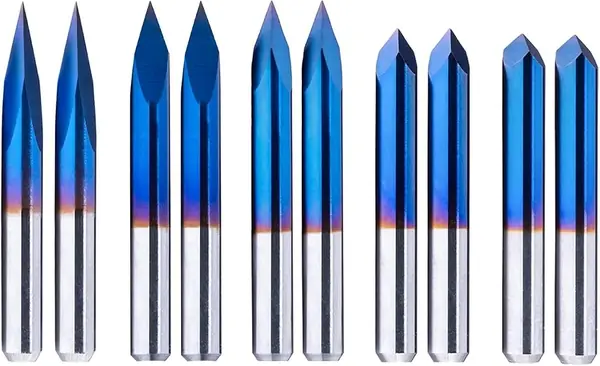
FoxAlien ten-piece triangular engraving bit set in five angles with 1/8-inch shanks

Desktop CNC engraving

Shop Score 85/100
Shank Diameter
1/8 inch
Pieces Included
10
Tip Diameter
0.1 mm
Included Angles
20, 30, 45, 60, and 90 degrees
View on Amazon

An 1/8-inch shank decides this set before the angles do. It fits a desktop CNC spindle or a rotary tool with an 1/8-inch collet; it will not clamp in the 1/4-inch collet on the trim router that most hand sign work uses, at least not without a reducing sleeve.

If that is your machine, the range is genuinely good: ten bits, two each at 20, 30, 45, 60 and 90 degrees, all with 0.1mm points and a nano blue coating for wear resistance. For lettering a small plaque, engraving an acrylic blank or cutting fine inlay, that spread covers nearly every line you will draw.

The 0.1mm point is the trade-off. It is a needle — startlingly fine in the cut, and gone if you plunge it deep into hardwood or side-load it in a corner. Two of each angle in the box is the answer to that, and it is why we save the 20- and 30-degree bits for finishing passes.

Worth Noting

  • 0.1mm points snap under deep or angled cuts
Our Verdict

Built for desktop CNC and rotary-tool collets; if that is your setup, five angles of fine engraving come at modest money.

Check Latest Price

How We Tested Router Bits by Cutting Actual Signs

We built the shortlist by sorting the market on the things that actually change a cut: point angle, tip size and cutting diameter, shank diameter, and whether the cutter was solid carbide or high-speed steel. That whittled a long field of sets and singles down to 14 bits and sets, which stayed in rotation for four months.

Each bit cut the same two test signs — a house-number plaque and a script-style shop sign — in MDF, maple, and a scrap of cast acrylic. We ran them in a trim router, a router table, and a desktop CNC spindle, starting shallow and stepping deeper only until the cut told us to stop, and we caliper-checked the width of the V at the surface to see which angles truly held a hairline. We watched the corners for chatter, noted whether the shoulder came off clean or fuzzy, and flagged any scorching when we pushed the feed rate.

Safety looked the same every session: eye and hearing protection, a dust mask for the MDF, the router unplugged before every bit change, and spindle speed kept under the maximum marked on the shank. We also priced a replacement bit and a resharpening against the cost of the set, because a bargain bit that dies after a dozen signs isn't one.

How to Choose Router Bits for Sign Making

Pick the angle before the piece count

Angle sets the shape of every stroke. A 90-degree V cuts a wide, shallow groove that reads as a bold line; a 20-degree point cuts narrow and deep and gets into the corner of a serif. That is why we sort these bits by the angle they put in the wood and not by how many come in the box. One fine angle between 15 and 30 degrees plus one open angle at 60 or 90 covers lettering, outlines and decorative bevels. The trap is a twenty-piece assortment where every V turns out to be 90 degrees.

Match the shank to the machine you own

Nearly every router used for hand sign work runs a 1/4-inch collet, and that is the shank to buy. An 1/8-inch shank belongs to rotary tools and small desktop CNC spindles; it will not clamp in a 1/4-inch router collet without a reducing sleeve, which is a compromise at router speed. If you cut on a desktop CNC, check the collet it shipped with, since many take 1/8 inch natively — that is where the FoxAlien set earns its place. Buy for the machine on the bench, not the one you might own later.

Carbide, coatings and how long an edge lasts

Solid carbide is the material to look for in anything that turns at router speed. High-speed steel bits are built for slow rotary tools and give up their edge quickly in a router. Edge life after that depends on the material: MDF is abrasive and takes the point off first, hardwood is harder on a light finishing cutter than softwood is, and paint or laminate on a blank adds its own wear. Coatings help with chip clearance and heat, but they do not rescue a dull bit.

Sets versus singles

A four-angle kit is usually the cheapest way to own the range, and one box with 15, 20, 60 and 90 degrees covers outlining, lettering and wide V-carves. Singles make sense when one angle does most of your work and you want a spare on the shelf, or when a single wide cutter is all your block lettering needs. If you already own a 90, add a 20-degree bit before you buy another set.

Passes, feed rate and the finish you get

A V-bit tells you when it is unhappy. Burn marks mean too slow a feed or too deep a pass; fuzz and torn edges mean the opposite, or a dull edge. Take deep V-carves in two or three passes, run a scrap board of the same material before the good blank, and save your finest angle for the last light cut. MDF behaves better if you seal the surface first, since bare MDF drinks paint and fuzzes at the sheared edge.

Frequently Asked Questions

Final Verdict

The FOOS kit is what we tell a sign maker to buy first. Four angles on a 1/4-inch shank means one purchase covers fine letter interiors, letter outlines and wide V-carves, and the solid carbide holds up in the MDF and softwood most signs are cut from.

Add the SpeTool 90-degree bit when your lettering gets big and bold, or start with the Yakamoz set if the budget is tight and 90 degrees is all your designs call for. Either way, keep a 20-degree bit in the drawer for the corners.