↑↓ navigate ↵ open Esc close All results →

Best Cordless Routers of 2026

The knock on cordless routers has always been the same: plenty of convenience, maybe not quite enough motor. It's a fair worry — a router is the one small power tool that punishes a weak motor, and bog down in white oak and you get burn marks and chatter instead of a clean shoulder. What a good one buys you is bringing the tool to the workpiece instead of dragging an extension cord across the floor.

I put off buying one for years over exactly that. We ran 10 cordless routers for eight months through hinge mortises in door jambs, roundovers on red oak, and edge trimming on plywood shelves, and the brushless badge on the side said less about power than the base and the battery did. Most of these ship as bare tools, so the platform you're already invested in narrows the field fast.

Depth adjustment is where the money shows: a fussy one turns a two-minute setup into twenty. The list below runs from palm-sized trimmers to a full plunge model, because fixed and plunge bases are genuinely different jobs.

Our Top Picks

The Best Cordless Routers

1.

DEWALT 20V MAX XR Compact Router (DCW600B) Best Overall
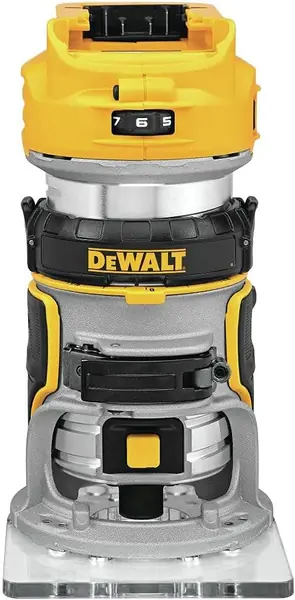
DeWalt 20V MAX XR compact router in black and yellow with fixed base

All-around trim routing

Shop Score 97/100
Base Type
Fixed
Tool Weight
4.2 lb
Maximum Speed
25,500 rpm
Speed Control
Variable-speed dial
View on Amazon

Two LEDs sit either side of the bit, and in a dim corner of the shop they're the difference between watching a cut and guessing at it. That visibility won us over first, but the real case for the DCW600B is how much of a corded compact it behaves like: a 25,500 rpm brushless motor, a soft start with electronic feedback that holds speed through a cut, and 4.2 pounds of tool that steers one-handed along a clamped straightedge. It's the cordless router we recommend to most people buying their first one.

The depth ring is the other detail we liked. Turning it walks the motor up or down in the base in positive steps, so a small change is a counted move rather than a guess, and the release clamp lets you pull the motor out for a bit change without losing the setting. The base is on the larger side for a compact at 5.82 by 5.75 inches, which keeps it steady against a template and less likely to tip at the end of a pass. The electronic brake stops the bit quickly when you let off the switch, so you're not standing there waiting to set the tool down.

Where it fits is a shop already running 20V MAX. It shares the packs that drive your drill and circular saw, the soft start keeps the tool from jumping when the bit touches wood, and the brake has it stopped before you've lifted it clear. Nothing in this group makes a first cordless router feel this undramatic, and that is exactly the quality we want in a tool you'll reach for constantly.

Worth Noting

  • Limited to 1/4-inch bit shanks
  • Bare tool; batteries and charger sold separately
Our Verdict

We recommend it as the default cordless router: it holds speed in hard stock, the LEDs keep the bit visible, and it runs on the 20V MAX packs you may already own.

Check Latest Price
2.

Milwaukee M18 FUEL Compact Router (2723-20) Best for Heavy Cuts

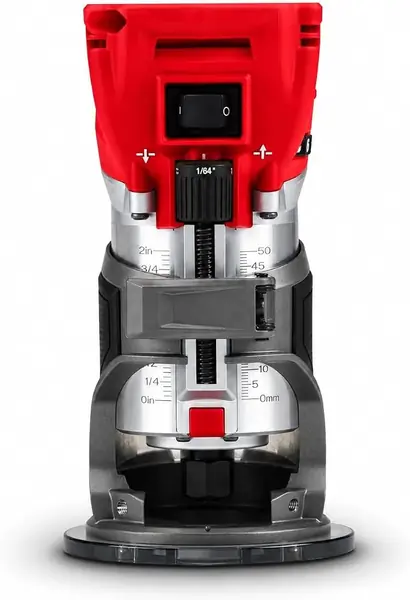
Milwaukee M18 FUEL compact router in black with fixed base and depth dial

Hardwood cutting

Shop Score 96/100
Base Type
Fixed
Speed Range
10,000 to 31,000 rpm
Horsepower
1.25 hp
Battery Platform
Milwaukee M18 18V
View on Amazon

A 1.25-horsepower rating on a palm-sized router reads like a sticker claim until you lean on it in white oak. Milwaukee backs the number with the highest top speed in this group, 31,000 rpm, and the widest dial — it starts down at 10,000, slow enough to tame a large bit and leave a burn-free edge on cherry. The POWERSTATE brushless motor and REDLINK electronics pull current back when a cut loads up instead of stalling, and the package stays composed in hard stock where a smaller router starts to chatter.

The macro adjust button is the feature we appreciate most. One press unlocks an inch and a half of travel, then the fine wheel takes over for the last few thousandths. That's more adjustment range than a fixed-base router usually offers, and it's why this one can go from a shallow chamfer to a deep hinge pocket without a base change. It's also the steadiest of the compacts in a deep cut, with the mass sitting low over the work.

Two things to know going in. The collet grips hard, and a bit that's been sitting in it under load can take a firm pull on the wrench to release — a small tax on every change if you swap bits constantly. And a motor this strong is thirsty: the compact packs that run a drill will handle a quick roundover, but a long session in hardwood wants the biggest pack in your kit. For a shop already on M18, both are fair trades for the power.

Worth Noting

  • Depth setting can shift under vibration
Our Verdict

We pick it when the cut is the hard part: 1.25 hp and the highest top speed in this group make hard stock feel routine, as long as you're on the M18 platform.

Check Latest Price
3.

Makita 18V LXT Compact Router (XTR01Z) Best Warranty

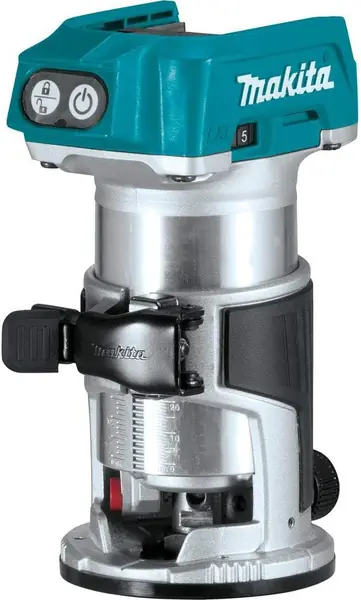
Makita 18V LXT compact router in teal with fixed base and wrenches

Repeated precision setups

Shop Score 95/100
Base Type
Fixed
Speed Range
10,000 to 30,000 rpm
Warranty
3-year limited
In The Box
1/4 in. collet, two wrenches, straight guide
View on Amazon

Three years of limited coverage is the longest warranty on this page, and on a tool that rides in a bag and gets set down hard a hundred times a week, that's worth real money. The XTR01Z earns it with an 18V brushless motor running from 10,000 to 30,000 rpm, and electronic speed control that holds the set speed as the cut loads — you hear the pitch stay steady instead of sagging into the wood.

Soft start is the other feature we noticed in use. The motor ramps rather than snapping to speed, which matters on a small base where a sudden start can walk the tool off your line, and the on/off button is separate from the lock so a thumb can't bump it into life. The 1/4-inch collet, two wrenches, and straight guide all come in the box, and the tool balances well enough that a roundover along a shelf edge is a comfortable pass.

Long-run durability is the open question with this one, and it's the reason the three-year coverage matters as much as any spec on the card. Buy it for the speed control, the soft start, and the fact that Makita is still answering for it in year three. If you change depth twenty times a session, look elsewhere; if you set up and cut, this is the calmest router in the group.

Worth Noting

  • Fine depth adjustment takes small nudges
Our Verdict

Our pick for steadiness: electronic speed control, soft start, and the longest warranty here make it the router we trust for repeated setups.

Check Latest Price
4.

CRAFTSMAN V20 Cordless Router (CMCW400B) Best Value

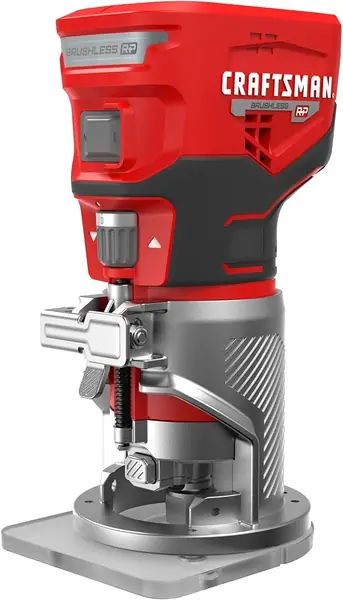
Craftsman V20 cordless fixed-base router in black with edge guide and dust port

Budget-minded first router

Shop Score 92/100
Base Type
Fixed
Tool Weight
4.1 lb
Speed Range
16,000 to 30,000 rpm
In The Box
Edge guide, dust port adapter, wrench
View on Amazon

The box includes an edge guide and a dust port adapter, two things several routers on this page make you buy separately. The edge guide is the useful one: it rides the edge of the workpiece so you can run a groove or a profile parallel to it without clamping a straightedge down first, and it's the accessory first-time router owners usually end up improvising with a scrap of wood.

Seven speeds between 16,000 and 30,000 rpm, a brushless motor, and both macro and micro depth adjustment add up to more control than the outlay suggests. What we noticed first was the depth adjustment: the dial moves the motor smoothly, it stays where you set it, and the motor lifts out of the base for a bit change without disturbing the setting. At 4.1 pounds it isn't the lightest tool here, but the mass sits low and it tracks a fence without fighting you.

The catch is the platform. The router only makes sense if you already own Craftsman V20 batteries; otherwise the packs and charger close the gap to the DeWalt. The two-amp rating is also modest for a router this size — it held speed through three-quarter-inch oak in our cuts, but a heavy template pass in hard stock is where the premium motors show their extra headroom.

Worth Noting

  • Locked into the Craftsman V20 platform
Our Verdict

We point budget-minded buyers here: smooth depth control, an edge guide in the box, and enough motor to hold speed in three-quarter-inch oak.

Check Latest Price
5.

DEWALT 20V MAX XR Plunge Router (DCW620B) Best Plunge Router

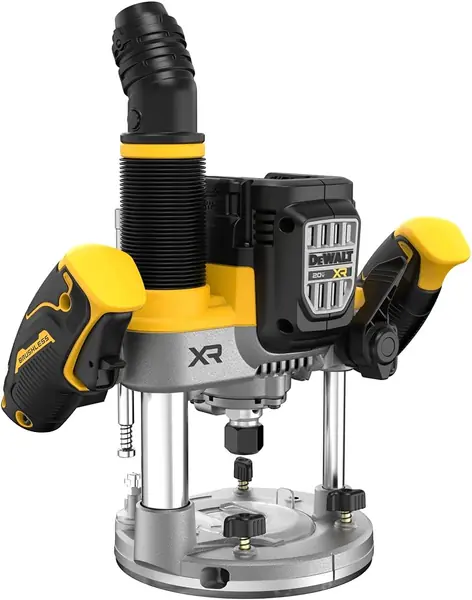
DeWalt 20V MAX XR plunge router in black and yellow with dust port

Deep plunge cuts

Shop Score 91/100
Tool Weight
11.1 lb
Horsepower
2.25 hp
Collets
1/4 in. and 1/2 in.
Dust Port
AIRLOCK compatible
View on Amazon

A 1/2-inch collet on a battery-powered router is still rare, and it's the first thing that earns the DCW620B its space. With a 2-1/4 peak horsepower brushless motor and both 1/4- and 1/2-inch collets in the box, it spins the panel-raisers and deep-groove bits that every other router here has to turn down.

The plunge mechanism is what surprised us. The columns run smoothly, the lock falls under your thumb, and the return is light enough that you feel the cut rather than the hardware. DeWalt's variable-speed dial holds set speed under load, and an anti-rotation system cuts the motor if the tool twists hard — a genuine comfort with a big bit in a portable machine, though it's a backstop and not a substitute for two hands and a secured workpiece.

Dust is where this one separates from the rest. The AIRLOCK port takes DeWalt's extractor, and the chip collector and dust shields in the box mean you can rout a groove in particleboard without wearing half of it. DeWalt's capture figure for particleboard is a maker's number, not ours, but the port, the shields, and the two sub-bases are all real, and they're the reason this is the pick for indoor work.

One router doing everything is the pitch, and at 11.1 pounds it is emphatically a two-handed tool. That weight is what you pay for a motor that will spin a half-inch bit without complaint, and it's also why this isn't the router you grab for a quick roundover on a hung windowsill. Buy it if your work runs to deep grooves, hinge pockets, and raised panels, and keep a compact for the light passes. If you want one router that covers the widest spread of cuts, this covers more of them than anything else here.

Worth Noting

  • No fixed base included
Our Verdict

We keep it for the cuts the compacts can't make: half-inch bits, stopped grooves, and hinge pockets, with dust collection that actually works.

Check Latest Price
6.

RYOBI ONE+ 18V Compact Router (PCL424B) Best Budget

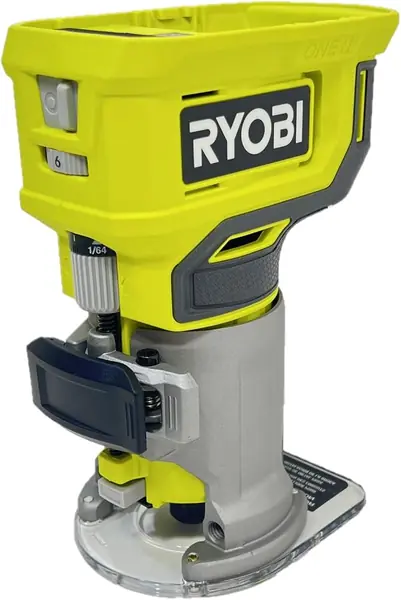
Ryobi ONE+ 18V compact router in green and black with fixed base

Weekend DIY projects

Shop Score 90/100
Base Type
Fixed
Tool Weight
3.2 lb
Speed Range
20,000 to 30,000 rpm
Warranty
30-day limited
View on Amazon

Three point two pounds is lighter than the DeWalt and the Craftsman, and it changes how you use a router. Overhead work on a cabinet face, a roundover on a shelf that's already hung, one hand on the tool and one holding the work steady — the PCL424B is the one that doesn't wear your wrist out in the first five minutes.

There's more control here than the outlay suggests, and we ran into it at the depth dial: a micro adjustment backed by a quick-release lever makes a bit change a single move, and a variable-speed dial covers 20,000 to 30,000 rpm. There's an LED at the base and a dust port that takes a shop vac hose. It runs on any 18V ONE+ pack, which is the real argument — if Ryobi batteries are already in your garage, this adds nothing to your charging setup.

What you give up is the long haul: this is a weekend-project router, not the tool you hand to a crew. For a hobbyist already in the ONE+ system it does everything the first three projects ask of it, and it's light enough that you'll pick it up instead of dragging the corded machine out of its case.

Worth Noting

  • 30-day warranty is the shortest here
  • 20,000 rpm floor is fast for wide bits
Our Verdict

We recommend it to hobbyists already on the ONE+ platform: light in the hand, easy on the budget, and enough router for weekend projects.

Check Latest Price
7.

Bosch 12V Max Palm Edge Router (GKF12V-25N) Best for Edge Trimming

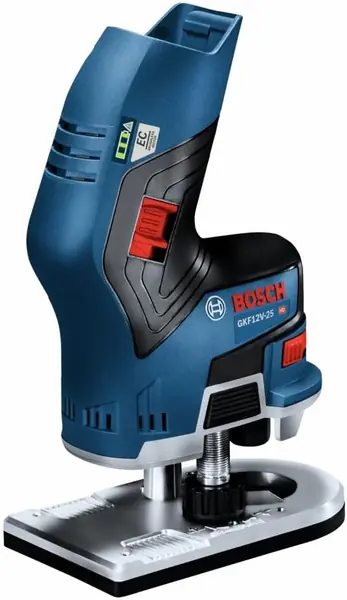
Bosch 12V Max palm edge router in black with offset body and collet

Edge trimming

Shop Score 89/100
Tool Weight
2.2 lb (tool only)
Maximum Speed
13,000 rpm
Collet
1/4 in. self-releasing
Depth Adjustment
0.04 in. per revolution
View on Amazon

Most of this tool sits over the bit rather than beside it, so your hand is above the work and the cutter is right under your eye. That offset body is the whole idea, and it pays off: at 2.2 pounds the Bosch is the lightest router here and the easiest to run one-handed along an edge you can't get a clamp on, and we were surprised how quickly a bit change goes with the self-releasing collet. For laminate trimming and edge banding, nothing else in this group feels this controlled.

The ceiling is speed. Bosch caps the brushless motor at 13,000 rpm, less than half what the DeWalt and the Milwaukee will turn, and that rules the tool out for grooving, dados, and anything with a wide bit. It's a 12-volt router built around small cutters — Bosch's own figure of 23 feet of roundover per battery amp-hour in 0.2-inch beech is an honest description of the intent.

So treat it as a specialist rather than a first router. Trimming veneer, rounding over shelf edges, flushing edge banding on cabinet doors — the offset grip and the depth lock make it the nicest tool here for those jobs, and the depth dial's 0.04 inch per revolution is fine enough to sneak up on a finished surface. If you need one router for general shop work, the money goes further elsewhere on this page.

Worth Noting

  • Bare tool; 12V Max batteries sold separately
Our Verdict

We choose it for edge work alone: no other pick here feels as natural one-handed on laminate and edge banding.

Check Latest Price

How We Tested Cordless Routers

We started with research rather than a shopping cart: reading spec sheets and manuals, sorting out which routers used a 1/4-inch collet and which could take 1/2-inch bits, which had fixed bases and which plunged, and which battery platforms were still current. From that we bought 10 units across price points and platforms and put them to work for eight months.

Testing happened in a garage shop and on job sites, not on a bench. We cut hinge mortises in door jambs, ran roundovers along red oak, trimmed edge banding off plywood, and hogged out dados. To judge power we listened and felt for rpm drop in the middle of a cut in white oak and counted how many passes a shelf edge took. Every speed dial went from its slowest setting to its top on scrap, and we watched for a soft start that kept the bit from jumping when the switch went on.

Depth adjustment got its own workout: we zeroed each base, cut, backed out, and returned to the mark ten times, then checked with a feeler gauge how far it had drifted. We weighed every router with a battery in it, ran one down a vertical edge to see how it balanced, and checked whether we could see the bit past the base plate.

Dust ports got watched to see where chips actually flew; battery life we measured by cutting until the tool sagged, and durability by letting the routers ride loose in a tool bag between jobs. Every cut happened with eye and hearing protection on, the workpiece clamped, both hands on the plunge base, and a bit matched to the tool's rating.

How to Choose a Cordless Router

Fixed base or plunge, and what each one is for

A fixed-base compact router — the trim router most of this group belongs to — sets depth with a ring or dial on the motor housing and holds it for the whole pass. That's what you want for roundovers, chamfers, hinge mortises, edge profiles, and grooves at a set depth. A plunge router adds spring-loaded columns so you can drop the bit into the middle of a board, which is the only sane way to cut a stopped groove or a hinge pocket with a big cutter.

The trap is assuming a palm router can grow into plunge work. Depth on a fixed base is set before the cut, not during it, so if your project list includes stopped cuts, buy the plunge machine first and add a compact later — the DeWalt DCW620B is the plunge router in this group.

What the motor numbers do and don't tell you

Rpm and horsepower measure different things, and neither one alone predicts how a router behaves in oak. Top speed matters because small bits need rpm to cut cleanly, while large-diameter bits need slower speeds and more torque. A router that turns 13,000 rpm is not automatically weaker than one that turns 31,000; it's a different tool aimed at a different cutter.

What separates a good router from a merely fast one is what happens when the bit loads up. Electronic speed control and a brushless motor holding rpm through a cut are worth more than another thousand on the dial. Soft start is the other giveaway: a compact router that snaps to full speed will jump in your hands on contact.

Depth adjustment is where the money shows

Every router here adjusts depth, and they don't do it equally well. A graduated ring on the motor housing is quick and repeatable when it locks positively; a separate micro dial is finer but slower to move between settings; a plunge mechanism adds repeatability through its stop rod. The Craftsman pairs macro and micro adjustment, the DeWalt compact counts out changes on its ring, and the Bosch dials a fine 0.04 inch per revolution.

Whichever design you choose, test it the same way we do: set a depth, take a cut in scrap, and check the setting against your mark before the workpiece goes under the bit. A router whose depth moves on that test will move on the project.

Batteries, bare tools, and the real cost

Almost every router here is sold as a bare tool, so the listing figure is only part of what you'll spend. Price it out with two packs and a charger if you're starting from nothing, and compare that total against a corded router plus a good extension cord before you decide the cordless version is expensive.

If you're already on a platform, the router is the cheap part — but check which platform and which class. A 12-volt palm router and an 18-volt compact are different tools, and the small packs that run a drill will not carry a router through a long session in hardwood.

Frequently Asked Questions

Final Verdict

The DeWalt DCW600B is the cordless router we recommend to most people. It holds speed in hard stock, the LED-lit base keeps the cut visible, and it runs on the 20V MAX packs a DeWalt owner already has — a combination that makes cordless routing feel ordinary rather than novel.

Two requirements change the answer. If your work runs to deep grooves, hinge pockets, or half-inch bits, step up to the DCW620B plunge router, the only one here that takes them. And if the budget is tight and you're already on V20, the Craftsman gives you comparable control for less.