↑↓ navigate ↵ open Esc close All results →

Best Wood Routers of 2026

Few tools handle as many jobs as a router—hinge mortises, shelf roundovers, plywood dadoes, and flush-trimming hung cabinets—yet none ruins hardwood faster in a single misjudged pass. That range forces an immediate trade-off between a compact fixed-base unit built for one-handed edge control and a heavier fixed-and-plunge kit able to swing a 1/2-inch shank bit under real load.

Running 12 routers through eight months of mortising, edge profiling, and dado cuts confirmed how sharply that split divides the shop. Light trim routers handle quick chamfers without fatigue, whereas a two-base corded kit or full-size plunge body stays composed when hogging deep grooves with larger bits.

Cordless convenience adds one more constraint because several battery-powered models ship tool-only, making an existing battery platform part of the math. Whether outfitting a first router table, trimming cabinets on site, or building a one-router shop, the eight models below balance cut quality, depth adjustability, and collet capacity.

Our Top Picks

The Best Wood Routers

1.

Bosch 1617EVSPK Router Combo Kit Best Overall
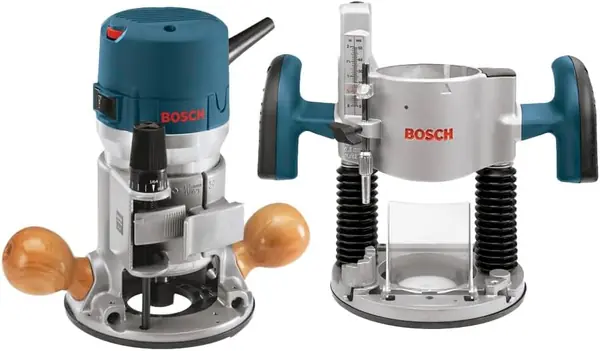
Bosch 1617EVSPK router kit with black fixed and plunge bases and a carrying case

One-router shops

Shop Score 98/100
Motor
2.25 hp, 12 amps
Speed Range
8,000–25,000 rpm
Collets
1/4 in. and 1/2 in.
Bases
Fixed and plunge
View on Amazon

The kit ships with both a fixed base and a plunge base, and that pairing is why it sits at the top of our list. The fixed base handles edge profiles, round-overs, chamfers, and table mounting; the plunge base lets you drop the bit into the middle of a board for mortises, stopped grooves, and hinge pockets. One motor, two ways to work, one case.

The 12-amp, 2.25-hp motor is the most powerful in this group. With 8,000–25,000 rpm on the dial and Constant Response circuitry holding the selected speed as the bit loads, it keeps cutting oak and maple instead of bogging and scorching. Microfine depth adjustment and the quick-clamp system let us creep up on a finished depth in small steps, and the fixed base's height ring can be turned from above once the motor is in a table.

Both collets are in the box, 1/4 inch and 1/2 inch, and the bigger one is the dividing line in this category. Panel bits, wide profile bits, and deep cuts need a 1/2-inch shank behind 2 hp; the palm-sized routers here simply cannot hold those bits. Plenty of shops buy a small router first and discover that limit a year later.

Where it earns its keep is range: fixed-base edge work, plunge cuts, and a motor that drops into a router table later without a second purchase. The one-year warranty is thin for a tool at this end of the price range, so buy from a seller whose returns are easy.

Worth Noting

  • 18.2 pounds rules out one-handed trimming
Our Verdict

Our pick for the woodworker who wants one router to handle fixed-base, plunge, and table work without buying twice.

Check Latest Price
2.

DEWALT DWP611 Compact Router Best Corded Compact

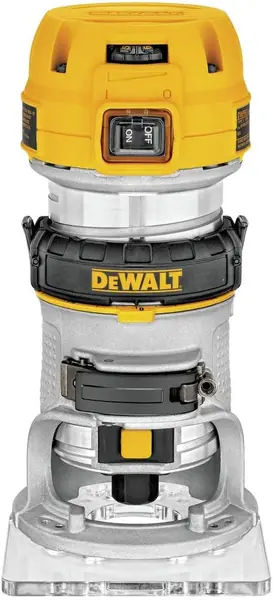
DEWALT DWP611 corded compact router in black and yellow with clear fixed base

Edges and hinges

Shop Score 97/100
Motor
1.25 hp, 7 amps
Weight
5.5 lb
Top Speed
27,000 rpm, variable
Depth Adjustment
1/64 in. increments
View on Amazon

A 1-1/4-hp motor in a 5.5-pound body is the entire pitch, and it's a good one. This is the corded router we reach for when a full-size machine is more tool than the job needs: round-overs on a shelf, hinge mortises in a jamb, a quick chamfer, a shallow inlay pocket. It handles all of it one-handed without fighting back.

The details are what we appreciate. Dual LEDs and the clear sub-base put light and a sightline right where the bit meets wood, the soft-start motor comes up without a lurch, and full-time electronic feedback holds rpm through a cut. The adjustment ring moves in 1/64-inch steps, fine enough to dial in a shallow rabbet or a hinge depth and repeat it on the next door.

Variable speed tops out at 27,000 rpm, and the motor slides out of the base for bit changes. What it is not is a plunge router: this package is the standard base only, so stopped cuts inside a board need another tool or a separate base. It's also a 1-1/4-hp machine, and the wide, deep profiles that want 2 hp belong to the full-size models.

For us it has become the router that stays out on the bench, because it is light enough to grab for one edge, precise enough to trust on a hinge, and quieter than the full-size machines here. That combination is why it earns a place even in shops that already own a big router.

Worth Noting

  • Motor can overheat in continuous machine-fed use
Our Verdict

We think it's the best corded compact for edges, hinges, and quick chamfers, so long as you don't expect it to replace a full-size router.

Check Latest Price
3.

DEWALT DCW600B Cordless Router Best Cordless

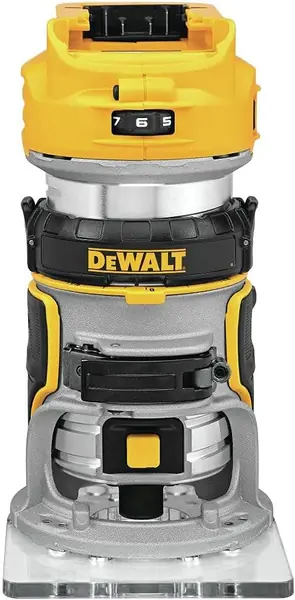
DEWALT 20V Max XR cordless compact router in black and yellow with fixed base

Installed trim work

Shop Score 96/100
Weight
4.2 lb
Base Type
Fixed
Top Speed
25,500 rpm
Power Source
20V MAX battery (tool only)
View on Amazon

No cord means no cable dragging across a panel you just finish-sanded and no hunting for an outlet on a trim job. That's the case for the DCW600B, and it holds up better than we expected: the 20V motor spins to 25,500 rpm with electronic feedback and a soft start, and it runs 1/4-inch bits through hardwood without the wheeze we associate with battery routers.

We keep reaching for it on round-overs, chamfers, hinge pockets, and flush trimming, which is most of what a compact router does in a shop anyway. At 4.2 pounds it balances in one hand, the depth ring is quick to nudge, and the electronic brake stops the bit fast instead of letting it coast. The dual LEDs sit close to the bit, so the cut line stays visible inside a cabinet where a corded tool and its shadow would not.

What we like most is how little setup it asks for. The release clamp makes bit and base changes quick, the depth ring gets you close before you fine-tune, and there's no cord to route around an installed cabinet. Load a battery, set the depth, cut.

Worth Noting

  • Bare tool; battery and charger sold separately
  • Slower than corded routers in hard stock
Our Verdict

Our favorite cordless router for trim and installed work, provided you're already on DEWALT's 20V system.

Check Latest Price
4.

Skil RT1322-00 Router Combo Best Value Two-Base Kit

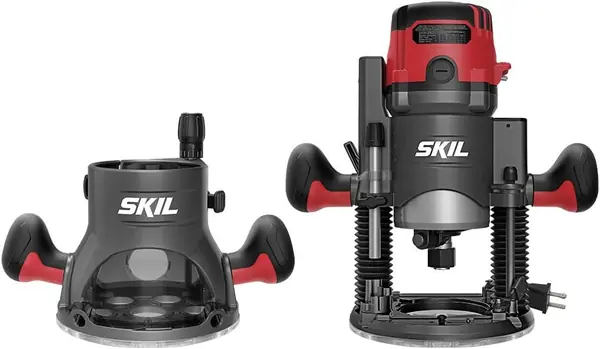
Skil RT1322-00 plunge and fixed base router combo with dust adaptors and collets

Value plunge work

Shop Score 95/100
Motor
2.42 hp, 14 amps
Speed Range
10,000–25,000 rpm
Collets
1/4 in. and 1/2 in.
Bases
Fixed and plunge
View on Amazon

A digital speed readout on a router sounds like a gimmick until you've scorched an edge because the bit was spinning too fast for the wood. Set the bit type and material on the Skil's LCD and it suggests an rpm for the job; electronic feedback then holds that speed through the cut. For anyone who hasn't memorized a speed chart, we think that's genuinely useful rather than decorative.

The rest of the package is a two-base kit for less money than a single-base premium router. Fourteen amps and 2.42 hp, 10,000–25,000 rpm, both 1/4-inch and 1/2-inch collets, fixed and plunge bases, three LEDs at the base, soft start, and a dust port on each base. That's the whole checklist, and the 14-amp motor never felt short in the cuts we gave it.

Where it gives ground is refinement. The controls feel a step behind the Bosch's, and the plastic base components are the parts that give way if the tool takes a fall. For a shop that wants real plunge capability without paying premium money, though, that's a fair trade — and the two-base setup is what makes it worth the shelf space.

Worth Noting

  • 14.3 pounds makes it a two-handed tool
Our Verdict

This is the value pick of the group: both bases, 14 amps, and a digital speed readout for less than our top pick.

Check Latest Price
5.

Makita RT0701C Compact Router Best Lightweight Corded

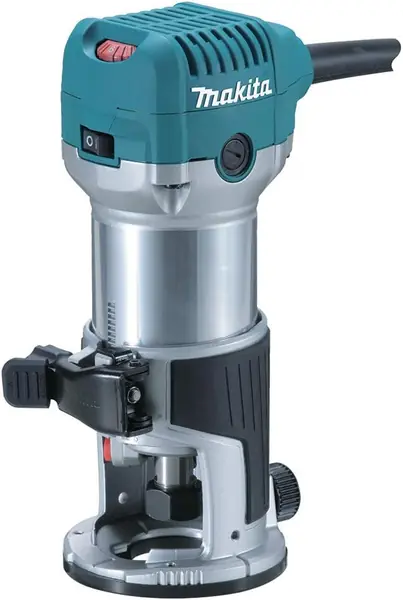
Makita RT0701C corded compact router with teal aluminum body and fixed base

Light handheld work

Shop Score 94/100
Motor
1.25 hp, 6.5 amps
Speed Range
10,000–30,000 rpm
Weight
3.9 lb
Depth Adjustment
Rack-and-pinion fine adjust
View on Amazon

At 3.9 pounds this is the lightest corded router here, and you feel it in a good way: one hand on the body, one hand guiding the work, no fatigue after a run of shelf edges. The aluminum body and slim barrel make it feel like a trim tool rather than a shrunken full-size router, which is exactly what most handheld routing actually calls for.

The 1.25-hp, 6.5-amp motor turns 10,000–30,000 rpm, the widest speed range of any corded router in this group, so you have room to slow down for a wide round-over or speed up for a small chamfer. The rack-and-pinion depth adjustment with the cam lock is quick to set and stays where you put it, a simple system that's easy to trust.

What wins us over is how little this router asks of you: light, quiet enough for a small shop, and cheap enough to keep a dedicated round-over bit mounted while a bigger machine does the heavy work. Heat is the one thing to watch, since the aluminum body conducts it and the barrel warms up after a long session — in short passes, which is this tool's job, it never became a problem for us.

Worth Noting

  • No work light on the base
  • Ships without a case or storage bag
Our Verdict

We like it as the light, low-cost corded router you keep set up with one bit, as long as you can live without a work light.

Check Latest Price
6.

Skil RT1323-00 Fixed Base Router Best Budget Fixed-Base

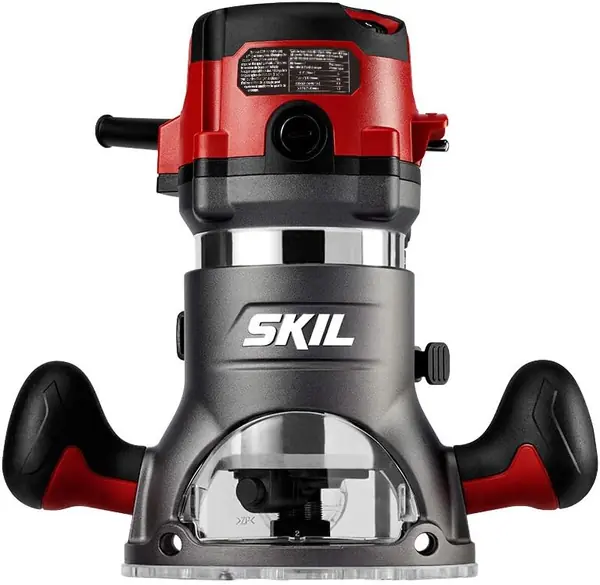
Skil RT1323-00 fixed base router with dual LEDs and dust extraction adaptor

First table router

Shop Score 93/100
Motor
2 hp, 10 amps
Speed Range
10,000–25,000 rpm
Weight
7.7 lb
Collets
1/4 in. and 1/2 in.
View on Amazon

A 1/2-inch collet is what separates a serious router from a trim tool, and this Skil has one at the bottom of the price range. That means wide round-overs, panel bits, and deep profiles a palm router can't hold, from a 10-amp, 2-hp motor with 10,000–25,000 rpm and a soft start that keeps the tool from jumping when you flip the switch.

The rest of the spec list reads like a tool that costs more: three coarse depth settings plus micro adjustment, dual LEDs, a live-tool indicator that lights when the router is plugged in, a built-in vacuum port, and a parallel guide in the box. At 7.7 pounds it sits steady on a wide edge, and the shaped handles give both hands somewhere to go.

The price does show in the controls. Depth setting takes a couple of steps, and the adjusters feel lighter-duty than the Bosch's, so you check the lock before a finish pass. Against that, soft start and a live-tool indicator are features we expect to pay more for, and for a first full-size router — or a second one dedicated to a table — the value is hard to argue with.

Worth Noting

  • Fixed base only; no plunge base included
Our Verdict

The least expensive route into 1/2-inch bits and full-size power, and the router we recommend for a first table setup.

Check Latest Price
7.

Milwaukee 2723-20 Compact Router Best for M18 Battery Owners

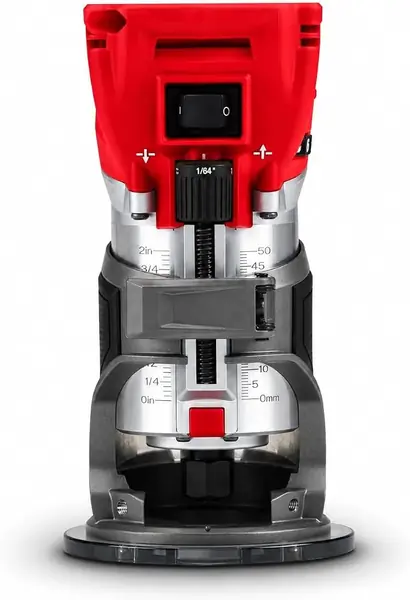
Milwaukee M18 Fuel compact cordless router in black and red with fixed base

M18 battery owners

Shop Score 92/100
Motor
1.25 hp brushless, 18V
Speed Range
10,000–31,000 rpm
Base Type
Fixed
Depth Travel
1.5 in. macro adjust
View on Amazon

If your shop already runs on M18 batteries, this is the cordless router to buy. If it doesn't, the DEWALT DCW600B costs less and gives up little, so the case for the Milwaukee rests on the battery platform you already own and on a 10,000–31,000 rpm range that is the widest of any cordless router here.

The POWERSTATE brushless motor is rated at 1.25 hp, and it cuts hinge mortises and edge profiles in hardwood without straining; REDLINK electronics cut power if the tool overheats or the battery sags. The macro-adjust button moves the motor through 1.5 inches of travel in a hurry, and the body is compact enough that a deep cabinet interior doesn't feel like a reach.

Runtime is the practical note. This motor draws hard, and the small packs that live on a drill won't get you far, so plan on high-capacity batteries and a charged spare. Do that and it does everything the corded compact routers do, without a cord over your shoulder.

Worth Noting

  • Depth setting can creep during a cut
  • Bare tool with no battery in the box
Our Verdict

M18 owners should start here; everyone else gets more router for less money from the DEWALT cordless.

Check Latest Price
8.

Ryobi PCL424B Cordless Router Best for Light Trim Work

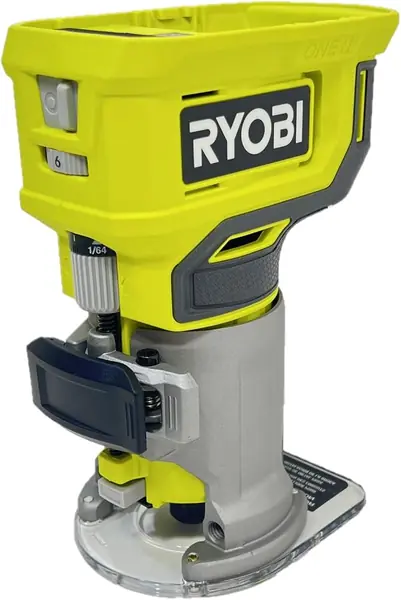
Ryobi ONE+ 18V cordless compact router in green with fixed base and dust port

Light trim work

Shop Score 91/100
Speed Range
20,000–30,000 rpm
Weight
3.2 lb
Base Type
Fixed
Power Source
18V ONE+ battery (tool only)
View on Amazon

This is the least expensive router here as a bare tool, and for anyone already carrying ONE+ batteries that is most of the argument. It spins 20,000–30,000 rpm, weighs 3.2 pounds, and pairs a micro depth dial with a quick-release lever, so bit changes and depth tweaks don't turn into a project of their own.

We like it for what it is: a light, one-handed router for round-overs, chamfers, and trimming plywood edges, with an LED and a dust port that plenty of routers in this bracket leave off. The plastic body tells you where it sits in the hierarchy — a home-shop tool rather than a production one — but it balances well in the hand and the depth dial is easy to set.

Where it makes sense is on the shelf of someone who already has the batteries and does occasional trim work: a second router kept loaded with a dedicated bit, a first router for small projects, or a tool that lives in the house instead of the shop. It is not the router to buy if routers are the point of your shop.

Worth Noting

  • Ships as a bare tool without batteries
  • 30-day warranty is the shortest here
Our Verdict

A light, simple cordless router we recommend to Ryobi ONE+ owners doing occasional trim and edge work.

Check Latest Price

How We Tested the Best Wood Routers

We started with every router we could find from brands we trust, then filtered by what actually changes what a tool can do: fixed base only or a fixed-and-plunge kit, whether it accepts a 1/2-inch collet as well as a 1/4-inch, amperage and horsepower, speed range, and, for cordless models, whether a battery is in the box. That last filter eliminated a few candidates — a bare tool is only a bargain if you already own the platform.

Twelve routers came into a home shop for eight months. We cut hinge mortises in interior doors, ran roundovers on oak and maple shelf boards, cut dadoes in plywood, and trimmed laminate on cabinets that were already hung. Bits and bases came out only with the cord unplugged or the battery pulled.

Every router ran the same checks. We counted depth-adjustment turns and verified the change with a feeler gauge, leaned on the base lock to see whether the motor would twist, and returned to a set depth after a bit change to see if the cut landed in the same place.

We pushed a wide bit through white oak to hear whether the motor bogged, watched for a jump at startup, and ran each one one-handed along an edge to judge weight and balance. A full day of routing followed, then we checked for collet runout, hot housings, and sloppy switches. Nothing went upside down in our hands — inverted work went into a router table with the motor clamped in its base.

Last, we weighed what came in the box — a second base, both collets, a case — against the price, and read each warranty line by line. The eight that stayed in rotation held their depth, kept their speed under load, and still felt controlled after an hour.

How to Choose a Wood Router

Fixed Base, Plunge Base, or Both

A fixed base holds the motor at a depth you set, which is what edge profiles, round-overs, chamfers, and table mounting need. A plunge base lets you push the bit down into the work, so it handles mortises, stopped grooves, and hinge pockets. When we point people to a two-base kit like the Bosch 1617EVSPK or the Skil RT1322-00, that's the reason: one motor covers both kinds of work.

Not every fixed-base router has a plunge base available for it later, and the ones that do often cost more as a separate purchase than as part of a kit. If you think plunge cuts are in your future, buy the two-base kit now rather than a single-base router and a hope.

Corded or Cordless

Cordless routers have closed most of the gap, and the remaining difference is about the work rather than the technology. A battery router shines on installed trim, cabinet interiors, and job sites where an outlet is a walk away; a corded one holds speed better through long cuts in thick hardwood and never asks you to swap a pack.

Keep the comparison honest: cordless routers usually sell as bare tools, so add packs and a charger unless you're already in that battery system. We treat cordless as a complement to a corded router, not a replacement for one.

Collet Size and Bit Capacity

Compact routers and palm routers are built around 1/4-inch shank bits, which covers round-overs, chamfers, small grooves, and hinge work. A 1/2-inch collet is a different level of capability: panel bits, wide profile bits, and deep cuts need the bigger shank and a 2-hp motor behind it. If raised panels or big edge profiles are on your list, buy a full-size fixed-base or two-base router — the Skil RT1323-00 is the least expensive way to get a 1/2-inch collet in this group.

An adapter sleeve does not turn a palm router into a panel router. The motor and the base are still the limit, and a wide bit in a small router is how burns and scary kickback happen.

Power, Speed, and the Electronics

Amps and horsepower describe how much the motor can pull through a cut; the speed dial describes whether you can match rpm to the bit. Wide bits run slower, small bits run faster, and a router with one fixed speed forces you to feed at whatever pace the motor dictates.

We look for soft start, which stops the tool from jumping when you flip the switch, and electronic feedback or constant-response circuitry, which holds rpm as the bit loads. For 1/2-inch bits in hardwood, 12 to 14 amps and a 2-hp rating is the floor rather than a luxury.

Depth Adjustment, Weight, and Control

Depth is where inexpensive routers feel inexpensive: a good system moves in small increments, locks without creeping, and repeats a setting you used yesterday. Mass cuts both ways — an 18.2-pound two-base kit steadies a wide edge but needs two hands, while a 3.9-pound palm router can be guided with one.

If the router will live in a table, confirm you can adjust depth from above the table surface before you buy. Reaching underneath to tweak a cut gets old in a hurry, and some bases simply aren't built for it.

Frequently Asked Questions

Final Verdict

The Bosch 1617EVSPK is the router we recommend to most woodworkers. Two bases, 2.25 hp, and a 1/2-inch collet cover edge profiles, plunge cuts, and table duty in one purchase, which is why it takes the top spot here.

If a full-size router already lives in your shop, the DEWALT DWP611 is the better second tool — lighter, handier, and precise on hinges and edges. And if your batteries are already on the shelf, the DCW600B earns its place on trim work that a cord would only slow down.