↑↓ navigate ↵ open Esc close All results →

Best Trim Routers of 2026

At just a few pounds, a trim router telegraphs every design flaw straight to your wrist: a tipping sub-base burns a shelf edge, a creeping depth collar ruins laminate, and a recessed collet turns bit swaps into a fumble. Because woodworkers grab compact routers for overhead work, countertop edge-banding, and hinge mortises in tight jambs, small ergonomic details carry more weight than motor specs.

Running 12 corded and cordless trim routers for nine months across edge profiles and shallow mortises also exposed a hidden cost gap. Cordless convenience often doubles the real price once batteries and a charger are added to a bare-tool listing.

Models that locked depth firmly, ramped up smoothly without twisting in hand, and kept a clear sightline to the bit separated themselves quickly during repeat passes.

Our Top Picks

The Best Trim Routers

1.

DEWALT DCW600B 20V Max XR Best Overall
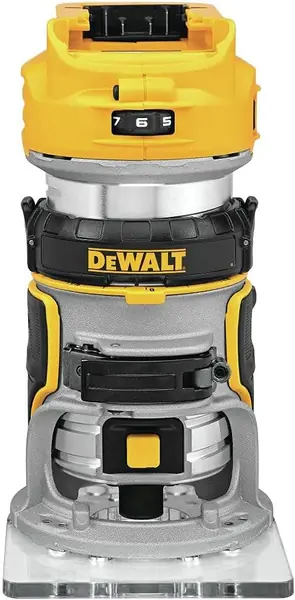
DEWALT 20V Max XR cordless compact router with black and yellow fixed base

Most shops

Shop Score 97/100
Power Source
20V MAX battery, tool only
Max Speed
25,500 rpm
Base Type
Fixed
Tool Weight
4.2 lb
View on Amazon

Trim work is mostly a test of how well you can follow an edge, and a cord is what usually breaks the rhythm. It snags on a clamp, drags across the workpiece, and decides for you which corners you can reach. The DCW600B takes that out of the equation: a 20-volt, 4.2-pound fixed-base router that tops out at 25,500 rpm, with dual LEDs, a variable-speed dial, soft start, and an electronic brake.

What we noticed first is how little drama there is in the cut. Soft start keeps it from jumping when you squeeze the trigger, the electronic feedback holds motor speed as the bit loads, and the brake stops the bit fast enough that you aren't standing there holding a spinning router while you decide where to set it down. The speed dial is the control we reached for most: slow for laminate, faster for hardwood roundovers. With a 1/4-inch bit at a sensible depth of cut, it doesn't bog in oak.

Balance is the other thing that surprised us. At 4.2 pounds it sits down on the workpiece instead of skittering across it, and the base is broad enough to register against an edge without tipping. The depth ring is quick enough that moving between passes doesn't slow you down.

The fixed base means edges, dados, and hinge mortises rather than plunge cuts, so if plunge work is on your list, that's a second tool. The Makita RT0701C is the corded answer for anyone who would rather not think about batteries at all.

Worth Noting

  • Tool only, batteries and charger extra
Our Verdict

We recommend it to most shoppers: it trims a long edge without a cord fighting you, holds speed in hardwood, and stops fast when you let go.

Check Latest Price
2.

Makita RT0701C Best Corded Value

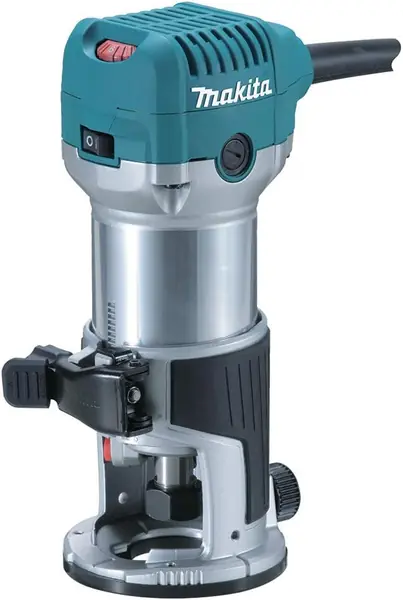
Makita RT0701C compact corded router with teal body and fixed base

Corded edge work

Shop Score 96/100
Weight
3.9 lb
Speed Range
10,000–30,000 rpm
Horsepower
1.25 hp
Depth Adjustment
Rack and pinion
View on Amazon

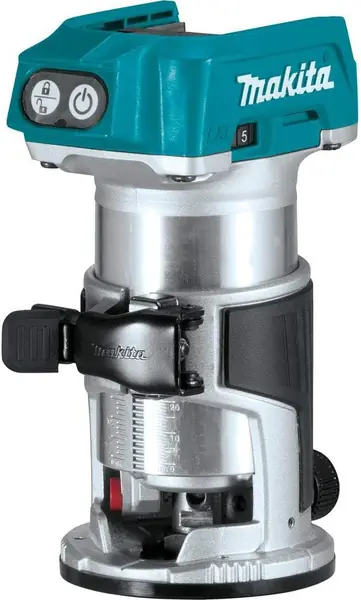
We point most corded shoppers here, and the reason is simple: it's one of the least expensive tools on this list and it doesn't ask you to give much up for that. A 1.25-hp, 6.5-amp motor, 10,000 to 30,000 rpm, and 3.9 pounds in a slim body that wraps easily in one hand.

Rack-and-pinion depth adjustment is the part we appreciate most. It's a fine adjustment rather than a guess-and-check ring, and the quick cam lock releases the whole base so you can get a wrench on the collet without fighting the housing. Electronic speed control keeps the motor from sagging when the bit loads, and the dial covers everything from a slow spin for a wide bit to full speed for a small roundover.

Motors can fail on a router in this class, and that's the honest risk here; the one-year warranty is the protection if yours does. For weekend work, that's a trade we're comfortable with. In a production shop, the money is better spent on the DEWALT DWP611 or the Bosch Colt.

Worth Noting

  • No onboard light at the cut line
Our Verdict

We steer most corded shoppers here: it costs less than the bigger corded routers and still has the power and fine depth control for edge work.

Check Latest Price
3.

DEWALT DWP611 Best Corded Power

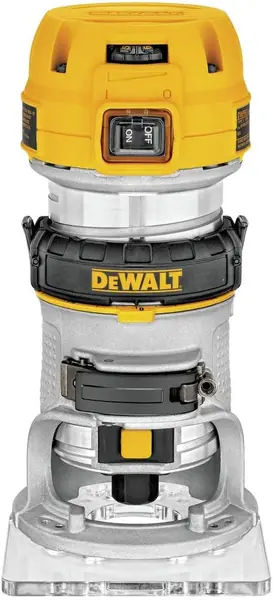
DEWALT DWP611 corded compact router with clear sub-base and dual LEDs

Deep profile cuts

Shop Score 95/100
Weight
5.5 lb
Horsepower
1.25 hp
Max Speed
27,000 rpm
Depth Precision
1/64 in.
View on Amazon

Depth adjustment on this router moves in 1/64-inch steps, the kind of number that sounds like marketing until you're mortising a hinge and the plate drops in flush on the first try. That's the finest adjustment in this group, and it sits on a 7-amp, 1.25-hp motor that turns at 27,000 rpm. The ring is the control you touch most, and it moves in those small increments without overshooting.

Power is the other half of the pitch, and this is the strongest corded motor here. With soft start and full-time electronic feedback, it holds speed through a deep roundover in oak that would make a cordless model work for it. The clear sub-base and dual LEDs put the bit and the cut line in view, which matters more on a finish pass than any figure on the box.

Motors can fail on this model, so we treat the power as something to use in sensible passes rather than all day at full depth. For doors, trim, and countertops on weekends, that's a fair trade for the muscle; a shop asking for full depth from morning to night is asking for trouble.

Worth Noting

  • Heavy at 5.5 pounds overhead
Our Verdict

When the cut is deep and the wood is hard, we want this corded router in our hands; just plan on two hands and a patient pace.

Check Latest Price
4.

Milwaukee 2723-20 M18 FUEL Most Powerful Cordless

Milwaukee M18 FUEL compact router in black with fixed base and speed dial

M18 battery owners

Shop Score 94/100
Speed Range
10,000–31,000 rpm
Horsepower
1.25 hp
Power Source
18V battery, bare tool
Macro Depth Range
1.5 in.
View on Amazon

If your shop already runs on M18 batteries, the arithmetic on this router is different from everyone else's: the bare tool slides onto packs you own, and you get a 1.25-hp brushless motor with a dial from 10,000 to 31,000 rpm.

That's the most motor in a cordless router here, and it shows in cuts that make the others work, including deep roundovers, dados in hardwood, and hinge mortises in a door blank. REDLINK electronics back the motor off before it overheats, the macro adjust button covers an inch and a half of range in a hurry, and the body has the dense, square feel of a Milwaukee tool.

Depth is the one control that takes getting used to. The macro button is quick for big moves, and the fine setting is the part that takes the most care, so we set depth with a test cut on scrap and check it again before a finish pass. That costs a minute and saves a workpiece.

Where it earns its place is power per battery. For a Milwaukee shop we take it over the DEWALT, since the extra motor is worth the bigger number on the tag when the packs are already a sunk cost. If your batteries are yellow, teal, or green, that argument disappears and this becomes an expensive way to avoid a cord.

Worth Noting

  • Runs through compact batteries quickly
Our Verdict

For a shop already on M18 batteries, we take it over the DEWALT: more motor and a higher rpm ceiling, with a 5.0 Ah pack in the kit.

Check Latest Price
5.

Makita XTR01Z 18V LXT Best Cordless for Cabinet Work

Makita XTR01Z 18V LXT brushless compact router in teal with fixed base

Cabinet-scale routing

Shop Score 93/100
Speed Range
10,000–30,000 rpm
Power Source
18V LXT battery, tool only
Warranty
3-year limited
Included Accessories
1/4 in. collet, straight guide, two wrenches
View on Amazon

Three years of limited warranty is the longest coverage on this page, and on a tool that spins at 30,000 rpm that isn't a small thing. We recommend the XTR01Z for cabinet-scale work, meaning dados, hinge mortises, and edge profiles on stiles and rails, where a compact body and steady speed matter more than raw torque.

The brushless motor and electronic speed control are the reason it behaves: load it in a plywood dado and the rpm stays where you set it instead of sagging. The base releases for bit changes, and the separate lock button means the trigger can't fire while the tool is rattling around in a drawer, which is a small thing until a tool starts on its own. Makita includes a 1/4-inch collet, two wrenches, and a straight guide.

Where it fits on this list is between the DEWALT and the Milwaukee on price, and the choice against Makita's own corded router comes down to the cord: the RT0701C stays plugged in at the bench, and this one goes to the job. If you already own LXT batteries, that combination is easy to justify.

Worth Noting

  • Depth adjustment is fiddly on fine settings
Our Verdict

For cabinet parts and hinge mortises, we like this cordless Makita: three years of coverage, steady speed under load, and a base that comes off in seconds.

Check Latest Price
6.

RYOBI ONE+ PCL424B Best Budget Cordless

Ryobi ONE+ 18V compact fixed base router in green without a battery

ONE+ battery owners

Shop Score 92/100
Weight
3.2 lb
Speed Range
20,000–30,000 rpm
Power Source
18V ONE+ battery, tool only
Depth Adjustment
Micro dial with quick release
View on Amazon

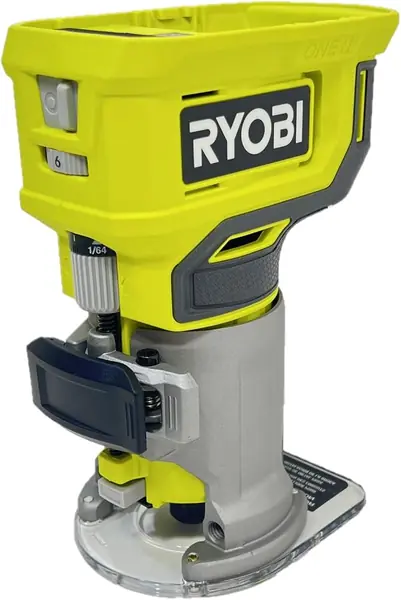
Not every shop needs a router that lives on the bench. If you're cutting a roundover on a shelf, mortising a hinge, or trimming a laminate edge once a month, the PCL424B does the job at 3.2 pounds with whatever 18-volt ONE+ pack happens to be charged in the drawer.

We like it for exactly that kind of work. It's light enough to run one-handed along a shelf edge, the micro depth dial and quick-release lever make bit changes a short job, and the dust port means you can hang a shop vac on it instead of wearing the chips. Speed runs from 20,000 to 30,000 rpm on a dial, and it takes standard 1/4-inch bits. The body is plastic and it's happiest as a light-duty tool, but it's the least expensive cordless router here, and for a homeowner that's the right amount of tool.

Set it against the corded Makita RT0701C and the trade is clear: one is lighter and cordless, the other never asks about batteries. For a second router that lives in a drawer until a project needs it, the Ryobi is the easier one to reach for.

Worth Noting

  • 30-day warranty is short for a power tool
Our Verdict

If you already own Ryobi 18V batteries, this is the least expensive way into cordless trimming, and it handles shelf edges and hinge mortises without fuss.

Check Latest Price
7.

Bosch GKF125CEN Colt Best for Fine Detail Work

Bosch GKF125CEN Colt corded router in black with aluminum fixed base

Fine detail work

Shop Score 91/100
Weight
4.4 lb
Horsepower
1.25 hp (max)
Max Speed
35,000 rpm
Bit Capacity
Up to 1-5/16 in. wide
View on Amazon

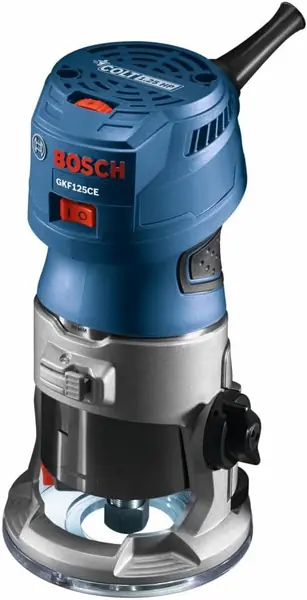
35,000 rpm is the highest spindle speed in this group, and it's the number that matters if you do a lot of work with small-diameter bits. A 1/8-inch roundover or a fine chamfer cuts cleaner when the bit spins fast enough to shear the fibers rather than scrape them.

The rest of the tool is built around control. The 1.25-hp (max), 7-amp motor has soft start and Constant Response circuitry to hold rpm under load, the 360-degree aluminum base accepts bits up to 1-5/16 inches wide, and an LED sits at the bit so you can see where the cut starts.

Depth adjustment pairs a macro release with a micro-fine dial, which is the arrangement we want for hinge mortises and stopped dados: drop the motor, lock it, then dial in the last fraction of an inch.

The trade is heat. It runs warm in a long session, so we give it a break between passes rather than leaning on it continuously. For furniture-scale trim with small bits, that's a deal we take happily; for long runs with a big roundover, the DEWALT DWP611 is the better partner.

Worth Noting

  • Costs more than the other corded routers here
Our Verdict

We reach for it when the bit is small and the profile is fussy: the highest spindle speed here and a wide bit opening make delicate cuts easier.

Check Latest Price
8.

TEENO 1.25 HP Compact Router Best for First-Time Routing

TEENO compact wood router in red with clear base and bit set

First-time routing

Shop Score 86/100
Weight
4.8 lb
Speed Range
15,000–32,000 rpm
Collet Sizes
1/4 in. and 6 mm
Included Bits
15-piece carbide set
View on Amazon

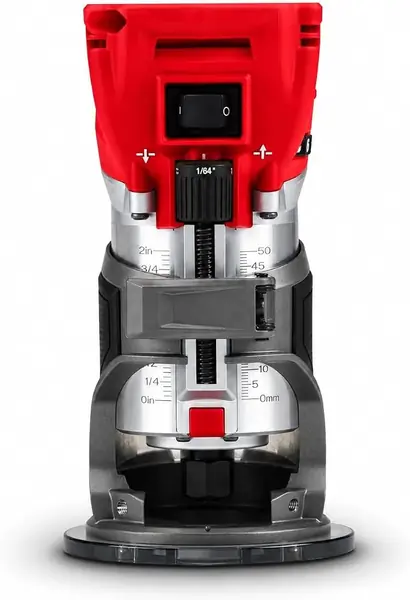
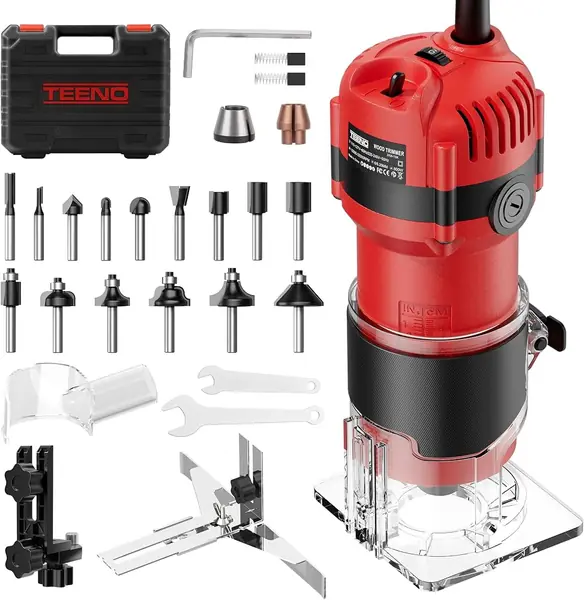
Open the box and you have a router, fifteen carbide bits in a case, 1/4-inch and 6 mm collets, an edge guide, a circle guide, a roller guide, a dust hood, spare carbon brushes, and two wrenches. For a first router, that's most of a starter shop in one purchase.

The tool itself is more capable than the price suggests: a 6.5-amp, 1.25-hp motor with six speeds between 15,000 and 32,000 rpm, a clear base that keeps the cut visible, and a dust hood that takes a shop vac hose. The rack-and-pinion adjuster locks down hard and releases quickly for bit changes.

Where the savings show is the finish: a plastic body over an aluminum base, controls that work without feeling refined, and a fixed base happiest on flat stock. It feels fine in the hand for weekend work, and it isn't the tool we reach for on a paying job. We still recommend it to the first-time buyer who wants one box to start with, and we point anyone who already knows their way around a router to the Makita RT0701C instead.

Worth Noting

  • Instructions explain almost nothing
Our Verdict

We point first-timers here: one box holds a working router, fifteen carbide bits, and the guides to run them, which is a cheap way to learn what you need.

Check Latest Price

How We Tested the Best Trim Routers

We started with every compact and trim router we could find from the major brands, then sorted them by the things that change the work: corded versus cordless, motor size and speed range, macro and micro depth adjustment, base design and bit visibility, collet size, warranty length, and what ships in the box. We dropped models that duplicated another router in the same power and price class, bought 12, and used them for nine months.

Most of that time was spent in a garage shop, with a few weeks on a kitchen remodel. We trimmed laminate on countertop edges, rounded over shelf fronts, cut hinge mortises into jambs, flush-trimmed plywood against a pattern, and ran the same roundover overhead one-handed to feel what a few pounds does to your wrist by the tenth pass. Every workpiece was clamped, we unplugged the corded models or pulled the battery before each bit change, and eye and hearing protection stayed on the whole time.

At every step we recorded what happened rather than what the spec sheet promised: how far the depth moved per turn of the dial and whether it returned to the same setting after a bit change, whether the motor held its pitch in white oak or bogged and scorched the cut, how much of the bit you could see past your own hand, and whether the manual got us through setup or left us guessing.

We also counted what came in the box, then priced the batteries and charger a bare-tool listing leaves out, because that changes what a cordless router really costs. Base plates, depth screws, and switches got months of steady use, which is where the cheaper castings started to show.

How to Choose a Trim Router

Corded or Cordless

Cordless freedom is real on a tool that follows edges, but the price on a bare-tool listing is only the entry fee. If you don't already own that brand's batteries, add a pack and charger before you compare anything, and check which pack size the tool wants, because the Milwaukee is famously thirsty on compact packs. Corded routers cost less to run and never fade mid-cut, which is why we keep one on the bench next to a cordless.

Our rule: buy into the battery system you already own, and buy corded if you don't own one yet and trim more than a few times a year.

Power and Speed Range

Every router here runs a 1/4-inch collet at roughly 1 to 1.25 hp, so the numbers look closer than the tools feel. What separates them is how the electronics behave under load: soft start, constant-speed feedback, and a variable dial matter more than a peak figure. A compact router with a dial you can slow to 10,000 rpm handles a wide bit or plastic laminate without scorching; a single-speed trimmer can't.

For hardwood roundovers and dados, look at the 1.25-hp, 7-amp end of the range, where the DEWALT DWP611 and the Bosch Colt sit. For shelf edges and hinge mortises, the smaller cordless models are plenty.

Depth Adjustment and Repeatability

Depth is where cheap routers give themselves away. You want a macro release for big moves and a micro adjust for the last fraction, which is the difference between a hinge mortise that fits and one you chase with a chisel. The trap: a depth scale is a reference, not a measurement. Set depth with a test cut on scrap and re-check it before a finish pass, especially where the fine setting is known to drift.

If your work is roundovers on shelf edges, a simple ring is enough. For mortises and stopped dados, insist on micro adjustment.

Weight, Base, and Bit Visibility

Weight cuts both ways. A 4- to 5.5-pound router sits down on the workpiece and steadies a deep cut; the same mass tires your wrist when you're trimming overhead. The lightest tools here, the Ryobi at 3.2 pounds and the Makita RT0701C at 3.9, are the ones we reach for on vertical surfaces.

Look at the base as well: a wider base registers against an edge without tipping, a clear sub-base and an LED show you the cut line, and a collet you can reach with a wrench makes bit changes quick. Confirm the base opening clears any wide bit you plan to run.

Collets, Bits, and What Comes in the Box

All of these take 1/4-inch shank bits, and the TEENO also takes 6 mm. Half-inch shank bits belong on a full-size router, so check the shank before you buy a bit set.

Included accessories are worth counting, since an edge guide and a dust port save you buying them separately and a straight guide is handy for dado work. But a box of fifteen bits is not a reason to choose a router. Buy the tool you want and add bits as the work asks for them.

Frequently Asked Questions

Final Verdict

For most people, the DEWALT DCW600B is the trim router to buy. Its whole advantage is the one thing a trim router exists to do, which is follow an edge, and it does that without a cord to snag, with enough power for 1/4-inch bits and a brake that stops the bit the moment you let go of the trigger.

If your work is heavier, the DEWALT DWP611 and the Bosch Colt are the corded tools we hand people. If your shop already runs on a battery system, buy into it: the Milwaukee 2723-20 for power, the Makita XTR01Z for coverage, the Ryobi PCL424B if you're trimming on a budget. And the Makita RT0701C is still the corded value pick that handles most of what a home shop asks.