↑↓ navigate ↵ open Esc close All results →

Best Corded Trim Routers of 2026

A trim router only needs a depth ring to creep a sixteenth of an inch mid-pass to ruin a laminate countertop edge. Small motors and compact bases make these tools nimble for one-handed shelf roundovers, laminate flush-trimming, and hinge mortising, but that agility depends on holding speed in white oak and locking depth firmly in place.

Eight months of testing 11 corded trim routers on countertop installs, door jambs, and shelf edges confirmed that listed horsepower clusters too tightly to separate models on paper. Electronic feedback that keeps the bit from bogging under feed pressure and clear sightlines to the cutter matter far more in practice.

Ranging from dedicated laminate trimmers to plunge-ready routers, all four models accept 1/4-inch shanks, hold their depth settings, and balance cleanly in one hand.

Our Top Picks

The Best Corded Trim Routers

1.

DeWalt DWP611 Compact Router Best Overall
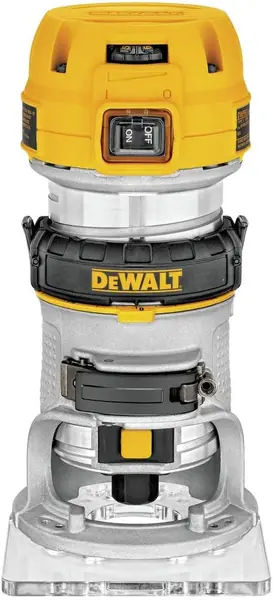
DeWalt DWP611 corded compact router with black and yellow body and clear fixed base

All-around trim routing

Shop Score 95/100
Motor
1-1/4 HP
Weight
5.5 lb
Speed Range
Variable, up to 27,000 RPM
Depth Adjustment
1/64 in. increments
View on Amazon

Two LEDs sit just behind the bit, and the fixed base is clear plastic rather than black aluminum, so a cut inside a dark cabinet or under a counter overhang is something you watch instead of guess at. No other router here pairs a see-through base with a light. The 1-1/4 HP motor tops out at 27,000 RPM, and soft start keeps the tool from lurching when you pull the trigger.

Repeatability is what won us over. The adjustment ring moves the motor in 1/64 inch steps, and once you clamp it the depth stays put through the cut. That sounds minor until you have fought a router that creeps: most of a trim router's life is edge work, and a setting that drifts a sixty-fourth mid-pass leaves a ledge you have to sand out. We also appreciated that the electronic feedback holds RPM when the bit loads up in oak instead of bogging and scorching the edge.

Weight is the trade-off. At 5.5 lb it is the heaviest of the four, and after a few minutes of one-handed work along a countertop your wrist knows it. What the mass buys is a base that sits flat and stays there, with vibration damped instead of driven into your fingers. Bench and countertop work, we don't mind it at all; overhead or vertical work is where the lighter Makitas earn their place.

The one caveat we hold is motor life. Continuous heavy cuts, the kind where the tool runs for minutes without a break, are where this model's motor is likeliest to let go — so if your week is hours of flush trimming rather than a series of passes, buy with that in mind.

Worth Noting

  • Heaviest fixed base here at 5.5 lb
Our Verdict

We recommend the DWP611 to anyone who wants a single corded trim router for edge work: it has the best bit visibility here and the finest depth adjustment.

Check Latest Price
2.

Makita RT0701C Compact Router Best Value

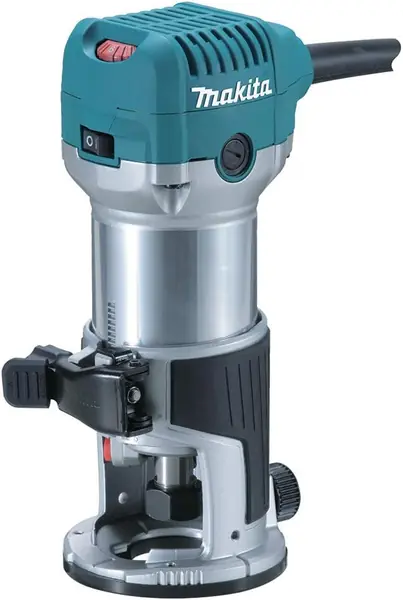
Makita RT0701C teal compact router with slim fixed base and 1/4 inch collet

Budget first router

Shop Score 94/100
Motor
1-1/4 HP, 6.5 amps
Weight
3.9 lb
Speed Range
10,000 to 30,000 RPM
Depth Adjustment
Rack and pinion with cam lock
View on Amazon

1-1/4 horsepower, a 6.5 amp motor and the lowest price of any router here: that combination is why the RT0701C is the one we suggest first to someone buying a first trim router. The variable-speed dial runs 10,000 to 30,000 RPM, electronic speed control holds the setting under load, and the barrel is slim enough at 3.9 lb that you can run a roundover along a shelf one-handed and still feel where the base is.

Depth adjustment is a rack and pinion behind a quick-release cam: pop the cam, slide the motor to rough depth, lock it, then fine-tune with the rack. It is smooth and it holds, and the same cam releases the motor when you want to swap bases. We paid close attention to heat here, because the aluminum housing conducts it straight into your palm — a long pass in oak leaves the barrel warm, and an afternoon of them gets uncomfortable. Let it cool between passes or wear a glove. There is also no work light, so in a dark cabinet you'll want a clamp light aimed at the cut, which is a two-dollar fix but an extra step the DeWalt saves you.

Durability is the one thing we can't vouch for in the long run. Hand-held use has been fine for us, but the failures cluster in continuous-duty mounting, where a small motor running for hours never gets a break. Buy it for edges, profiles and trimming and it earns its money; treat it as a production spindle and you are asking for trouble.

Worth Noting

  • Motor life is mixed in continuous-duty use
Our Verdict

Buy it when you want a full 1-1/4 horsepower and a variable-speed dial without paying the most; we think it's the sharpest first trim router here.

Check Latest Price
3.

Bosch GKF125CEN Colt Palm Router Best for Depth Control

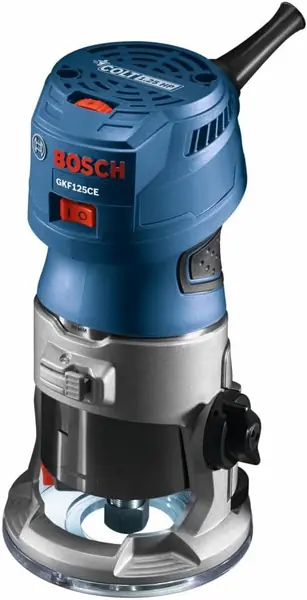
Bosch GKF125CEN Colt palm router in black with aluminum fixed base and dual LEDs

Precision depth work

Shop Score 93/100
Motor
1-1/4 HP max, 7 amps
Weight
4.4 lb
Speed Range
Variable, up to 35,000 RPM
Max Bit Diameter
1-5/16 in.
View on Amazon

Depth is where a palm router earns or loses its keep, and Bosch's system on this Colt is the most precise of the four. A threaded adjuster takes up the last fraction of an inch in fine increments, then the motor locks into a 360-degree aluminum base that does not flex when you lean on it. What that buys is a cut you can come back to: set the depth, run the profile, and the second pass picks up where the first left off without re-zeroing against a scrap block.

The 7 amp motor is rated 1-1/4 HP at maximum and spins to 35,000 RPM, the highest top speed in this group. Small bits want that headroom — an eighth-inch roundover and a flush-trim bit both cut cleaner at speed — and the base swallows bits up to 1-5/16 inch in diameter, wider than we expected on a router this size, so a small chamfer or rabbeting bit clears without hunting for a bigger machine. Two LEDs light the bit area, which matters more than it sounds once you are working inside a cabinet.

At 4.4 lb it lands between the Makitas and the DeWalt, and the palm-grip shape with the soft overmold is the one we found easiest to keep flat on a vertical edge — it doesn't skate the way a hard plastic barrel can. It is the priciest router here, and we think that premium is worth paying only if repeatable depth and top-end speed are what your week actually demands. For occasional roundovers on a weekend project, the RT0701C gets you to the same edge for a lot less.

Worth Noting

  • Runs hot in the hand during long sessions
Our Verdict

Choose this Colt when a repeatable depth setting and top-end bit speed matter more to your work than money; that is what the premium buys.

Check Latest Price
4.

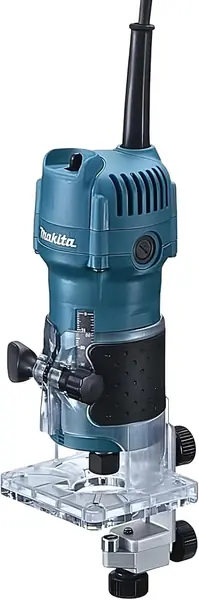
Makita 3709 Laminate Trimmer Best for Laminate Flush Trimming

Makita 3709 teal laminate trimmer with transparent fixed base and top-mounted cord

Laminate flush trimming

Shop Score 92/100
Motor
4 amps, 0.71 HP
Weight
3.3 lb
Base
Transparent fixed base
Speed
30,000 RPM, single speed
View on Amazon

A transparent base is the entire idea: set the trimmer down on the laminate, look through the plastic at the bit, and run the bearing along the substrate edge. The 3709 is a dedicated laminate trimmer rather than a general-purpose compact router, and on countertop work — trimming an overhang flush, running around a sink cutout — the clear base and the top-mounted cord that stays clear of the work make it easier to follow a line than the taller routers here. It comes with a trimmer guide and template guide, so the guided work is ready out of the box.

Everywhere else it gives ground. The 4 amp motor is rated 0.71 HP, the least power in this set by a wide margin, and there is no speed dial — 30,000 RPM at the switch and that is your only option. For a flush-trim bit shaving laminate that is exactly right; for pulling a 3/4 inch roundover through white oak it is not, because there you want to slow the bit and let the electronics carry the load, and this one has neither. We liked how light it feels at 3.3 lb, the lightest of the four, though light also means less mass holding the base flat along a long edge. And it costs more than the more powerful RT0701C, which makes it a hard recommendation unless flat laminate is a regular part of your week.

Worth Noting

  • Single speed with no variable-speed dial
  • Least power here at 0.71 HP
Our Verdict

Buy it if you trim flat laminate regularly and want to see the bit through the base; for general routing, the cheaper RT0701C does more.

Check Latest Price

How We Tested Corded Trim Routers

We started with spec sheets, owner reviews, and current pricing, then narrowed the field to models with a 1/4-inch collet, a depth mechanism we could adjust in fine increments, and an available plunge base, since that last one decides whether a router grows with you or stays an edge tool forever. That left us with 11 routers to buy and put to work. Everything happened where these tools actually live: a garage bench, a laminate countertop install, and a run of door jambs waiting on hinge mortises.

Power was easy to judge honestly. Goggles and muffs on, we chucked a straight bit and buried it in white oak, listening for the RPM sag and feeling whether the electronic feedback caught the motor before the cut stalled. For depth, we set a known depth, made the cut, then measured the result with calipers and checked the setting again; anything that crept got marked down no matter how clean the first pass looked. We kept bit diameter inside each base's stated opening and unplugged the router before every bit change or base swap.

Visibility and control came next: we flush-trimmed laminate into a scribed line and noted whether the bit stayed readable against the base, then weighed each router and ran edges one-handed on vertical faces and overhead under an overhang. Bit retention got a pencil mark on the shank, because a bit that walks in the collet after a few cuts is a problem you want to catch early. For durability, we stacked repeated cuts without a cooldown and checked housing temperature, switch feel, and whether the base still sat flat afterward.

How to Choose a Corded Trim Router

Horsepower and Speed Control

A 1-1/4 HP, 6.5 to 7 amp motor is the working standard in this class and handles 3/4 inch stock, hardwood roundovers and flush trimming without bogging. A 0.7 HP laminate trimmer will shave laminate all day and struggle the first time you ask for a deep profile in oak.

Just as important is the dial. Variable speed lets you drop to 10,000 or 16,000 RPM for large-diameter bits, and for laminate and plastics that scorch at full tilt. We care more about that range than about the last fraction of a horsepower, because you can work around a horsepower deficit with lighter passes but not around a bit running too fast.

Depth Adjustment That Holds

Every router here locks the motor into a base; they differ in how you reach a number and whether that number survives the cut. Rack-and-pinion systems slide the motor smoothly and clamp with a cam; threaded rings turn in fine steps and stay put. The trap is a scale that reads precisely but creeps once the bit bites.

Before you commit a workpiece, set a depth, lock the base, and press down on the top of the motor to see whether anything moves. If you plan on two-pass profiles, buy the tool whose adjustment you can repeat without reaching for a gauge.

Grip, Weight, and Seeing the Cut

Palm routers in this group run from about 3.3 to 5.5 lb, and the difference shows up at the end of a long edge rather than in the first minute. Lighter is easier overhead and on vertical faces; heavier settles flat and damps vibration. A word about the word compact: it describes the body, not the weight, and our heaviest pick is still a one-handed tool — it is just the one your wrist notices.

Visibility counts too. LEDs, a clear sub-base or a transparent base all help in a dark cabinet, and if you rout installed work you will use them more than you expect.

Bases, Collets, and Versions

Everything here takes 1/4 inch shank bits, which is the practical limit on what a trim router can do. Check the base opening against your biggest bit: the Bosch clears bits up to 1-5/16 inch in diameter, and a wide chamfer or rabbeting bit will not fit every base.

Fixed base is standard; plunge bases are sold separately for some models and are worth it only if you mortise hinges or cut stopped grooves. Watch which version you are buying, too — the Makita RT0701C ships as a bare fixed-base tool and also as a three-base kit, and those are different purchases.

Frequently Asked Questions

Final Verdict

For most people the DeWalt DWP611 is the one to buy. You can see the bit in a dark cabinet, dial depth in 1/64 inch steps and trust it, and the electronics hold RPM when the cut loads up — small advantages that add up to faster, cleaner hand-held trimming.

If money is the constraint, the Makita RT0701C gives you the same 1-1/4 horsepower and a variable-speed dial for less than anything else here; you give up the light and the fine ring. Buy the Bosch Colt instead when repeatable depth and top-end speed matter more than the premium.