↑↓ navigate ↵ open Esc close All results →

Best Router Circle Cutting Jigs of 2026

Cutting a true circle with a router works like swinging a compass: if the center pin shifts at all, a 30-inch tabletop comes out noticeably oval, and sanding will never square up a round window frame. A dedicated circle jig locks the router at a rigid radius from one pivot so the diameter set on the scale matches the cut.

Testing 12 jigs over eight months across cuts ranging from 1-1/2-inch speaker baffles up to a 42-inch tabletop showed that advertised size ranges matter far less than mechanical rigidity. Direct baseplate mounting without sloppy adapters, an arm that resists flexing at full extension, and repeatable diameter locks after swapping bits separated accurate setups from frustrating ones.

Whether paired with a full-size plunge router or a compact cordless trim base, reliable jigs keep scale readings honest and hold their radius through repeated shop passes.

Our Top Picks

The Best Router Circle Cutting Jigs

1.

Milescraft 1219 Circle Guide Kit Best Overall
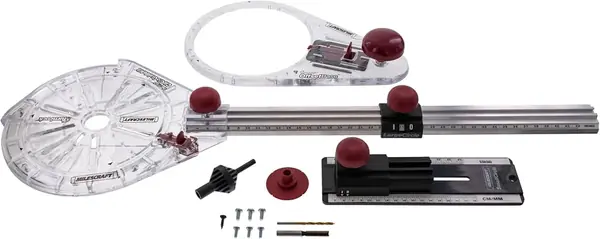
Milescraft 1219 circle guide kit with small and large jigs plus baseplate

All-around shop circles

Shop Score 94/100
Circle Range
1.5 to 52 in.
Weight
3.86 lb
Kit Contents
Five pieces: two jigs, baseplate, offset base, bit
Scale Markings
Metric and imperial, with readout window
View on Amazon

Two jigs, one baseplate, one bit. The Circle Guide Kit covers 1-1/2 inches to 52 inches in diameter — the widest span in this group — because it splits the job: a short jig handles 1-1/2 to 12 inches, and a long arm picks up from 10 inches and runs to 52. Both read off built-in imperial and metric scales through a window that lets you set an inside cut and an outside cut separately, which sounds fussy until you have cut a hole a hair too small for the speaker that goes into it.

What sold us is the problem it removes before you start. A circle guide is only as good as its fit to your router base, and by shipping its own TurnLock baseplate Milescraft takes the hole-pattern question off the table — the plate goes on, the lock ring turns by hand, and bushings swap without a screwdriver. The kit also throws in a 13-inch offset base for edge work and a brad-point bit, so the first circle does not begin with a trip to the hardware store.

The arms are polycarbonate rather than acrylic or aluminum, which is fine in normal use but means the kit rewards careful handling — it lives in a drawer, not a bucket of clamps. Run one test circle on scrap before you commit a good blank: the small jig has to seat in the right post position or the circle stops short of closing, and that is the one setup step worth rehearsing.

Worth Noting

  • Supplied plate may not fit three-screw bases
Our Verdict

We recommend this kit as the default: it is the one jig here that spans speaker-sized holes and full tabletops, and the included baseplate takes the mounting guesswork out of it.

Check Latest Price
2.

Jasper 300 XLC Circle Guide Best for Full-Size Plunge Routers

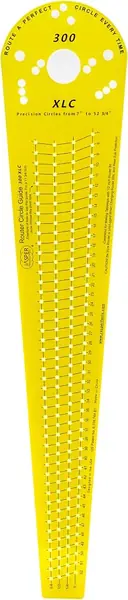
Jasper 300 XLC yellow acrylic circle cutting jig for full-size plunge routers

Full-size plunge routers

Shop Score 91/100
Circle Range
7 to 52-3/4 in.
Router Fit
Full-size plunge bases, 1-1/2 HP and up
Sizes
184, in 1/4 in. steps
Material
Hardened acrylic
View on Amazon

Nothing to measure. Pick the diameter, drop the pin in the matching hole, and the radius is set: 184 sizes between 7 and 52-3/4 inches in 1/4-inch steps. A sliding arm can creep between cuts; a hole drilled in a sheet of acrylic cannot.

That indexed system is why this is our pick for full-size plunge routers. The 31-inch arm is stiff enough that a 40-inch radius does not wander, and the pin stays put through a full revolution, which is the part you notice on the second and third identical part. The hard floor at 7 inches is the trade: no speaker baffles, no cup holders, no small inlays. For those you want the Jasper 290 or the Milescraft kit.

The diameter markings are printed on the underside, where they rub against the workpiece as you swing, so tape over them or keep a pencil note of your setting on the bench and the numbers stay readable past the first tabletop.

Worth Noting

  • Plunge bases only; fixed bases do not fit
Our Verdict

If your router is a full-size plunge unit, this is the guide we point you to — indexed holes make repeat diameters exact, and 52-3/4 inches is a genuine tabletop.

Check Latest Price
3.

Jasper 290 Circle Jig Best for Compact and Cordless Routers

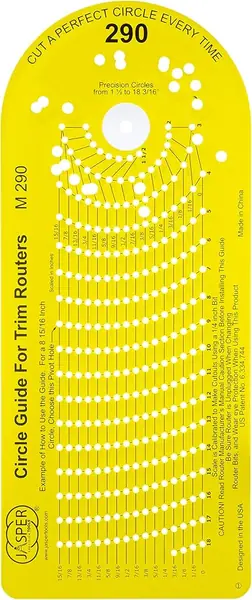
Jasper 290 acrylic circle jig for compact trim and cordless routers

Compact router owners

Shop Score 90/100
Circle Range
1-1/2 to 18-3/16 in.
Weight
12.6 oz
Router Fit
Compact, trim and cordless bases
Sizes
268, in 1/16 in. steps
View on Amazon

Compact routers have their own mounting geometry, and this guide is drilled for it. The Bosch Colt, DeWalt's DWP611 and DCW600, the Makita XTR01, Milwaukee's M18 Fuel and several Porter-Cable and Ridgid bases are all named by Jasper, which means the plate sits square on the base instead of being persuaded into place with two of four screws.

Indexed holes do the measuring: 268 diameters from 1-1/2 to 18-3/16 inches in 1/16-inch steps, with a calibration disc and a centering pin to line the bit up before you cut. What we like most is the bottom of that range. Plenty of jigs here cannot get near 1-1/2 inches, and that is exactly where speaker terminals, cable pass-throughs and small inlays live.

Use a sharp 1/4-inch bit and take shallow passes. Acrylic is stiff but it is not indestructible, so snug the mounting screws rather than leaning on them — the screw holes are where this material takes its stress.

Worth Noting

  • Tops out at 18-3/16 inches
Our Verdict

For compact, trim and cordless routers this is the jig we reach for — it goes down to 1-1/2 inches and the hole pattern is drilled for the small bases.

Check Latest Price
4.

MPOWER CRB7 Router Circle Jig Best for a Mixed Router Collection

MPOWER CRB7 router circle jig with guide rods and offset handle

Multi-router shops

Shop Score 89/100
Circle Range
1-1/2 in. to over 4 ft
Weight
2.3 lb
Router Fit
Twin guide-rod mounts, 650+ models
Functions
Seven, including offset base and mortise jig
View on Amazon

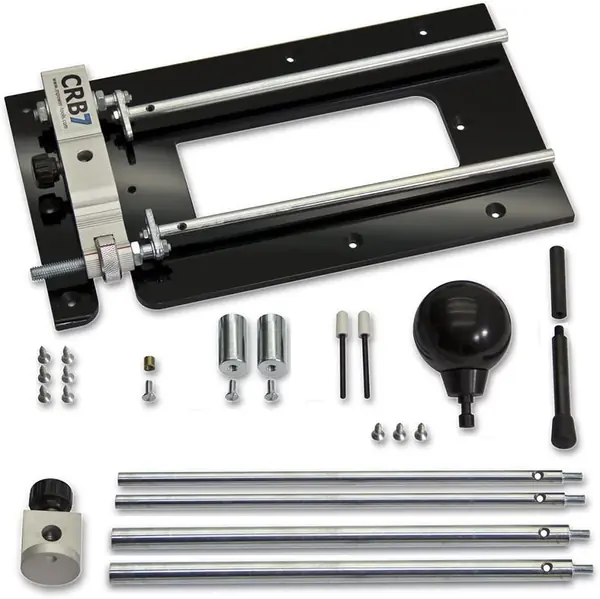
Guide rods, not screws. The CRB7 clamps to the twin guide-rod mounts most routers already have, which is how MPOWER gets to its 650-plus model claim, and it means no baseplate to drill and no hole pattern to chase. Set the radius with the crank and the indexed micro adjuster rather than stepping between pins.

Circles run from 1-1/2 inches to over 4 feet. The same plate also does duty as an offset base, a mortise guide and an anti-tilt support, and the micro adjuster moves the cutter in fine, repeatable increments — handy for creeping up on a dado as well as for sizing a circle.

That flexibility is worth the premium if your routers come from different makers, or if you keep one big plunge unit and one trim router on the same bench: you buy once and stop thinking about hole patterns. The adjuster is deliberate rather than quick — locking and unlocking it takes a wrench, so keep one on the bench — and the plate's 2.3 pounds is noticeable on a palm router, invisible on a full-size base.

Worth Noting

  • Edge guide is not in the box
Our Verdict

The jig for a shop with more than one router: guide rods clamp to what you already own, and the circle range runs past four feet with no mounting hole to match.

Check Latest Price
5.

Rockler Router Circle Cutting Jig Best for Large Round Tabletops

Rockler router circle cutting jig with phenolic arm and pivot pins

Large round tabletops

Shop Score 88/100
Circle Range
10 to 52 in.
Weight
2.71 lb
Arm Material
Phenolic
Pivot Hardware
Two pins, T-bolt and star knob
View on Amazon

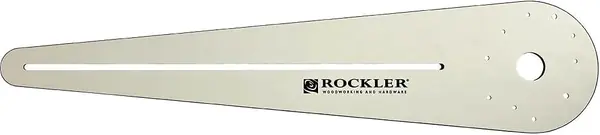
Ten inches is the floor. This jig cuts from 10 to 52 inches in diameter and nothing smaller, so it is not the one for speaker baffles, cup holders or small inlays — but for a round tabletop, an arch template or a shop-made lazy Susan, the phenolic arm is stiffer than the acrylic guides here and it holds its line when a heavy plunge router swings out to a 40-inch radius.

Setup is two pieces and a T-bolt: the pivot pin threads into the work, the arm clamps to your base, and a four-star knob tightens by hand — no calibration disc, no centering sequence. Against the Jasper 300 XLC on the same tabletop job, the Jasper's indexed holes are quicker to repeat while this one adjusts anywhere in its range without stepping to a new hole. The mounting hardware covers Porter-Cable, Makita, DeWalt, Hitachi and Bosch, and the pivot pin threads in counterclockwise, which surprises almost everyone the first time.

Worth Noting

  • Bosch 1617 plunge base does not fit
Our Verdict

Buy it for big rounds: it cuts 10- to 52-inch circles off a stiff phenolic arm, and it is the wrong tool for anything smaller than a dinner plate.

Check Latest Price
6.

Kreg Trim Router Circle Guide Best for Trim Router Owners

Kreg trim router circle guide with single grip handle and pivot arm

Trim router owners

Shop Score 87/100
Circle Range
3-1/2 to 52 in.
Weight
1.84 lb
Router Fit
Most trim routers
Handle
Single grip
View on Amazon

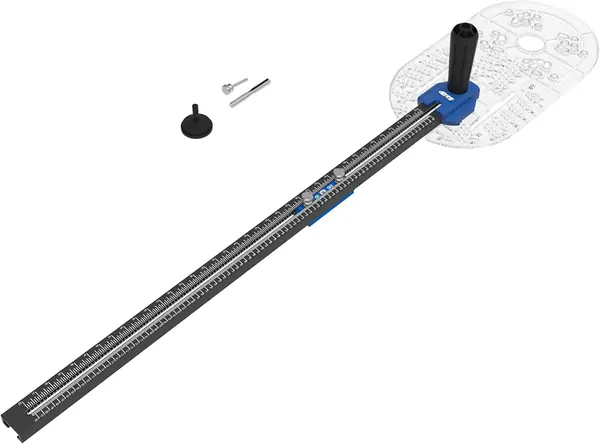
The handle is the idea. Kreg puts a single grip on the base so one hand drives the router around the pivot while the other steadies the work, and on a long radius a trim router wants to chatter — a grip that keeps your wrist over the cut does more for that than another half-inch of arm ever will.

Diameters run up to 52 inches, enough to take a small router places it has no business going, and the guide is built around Kreg's 1/4-inch straight bit on a 1/4-inch shank. It mounts to most trim routers. We are calling it promising rather than proven: the design is the right one for a palm router, but it is the newest jig here and we want more miles on it before it displaces a Jasper in our own shops.

Worth Noting

  • Trim routers only; 3-1/2 inches is the smallest
Our Verdict

A grip handle makes this the easiest trim-router guide here to steer around a long radius, and it reaches 52 inches from a small base.

Check Latest Price
7.

Bosch RA1054 Deluxe Router Guide Best for Bosch Router Owners

Bosch RA1054 deluxe router guide with pivot plate and dust hood

Bosch router owners

Shop Score 86/100
Circle Range
Up to 32 in.
Weight
16 oz
Router Fit
Bosch 1611-1619, MR23, PR011
Edge Guide Reach
Up to 8 in.
View on Amazon

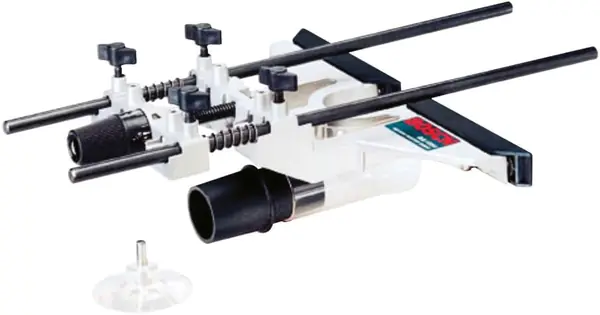
The box says router guide, and that is the honest description: an edge guide that runs up to 8 inches in from the workpiece edge and becomes a circle cutter when you bolt on the pivot plate. The mounting rods are fixed-width, so this is a Bosch-fit accessory rather than a universal one — you buy it because you already own one of the routers on its list, not because it will adapt to whatever is on the bench.

Where it earns its keep is as a second purchase rather than a first. If you run a 1617 or an MR23, the fine-adjust knob is the reason to own it: it walks the cutter in small, repeatable increments, which is how you creep up on a rabbet without shimming the fence. The dust hood and hose adapter in the box are the kind of accessory we usually end up buying separately a month later.

Circle cutting with it is basic — a pivot plate and a pin, no scale to read a diameter from, so you set the radius with a rule and trust your mark. Check your model against the fit list before ordering, because it is specific: 1611, 1613, 1617, 1618 and 1619 series, the MR23, and the PR011 palm router plunge base.

Worth Noting

  • Circle cutting stops at 32 inches
Our Verdict

Buy it as an edge guide that moonlights as a circle cutter: a fine-adjust knob, a dust hood, and a fit list that starts and ends with Bosch.

Check Latest Price

How We Tested Router Circle Cutting Jigs

We built the shortlist by reading mounting specs for full-size plunge, fixed-base, compact, trim, and cordless routers, then narrowing to jigs that ship with a drilled baseplate, twin guide rods, or a hole pattern that matches common bases. Twelve of them stayed in rotation for eight months.

Each session began with the router unplugged while we mounted the jig and set the pivot. We clamped every workpiece with two clamps, kept both hands on the router grips through the cut, and wore eye and hearing protection — a router at speed throws chips across the shop. Test circles ran from 1½ inches to 42 inches in half-inch plywood and MDF: speaker baffles, a round tabletop, wheels for a toy.

We noted whether an indexed hole landed on the size we wanted or a sliding arm needed a test cut, whether the scale read the inside or outside of the cut, and how far the finished disc strayed from the promised number once we measured it. At full extension we pressed the arm sideways and watched for flex, then ran a heavy 2½-hp router at the far end and listened for chatter.

Several jigs doubled as an edge guide, so we ran them along a straightedge to see whether fine adjustment moved in small, repeatable steps. We also counted what came in the box — baseplate, bit, pivot pins, storage — and how the arm held up after being knocked off the bench and packed away between jobs.

How to Choose a Router Circle Cutting Jig

Fit the Jig to Your Router First

Three mounting systems cover almost everything: a plate drilled for one family of routers, a plate with multiple slots, or guide rods that clamp to the router's own rod mounts. Take your router's base plate off and measure the screw spacing, or sit down with the jig's model list and your router's model number.

The trap is the word compatible. It often means the maker drilled one popular pattern and called it universal, and the odd router out is the one you own. If your base does not match anything, a kit that includes its own baseplate or a jig that clamps by guide rods saves you drilling holes in a plate you would rather keep square.

Measure Your Smallest Circle, Not Your Largest

Most buyers check the top of the range, because that is the number in the headline, then find out the jig will not cut a 4-inch hole. Dedicated guides here start anywhere from 1-1/2 inches to 10 inches, and that floor decides speaker baffles, cup holders and inlays far more often than the ceiling does.

How a size is set matters as much. Indexed holes drop a pin into a drilled diameter — precise, repeatable, and limited to the sizes on the pattern. A sliding arm covers everything in between but depends on your measurement holding. We prefer indexed holes for repeated parts and a single arm for one-off arcs.

Inside Cuts and Outside Cuts Are Different Jobs

An outside cut makes a disc: the pivot goes into the workpiece and the router travels around it. An inside cut makes a hole, and the pin has to bite into something other than the piece you are keeping. Most jigs here do both, but check where the pivot plate sits and how much of it hangs over the edge.

Scale labeling is the other half of it. Some scales read the diameter of the hole, some the diameter of the disc, and a few are really giving you a radius. Confirm which number you are setting before you commit a good blank.

Stiffness Matters More Than the Material Name

Acrylic, polycarbonate, phenolic and aluminum all appear in this category, and the label matters less than how much the arm flexes at full extension. A long arm on a heavy plunge router will tell you quickly: phenolic and aluminum hold their line, thinner plastic can bow under the same load.

Two habits protect any of them. Snug the mounting screws instead of torquing them, because screw holes in acrylic are where cracks start. And store the arm flat rather than standing it in a bucket of offcuts, where a knock can take out the pivot end.

Decide How Many Functions You Will Actually Use

A seven-in-one routing plate or a guide that is really an edge guide first both cost more than a plain circle arm, and both earn it only if the extra function replaces something you were going to buy anyway. If you already own an edge guide you like, pay for circle cutting alone.

If your shop runs on one router and one bench, the multi-function plate can be the smarter buy — provided the piece you want most is genuinely in the box and not an add-on.

Frequently Asked Questions

Final Verdict

The Milescraft 1219 is the jig we point most people to, because it covers the two jobs that actually come up — a hole for a speaker and a round for a tabletop — and the included baseplate means the fit question is mostly answered before you open the box.

Own a full-size plunge router? The Jasper 300 XLC's indexed holes are quicker and more exact, and worth the step up. Own a trim router and nothing else? Buy the Jasper 290 and stop reading.