↑↓ navigate ↵ open Esc close All results →

Best Screw Extraction Pliers of 2026

When a soft screw head strips into a smooth crater under a driver, ordinary slip-joint pliers simply skate off the rounded rim. Dedicated screw extraction pliers replace smooth cross-hatching with curved, lengthwise serrations that bite directly into low-profile dome and pan heads so you can back out stalled fasteners on cabinet hinges, dryer panels, or rusted brackets.

Six months of turning 12 pairs loose in the garage, at the kitchen table, and inside laptop and game-controller teardowns separated tools by nose reach into recessed pockets, jaw bite under heavy torque, handle comfort over repeated turns, and whether integrated wire cutters stayed sharp without getting in the way.

Hardened jaws grip best when they are harder than the fastener, which is why makers exclude hardened, self-drilling, and coarse-thread screws — wear eye protection, expect to discard the chewed fastener, and choose the nose profile that matches anything from tiny electronics screws to corroded exterior bolts.

Our Top Picks

The Best Screw Extraction Pliers

1.

ENGINEER PZ-58 Screw Removal Pliers Best Overall
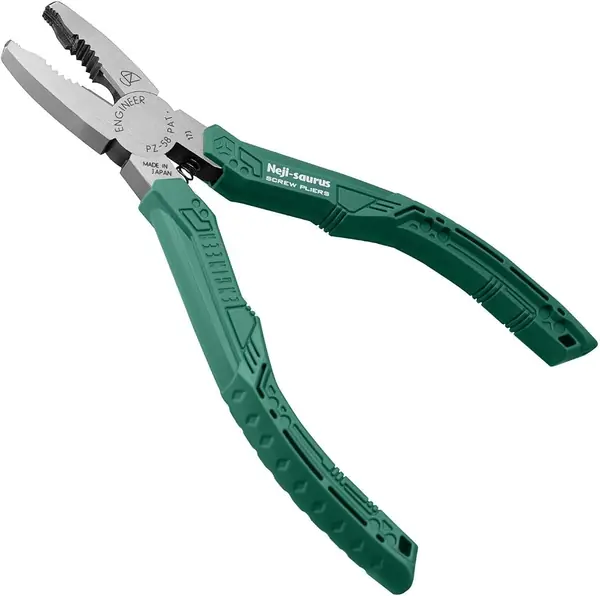
ENGINEER PZ-58 green-handled screw removal pliers with serrated jaws and side cutter

Tight-space screw removal

Shop Score 97/100
Overall Length
160 mm
Screw Head Range
Ø3 - 9.5 mm
Jaw Tip Width
17.5 mm
Wire Cutting Capacity
Copper Ø3.2 mm, steel Ø2.6 mm
View on Amazon

The tip is the whole argument. Vertical grooves run down each jaw and horizontal serrations cut across them, so a domed or chewed-out pan head has nothing to slide along. We reach for the PZ-58 first because of that bite: squeeze until the teeth seat, twist, and the screw turns instead of the jaws camming off it and polishing the head smoother.

The jaws are narrow too, with a 17.5 mm tip and a concave face that wraps a low head down to Ø3 mm, so the plier goes where a fat lineman's jaw won't — behind a cabinet hinge, under a fender lip, into the recess around a license-plate screw. The spring opens the handles between bites, which matters when you are working one-handed in a tight spot, and the side cutter (copper to Ø3.2 mm, steel to Ø2.6 mm) saves a trip for another tool.

At 160 mm and 5.26 oz it drops into an apron pocket and disappears there. What we don't love is cosmetic: the teeth mark the head they grip, so a screw you plan to reuse comes out looking worked over. For a rusted fastener headed for the bin, that costs nothing. The stated Ø3 to 9.5 mm range covers the trim screws, hinge screws, and appliance fasteners that send most people shopping for screw removal pliers in the first place.

Worth Noting

  • Jaws leave bite marks on the screw head
Our Verdict

We reach for the PZ-58 first: serrated jaws that bite a stripped head without slipping, a slim tip for tight recesses, and a size that makes it an easy default.

Check Latest Price
2.

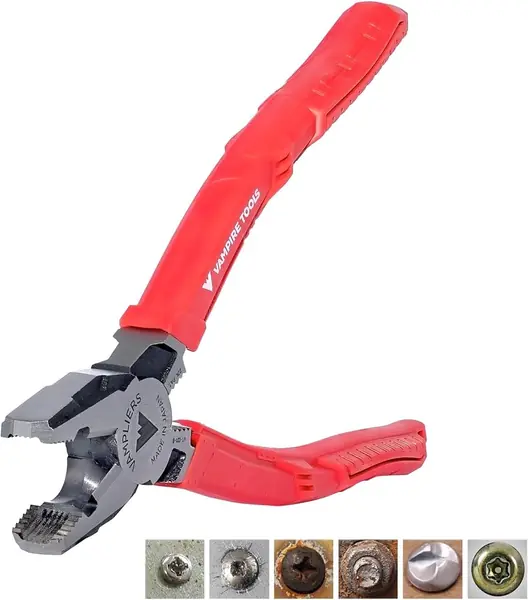
VAMPLIERS 8-Inch Lineman Screw Extractor Best for Large Screws

VAMPLIERS 8-inch red-handled lineman screw extractor pliers with side cutting jaws

Larger rusted fasteners

Shop Score 96/100
Overall Length
8 inches
Weight
10.6 oz
Screw Head Range
Ø3 - 12 mm
Jaw Hardness
HRC60±2
View on Amazon

Above Ø9.5 mm the PZ-58 runs out of jaw, and that is the gap the 8-inch Vampliers fills: a stated head range of Ø3 to 12 mm takes in the fat, rusted screws on outdoor furniture, trailer decks, and old machinery. Underneath the extraction grooves it is a proper lineman's plier — 8 inches, 10.6 oz, a side-cutting jaw, and intermeshed teeth below the nose for holding sheet metal steady.

We like it for fasteners that have already beaten a smaller tool. The front grooves are cut vertically, the jaws are hardened to HRC60±2, and the extra two inches of handle over the 6-inch pliers is where the torque comes from — on a rusted lag screw that is the difference between a jaw that bites and one that skates around the head.

Two things to know before you buy. The listed range starts at 3 mm, so tiny device screws are somebody else's job, which is where the PZ-57 comes in. And at 10.6 oz on an 8-inch handle it is a toolbox tool rather than a pocket one; you won't notice it in a bag, but you will notice it hanging off a belt all afternoon. What that buys you is a plier that also cuts wire, turns a rounded nut, and holds a piece of flashing while you drive the screw.

Worth Noting

  • Premium price for occasional use
Our Verdict

For fat, chewed-up fasteners we hand people the 8-inch Vampliers: it bites heads up to 12 mm and still earns its keep as a lineman's plier.

Check Latest Price
3.

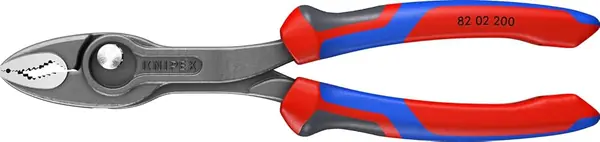
KNIPEX TwinGrip 82 02 200 Pliers Best for Bolts and Nuts

KNIPEX TwinGrip 82 02 200 gray comfort-grip pliers with front and side jaws

Bolts and mixed fasteners

Shop Score 95/100
Overall Length
8 inches
Adjustment
5 push-button positions
Teeth Hardness
Approx. 61 HRC
Gripping Capacity
5/32" to 7/8" (4 to 22 mm)
View on Amazon

Five positions, one button: squeeze the handles, push the button with a thumb, and the jaw slides to a new width and locks there. It is the old slip-joint trick, and the TwinGrip is the best-executed version of it in this group — the button falls under the thumb without a look, and the positions don't wander once they are set.

The front jaw is the extraction end, cut to grip a stripped screw head, while the side jaws carry opposing teeth for round, square, and hex stock and a three-point contact that holds pipe and nuts without spinning. A box joint keeps the two halves from rocking, the head is slim enough for confined work, and a pinch guard stops the handles from eating your palm at the top of a hard squeeze.

Where it earns its place is the mixed-repair job: a stripped screw at one corner of a bracket and a rounded nut at the other. The front jaw takes the screw, the side jaws walk the nut off, and you have not made two trips to the toolbox. We did find that the adjustment takes a few tries before it becomes second nature one-handed; after that you stop thinking about it.

Worth Noting

  • Highest price in this set
Our Verdict

When the damaged fastener is a bolt rather than a screw, the TwinGrip is the one we pick: five locked positions, side jaws that hold, and a front jaw that still bites.

Check Latest Price
4.

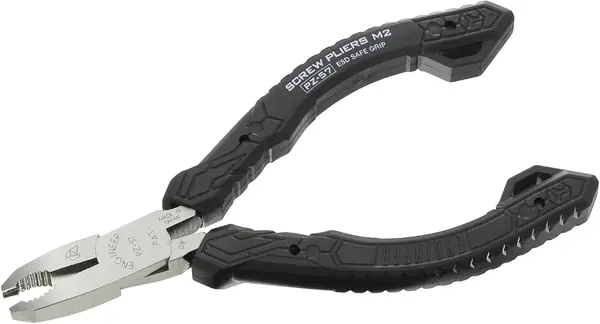
ENGINEER PZ-57 Screw Removal Pliers Best for Electronics

ENGINEER PZ-57 slim screw removal pliers with black ESD-safe elastomer handles

Small electronics screws

Shop Score 94/100
Overall Length
4.72 inches
Weight
2.65 oz
Handle Specification
ESD-safe elastomer, RoHS compliant
Screw Diameter Range
2 - 3.5 mm
View on Amazon

A stripped M2 screw two inches inside a laptop shell is a particular kind of stuck: too small for a normal plier, too deep for fingers, and surrounded by plastic you cannot scratch. The PZ-57 is built for that screw — 4.72 inches long, 2.65 oz, with jaws narrow enough to follow a screw hole down and grab a head as small as 2 mm.

We keep it for electronics because of two details beyond the bite. The handles are ESD-safe elastomer, so you are not pumping static into a board every time you pick the tool up, and the plier is RoHS compliant, which matters when you work on someone else's machine. The serrations run both ways across the jaw like the larger Engineer pliers, and the concave face seats on a low head instead of skating over it.

The short handles are the trade: 4.72 inches gives you control in a tight space and very little leverage, so this is the plier for a thread-locked case screw, not a rusted bracket bolt. And the range stops at 3.5 mm — standoffs, case screws, and controller shells yes; anything larger, reach for the PZ-58.

Worth Noting

  • Grips nothing larger than a 3.5 mm head
Our Verdict

For stripped screws inside laptops, handhelds, and controllers, this is the pair we keep on the bench: ESD-safe, narrow enough to reach, and small enough to control.

Check Latest Price
5.

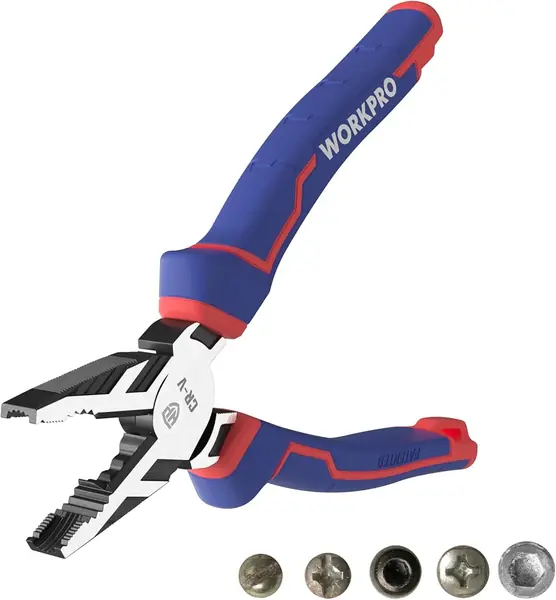
WORKPRO 8-Inch Linesman Screw Extractor Pliers Best Budget

WORKPRO 8-inch blue-handled linesman screw extractor pliers with non-slip jaws

Budget toolbox backup

Shop Score 93/100
Overall Length
8.66 inches
Weight
12.3 oz
Screw Head Range
2.46 - 10.5 mm
Jaw Hardness
55 HRC
View on Amazon

This is the least expensive pair in the guide, and nothing about the build announces it: 8.66 inches, chrome-vanadium steel, induction-hardened cutters, and edges ground so you can ream the inside of conduit with the nose. The concave jaw is cut with teeth that bite a rounded head rather than skate across it.

We treat it as the second pair — the one that lives in the truck box or the shed drawer where a premium plier tends to wander off. The stated head range runs 2.46 to 10.5 mm, wider at both ends than the PZ-58, so it covers a stripped cabinetry screw, a fan screw inside a console, and a rusted bracket under a mower deck without a second thought about which tool to grab.

The heft is real: at 12.3 oz it is the heaviest plier here, and on a long twist that weight plus the 8.66-inch handles works for you rather than against you. It is also the pair you can hand to a helper without a second thought, which is the real job of a second pair.

Worth Noting

  • Thin jaw tips can snap under sideways load
Our Verdict

The budget pick we actually keep: a wide 2.46 to 10.5 mm head range, long handles for leverage, and cutters that earn their place in the drawer.

Check Latest Price
6.

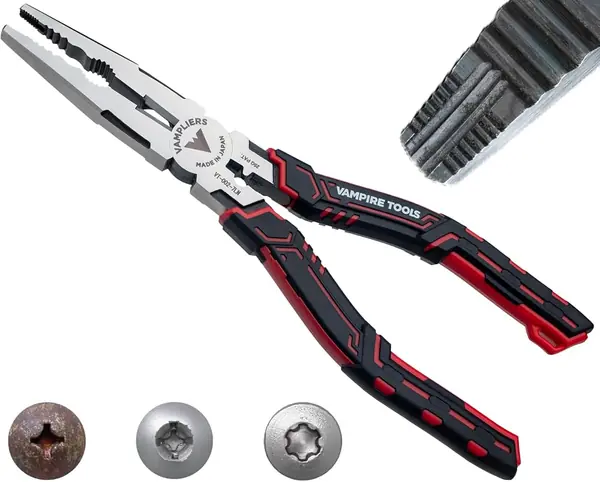
VAMPLIERS 7.5-Inch Long Nose Screw Extractor Best for Deep-Set Screws

VAMPLIERS 7.5-inch black and red long nose screw extractor pliers with crimper

Deep-set screws

Shop Score 92/100
Overall Length
7.5 inches
Weight
6.53 oz
Screw Head Range
Ø2 - 5.5 mm
Crimper Range
1.25 - 3.5 mm²
View on Amazon

Read past the extraction grooves and this is a working needle-nose: square serrations in four sizes for wire and thin rod, a round press for tubing, a flat press for sleeves, a crimper for 1.25 to 3.5 mm² terminals, and a 10 mm wire cutter. The extraction grooves are cut down the front of the nose, which is what makes it a screw tool rather than just another pair of long pliers.

The nose is the point. At 7.5 inches with a 6.53 oz body it reaches screws a 6-inch extractor cannot touch — down a recess in a door mechanism, behind a dash panel, alongside a bracket where the handles have to stay clear of the surrounding parts. The jaws are hardened to HRC60±2 and the stated range runs Ø2 to 5.5 mm, so it takes device screws as happily as trim screws.

Here is the honest limit: 5.5 mm is a low ceiling, and plenty of chewed-up screws are bigger than that. What it buys you instead is reach, plus a second life as a crimper and wire cutter, so it earns a place in a bag where a dedicated extractor would sit unused. If the screws you fight are the fat kind, the 8-inch Vampliers is the better use of the same money.

Worth Noting

  • Grips nothing wider than a 5.5 mm head
Our Verdict

We keep this one for screws tucked out of reach: the long nose gets in and bites, as long as the head measures under 5.5 mm.

Check Latest Price

How We Tested Screw Extraction Pliers

We started with a research list of several dozen pairs sold by tool brands and specialty importers, narrowing it by jaw range, tip width, nose length, and price until we had 12 to buy. Then we spent six months using them the way people actually do — on rusted gate hinges and truck-bed brackets in the garage, on cabinet hardware, and on laptop and controller teardowns at the kitchen table.

Each pair got the same first test: a screw driven flush, then sunk a quarter inch into a counterbored hole, to see whether the nose reached it. We measured tip width and jaw opening with calipers, then deliberately rounded over the heads of soft, matched screws and twisted each plier until the jaws either held or slipped, noting which.

Durability got the long view: we kept using them and inspected the serrations every few weeks for chipped or rounded teeth, and handled them with oily gloves to check grip. We noted where the handles pinched during a long twist and whether a spring reopened the jaws. Because several double as wire cutters or bolt grippers, we cut copper and steel wire with the pairs that had cutters and pulled nuts off a scrap bracket.

For the small electronics work, we powered every device down and pulled the battery first — a static-safe handle doesn't make a live board safe — and we wore safety glasses throughout, since the teeth throw chips. At the end we compared what each pair actually did against what it cost.

How to Choose Screw Extraction Pliers

Match the jaw range to the head you are fighting

Every range in these listings is measured across the screw head, not the thread, and that is the number that decides the purchase. A screw sold as M4 can carry a head close to twice that wide, so measure the head of a fastener you already have rather than reading the size off the box.

Device screws sit around 2 to 3.5 mm (the PZ-57), the household middle of trim, hinge, and appliance screws runs 3 to 9.5 mm (the PZ-58), and furniture, trailer, and machinery fasteners go to 12 mm and past it (the 8-inch Vampliers). Pick a plier whose stated range clears your measurement with a little room at the top.

Check the reach before you check the bite

A weak bite is annoying; no access at all is fatal. Tip width is what gets you into a pocket — the PZ-58's 17.5 mm nose slides behind a hinge where a lineman's jaw will not — and nose length is what gets you down a recess, which is the whole case for the long-nose Vampliers.

There is a trap here. If the head sits flush in a counterbore or below the surface, no plier of any kind will reach it, and the job belongs to a left-hand drill bit. Look at how much of the head stands proud before you spend anything.

What a jaw that holds looks like

Two serration directions are the giveaway. Vertical grooves bite into the head while horizontal ones stop it sliding out the front of the jaw, and a concave face wraps a low dome instead of rocking on top of it. That combination is why the Engineer and Vampliers jaws hold where a straight-knurled plier cams off and polishes the head rounder.

For hex stock, pipe, and rounded nuts, a front-and-side arrangement does more: the Knipex TwinGrip's three-point contact grabs flats that a single-direction jaw cannot.

Handles, springs, and how long the teeth last

Handle length buys torque and costs control. The 4.72-inch PZ-57 is the tool for a device screw; the 8.66-inch WORKPRO is the one for a rusted bracket. A spring that opens the handles for you is worth having whenever the other hand is holding a panel in place.

Then look at jaw hardness, which runs from 55 HRC on the budget WORKPRO to roughly 60 to 61 HRC on the Japanese and German picks. Harder teeth keep their edge longer but chip where softer ones would bend, and none of these pliers belongs on a hardened self-drilling or tapping screw.

Frequently Asked Questions

Final Verdict

Buy the ENGINEER PZ-58 unless something about your work says otherwise. Crossed serrations and a 17.5 mm tip cover the Ø3 to 9.5 mm screws behind most stripped-head emergencies, and it is compact enough to stay within reach instead of buried in a toolbox.

Two exceptions are worth naming. If the fastener that defeats you is bigger than 10 mm, or is a rounded bolt rather than a screw, step up to the 8-inch Vampliers for torque or the Knipex TwinGrip for side jaws that walk a nut off. And if the work happens inside a laptop, the PZ-57 is the right tool, because a full-size extractor will not fit in there.