↑↓ navigate ↵ open Esc close All results →

Best Ratcheting Screwdrivers of 2026

Driving two hundred cabinet hinge screws with a fixed-blade driver wears out your forearm simply from lifting and re-seating the tip on every quarter-turn. A ratcheting mechanism lets the handle reset without leaving the fastener, though weak internal pawls and sloppy chucks often strip or jam long before the included bit set shows wear.

Six months of driving fasteners with 14 ratcheting screwdrivers — ranging from flat-pack furniture hardware up to long exterior deck runs — separated crisp, tight gears from sloppy ones within an afternoon. Two limitations regularly catch shoppers off guard: a coarse tooth count needs too much swing arc inside a cramped face-frame corner, and proprietary shanks lock out standard 1/4-inch hex insert bits.

From a compact stubby built to clear drawer boxes up to a detachable-handle kit packed with full bit coverage, none of these eight drivers is the bargain option in its class, yet each justifies its price through crisp pawl engagement, solid bit retention, and grip comfort.

Our Top Picks

The Best Ratcheting Screwdrivers

1.

Klein Tools 32305 15-in-1 Ratcheting Screwdriver Best Overall
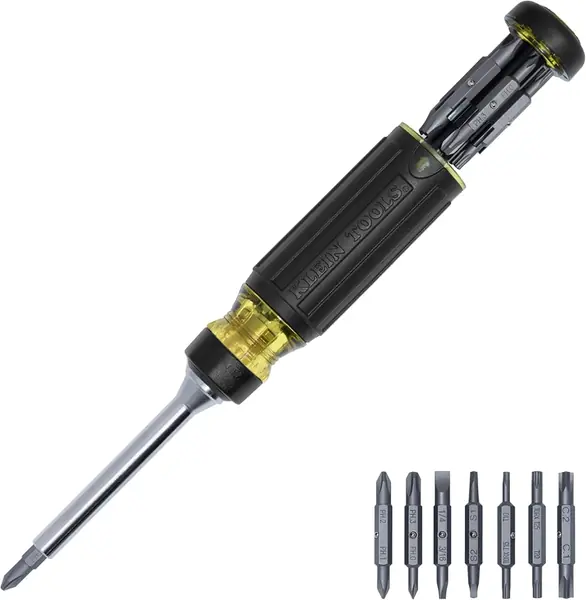
Klein Tools 32305 black and yellow 15-in-1 ratcheting screwdriver with bits stored in the handle

Everyday woodworking tasks

Shop Score 97/100
Weight
10.4 oz
Bits Included
14 double-ended bits plus 1/4-inch nut driver
Overall Length
9.5 inches
Ratchet Settings
Forward, fixed, reverse
View on Amazon

Square drive, Torx, and a 1/4-inch nut driver are the three things we check before recommending any multi-bit driver to someone who builds furniture, and the Klein 32305 covers all three. Fourteen double-ended bits sit in the handle plus the nut driver, so the 15-in-1 count is one grip rather than a drawer of tools. The collar clicks between forward, fixed, and reverse, and that fixed setting is the one we use to break a tight screw loose before handing the work over to the ratchet.

The ratchet is where this one separates itself from the rest of the group. The stroke is short and positive, with none of the mushiness that makes a cheap driver feel like it is deciding whether to engage, and the Cushion-Grip handle gives us something solid to push against when a screw is buried in oak. At 9.5 inches and 10.4 ounces it is not a pocket tool, but that length is what makes it steady over a drawer box or a bench vise.

One thing to plan around: the bits are double-ended and live in the handle, so this is not the driver for using up the loose 1/4-inch insert bits in your shop drawer — the Williams or the Wera 838 hosts those. If you would rather never hunt for a #2 square again, it is the right call. It costs about what the WORKPRO does and well under the Williams, which makes it the easiest recommendation on this page.

Worth Noting

  • Bit holders can break under heavy use
  • Handle runs large for smaller hands
Our Verdict

We point most people here: square and Torx bits ride in the handle, the three-position ratchet engages cleanly, and the grip takes real torque.

Check Latest Price


2.

Williams JHWWRS-1 Ratcheting Screwdriver Best Ratchet Action

Williams JHWWRS-1 blue handle magnetic ratcheting screwdriver with five included bits

Smooth, low-effort driving

Shop Score 96/100
Weight
7.84 oz
Bits Included
2 slotted, #1 and #2 Phillips, T15 Torx
Bit Compatibility
Standard 1/4-inch hex shank
Blade Length
4 inches
View on Amazon

The ratchet is the first thing we noticed: the stroke is light and immediate, with so little drag that the return practically resets itself, and the three-way collar clicks from on to off to locked without the wobble that shows up in cheaper mechanisms. It is the best-feeling ratchet of the drivers here. The magnetic shank holds a bit hard enough that it stays put while you line up a screw by feel, and 7.84 ounces over a 4-inch blade gives it reach into the back of a cabinet without feeling nose-heavy.

What you give up is coverage. Five bits come in the box — two slotted, #1 and #2 Phillips, and a T15 Torx — and the storage in the handle is minimal, so plan on carrying your own. The upside is that the chuck takes standard 1/4-inch hex shank bits, which turns the collection you already own into the set. We think that is the right trade for anyone who drives screws most days and has opinions about which tips they use, and it still costs well under the Wera magazine driver.

Worth Noting

  • Ships with five bits; handle storage is minimal
Our Verdict

If the ratchet stroke matters more to you than bit count, this is our pick — nothing else here turns as smoothly.

Check Latest Price
3.

Wera Kraftform 27 RA Ratcheting Screwdriver Best Premium Pick

Wera Kraftform 27 RA multi-color ratcheting screwdriver with bit magazine in the handle

Premium everyday driving

Shop Score 95/100
Weight
7.05 oz
Bits Included
Six: slotted, Phillips, square
Bit Storage
Integrated magazine in handle
Ratchet Teeth
60
View on Amazon

This is the most expensive driver in the group by a wide margin, and the interesting question is what the money buys. Not quantity: the Kraftform 27 RA carries six bits. What it buys is the mechanism and the way the tool is put together — a 60-tooth ratchet with a switchover ring that moves from right to fixed to left, rated to 50 Nm, and machining that shows in how little the collar moves when it is set.

The magazine is the other draw. Bits sit in an integrated carrier inside the grip rather than in a case or a pouch, so the driver is self-contained in a way a five-bit driver is not. The Kraftform handle has a non-roll shape that keeps it from skating off a bench, and the multi-component grip stays comfortable across a run of screws. It is 7.05 ounces and about 9 inches overall, which puts it in the same working class as the Klein.

The bit selection is aimed squarely at cabinet and electrical work: #1 and #2 Phillips, #1 and #2 square, and 5.5 and 6.5mm slotted. That covers the hardware we drive most, and the square bits mean a woodworker is not giving anything up to get the better ratchet. If your work is Torx-heavy, a set with more tips is the smarter buy.

Whether it earns its price depends on frequency. When the driver is out every day, the short return angle is what saves your wrist in a drawer box, and the magazine is why you stop walking back to the bench. For occasional flat-pack assembly, we think the Klein does most of the same work for a fraction of the cost, and the two extra Torx sizes matter more than the tooth count.

Worth Noting

  • Six bits only for the highest price here
  • Direction ring sits proud and shifts easily
Our Verdict

Worth the splurge if a driver is in your hand most days: the fine-tooth ratchet barely swings and the bits live in the grip.

Check Latest Price
4.

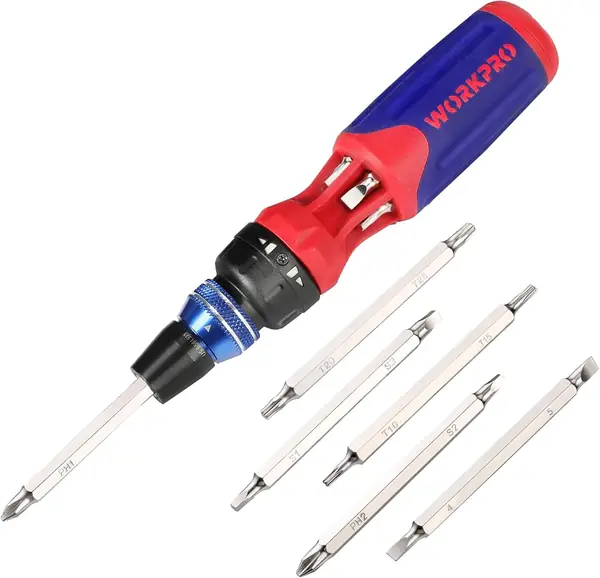
WORKPRO 12-in-1 Ratcheting Screwdriver Best Lightweight

WORKPRO blue and red 12-in-1 ratcheting screwdriver with double-ended bits stored in the handle

Light tool-bag carry

Shop Score 94/100
Weight
4.48 oz
Bits Included
6 double-ended S2 bits, 12 tips
Bit Storage
Inside the handle
Bit Loading
One-handed quick-load chuck
View on Amazon

Four and a half ounces is the number that decides where this driver ends up. The WORKPRO is light enough to ride in a tool bag or a kitchen drawer without anyone noticing it is there, and small enough that it disappears among the other tools rather than asking for its own slot. Six double-ended S2 steel bits hide in the handle — twelve tips covering Phillips, slotted, Torx, and square — and the chuck is a genuine quick-load design with an auto-locking mechanism.

That quick-load chuck is the detail we appreciated most. Press the collar, drop in a bit, and it locks without a second hand, which is exactly what you want when you are holding a cabinet door open with the other one. The ratchet switches forward, reverse, and lock, and the slip-resistant grip gives enough purchase that we never felt short of torque for a tool this light. The place it gives ground is the bits themselves, which can rust and snap under steady use — so we treat this as the driver for the drawer and the car, not the one to lean on with a stuck deck screw.

Worth Noting

  • Bits can rust or snap under hard use
Our Verdict

Our choice for a tool bag or a kitchen drawer: barely more than four ounces, with a chuck you can load one-handed.

Check Latest Price
5.

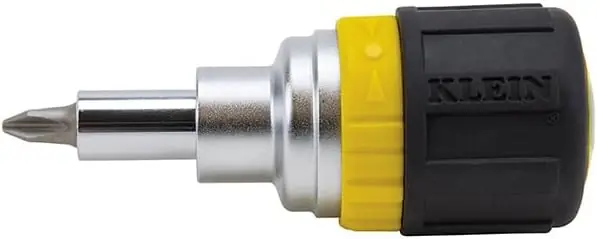
Klein Tools 32593 Stubby Ratcheting Screwdriver Best for Tight Spaces

Klein Tools 32593 yellow and black stubby 6-in-1 ratcheting screwdriver with short shaft

Tight and recessed screws

Shop Score 93/100
Weight
1.6 oz
Bits Included
2 Phillips, 2 slotted, 2 nut drivers
Overall Length
6.62 inches
View on Amazon

The screw is inside a drawer box, or behind a hinge, or under a sink where the handle of a normal driver fouls the cabinet floor — that is the situation this tool exists for. The 32593 is 6.62 inches overall and 1.6 ounces, with a short shaft that gets your knuckles into the space the screw is actually in. Six tools ride on it: #1 and #2 Phillips, 3/16- and 1/4-inch slotted, and 1/4- and 5/16-inch nut drivers. The ratchet is what makes it more than a stubby, because it turns a screw you can only reach with a quarter-turn of the wrist.

Two things to know before you buy. The bits seat deeply and take a firm pull to swap, which is precisely why they never drop out into a cabinet void. And they are Klein's own double-ended pattern, so replacements come from Klein rather than the loose-bit drawer. We keep it for cabinet interiors, drawer slides, and appliance panels, where the alternative is a right-angle adapter and a lot more swearing.

Worth Noting

  • Replacement bits must come from Klein
Our Verdict

For screws a full-size driver cannot sit square on, this stubby is the one we reach for, and the ratchet saves your wrist.

Check Latest Price
6.

CRAFTSMAN SpeedDrive Ratcheting Screwdriver Best for Repetitive Driving

CRAFTSMAN SpeedDrive red and black ratcheting screwdriver with bits stored in the handle

Repetitive assembly work

Shop Score 92/100
Weight
11.6 oz
Bits Included
7 double-ended bits, 14 tips
Drive
SpeedDrive, drives on both strokes
Handle Storage
Holds up to 6 bits
View on Amazon

Most ratchets drive on one stroke and idle on the other. SpeedDrive does not: the mechanism engages in both directions, so the handle turns the screw whether you are pushing or pulling, and that is where the twice-the-speed claim comes from. It takes a few screws to stop fighting the rhythm your hand expects, and then the wasted half of every turn is gone.

The rest of the tool is conventional and well executed. Seven double-ended bits give 14 tips across Phillips, slotted, square, and Torx, the handle holds up to six of them, and the extended locking bit holder keeps the bit from wandering in the head. The bi-material handle has a flare at the base that helps on the pull stroke, and the collar reverses cleanly when you need to back a screw out.

In a run of assembly screws it is the fastest driver here — hinge plates, a fence panel, a bookshelf held together with forty screws — because you stop thinking about which stroke is the working one. It has become our default for flat-pack sessions, and anyone who assembles for a living will feel the difference inside the first ten screws. The Klein stubby covers the tight spots this one cannot.

Worth Noting

  • Long grip and stem make tight spaces awkward
  • Heaviest driver here at 11.6 ounces
Our Verdict

We like it for long runs of assembly screws, where driving on both strokes genuinely shortens an afternoon of hinges and flat-pack panels.

Check Latest Price
7.

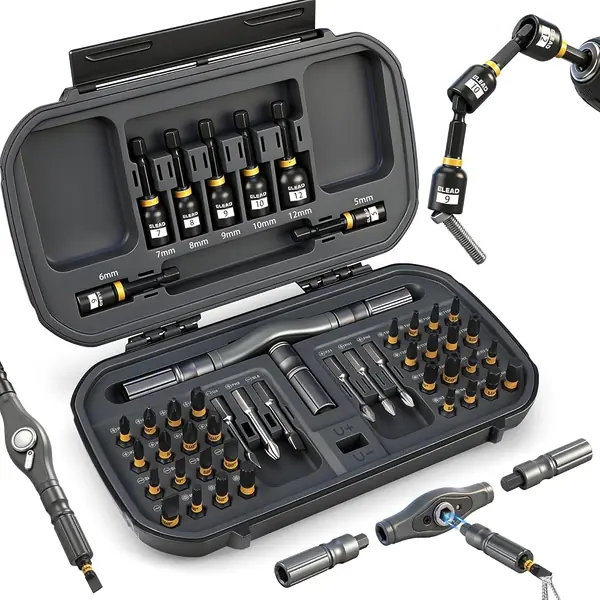
ELEAD 46-Piece Ratcheting Screwdriver Set Best for Furniture Assembly Projects

ELEAD yellow 46-piece ratcheting screwdriver set in a case with S2 steel bits and nut drivers

Furniture assembly projects

Shop Score 91/100
Bits Included
38 S2 bits and 6 nut drivers
Ratchet
58-tooth forward and reverse
Case
Molded storage case
Handle
Detachable ratchet handle
View on Amazon

Forty-six pieces is the pitch: 38 S2 steel bits and six magnetic nut drivers in a molded case, covering Phillips, slotted, Torx, hex, and square. The bits are labeled, the case has a shaped spot for each one, and the whole thing closes into something you can set on a shelf and forget until the next flat-pack box arrives.

What makes it more than a bit box is the handle. It is a ratcheting driver with a 58-tooth forward and reverse mechanism, and the shaft detaches so you can run it as a stubby driver or add the extension for a recessed screw. There is a magnetizer slot in the case for waking up a tired tip, and the nut drivers handle standoffs and cabinet hardware that bit-only sets cannot touch.

Furniture is where a set like this earns its keep — hex and Torx fasteners on flat-pack, appliance panels, bike hardware, the odd security bit. The labeled case means you find the size instead of guessing, and the breadth is the whole point. It is also why the case stays in a cabinet rather than a pocket.

We treat it as the household kit rather than the driver we carry. It is the one we reach for when we do not yet know what fastener we are facing, and the wrong choice for a professional who wants one handle and eight bits — the Klein or the Williams is faster in the hand. Ours has stayed organized, which is more than we can say for a loose bit drawer.

Worth Noting

  • Bit holder and handle magnets can come apart
  • Ratchet can stick between directions
Our Verdict

A sensible buy if you want one case covering furniture, bikes, and appliances, though the hardware inside is the part to watch.

Check Latest Price
8.

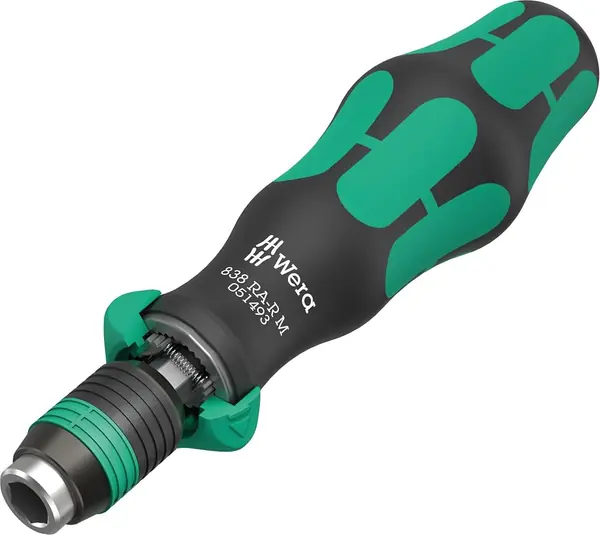
Wera 838 RA-R M Bit-Holding Ratcheting Screwdriver

Wera 838 RA-R M compact bit-holding ratcheting screwdriver with Rapidaptor quick-release chuck

Compact bit-holder carry

Shop Score 90/100
Weight
3.84 oz
Ratchet
36 teeth, 10-degree return angle
Bit Compatibility
1/4-inch hex, DIN ISO 1173 C 6.3 and E 6.3
Length
4.86 inches
View on Amazon

There are no bits in the box. The 838 RA-R M is a handle — a bit holder with a ratchet built into it — and that is the entire idea: it turns the 1/4-inch hex bits you already own into a ratcheting driver. The chuck is Wera's Rapidaptor quick-release, made for standard 1/4-inch hex bits to DIN ISO 1173 C 6.3 and E 6.3, and it locks them without the wobble you get from a tired magnetic holder.

Thirty-six teeth give a 10-degree return angle, and the switch moves clockwise, counterclockwise, or neutral, so you can spin a long screw down with the ratchet disengaged and then seat it. There is a magnet behind the bit and a sleeve you pull to release, which is quicker than pinching a bit out of a deep socket. It measures 4.86 inches and weighs 3.84 ounces, so it adds almost nothing to a tool roll.

This is the driver that disappears into an apron pocket, and it is the one we take when the job is a handful of screws in a finished room — a hinge, a switch plate, a cabinet pull — where a full-size handle is more tool than the task needs. It will not out-leverage the Williams on a stubborn screw, and it is not a substitute for a bit set, but paired with the bits already in your bag it is the most precise-feeling driver here.

Worth Noting

  • Small handle gives less leverage on stubborn screws
Our Verdict

Our pick if you already own a bit set and want a compact, precise ratcheting handle that lives in an apron pocket.

Check Latest Price

How We Chose and Tested Ratcheting Screwdrivers

We started by gathering every ratcheting screwdriver we could find from brands we trust and a few we wanted to check, then filtered by what actually changes a buying decision: ratchet teeth, what the chuck accepts, on-board bit storage, bit coverage, overall length and weight, and price. From that group we bought 14 and put them to work for six months.

Most of the testing happened where these tools actually live: on the floor beside a half-built dresser, under a kitchen cabinet hanging hinges, at bicycle brake bolts, behind wall plates, and on a deck run that needed hundreds of screws. We drove bits into pine, oak, and the particleboard flat-pack furniture is made of, and wore safety glasses any time we worked overhead or into hardwood, where cam-out is most likely. Nothing that isn't impact-rated went into an impact driver.

At each step we recorded what happened rather than whether we liked the tool. We counted ratchet teeth and measured the swing needed to catch the next one, felt for backlash, and loaded the ratchet to see whether the locked position held. We flipped the direction switch mid-job to check it stayed put, and turned each driver upside down with a screw hanging off the tip to judge magnetic strength. Bits went into a tool bag and got shaken to see what worked loose, and over the months we watched holders for wobble, tips for rounding, and handles for play.

The eight that made the list are the ones still tight in month six, and the ones we'd hand to a friend without a caveat.

How to Choose a Ratcheting Screwdriver

Judge the ratchet before the bit count

Two numbers describe a ratchet, and neither is the piece count on the package. Tooth count and return angle set how far your wrist has to travel before the mechanism re-engages: a 60-tooth driver like the Wera 27 RA turns a screw with a shorter swing than a coarse one, which is the difference between working under a sink and giving up on it. Backlash matters just as much, because a ratchet with play in it wastes the first few degrees of every stroke.

A true locked position is the feature buyers overlook. Every three-position driver here can be set to fixed, which lets you break a stubborn screw loose with steady force instead of clicking your effort away. Check that the switch holds its setting under pressure; a ring that shifts in a gloved hand is worse than a stiff one.

Check what the chuck accepts

Bit compatibility splits this group in two. The Williams and the Wera 838 take standard 1/4-inch hex insert bits, so the collection you already own becomes the set. Others, including both Klein drivers here, use their own double-ended bits in a dedicated holder, and the count printed on the package is what you get.

Neither approach is wrong, but buying the second kind while expecting to use the insert bits in your shop drawer is the most common mismatch in this category. If you already own bits, buy a chuck that takes them. If you do not, buy a driver that carries its own, and check that the handle holds them securely enough that they do not rattle loose in a bag.

Match the size to where the driver lives

Full-size drivers here run roughly 9 to 10 inches and 7 to 11 ounces, and that is the range that gives you torque and reach over a bench. Compact handles like the Wera 838 suit an apron pocket, and a stubby like the Klein 32593 is the only real answer for the inside of a cabinet or a drawer box.

The trap is that compact in a listing can describe the case rather than the tool, so check the overall length against the space you actually work in. If your projects happen in finished rooms, a small driver gets picked up far more often than the big one, and the big one earns its place only if you drive long screws by hand.

Decide where the bits live

Handle storage keeps a driver self-contained: a magazine in the grip, a pull-out holder, or a sliding carrier. That is what you want in a tool bag, because there is no case to open and nothing rolling under the bench. A molded case makes more sense for a large kit that stays on a shelf, and a case that does not fit its own driver is worse than no case at all.

Whichever you choose, test the retention. Bits that seat with a firm click stay put through a job; bits that fall out of a loose holder are the reason people end up buying the same driver twice.

What the extra money buys

The premium in this group buys ratchet refinement and tip quality, not quantity: our most expensive pick carries six bits while a driver costing a fraction of it carries fourteen. Spend up when the driver is in your hand daily and you care how the return stroke feels. Spend on coverage when the tool lives in a drawer and comes out for flat-pack twice a year. Paying for both at once is how people end up with a driver they admire and never use.

Frequently Asked Questions

Final Verdict

The Klein 32305 is the driver we hand to most people: fifteen tools in the handle, square and Torx coverage that suits cabinet and furniture work, and a ratchet that engages cleanly on every stroke. Buy the Williams JHWWRS-1 instead if you already own a drawer of 1/4-inch bits and care most about how the ratchet feels under your palm.

If the screws you fight are inside a cabinet, the Klein 32593 is the one that reaches them, and the Wera 27 RA is the upgrade worth paying for when a driver is in your hand every working day. Start with how often you drive screws and where, and the rest of this list sorts itself.