↑↓ navigate ↵ open Esc close All results →

Best Timber Framing Chisels of 2026

Dependable timber chisels survive square blows from a heavy mallet and still pare a clean shoulder across white oak knots without rolling an edge. Lower-grade steel either folds the moment it hits dense grain or tears fibers out of a hinge pocket when you try to pare fine shavings.

Across nine months putting 14 singles and sets—from half-inch up to two inches wide—through framing mortises and heavy joinery, factory labels rarely predicted job performance. Taking a bare wooden handle under a steel hammer quickly splits the butt, and almost every blade required back flattening and time on a water stone before cutting its first mortise despite "pre-sharpened" claims.

Options range from compact three-chisel wallets to boxed sets with honing gear, and from mallet-only wooden handles to steel-capped butts built to absorb framing hammer strikes.

Our Top Picks

The Best Timber Framing Chisels

1.

Spec Ops 1-Inch Wood Chisel Best Overall
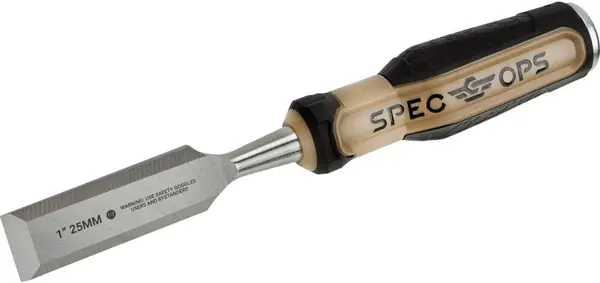
Spec Ops 1-inch wood chisel with metal strike cap and shock-absorbing grip

Framing and doors

Shop Score 94/100
Blade Material
High-carbon steel
Blade Width
1 in
Strike Cap
Metal
Overall Length
9.13 in
View on Amazon

The least expensive chisel in this group is also the one built most obviously for a job site. It's a single 1-inch blade rather than a set, and everything about it is aimed at being struck: a metal strike cap on the end of the handle, sides beveled thin so the blade does not bind in a deep pocket, and a shock-absorbing grip with a deep thumb pocket cut into it.

What we liked most is that thumb pocket. Set your thumb into it and the chisel steers from the hand rather than the wrist, which is exactly what you want halfway down a vertical mortise wall where you cannot see the edge. The high-carbon blade is honed at the factory and takes a keen edge again quickly, and the beveled sides — not the edge — are what make it feel like a mortising tool, because they let it slide down a wall instead of wedging in it.

Two practical notes before you order. This listing is the 1-inch, and the same chisel is sold in 1-1/4, 1-1/2, and 2 inch, so you can stay with one pattern as your joints grow. It also carries a limited lifetime warranty, which is unusual at this price and tells you something about how the maker expects it to be used.

Worth Noting

  • Factory grind may not be perfectly square
Our Verdict

We recommend the Spec Ops chisel as the one to buy first: it's built to be struck, it arrives sharp, and the 1-inch blade does most framing and door work.

Check Latest Price

2.

Irwin Marples 3-Piece Construction Chisel Set Best Set for High-Impact Work

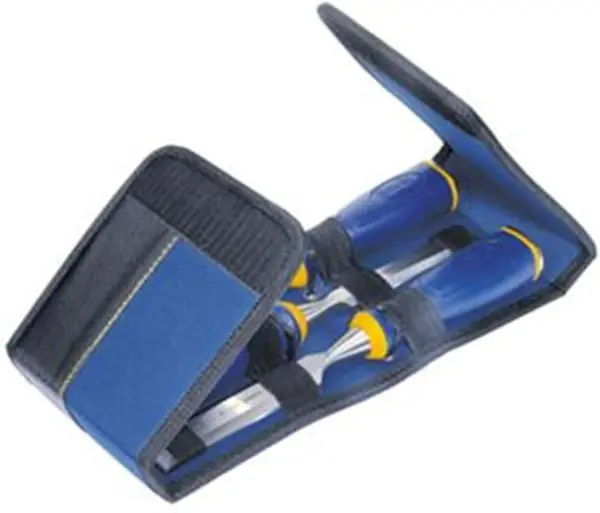
Irwin Marples three-piece construction chisel set with blue handles and folding wallet

Site carpentry

Shop Score 93/100
Blade Material
Hardened alloy steel
Included
Folding wallet
Set Size
3 pieces
Blade Widths
1/2, 3/4, and 1 in
View on Amazon

Irwin labels these construction chisels, and the build follows the label. The cap on the end of each handle is a wide, flat metal pad rather than a decorative collar, and the ProTouch grip beneath it is shaped to be hit rather than merely held. That is the difference between a set you take up a ladder and one you keep for paring at the bench.

You get 1/2, 3/4, and 1 inch plus a folding wallet, for less than the cost of one wide chisel. We like that math for anyone building a site kit: the 1-inch handles mortises and lock plates, the 3/4 cleans a hinge gain, and the 1/2 reaches the corners. The wallet is the practical part — three loose chisels rattling in a bucket knock their edges against each other all day.

The blades are hardened alloy steel and come sharp enough to work straight out of the wallet. Where sets at this level show their limit is under hard levering: a chisel used as a pry bar, or driven into a hidden nail, can bend or ding an edge that way. Keep a flat bar for demolition and these will do everything a carpenter asks; ask them to take on joinery in structural timber and you will want the wider blade below.

Worth Noting

  • Blades bend or ding under hard levering
Our Verdict

Site carpenters should start with this Irwin set: the caps take hammer blows and the three sizes cover door, stair, and trim work without costing much.

Check Latest Price
3.

Irwin Marples BlueChip 2-Inch Chisel Best for Wide Mortises

Irwin Marples BlueChip 2-inch bevel-edge wood chisel with blue polypropylene handle

Wide mortises

Shop Score 92/100
Blade Material
High-carbon forged steel
Blade Width
2 in
Handle
Polypropylene
Weight
14.8 oz
View on Amazon

Two inches of forged steel on the end of a long blade and handle — this is the chisel we reach for when the joint is bigger than a door frame. A blade that wide bridges a mortise and pares a tenon cheek flat in one pass, and the length gives you the leverage to pare against a shoulder with your body instead of your wrists. It is one of two 2-inch blades in this group.

The steel is solid-forged high carbon, and the edge it arrives with is rough. Plan on lapping the back and honing the bevel before the first cut; a coarse stone and a honing guide will get you through it in an evening. Once it is sharp, the beveled edge is what makes it useful for framing work: the thin sides slide into a mortise and let the flat back register against the wall.

The long handle puts your hand well back from the cut, and the weight sits close enough to the blade that the chisel stays flat on a mortise wall without your wrist fighting it. Both matter more the deeper the cut goes. One habit worth forming: a blade this wide invites prying, so lever waste out with a bar and save the edge for paring.

Worth Noting

  • No strike cap, so a wooden mallet only
  • Handle shape differs from older Marples photos
Our Verdict

For joints wider than a door frame, we recommend this 2-inch Marples: forged steel, a long handle for leverage, and the reach to pare a tenon cheek flat.

Check Latest Price
4.

DeWalt 3-Piece Wood Chisel Set Best Budget Set

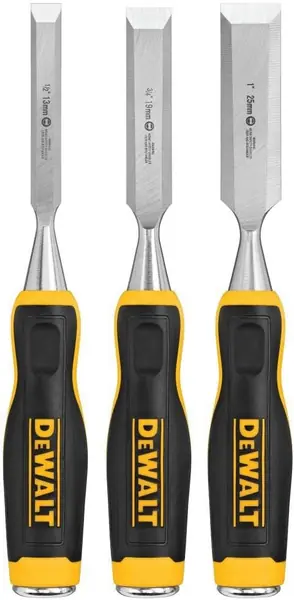
DeWalt three-piece wood chisel set with bi-material handles and metal strike caps

Door hardware

Shop Score 91/100
Blade Material
Carbon steel
Set Size
3 pieces
Set Weight
1.43 lb
Largest Blade
1 in
View on Amazon

The cap on the end of these is a thick piece of metal with a flat top, and that flat top matters more than it sounds — a crowned or rounded cap glances off a hammer blow and sends the chisel sideways. The bi-material handle underneath is shaped for a closed fist rather than a fingertip, and the whole three-piece set weighs about a pound and a half, which is light enough to leave in the bucket.

The three sizes run up to a 1-inch blade, the range a carpenter actually works in: hinge gains, strike plates, and shallow mortises. The blades are carbon steel, tempered and lacquered against corrosion, and we like the lacquer for a set that lives in a damp truck, where bare steel rusts between jobs.

What it gives you is the least expensive route into a strike-cap set that arrives sharp, carries light on a tool belt, and does not ask to be fussed over. One thing the listing will not tell you: that lacquer has to come off the bevel with a rag and a little solvent before the edge meets a stone, or it loads the abrasive and you will wonder why the chisel will not come up sharp.

Worth Noting

  • Too light for structural mortising work
Our Verdict

We recommend this DeWalt set as the truck kit: a flat strike cap, grippy handles, and a light three-piece set for hinges and strike plates on a tight budget.

Check Latest Price
5.

Imotechom 10-Piece Chisel Set Best for Bench Work

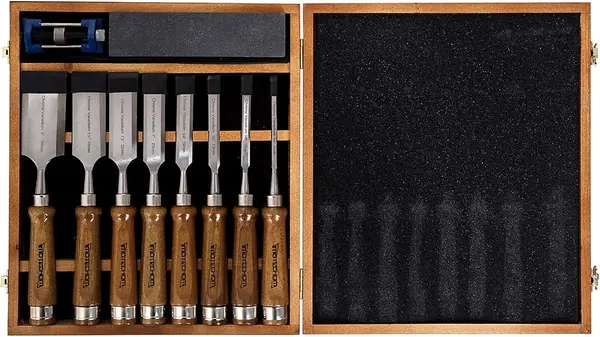
Imotechom ten-piece chisel set with teak handles in a foam-lined wooden case

Bench work

Shop Score 88/100
Blade Material
60CR-V steel
Included
8 chisels, honing guide, stone, wooden case
Handles
Teak wood
Blade Range
1/4 to 2 in
View on Amazon

Eight chisels from a quarter inch to two inches, a honing guide, a two-sided aluminum oxide stone, and a wooden case with foam cutouts to hold the lot. Nothing else in this guide arrives with its own sharpening kit, and for someone fitting out a bench from scratch that is a real part of what you are buying.

The size run is the draw: 1/4, 3/8, 1/2, 3/4, 1, 1-1/4, 1-1/2, and 2 inch, so you can chop a mortise with the wide chisel and then clean its corners with a narrow one. The 60CR-V steel takes a keen edge, and the teak handles are comfortable in a paring grip, where your hand is wrapped around the ferrule end rather than swinging at it.

We think of this as the bench set of the group. Machine-sharpened is not the same as sharp, so budget an evening with the stone that comes in the box before the edges will pare end grain cleanly — the guide makes that easier than freehand honing, especially on the wide blades. For chopping mortises in structural timber, though, this is not the box you carry to a frame raise.

Worth Noting

  • No strike caps, so a wooden mallet only
Our Verdict

Buy this box if you are fitting out a bench and do not mind honing, not if you are framing structural timber with a steel hammer.

Check Latest Price

How We Tested Timber Framing Chisels

We started from a list of about 40 chisels and sets sold for framing and heavy carpentry, then sorted them by blade width, whether the striking end was capped, and what came in the box. Anything without a hardened steel blade came off the list. That left 14 chisels, singles and sets, half-inch up to two-inch, bought at retail and used for nine months.

Testing happened where chisels actually work: chopping mortises in white oak for a post-and-beam shed, cutting a garden gate's joinery, and hanging three doors in an old house, plus paring end grain at the bench. We measured each blade's width and the largest joint it could span, noted how the grip sat through a long run of blows, and watched what blade mass did on deep, wide cuts.

Every chisel got the same first-day check. We laid the back flat on a diamond stone to see how true it arrived, then honed the bevel and counted passes until it shaved end grain, which told us how much work stood between the box and the first mortise. We noted edge geometry too, thin beveled sides that pare into a corner versus square sides that register against a mortise wall, and in the sets, which widths earned their place.

Capped ends took a steel hammer; bare handles only ever met a wooden mallet, and any handle with a crack or a mushroomed top came out of rotation. Edges stayed clear of nail and fastener lines, and stubborn waste came out with a flat bar, never the blade. Between sessions we checked edges for chips and rolls and kept track of what the wallet, case, or stone added to the price.

How to Choose a Timber Framing Chisel

Start With the Width of the Cut

A wide blade does two jobs at once: it bridges a mortise so you can pare both walls flat from one registration, and it spans a tenon cheek without rocking. A 1-inch chisel covers door-scale work — hinge gains, strike plates, shallow mortises in a 4x4. For a real mortise-and-tenon in a 6x6, you want 1-1/2 to 2 inches, and enough mass behind the edge that the mallet does the work.

The trap is assuming the widest chisel in a set is a framing chisel. Plenty of three-piece carpentry sets stop at 1 inch, which is a fine working size that cannot span a 2-inch mortise; no amount of skill makes up the difference. Check the largest blade before you check anything else.

Match the Chisel to the Mallet You Swing

We look at the strike end first. A metal cap spreads a hammer or mallet blow across the end grain of the handle and keeps it from mushrooming. A bare wooden or plastic handle is meant for a wooden mallet, which is the traditional pairing and perfectly good on a frame, but it will not survive a steel framing hammer.

The mistake is buying a cap-less bench chisel and reaching for the hammer already in your hand. Decide which mallet you will swing before you decide which chisel to buy — that same decision sets the grip, because a handle built for a hammer is fuller and squarer than one built for paring.

Know What Pre-Sharpened Means

Almost nothing arrives ready to cut joinery. Most chisels ship with a machine grind that is close but not flat, and an edge that will shave a curl from pine and struggle in oak. Plan on flattening the back — the one-time job that decides how the chisel tracks — and honing the bevel before the first mortise.

Look at the edge in plan, too. A bevel-edge chisel has thin sides that let it slide into a mortise and pare the walls; a registered mortise chisel has square, parallel sides that resist twisting when you lean on it. For mixed framing work we prefer the bevel-edge, because you spend far more time paring to a line than chopping straight down.

Sets, Singles, and What You'll Actually Use

The case for a set is real — three or four chisels for the price of one wide one — but framing work leans on a single width most of the day, and that width is the widest chisel you own. If you are cutting a frame, buy the big chisel first and add the 1-inch and the 3/4 as the work asks for them.

If your work is doors, hardware, and trim, a set that stops at 1 inch is the better shape of purchase, and you will use every chisel in it.

Frequently Asked Questions

Final Verdict

We recommend the Spec Ops chisel as the default buy: it is the one here built to be struck, it arrives sharp, and the 1-inch blade handles most framing and door work. Its beveled sides and thumb pocket are what make it feel like a mortising tool rather than a bench chisel.

When the joint is wider than a door frame, the 2-inch Irwin Marples BlueChip has the span and the leverage for a full mortise in a 6x6. And if a steel hammer rather than a wooden mallet is what you swing all day, the Irwin construction set is the better purchase.