↑↓ navigate ↵ open Esc close All results →

Best Tung Oils of 2026

Grabbing a can labeled "tung oil finish" when you want pure oil is the easiest way to end up with a varnish blend that sits on the wood as a satin film instead of soaking into the grain. True tung oil deepens wood character without looking plastic, repels spills once cured, and leaves a matte, fingerprint-resistant surface safe for food-contact boards.

Brushing and wiping 14 bottles onto cutting boards, a cabinet door, deck planks, and small craft stock over eight months tracked absorption, tack time, and lingering next-day odor across pure oils, citrus-thinned blends, and varnish mixes. Cutting boards that meet a knife call for 100 percent pure oil, while small boxes need only a few ounces and outdoor decks demand gallon-sized containers.

Matching container size and base chemistry to the actual project prevents half-used cans from gumming up on a shop shelf.

Our Top Picks

The Best Tung Oils

1.

Hope's 100% Pure Tung Oil Best Overall
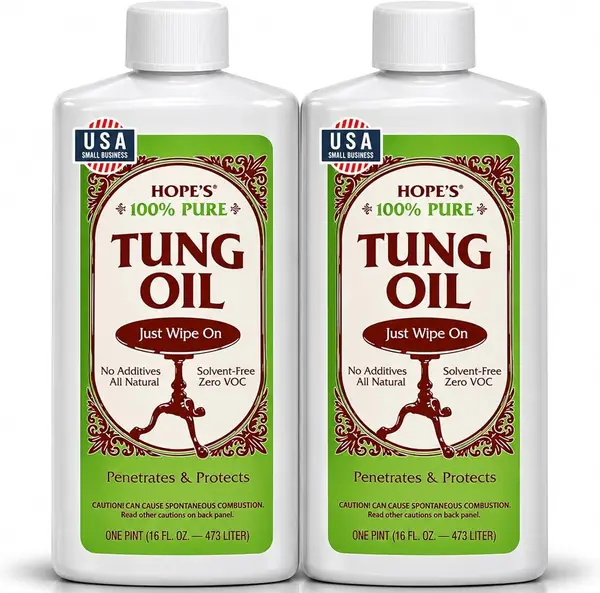
Hope's 100% Pure Tung Oil wood finish in two 16-ounce bottles for sealing wood

Furniture and boards

Shop Score 95/100
Size
16 fl oz each, 2-pack
Oil Type
100% tung oil
Food Contact
Safe once cured
Surfaces
Wood, concrete, stone
View on Amazon

What is missing from this bottle is exactly why we reach for it. There are no solvents, no dryers, and no varnish resins — just tung oil — so it sinks into the fibers and hardens in place instead of laying a film across the top. That is what gives a table the deep, open-grained look of finished wood rather than the flat shine of a coating.

Using it is a two-step rhythm: flood on a thin coat, give it a short while to soak, then wipe off everything the surface has not taken. The wiping is the step beginners skip, and oil left pooled in a corner or a mortise cures into a sticky, wrinkled skin that has to be sanded back out. On dense stock like maple we cut the first coat with a citrus solvent so the oil goes in rather than sitting on top.

Two 16-ounce bottles fit the way this finish actually gets used: one open for the coats going on now, the other still sealed for the third and fourth coat weeks later. That is not a packaging nicety — it is the difference between working from fresh oil and working from a bottle that has been sitting open. What builds up handles water rings and alcohol spills on furniture, and it is just as comfortable on a cutting board.

Worth Noting

  • Strong smell while the oil is curing
Our Verdict

We recommend Hope's as the pure tung oil to start with: nothing added, safe for cutting boards once cured, and two bottles to see a project through.

Check Latest Price
2.

Real Milk Paint Pure Tung Oil Best for Big Projects

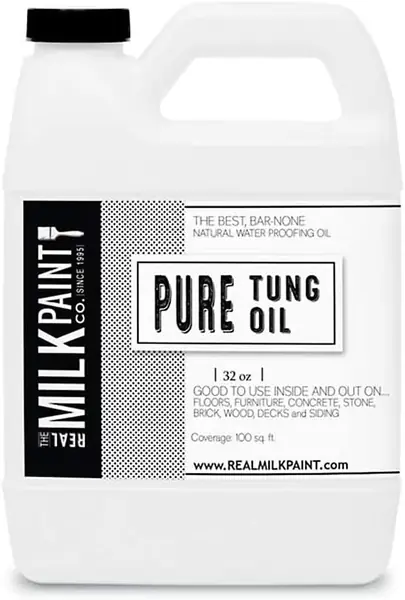
Real Milk Paint Pure Tung Oil in a 32-ounce bottle for wood finishing

Big finishing projects

Shop Score 94/100
Size
32 fl oz
Oil Type
100% pure tung oil
Finish
Matte
Listed Dry Time
4 hours
View on Amazon

The surface this leaves is flat — matte, open, and close to what the raw wood looked like before you started, only deeper in color. On white oak and ash that is exactly the look we want, and it is the reason this bottle stays on the shelf whenever a project should feel like furniture rather than lacquer.

It is pure tung oil with no VOC content, no metallic dryers, and no distillates, and the company sells a citrus solvent alongside it for cutting the first coat. The label lists four hours to dry, which we read as the recoat window — sand lightly, wipe, go again — not a signal that the piece is finished.

Thirty-two ounces is a real project's worth, enough for a dining table with some left over, and the oil is thin enough to wipe out evenly without fighting you. We keep it for pieces where the wood is the whole point and any build-up would hide it.

Worth Noting

  • Days of curing before the piece is usable
Our Verdict

We reach for this one when a piece deserves a bare, matte finish and we have the time to build it in thin coats.

Check Latest Price
3.

Real Milk Paint Half & Half Best Ready-Mixed

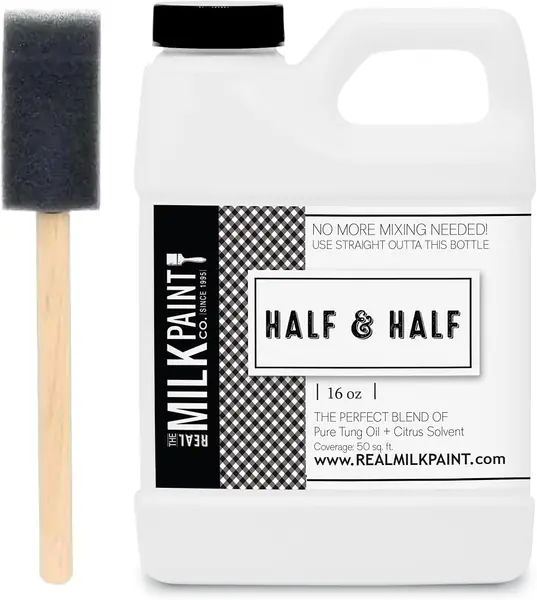
Real Milk Paint Half and Half tung oil and orange peel oil in a 16-ounce can

Wipe-on cutting boards

Shop Score 93/100
Size
16 fl oz
Formula
Pure tung oil and orange peel oil
Food Contact
Safe for food contact
Stated Cure
7-10 days to water resistance and 30 days for a complete cure
View on Amazon

Buying a can of solvent and guessing at the ratio is the most irritating part of finishing with tung oil, and Half & Half removes it: pure tung oil already cut with orange peel oil, ready to wipe straight from the can. It pours thin, spreads fast, and soaks into tight woods like cherry and maple instead of sitting on the surface looking wet.

The trade-offs are time and smell. The label lists three to five coats to seal, seven to ten days to develop water resistance, and thirty days for a complete cure, and the citrus note is strong enough in a small shop that we crack a window even in November. What we like is that the solvent in the mix is orange peel rather than mineral spirits, so the smell that hangs around is fruity rather than petroleum.

For kitchen pieces the combination is hard to beat: food-safe ingredients, no extra bottles, and a finish that reads as oiled wood instead of a film. We keep it for countertops and boards, and for the final coat on furniture, when neat tung oil is too thick to wipe out evenly.

Worth Noting

  • Highest cost per ounce in this group
  • Citrus smell is strong in a small shop
Our Verdict

We go to Half & Half when we want tung oil's protection without buying and mixing solvent, especially on cutting boards and countertops.

Check Latest Price
4.

Walrus Oil Pure Tung Oil Best Coverage

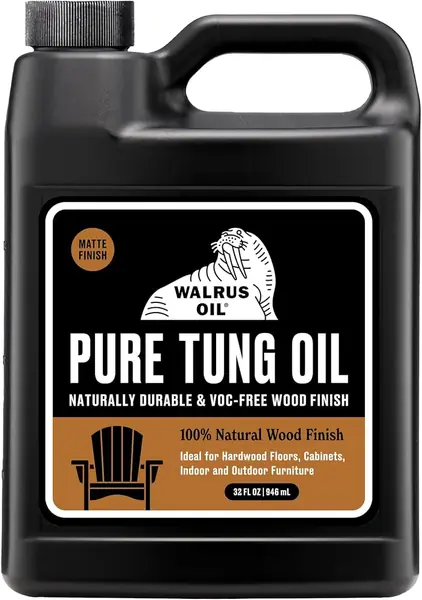
Walrus Oil 100% Pure Tung Oil in a 32-ounce jug for wood projects

Decks and floors

Shop Score 92/100
Size
32 fl oz
Oil Type
100% pure tung oil
Stated Coverage
100 sq ft per 32 oz
Use
Interior and exterior
View on Amazon

Outdoor wood is where most oils give up and go gray by the second summer. This one is rated for interior and exterior use and is the finish we take outside for cedar chairs, a deck table, and the porch railings that never get a break from the weather.

The label states 100 square feet of coverage per 32-ounce jug, the largest figure in this group, and we plan with it as a thin-coat number on smooth milled stock rather than a promise. The formula is pure tung oil with no solvents, dyes, or dryers, so it goes on thick and slow and wants a solvent cut for the first coat.

Color is where it surprised us. A teak chair came back a shade deeper and warmer without going orange, and the surface stayed matte rather than glossy, which is what you want on furniture that lives outside and will weather between coats.

What we come back to is volume. A jug this size does a deck and a set of chairs without a second order, and the same bottle handles the dining table indoors when the weather turns.

Worth Noting

  • Thick raw oil applies slowly and wants thinning for the first coat
Our Verdict

We hand this to anyone finishing outdoor furniture or a floor, where the big jug and the exterior rating earn their keep.

Check Latest Price
5.

NetLea Pure Tung Oil Best for Small Projects

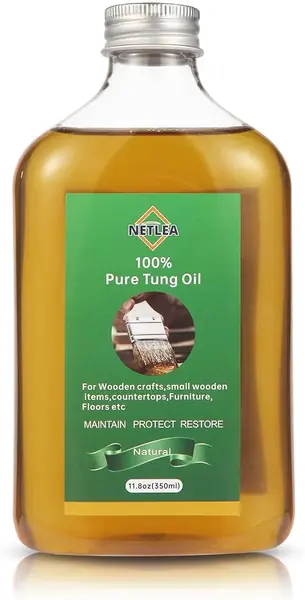
NetLea Pure Tung Oil in an 11.8-ounce bottle for small wood crafts

Small craft projects

Shop Score 91/100
Size
11.8 fl oz
Oil Type
100% pure tung oil
Application
Soft cloth or small brush
View on Amazon

Eleven ounces is not much oil, and for a lot of work that is precisely the appeal. This is the bottle for a jewelry box, a turned bowl, a set of knife scales, or a first attempt at tung oil when you do not want a quart going gummy on the shelf between projects.

It is pure tung oil with nothing added, thin enough to wipe on with a cloth and work into corners without flooding them. Plan on a light sanding between coats and on waiting, since the film builds slowly and softwoods like pine keep a tacky feel noticeably longer than hardwoods do.

We treated the small bottle as a sampler and it behaved like the larger ones: same amber tone, same deepening of the grain, same need to wipe off what the wood does not absorb. The packaging is what we mind — the bottle is thin and can arrive leaking — so open it over a rag and check the cap before you put it on the shelf.

Worth Noting

  • Bottle can arrive leaking in transit
  • Too little for a table or a floor
Our Verdict

We keep this small bottle for craft-scale work, where a little pure tung oil goes a long way and a quart would be waste.

Check Latest Price
6.

OAIEGSD Pure Tung Oil Best for Bulk Budget Jobs

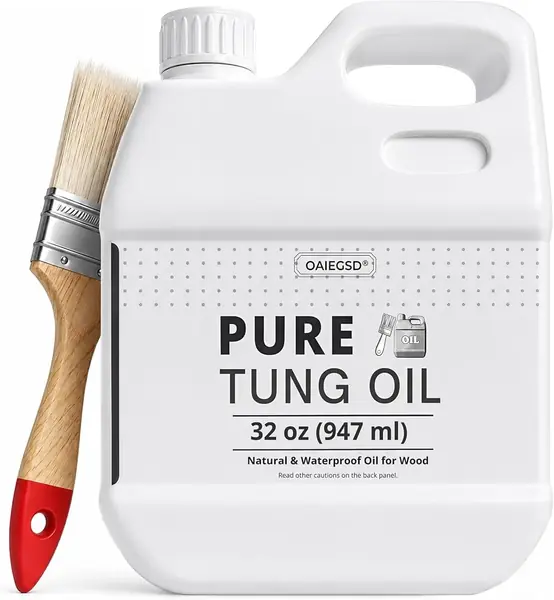
OAIEGSD 32-ounce bottle of 100% pure tung oil wood finish and sealer

Bulk budget jobs

Shop Score 90/100
Size
32 fl oz
Oil Type
100% pure tung oil
Water Resistance
Waterproof sealer
View on Amazon

Per ounce, nothing else on this page comes close. Thirty-two ounces of pure tung oil for the price of a small bottle makes this the arithmetic winner if you are sealing a deck, a fence, a garden bed, or a stack of shop jigs and do not need anyone to hold your hand through it.

It behaves the way pure tung oil should: thin, slow, and deep-penetrating, building a water-resistant finish over several coats. What you give up is guidance — there is no coverage figure to plan a project around and no real description of the finish — so buy it for volume and let the first piece be your test panel.

Worth Noting

  • No coverage figure to plan a project around
Our Verdict

We reach for this jug when the job is big and the budget is small, and when we are finishing shop work rather than a showpiece.

Check Latest Price
7.

Minwax Tung Oil Finish Best for Cabinets and Trim

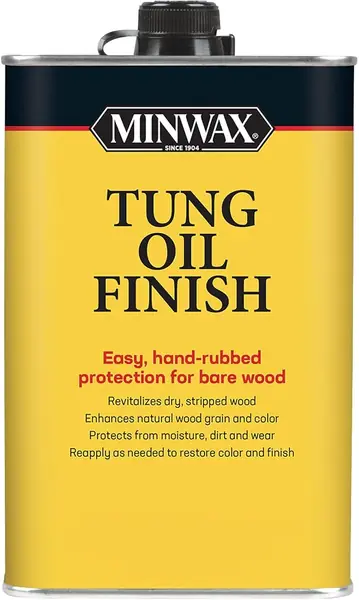
Minwax Tung Oil Finish in a one-pint can for cabinets and furniture

Cabinets and trim

Shop Score 89/100
Size
16 fl oz (1 pint)
Finish
Satin, low gloss
Formula
Tung oil varnish blend
Stated Coverage
31.25 sq ft - 37.5 sq ft
View on Amazon

The first thing to know is that this is a blend, not a bottle of pure tung oil. Tung oil is in there, cut with varnish resins and solvent, which is why it builds a low-gloss satin finish in a few coats instead of soaking in and disappearing. The can lists 31.25 sq ft - 37.5 sq ft of coverage and twenty-four hours between coats.

For cabinets, doors, and trim that trade is a good one: it wipes on like an oil, buffs out even, and the film stands up to moisture and handling better than a pure penetrating oil will. What it is not is the finish for a cutting board or for a piece where you want to feel the grain under your hand, so we keep it on vertical surfaces and reach for a pure oil whenever food or bare wood is involved.

Worth Noting

  • Blend rather than 100% tung oil
  • Not labeled for food-contact surfaces
Our Verdict

We use this blend when we want a satin film on cabinets and trim without reaching for polyurethane.

Check Latest Price

How We Tested Tung Oil on Real Wood

We started with the labels. Bottles went into three piles: 100 percent tung oil, pure oil cut with a thinner such as orange peel oil, and varnish blends sold under a tung oil name. From there we compared container sizes and cost per ounce, because a quart of oil bought for a jewelry box is money sitting on a shelf for years.

Fourteen bottles came into the shop, and we spent eight months working through them on maple cutting board blanks, an oak cabinet door, a run of deck boards, and a handful of jewelry boxes and small carvings. Everything went on in a ventilated garage with a fan running, and every oily rag was spread flat on the concrete outside to dry before it went in the trash.

We timed how quickly the first coat disappeared into the grain and noted which boards needed the oil thinned before it would soak in evenly. After each coat we wiped the excess and recorded how long the surface stayed tacky, how many coats it took before a drop of water beaded instead of darkening the wood, and how the grain looked — wet and deepened under a matte oil versus sitting under a satin film. Odor got its own check: we sniffed at application and again the next morning, with the solvent-thinned and citrus-thinned bottles curing by the open door.

Coverage we measured by marking off a square foot at a time and counting how far an ounce stretched. Boards headed for the kitchen were set aside for the full cure before anything was chopped on them, and we checked food-contact claims against the label rather than the marketing copy. The bottles that held up are still on the shelf, and we re-oil with them every few months to see how the finish wears.

How to Choose a Tung Oil

Pure Tung Oil or a Tung Oil Finish

A bottle that says 100% tung oil contains nothing but the oil, which is what you want for cutting boards, butcher blocks, and any piece where you would rather feel wood than film. A can labeled tung oil finish is almost always a blend of tung oil, varnish resins, and solvent. It builds a satin sheen in a few coats and shrugs off moisture, but it sits on the surface and it is not the penetrating oil the name suggests.

Read the ingredient line before you read the front of the can. Minwax Tung Oil Finish here is that blend; Real Milk Paint's Half & Half is the other kind of shortcut, pure oil already thinned with orange peel oil so you skip the mixing without losing the oil.

Thin the First Coat and Wipe Off the Rest

Tung oil is thick, and on tight-grained woods it will sit on the surface looking wet without going anywhere. Cutting the first coat roughly half and half with a citrus solvent or mineral spirits gets it into the fibers; later coats can go on neat.

Whatever the ratio, wipe off what the wood does not take. Oil pooled in a corner, a mortise, or a run of end grain cures into a sticky, wrinkled skin that has to be sanded back out — far more work than the wiping would have been.

Size the Bottle to the Project

Coverage figures assume a thin, wiped coat on smooth milled wood, so treat them as a starting point and buy up if the project has end grain, rough sawn faces, or a butcher block, all of which drink oil. A 32-ounce jug suits a table, a run of shelves, or a floor repair; an 11-ounce bottle is plenty for boxes, turnings, and utensils.

Two smaller bottles are often handier than one big one, since the second stays sealed until the last coat instead of sitting open in the shop.

Food Contact and Water Resistance

An oil labeled food-safe is safe once it has fully cured, not when the can arrives. On a new cutting board, plan on several coats with a light sanding between and let it sit until the smell and the tack are gone before it meets a knife.

Water resistance works the same way. Real Milk Paint puts three to five coats and more than a week before their Half & Half turns water aside. A film-building blend beads water sooner, but that film can chip along the edge of a board.

Frequently Asked Questions

Final Verdict

Hope's 100% Pure Tung Oil is what we hand someone who asks which tung oil to buy. Nothing is added to it, it is safe for cutting boards once cured, and the two-bottle pack matches how the finish actually goes on: one bottle open, one waiting for the next coat.

If you prefer not to buy solvent separately, Real Milk Paint's Half & Half does the thinning for you at a higher cost per ounce. And if the job is a deck or a floor and coverage is what you are counting, the Walrus Oil jug states more square footage than anything else here.