↑↓ navigate ↵ open Esc close All results →

Best Cordless Jigsaws of 2026

Few saws wander off a pencil line as easily as an underbuilt jigsaw midway through a sink cutout, crown coping cut, or outlet notch. Keeping a curved cut square to the stock comes down to blade support, quick tool-free swaps, and steady battery power rather than raw stroke numbers.

Clamping scrap, hardwood, and PVC trim to sawhorses over eight months with 11 cordless jigsaws tested both bare tools and full kits, since buying redundant batteries inflates setup cost fast. Stroke speed and orbital settings work as a pair, and a reachable switch matters once hands are wearing shop gloves.

Across bench curves, trim coping, and platform-specific toolboxes, these eight saws balance clean line tracking with practical ergonomics.

Our Top Picks

The Best Cordless Jigsaws

1.

DEWALT 20V MAX XR Jig Saw (DCS334B) Best Overall
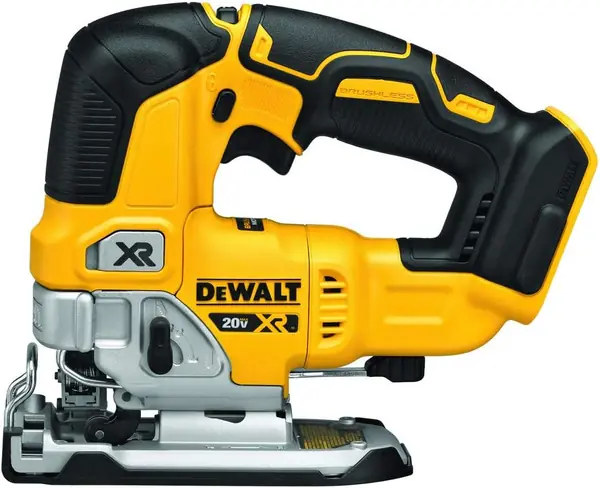
DEWALT DCS334B 20V MAX XR cordless jigsaw in yellow with a black grip

Everyday woodworking

Shop Score 97/100
Weight
4.2 lb
Stroke Speed
Up to 3,200 spm
Orbital Settings
4-position
Bevel Capacity
45 degrees
View on Amazon

Two numbers on the spec panel explain most of what this saw is: 3,200 strokes per minute and 4.2 pounds. That puts the DCS334B at the fast end of this group and the light end at the same time, which is exactly the combination that makes a jigsaw easy to steer around a curve instead of wrestling it through one.

The brushless motor is what makes those numbers usable. It pulls a blade through 3/4-inch plywood without the chattering bog-down that turns a cheap saw into a workout, and the four-position orbital action gives a genuine range between a clean edge and an aggressive rip. We spent most of our cutting on the middle two settings, where the saw feels most settled.

Detail work is where it keeps earning its place. The all-metal lever clamp changes a T-shank blade in seconds without hunting for a hex key, the shoe bevels through detents at 0, 15, and 30 degrees with a positive stop at 45, and a removable cover on the shoe keeps the base from scratching finished material. The LED throws light right where the blade meets the line — a small thing until you are following a pencil mark on the shadowed side of a cabinet.

It is also the cheaper of the two DEWALT jig saws here, which is unusual for the newer design. It is a bare tool, so the arithmetic works for anyone already running 20V MAX packs — one charger, one battery format, no orphan cells. If you want your hand lower and closer to the work, the DCS335B below is the same saw with a different grip.

Worth Noting

  • Plastic splinter insert works loose
Our Verdict

We recommend it as the default: the fastest and lightest DEWALT here, with four orbital settings that take it from trim cuts to rough framing.

Check Latest Price
2.

DEWALT 20V MAX XR Barrel-Grip Jig Saw (DCS335B) Best for Curves and Coping

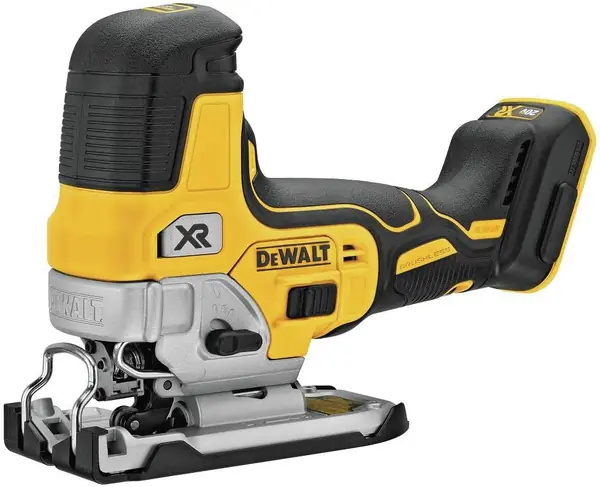
DEWALT DCS335B 20V MAX XR barrel-grip jigsaw in yellow with a low black handle

Coping and curves

Shop Score 96/100
Weight
4.76 lb
Stroke Speed
Up to 3,200 spm
Orbital Settings
4-position
Grip
Barrel
View on Amazon

The handle is the entire argument. On a barrel-grip saw your hand wraps the body just above the shoe, which puts your wrist closer to the work and your fingers nearer the line than a top handle allows. Trim carpenters have worked this way for decades, and it is the difference between steering a cut and aiming one.

Behind the grip it is the same tool as the DCS334B: 3,200 strokes per minute, four orbital positions, an all-metal keyless blade clamp, and bevel detents at 0, 15, and 30 degrees with a stop at 45. Speed lives on a dial under your thumb, and the LED is genuinely useful here because your hand sits below the cut line instead of behind it.

We recommend it for coping, sink cutouts, and any curve you cut by eye, where the low grip buys noticeably more control than a top handle. It costs a good deal more than the D-handle version, and accuracy is what that money buys; for framing and long straight runs, the DCS334B above does the same work for less.

Worth Noting

  • On/off switch crowds a left-handed grip
  • Fat barrel for larger hands
Our Verdict

Buy this one if you cope trim and steer curves by eye — the barrel grip buys control a top handle cannot match, at a stubborn premium.

Check Latest Price
3.

Makita 18V LXT Jig Saw (XVJ03Z) Best Cutting Accuracy

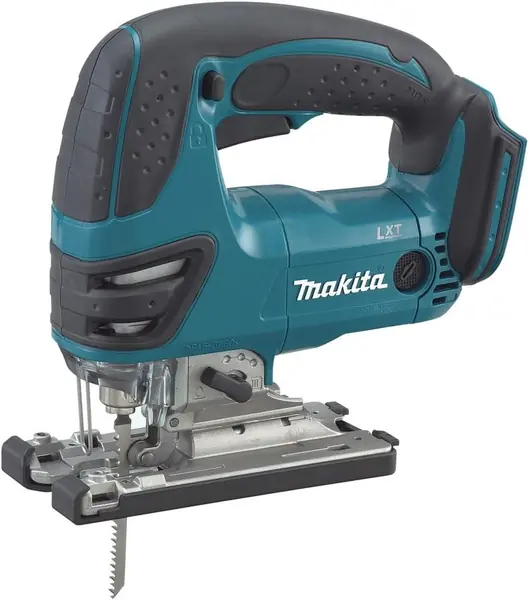
Makita XVJ03Z 18V LXT jigsaw in greenish blue with a rubberized handle

Accurate bench work

Shop Score 95/100
Weight
6 lb
Stroke Speed
0-2,600 spm
Orbital Settings
3 plus straight
Blade Changes
Tool-less lever
View on Amazon

Six pounds is a lot of jigsaw, and Makita has spent the weight on the parts that keep a blade honest. The base is heavy-gauge and machined flat, which you feel the moment you set it down on a board, and the blade guide system holds the blade vertical instead of letting it lean off the line when you push.

Straightness is what we keep coming back to. Where plenty of jigsaws let the blade wander on the back side of a curve, this one tracks, and it will hold a line through 8/4 hardwood without leaning off square. The tool-less lever swaps blades quickly, the two-finger trigger is easy to feather even with gloves on, and three orbital settings plus straight cutting cover everything from a fast rip to a face cut that has to look good.

What you get for the heft is a saw that does not skitter when a blade grabs, and a base that stays flat through a long curve. Nobody picks a jigsaw for its weight, but this is the one where the extra pounds read as control rather than burden.

Worth Noting

  • No onboard work light
Our Verdict

Our pick when accuracy matters more than weight: the steadiest saw in this group, and the one least likely to let a blade wander.

Check Latest Price
4.

SEESII Cordless Jigsaw Kit (JS01) Best Complete Kit

SEESII JS01 21V jigsaw in blue with two batteries, nine blades, and a bag

Starting from zero

Shop Score 94/100
Stroke Speed
0-2,800 spm
Orbital Settings
4-position
Blades Included
9 blades
Batteries Included
Two 21V packs and charger
View on Amazon

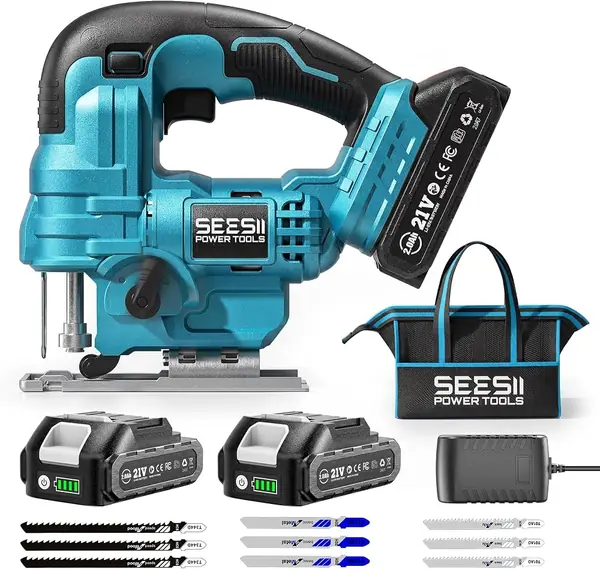
Two batteries, a charger, nine blades, a dust tube, a wrench, and a bag: that is what comes in the box, and it is why this saw makes the list. Most of the picks here are bare tools that assume you already own a battery and a charger, so the Seesii is the one you can hand someone who owns nothing, for less than most of the bare tools cost.

The saw under the kit is not a toy. A variable-speed trigger runs it to 2,800 strokes per minute, four orbital settings cover the usual range from clean to aggressive, the shoe bevels to 45 degrees, and the thumb-push clamp releases a blade without a tool. A light sits above the blade, and two packs mean one can charge while the other cuts.

Where it gives ground is the long game. The 21-volt packs are the brand's own system, so they fit nothing else on your shelf, and a bigger battery later means going back to the same small company. That is the trade for a complete kit at this end of the market, and for a first saw or a second saw kept loaded with a metal blade, it is a fair one.

Worth Noting

  • Batteries fit nothing else on your shelf
Our Verdict

The kit we hand a first-time buyer: saw, two batteries, charger, and nine blades in one box, with nothing else to shop for.

Check Latest Price
5.

CRAFTSMAN V20 Cordless Jig Saw (CMCS600B) Best Blade Flexibility

CRAFTSMAN CMCS600B V20 jigsaw in red and black with a beveling steel shoe

V20 tool owners

Shop Score 93/100
Weight
4.76 lb
Stroke Speed
Up to 2,500 spm
Orbital Settings
3
Blade Shank
T and U
View on Amazon

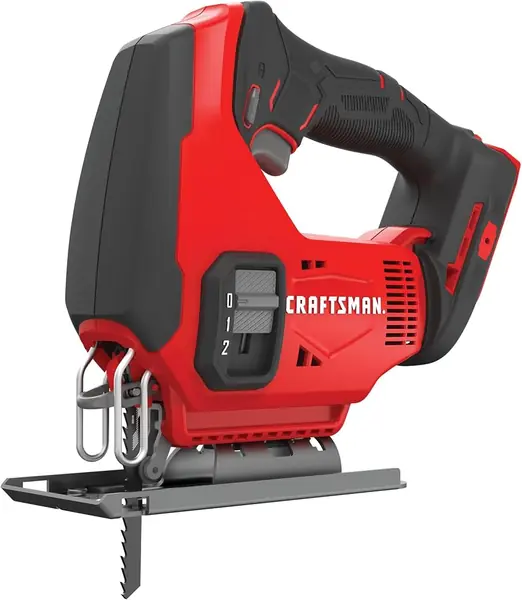
Look at the clamp and you find the thing no other saw here offers: the CMCS600B takes both T-shank and U-shank blades. If you inherited a coffee can of old U-shank blades, or the hardware store near you stocks one kind and not the other, that alone can settle the purchase.

The rest of the spec sheet is honest budget fare: a variable-speed trigger, three orbital settings, and a shoe that bevels to 45 degrees. At 4.76 pounds it is light enough to steer one-handed around a short curve and steady enough not to skate when the blade grabs, and vibration is well controlled for a saw at this end of the range.

Squareness is the one thing to verify. The shoe can drift out of alignment with the blade, so run a square against it before a cut that shows and adjust the base if it is off. Do that and the saw tracks well; skip it and a straight line comes out slightly tapered.

We like it most for V20 shops and for anyone whose blade drawer is already full of both shank types. It sits at the low end of the price range here, and for trim, shelving, and plywood cutouts it does not feel like a compromise.

Worth Noting

  • Top speed is on the slow side here
Our Verdict

A sensible budget bare tool for V20 shops, and the only saw here that will run both blade shanks.

Check Latest Price
6.

Ryobi 18V ONE+ Jig Saw (PCL525B) Best Budget Bare Tool

Ryobi PCL525B 18V ONE+ jigsaw in green and black with a tool-less blade clamp

Budget ONE+ builds

Shop Score 92/100
Weight
5 lb
Included
Bare tool only
Bevel Capacity
45 degrees
Battery Platform
Ryobi 18V ONE+
View on Amazon

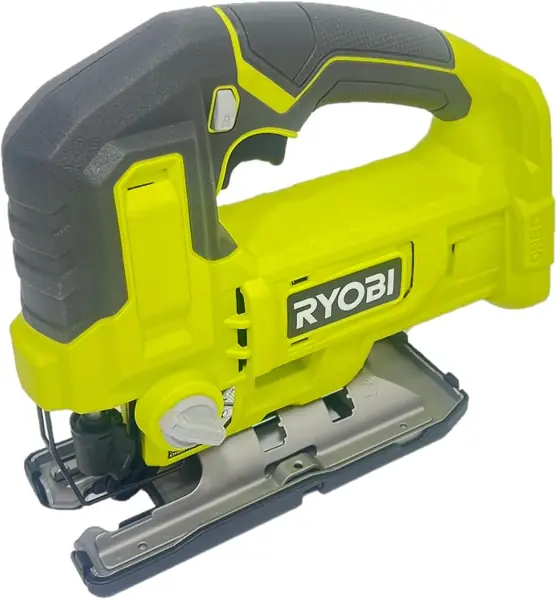
The cheapest way into a cordless jigsaw here is a bare Ryobi, and for anyone with a shelf of ONE+ packs it is a hard argument to beat. Nothing about the price shows in the tool: a variable-speed trigger, three orbital settings, and blade changes that take seconds with a twist of the clamp.

The built-in light is the detail we appreciated most, because it puts a bright spot right where the blade meets the line in a cabinet interior where no work light reaches. The gap is in the box: there is no rip fence, so clamp a straightedge when you need a parallel line.

Worth Noting

  • Bulky body for tight overhead work
Our Verdict

The value pick for anyone already on ONE+ batteries: a capable 18V saw with a light and variable speed at the lowest price here.

Check Latest Price
7.

Makita 18V LXT Brushless Jig Saw (XVJ04Z) Best for Finish and Trim

Makita XVJ04Z 18V LXT brushless jigsaw in blue with an LED above the blade

Finish and trim

Shop Score 91/100
Weight
4.3 lb
Stroke Speed
0-3,000 spm
Orbital Settings
3 plus straight
Motor
Brushless
View on Amazon

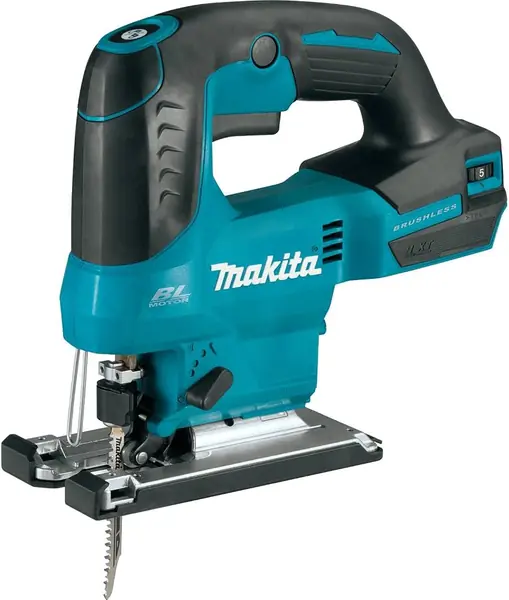
Two features separate this Makita from the XVJ03Z: a built-in LED and a soft no-load start that spins the blade up gradually as it enters the wood. On a finish cut the second one matters more than the first, because the blade settles into the line instead of slapping down onto it and chipping the edge.

Behind that sits a brushless motor running 0 to 3,000 strokes per minute, three orbital settings plus straight cutting, and 4.3 pounds of saw, nearly two pounds lighter than the XVJ03Z. Blade changes are a twist of the collar, the shoe bevels to 45 degrees, and the trigger falls naturally under two fingers.

We rate it the better Makita for finish work: lighter, brighter, and gentler at the start of a cut. The one thing to know is the safety switch, which takes firm thumb pressure every time you pick the saw up, and it gives up some of the XVJ03Z's planted feel on heavy stock to get there.

Worth Noting

  • Safety switch takes firm thumb pressure
Our Verdict

The Makita to choose if you want a work light and a gentler start; the XVJ03Z is still the steadier cutter.

Check Latest Price
8.

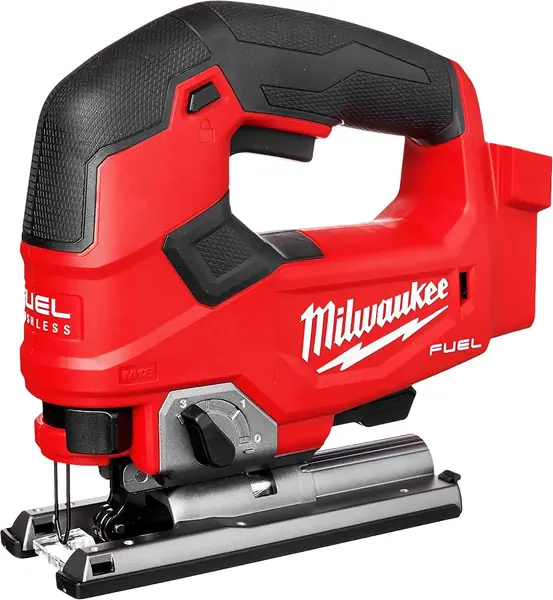
Milwaukee M18 FUEL D-Handle Jig Saw Best for M18 Battery Owners

Milwaukee M18 FUEL jigsaw in red and black with a D-handle grip

M18 battery owners

Shop Score 90/100
Grip
D-handle
Included
Bare tool only
Battery Platform
Milwaukee M18
View on Amazon

If your shop already runs on red packs, the decision is close to made for you: this is the M18 jigsaw, it ships as a bare tool, and it drops onto the batteries your drill and impact already use.

The D-handle layout is the familiar one — a top grip you can lean your weight into, a trigger under the index finger, and the shoe out front where the cut line is. We like that shape for bench work, shelving, and sink cutouts, where you are pushing down on the saw rather than steering it around a pattern.

Milwaukee calls the motor FUEL, which is its brushless line, and the tool carries the same red-and-black build as the rest of the M18 range. Beyond that, the case for it is the battery rather than the badge: the pack that runs your drill runs this saw, and one charger keeps the whole kit working.

So the arithmetic is simple. Switching systems for one saw is a bad trade, and an M18 shop does not have to — the saw drops onto the packs already on the shelf. We are glad it exists for that buyer, and we do not push anyone else toward it.

Worth Noting

  • Costs more than the DEWALT XR here
Our Verdict

An easy call if your shop already runs on M18 packs, and a hard one to justify if it does not.

Check Latest Price

How We Tested Cordless Jigsaws

We started with every cordless jigsaw we could get our hands on, then sorted by battery platform and by whether the saw ships bare or as a kit, because those two facts decide what you'll pay before the saw cuts anything. From there we narrowed by handle style, blade shank, weight, and how the shoe adjusts, and landed on 11 saws.

Testing ran eight months, mostly in a garage shop with a few weekend trim and deck jobs mixed in. Every saw cut clamped 3/4-inch plywood, pine, PVC trim, and a laminate countertop sink cutout, and each one coped crown molding, which is the cut that punishes a wandering blade fastest.

To judge cut quality we cut a straight line freehand and measured how far the blade drifted from the pencil line at both ends, then checked the shoe with a machinist square after beveling and returning it to zero. Blade changes were timed with a stopwatch, with the battery pulled first every time. Gloves on, we noted whether the power switch fell under a thumb without the saw leaving the cut.

Runtime we measured in feet of cut rather than minutes, running each saw through plywood until the pack quit. We also watched the sight line: some saws throw dust straight across it, and a couple of LED lights washed out the line more than they lit it. Every piece was clamped, eye protection stayed on, and both hands stayed on the saw.

How to Choose a Cordless Jigsaw

Start With the Batteries You Already Own

Every saw here except the Seesii ships without a pack, so the first question is not which saw but which battery you run. A bare tool from your own platform is almost always the better buy: one charger, one format, and no orphan cells rattling in a drawer. A kit makes sense only when you own nothing at all, and then look hard at what comes with it, because a kit built around a small pack and a slow charger has you waiting more than cutting.

The exception is a saw whose batteries fit nothing else you own. That is fine for a first tool or a spare, and a bad idea for the saw you plan to run every weekend.

Read Stroke Speed and Orbital Settings Together

Stroke speed is how many times the blade travels up and down in a minute. Orbital action is how far the blade is thrown forward on the upstroke, and it changes the cut more than the speed figure does: low or off for laminate, veneer, and any edge that shows, high for fast rips in framing lumber.

The saws here run from 2,500 to 3,200 strokes per minute, and the top figure is not a quality ranking. You will rarely cut hardwood at full speed, and a slower, steadier stroke usually leaves a cleaner face.

Handle Style and Weight Decide How Long You Can Work

A D-handle gives you a place to push down and keeps your hand behind the blade. A barrel grip wraps your hand around the body, close to the work, which is why trim carpenters reach for it when they cope. Weight runs from about 4.2 pounds to 6 here. Lighter is easier overhead and inside a cabinet; heavier steadies the saw on a bench.

A jig saw that fights its own weight in the air is the one that stays in the case, so be honest about whether you cut at a bench or above your head.

Blades, Clamps, and Bevel Stops

Most saws here take T-shank blades only; the CRAFTSMAN accepts T- and U-shank, which keeps an older blade collection usable. Keyless clamps are standard at this level, but the mechanism differs, and a lever beats a twist collar when your hands are cold or gloved.

Check that the shoe bevels in the direction you need and that it detents positively at zero. A shoe sitting a degree off square cuts a taper you will only notice once the piece is installed.

What Keeps a Cut Straight

Straightness comes from three things: a stiff blade guide near the shoe, a base machined flat, and your own patience. Wander shows up on the back side of a curve, where a long or dull blade leans off the line under feed pressure.

Use the shortest blade that clears the thickness, ease off as the blade exits, and check the shoe against the blade with a square before any cut that shows.

Frequently Asked Questions

Final Verdict

We recommend the DEWALT DCS334B for most woodworkers: 3,200 strokes a minute, 4.2 pounds, four orbital settings, and a brushless motor that keeps the blade moving through hardwood without leaning on the pack. It is the most complete combination of speed, weight, and control in this group, and it runs on the battery system a lot of shops already own.

Two situations push you elsewhere. If you cope trim and cut curves by eye, the barrel-grip DCS335B is worth its premium. If you own no batteries at all, the Seesii kit gets you cutting for less than most of the bare tools here.