↑↓ navigate ↵ open Esc close All results →

Best DEWALT Circular Saws of 2026

A circular saw decides how the rest of a project goes. A clean cut through plywood saves an hour of sanding; a saw that bogs down mid-rip turns a Saturday into a fight. The confusing part isn't quality here — it's matching the saw to batteries you already own and knowing whether the box holds a tool alone or a tool with a battery and charger.

Building a shed last spring meant days of overhead work between joists, which sorts saws fast. Over eight months we ran eight saws through plywood, 2x4s, and OSB — on sawhorses in a driveway, on subfloor, and in spots too tight for a full-size saw. We timed blade changes, ran batteries flat to count linear feet, and held each saw overhead until our arms complained.

Blade size, not voltage, sets your real depth of cut: a 6-1/2-inch saw won't crosscut a 2x4 at 45 degrees in one pass. Keep that in mind as you read — the picks below run from corded power to a trim-sized saw built for overhead work.

Our Top Picks

The Best DEWALT Circular Saws

1.

DEWALT DWE575SB Circular Saw Best Overall
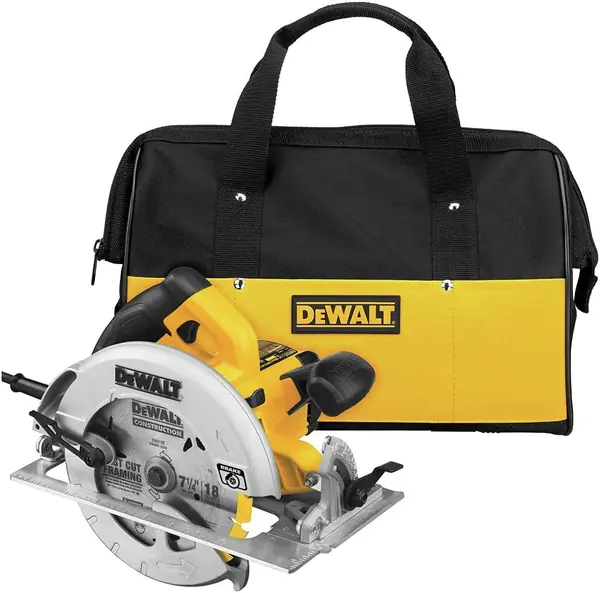
DEWALT DWE575SB corded circular saw in yellow with blade and contractor bag

Corded all-around cutting

Shop Score 97/100
Weight
8.8 lb
Blade Size
7-1/4 inches
Motor
15 A
Bevel Capacity
57 degrees
View on Amazon

At 8.8 pounds, the DWE575SB is one of the lighter full-size corded saws we handled, and its 15-amp motor is the reason it can keep a 7-1/4-inch blade moving through framing lumber. The 5,200 rpm speed and 2-9/16-inch depth at 90 degrees cover the cuts most woodworkers make, while the 57-degree bevel range lets you tip the shoe for chamfers and trim. DEWALT also includes a carbide-tipped blade and a contractor bag, so it is ready to work without a separate blade purchase.

We recommend it as the default DEWALT circular saw because it gives you full-size capacity without asking you to buy into a battery platform. The electric brake is a detail we appreciate every time we set the saw down; the blade stops quickly after the trigger is released. We also like the bevel stops at 45 and 22.5 degrees, which make repeat angle cuts less fussy. For a woodworker who wants one saw for framing, sheet goods, and trim, this is the most straightforward place to start.

The body feels balanced at the handle, and the shoe gives it a solid reference against the work. We did not find the weight tiring for bench work or deck cuts, and the corded design means no battery to manage. For a woodworker who wants a full-size saw without a battery platform, the DWE575SB is the straightforward choice: powerful, light for its class, and easy to live with.

Worth Noting

  • Cord restricts use away from outlets
Our Verdict

We recommend the DWE575SB as the default DEWALT circular saw for most woodworkers because it pairs full-size capacity with corded power, low weight, and an electric brake.

Check Latest Price
2.

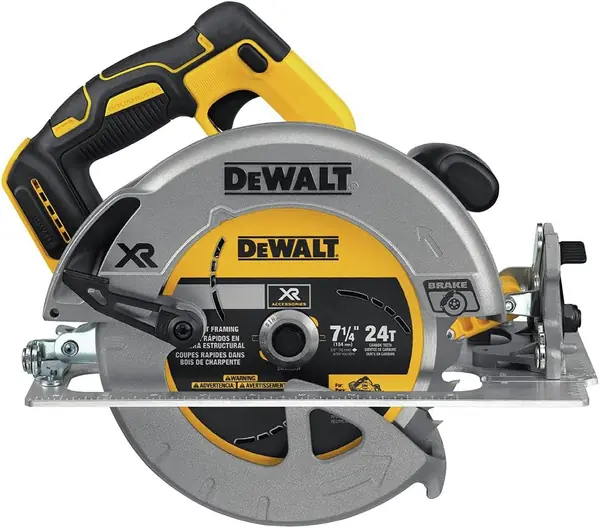
DEWALT DCS570B 20V Circular Saw Best Cordless Full-Size

DEWALT DCS570B 20V cordless circular saw in black and yellow with 7-1/4-inch blade

Cordless full-size cutting

Shop Score 96/100
Weight
7.5 lb
Blade Size
7-1/4 inches
Voltage
20 V
Max Depth At 90
2-9/16 inches
View on Amazon

The DCS570B is the cordless saw we recommend when you want a full-size 7-1/4-inch blade without giving up depth or a brake. Its brushless motor turns at 5,500 rpm, and the saw cuts 2-9/16 inches deep at 90 degrees, matching the corded DWE575SB on capacity. That makes it a real substitute for a plug-in saw on framing and sheet goods, not just a trim tool.

We like that it weighs 7.5 pounds, so it is actually lighter than the corded top pick, and the rubber overmolded grip gives you a secure hold when you are reaching across a sheet. The electric brake stops the blade after the trigger is released, and the 57-degree bevel capacity covers the angles most deck and trim work calls for. DEWALT rates it at 330 crosscuts in 2x4 pine, which is a useful benchmark for planning battery swaps.

The saw is tool-only, so the value depends on the 20V batteries and charger you already own. If you are starting from nothing, compare the total kit cost against the corded DWE575SB before you commit. For anyone already on the 20V platform, though, this is the full-size cordless saw that makes the most sense: it has the depth, the brake, and the balance to handle framing and plywood without a cord.

Worth Noting

  • Early brake or motor failures can occur
Our Verdict

For buyers already on DEWALT's 20V platform, we think the DCS570B is the cordless saw to get when you want 7-1/4-inch capacity and a brake without a cord.

Check Latest Price
3.

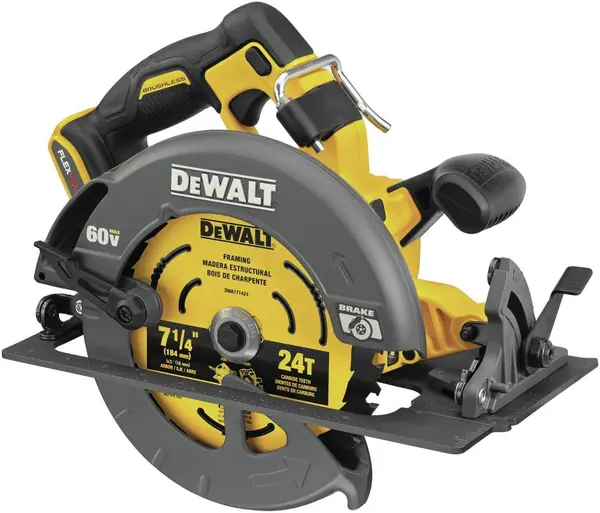
DEWALT DCS578B FlexVolt Circular Saw Best for Heavy Cutting

DEWALT DCS578B FlexVolt 60V circular saw with 7-1/4-inch blade and wrench

Heavy cordless cutting

Shop Score 95/100
Weight
8.2 lb
Blade Size
7-1/4 inches
Voltage
60 V
Speed
5,800 rpm
View on Amazon

The DCS578B is the closest thing to a corded saw in this cordless group, with a 60V FlexVolt battery and a 5,800 rpm motor aimed at dense lumber and repeated rips. DEWALT lists 2,456 unit watts out and a 7-1/4-inch blade with 2-9/16-inch depth at 90 degrees, so it has the capacity to match a full-size corded saw. The 57-degree bevel range and electric brake are the same useful features we look for on any full-size saw.

We reach for it when the cut is demanding and a cord is still out of the question. The brushless motor keeps its speed under load, and the integrated LED helps you follow a line in dim light. At 8.2 pounds it is heavier than the 20V saws, but the mass feels planted when you are pushing through wet lumber or engineered beams. The catch is the battery: this saw runs on 60V FlexVolt packs, so it is a separate investment if your shop is built around 20V tools.

We also appreciate the electric brake on a saw with this much momentum; it stops the blade quickly when you release the trigger, which matters when you are moving between cuts on a deck. The 7-1/4-inch blade is the common size, so you can swap in a fine-tooth blade for finish work without hunting for a specialty size. If you already own FlexVolt packs, it is the heavy-cutting cordless saw that earns its place.

Worth Noting

  • Battery life varies under heavy cuts
Our Verdict

We reach for the DCS578B when the cut is dense, repeated, or too demanding for a 20V saw and a cord is still out of the question.

Check Latest Price
4.

DEWALT DCS565B 20V Circular Saw Best Lightweight Cordless

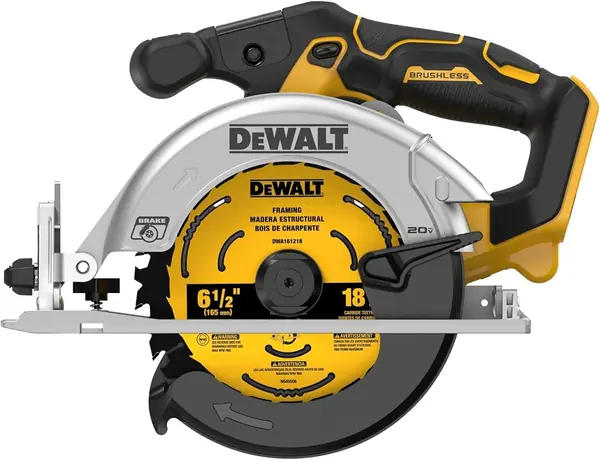
DEWALT DCS565B 20V brushless circular saw in yellow with rafter hook and LED

Overhead and trim

Shop Score 94/100
Weight
6.3 lb
Blade Size
6-1/2 inches
Voltage
20 V
Max Depth At 90
2-1/8 inches
View on Amazon

The DCS565B is built for the cuts you make above your shoulders, and its 6.3-pound body and rafter hook are the clues. A 6-1/2-inch blade keeps the saw compact, while the brushless motor turns at 4,950 rpm and cuts 2-1/8 inches deep at 90 degrees. The 50-degree bevel range is adjusted with a tool-free lever, which is a nice detail when you are changing angles between rafters.

We like the built-in LED for following a pencil line in a dim garage or under a deck, and the optional dust chute gives you a way to connect an extractor when the dust matters. The electric brake stops the blade quickly, and the rafter hook lets you hang the saw within reach instead of setting it on the work. At 6.3 pounds, it is easy to control one-handed for quick trim cuts.

We recommend it for roof work, trim, and punch-list cuts where a full-size saw feels clumsy. The trade-off is depth: a 6-1/2-inch blade cuts 2-1/8 inches at 90 degrees, so thick beveled cuts and deep framing belong on a 7-1/4-inch saw. If your work is mostly overhead or one-handed, that is a fair exchange for the lighter body.

Worth Noting

  • Tool-only; battery and charger sold separately
Our Verdict

We like the DCS565B for roof work and trim because it is light, braked, and easy to control overhead.

Check Latest Price
5.

DEWALT DCS391B 20V Circular Saw Best for Budget Light-Duty Jobs

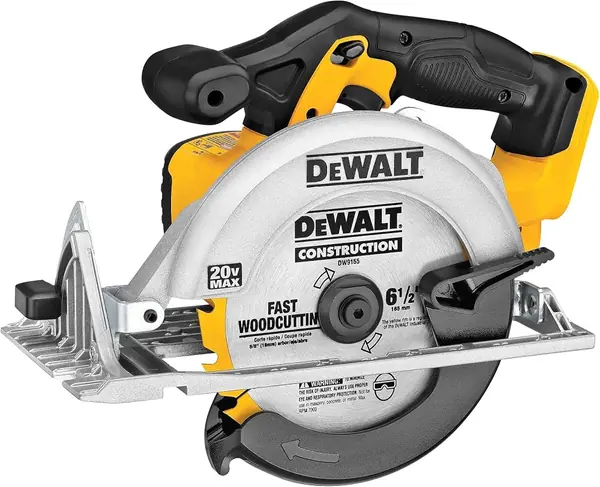
DEWALT DCS391B 20V circular saw in yellow with 6-1/2-inch blade and grip

Budget light-duty jobs

Shop Score 93/100
Weight
6.97 lb
Blade Size
6-1/2 inches
Voltage
20 V
Speed
5,150 rpm
View on Amazon

The DCS391B is the least expensive way into a DEWALT 20V circular saw in this group, but it still gives you a 6-1/2-inch blade, a 5,150 rpm motor, and a 50-degree bevel. At 6.97 pounds, it is light enough to carry around a house or up a ladder, and the rubber overmolded grip makes it comfortable for quick cuts. The keyless blade change is a real convenience when you switch between a framing blade and a finer trim blade, and the magnesium shoe gives the saw a stable base. It also comes with a blade and hex key.

We see it as the budget cordless saw for trim, plywood, and light framing. The 6-1/2-inch blade is easier to manage than a 7-1/4-inch saw, and the 50-degree bevel covers simple angles. The smaller blade also makes it less intimidating for a homeowner breaking down a sheet of plywood on sawhorses. If you already own 20V packs and want a second saw for smaller jobs, it earns its place.

Worth Noting

  • Battery life drops in continuous cuts
  • Blade depth limits thick stock
Our Verdict

We see the DCS391B as a sensible budget cordless saw for light trim and plywood jobs.

Check Latest Price
6.

DEWALT DCS571B Atomic Circular Saw Best for Tight-Space Work

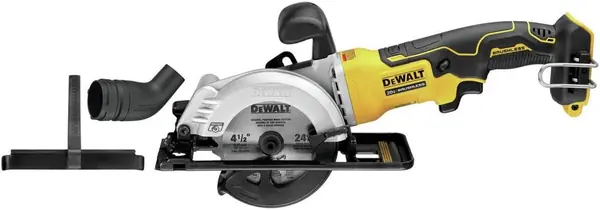
DEWALT DCS571B Atomic 20V compact circular saw in black with rip fence

Tight-space work

Shop Score 92/100
Weight
6.6 lb
Blade Size
4-1/2 inches
Voltage
20 V
Runtime
369 linear ft. of 3/4-inch OSB with DCB205
View on Amazon

The DCS571B is the saw we pick when a full-size circular saw will not fit, and its 4-1/2-inch blade and 6.6-pound body are why. DEWALT's bevel gear design lets it cut 2x material at 90 degrees and 1x material at 45 degrees, so it can handle quick framing cuts and trim in tight spots. The removable auxiliary handle adds control when you need two hands, and the hang hook keeps it close on a ladder.

We like the on-board blade key storage because blade changes are less likely to stall when the wrench is part of the tool. The 1-1/2-inch finger trigger lets you choke up for one-handed work, and the rip fence is useful for narrow rips. It is the one we reach for in a cabinet, closet, or overhead space where a full-size saw is too much.

The brushless motor is rated to cut 369 linear feet of 3/4-inch OSB with a DCB205 battery, which is a useful figure for planning a run of shelving or deck boards. We also appreciate the dust port adaptor for connecting a shop vac, since compact saws can throw a surprising amount of dust in a small room. For tight-space work, that combination of size and control is what sells it.

Worth Noting

  • Blade depth limits thick stock
  • Rip fence does not work under 1/4 inch
Our Verdict

We keep the DCS571B in mind for one-handed cuts and cramped work areas where a full-size saw simply will not fit.

Check Latest Price

How We Tested the Best Circular Saws

We started with every corded and cordless circular saw in the current lineup, then narrowed the field by blade size, battery platform, whether a battery and charger came in the box, and what each one costs relative to the batteries a buyer might already own. We brought in eight saws and ran them for eight months.

They cut 2x4s and pressure-treated 2x6s on sawhorses in a driveway, ripped 3/4-inch plywood on a subfloor, trimmed doors, and made overhead cuts between joists, where weight matters most. We noted which saws bogged down in wet lumber, how quickly the front end dipped when we held a saw up at arm's length, and whether we could follow a pencil line past the front of the shoe.

Before any blade change we unplugged the corded saws or pulled the battery from the cordless ones, then timed the swap with the onboard wrench, gloves on, and checked whether the spindle lock was easy to reach. We timed how long each blade took to spin down after the trigger came off, set every bevel to 45 degrees and checked it against a speed square, and measured depth of cut on scrap at 90 and 45. For runtime, we ran a fresh battery through 3/4-inch OSB until the saw quit and counted the linear feet.

Eight months of regular use showed which shoes stayed flat, which bevel detents loosened up, and which cords picked up nicks. Throughout, we supported stock on sawhorses, kept both hands on the saw with the cord routed behind us and clear of the cut line, and wore eye and hearing protection every time.

How to Choose a DEWALT Circular Saw

Corded or Cordless: Start With the Battery You Own

A corded saw like the DWE575SB gives you full power without batteries, and it is the simplest choice if your work stays near an outlet or a long extension cord. Cordless models ask a different question: do you already own DEWALT 20V or 60V packs? If you do, a tool-only saw is the efficient buy. If you do not, budget for batteries and a charger, because tool-only listings do not include them. We prioritize the platform you can share across tools over a small difference in specifications.

Blade Size Sets the Real Depth of Cut

A 7-1/4-inch saw is the full-size standard for framing and sheet goods, with 2-9/16 inches of depth at 90 degrees on the DWE575SB, DCS570B, and DCS578B. A 6-1/2-inch saw such as the DCS565B cuts 2-1/8 inches at 90 degrees; the DCS391B is in the same blade class and is easier to handle for trim and plywood. The 4-1/2-inch DCS571B is for tight spaces and one-handed cuts. The trap is beveling: depth drops as you tilt the shoe, so a cut that works at 90 degrees may not clear at 45.

Weight and Balance Matter More Overhead

The scale weight tells only part of the story, but it is a useful start: the DCS565B is 6.3 pounds, the DCS570B is 7.5 pounds, and the DWE575SB is 8.8 pounds. A lighter saw is easier to control on a roof or while reaching across a sheet, while a heavier full-size saw can feel more planted in thick stock. We also look for a rafter hook, an LED, and a comfortable grip because those details matter when you are working in dim light or changing positions often.

Brakes, Bevels, and Blade Changes

An electric brake is worth having on any circular saw, and every full-size pick here has one. It stops the blade after you release the trigger, which makes moving between cuts less rushed. Bevel capacity separates the saws: the DWE575SB, DCS570B, and DCS578B go to 57 degrees, while the DCS565B and DCS391B stop at 50 degrees. Look for detents at 45 and 22.5 degrees if you cut repeat angles, and check whether the bevel adjustment is tool-free or needs a wrench.

Batteries, Runtime, and What Comes in the Box

Battery size changes both runtime and balance. A compact pack keeps a 6-1/2-inch saw light for trim, while a larger pack is the better match for ripping plywood or cutting repeated 2x stock. DEWALT rates the DCS570B at 330 crosscuts in 2x4 pine and the DCS571B at 369 linear feet of 3/4-inch OSB with a DCB205 battery, but those figures assume a sharp blade and clean wood. We prefer to buy a tool-only saw when we already own packs, and a kit when we are starting fresh.

Frequently Asked Questions

Final Verdict

Start with the DWE575SB if you cut near an outlet. It gives you full 7-1/4-inch capacity, a 15-amp motor, an electric brake, and an 8.8-pound body for less than the premium cordless saw. If you are already on DEWALT's 20V platform and need to cut away from power, the DCS570B is the cordless equivalent we recommend; it matches the corded saw's depth and adds brushless efficiency and a brake. For overhead work, the lighter DCS565B is the one we reach for.