↑↓ navigate ↵ open Esc close All results →

Best Mini Circular Saws of 2026

A mini circular saw is a trade you make on purpose: you give up the deep cuts of a full-size saw for a tool you can carry up a ladder and steer with one hand. That trade pays off on trim, shelving, and panel work — until the base lifts off the board mid-cut, when you learn a light saw needs a clamped workpiece and both hands. What a good one fixes is reach: it gets into cabinets, closets, and overhead spots where a full-size saw won't fit.

We tested 11 compact saws over eight months, cutting plywood, door slabs, and PVC trim, and we watched the tenth cut as closely as the first. What separates them isn't top-end power or the laser line, which drifts — it's how much depth survives a bevel and whether the saw still tracks a clamped straightedge after a morning's work. Corded, cordless kit, or bare tool, the seven below held their depth and felt steady in one hand. None of them will replace a full-size saw; every one of them will save you dragging it out.

Our Top Picks

The Best Mini Circular Saws

1.

DEWALT ATOMIC DCS571B 4-1/2-Inch Circular Saw Best Overall
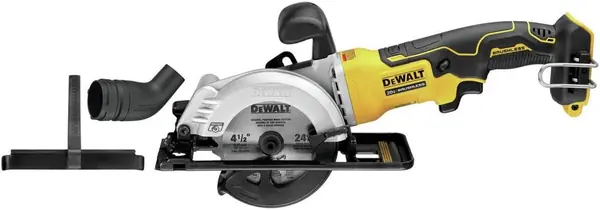
DEWALT ATOMIC 20V MAX brushless 4-1/2-inch circular saw with removable auxiliary handle

All-around shop use

Shop Score 95/100
Blade Size
4-1/2 in.
Weight
6.6 lb
Bevel Capacity
0-45 degrees
Max Cut At 90 Degrees
2x material
View on Amazon

Cross-cutting a 2x4 with a 4-1/2-inch blade is the trick this saw pulls off, and it is why the ATOMIC is our top pick. The bevel-gear layout leaves enough blade under the base to take 2x material at 90 degrees and 1x stock at 45, so the repair jobs that used to mean dragging out a full-size saw stay on the small tool. Run time is rated at up to 369 linear feet of 3/4-inch OSB on a DCB205 pack, which covers a long afternoon of deck work.

What we kept noticing is how the saw behaves at the line. The base adjusts without a fight and holds its setting, and the blade sits where you can watch it meet the mark, so following a pencil line across plywood does not turn into a squint. The removable auxiliary handle is the detail we did not expect to lean on and now do: on longer rips it turns a wandery one-hand cut into something you can steer, and it comes off when you want a narrow body for a plunge into a floor patch.

The small conveniences are right too. The blade key stores on board, the hang hook keeps the saw off the bench, the dust port adaptor takes a shop vac hose, and the long trigger lets you choke up on the grip for overhead work. Anyone already running DeWalt 20V packs gets the most out of it, and gets, we think, the best compact circular saw in this group.

Worth Noting

  • Tool only; battery and charger sold separately
  • Heavy at 6.6 lb for one-handed work
Our Verdict

We recommend it to anyone who needs a small saw that still cross-cuts 2x stock, and who already runs DeWalt's 20V batteries.

Check Latest Price
2.

Rockwell RK3441K 4-1/2-Inch Compact Circular Saw Best Corded

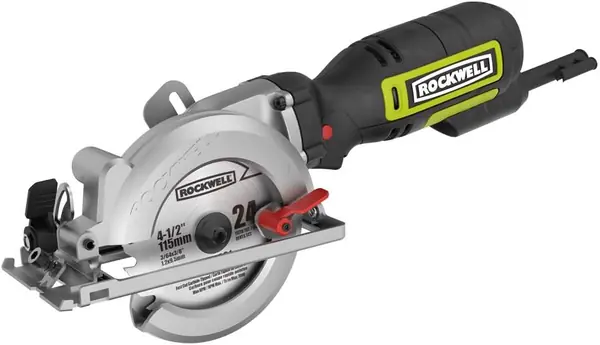
Rockwell RK3441K compact circular saw in black with left-side blade housing and rear motor

Corded cutting power

Shop Score 92/100
Blade Size
4-1/2 in.
Weight
5 lb
Speed
3,500 rpm
Bevel Capacity
0-45 degrees
View on Amazon

The blade on the RK3441K hangs on the left side of the motor housing, and that placement changes how the saw feels in use: the cut line sits right in front of you instead of behind a shoe full of dust. Trimming paneling already on a wall, notching a cabinet back, or running a short cut across a laminate countertop, we could watch the teeth meet the pencil mark without leaning around the tool.

The rear motor is the other half of what we like about it. Most of the mass sits over your palm rather than out at the nose of the base, so the saw balances instead of diving, and the 5-amp motor spins the 4-1/2-inch blade at 3,500 rpm, which is enough to take a 2x4 in a single pass. The thinner kerf of the small blade asks less of the motor, so it does not bog the way you might expect from five amps.

Depth and bevel levers fall under your thumb, the spindle lock makes a blade change quick with the included key, and the parallel guide and vacuum adapter are in the box rather than on a wish list. It is corded, so you trade a battery for an outlet and get a body that never sags in the middle of a cut. The three-year warranty is a nice thing to have on a tool that lives under a bench.

Worth Noting

  • Corded; needs an outlet at the work site
Our Verdict

Buy this one if you want corded power and a clear view of the blade; nothing else here makes the cut line this easy to follow.

Check Latest Price
3.

Makita SH02R1 12V max CXT 3-3/8-Inch Circular Saw Kit Best for Tight Spaces

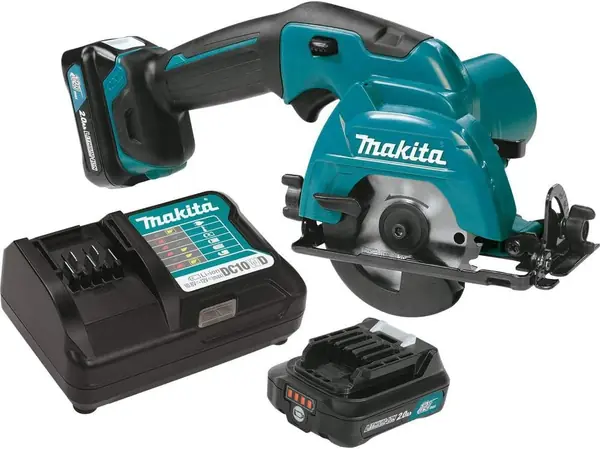
Makita SH02R1 12V max CXT 3-3/8-inch circular saw kit with two batteries and charger

Overhead and trim

Shop Score 91/100
Blade Size
3-3/8 in.
Weight
3.5 lb
Max Depth At 90 Degrees
1 in.
Included
Two 2.0Ah batteries and charger
View on Amazon

At 3.5 pounds with a 2.0Ah battery aboard, the SH02R1 is the lightest saw in this group, and the difference is obvious the first time you hold it one-handed above your head. The 3-3/8-inch blade and 1-inch maximum depth at 90 degrees put it firmly in trim-and-sheeting territory: plywood, MDF, pegboard, particleboard, melamine, and drywall are all fair game.

We reach for it on the cuts where a full-size saw is simply too much tool, like trimming a cabinet back panel, notching a scrap of quarter-inch ply, or opening up a patch in drywall. The 12V motor is no powerhouse, and in thicker hardwood it wants a slow, even push rather than a shove; feed it gently and the cuts come out clean and square. Two batteries and a charger come in the kit, so one pack is always on the dock.

The rest of the design is thought through for small work. Depth runs from 1 inch at 90 degrees down to 5/8 inch at 45 on a tilting base, blade changes are simple, and the packs carry their own LED charge indicator, which we ended up checking more often than expected. Nothing here is easier to carry up a ladder.

Worth Noting

  • One-inch depth rules out 2x lumber
Our Verdict

For trim, paneling, and cuts made overhead, we have not found a lighter, tidier option than this 3.5-pound kit.

Check Latest Price
4.

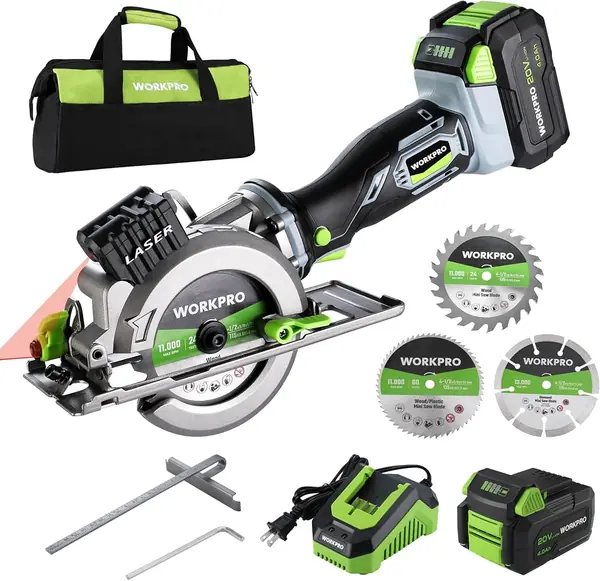
WORKPRO 20V 4-1/2-Inch Cordless Mini Circular Saw Best Cordless Kit

WORKPRO 20V cordless 4-1/2-inch mini circular saw in gray with battery, charger, and blades

Cordless convenience

Shop Score 89/100
Blade Size
4-1/2 in.
Max Depth At 90 Degrees
1-11/16 in.
Speed
4,500 rpm
Battery
20V 4.0Ah, charger included
View on Amazon

Buy the WORKPRO and you can cut the day it arrives: a 4.0Ah 20V battery, a fast charger, three blades, a parallel guide, a dust tube, and a storage bag all come in the box. That completeness is the whole argument for it against a bare tool, where the sticker looks smaller until you price the packs and charger you still need.

The numbers hold up as well. A 4,500 rpm motor and 1-11/16-inch depth at 90 degrees put it past the 2x lumber threshold, and depth and bevel adjustments move without hunting for a wrench. The laser is bright enough to be useful indoors, the parallel guide clamps to the base for rips, and the 60-tooth and diamond blades let one saw handle trim and a tile repair.

What we noticed most is how little ceremony there is in using it: pick it up, squeeze the trigger, and the cut is done without running an extension cord across a finished floor. The trade is run time, because the saw works a 4.0Ah pack hard and long ripping sessions will send you back to the charger. For decking, trim, and punch-list work between charges, we think it is the smartest cordless buy here.

Worth Noting

  • Run time fades during long rips
Our Verdict

The cordless kit we point first-time buyers to: battery, charger, and three blades arrive together, so there is nothing else to buy.

Check Latest Price
5.

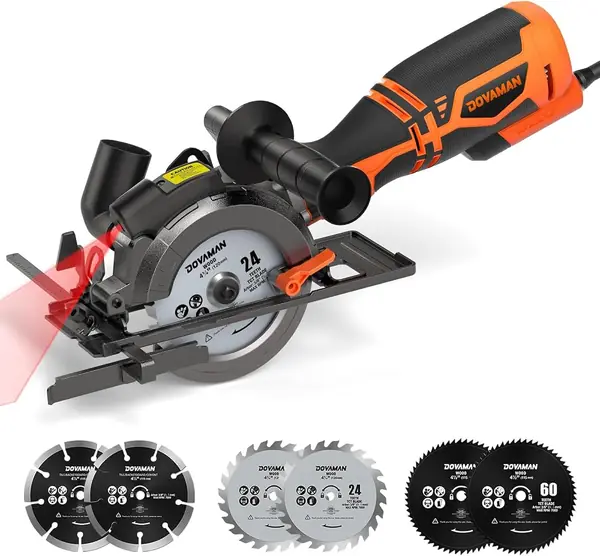
DOVAMAN MCS01A 4-1/2-Inch Circular Saw Best Budget

DOVAMAN MCS01A corded mini circular saw in orange with extra blades and auxiliary handle

Mixed-material projects

Shop Score 88/100
Blade Size
4-1/2 in.
Weight
8.6 lb
Max Depth At 90 Degrees
1-11/16 in.
Amps
5.8 amps
View on Amazon

Six blades for a budget price is the deal the MCS01A offers, and the spread is genuinely useful: two for wood, two for soft metal and plastic, two for tile. We think that assortment makes it the best value in this group for anyone whose projects wander across materials, a tile backsplash one weekend and plywood shelving the next, without a separate blade purchase before the first cut.

The 5.8-amp motor turns 3,700 rpm, and the base is a generous 3.5 by 9.5 inches, which is the part we appreciated most: a wide shoe stays flat on the workpiece and resists the tilt that makes small saws wander off a line. Depth reaches 1-11/16 inch at 90 degrees, so 2x stock is in range, and the metal auxiliary handle mounts on either side for left- or right-handed control.

Bevel changes take two steps and the depth lever is tool-free, so going from a 90-degree crosscut to a 45-degree miter does not send you looking for a wrench. The laser and edge guide want a clamped workpiece and a little patience to be useful. Buy it as the one small saw in a home shop and it will cover more ground per dollar than anything else on this page.

Worth Noting

  • 8.6 lb is a lot for one-handed work
Our Verdict

A lot of saw for a budget price: six blades and a rock-steady base make it the value pick for mixed-material projects.

Check Latest Price
6.

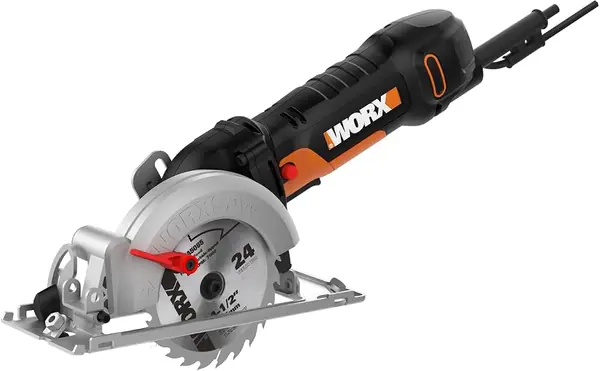
WORX WX439L 4-1/2-Inch Compact Circular Saw Best for Quick One-Hand Cuts

WORX WX439L 4-1/2-inch compact one-hand circular saw with depth-adjust lever

Quick one-hand cuts

Shop Score 87/100
Blade Size
4-1/2 in.
Weight
4 lb
Speed
4,100 rpm
Max Cutting Depth
2 in.
View on Amazon

Two inches of cut is an unusual claim for a 4-1/2-inch saw, and the WX439L backs it with a 4.5-amp motor turning 4,100 rpm, the fastest spindle in this group. Depth is what makes it interesting: enough to bury the blade in a 2x4 and, on the maker's numbers, slice through stock lumber in one pass.

The body is built around one hand. It is slim through the middle, the grip sits high, and the depth lever falls under your palm so you can reset depth without letting go. Bevel runs to 45 degrees, the spindle lock makes a blade change quick, and there is a dust port at the back of the base for a vac hose.

We like it for the cuts that do not deserve a setup: a deck board a whisker long, a piece of siding, a shelf trimmed in place. That is also where its limits show, because the saw can bind and stall in thicker plywood, and it rewards a slow feed and a clamped workpiece over a rushed one. Light, quick work suits it; all-afternoon ripping does not.

Worth Noting

  • Grip is a stretch for smaller hands
Our Verdict

Worth a look if most of your cuts are quick ones in the yard, provided your hands are not on the small side.

Check Latest Price
7.

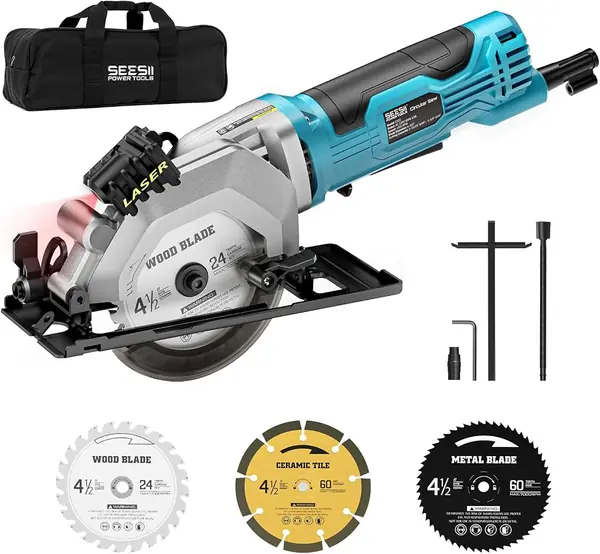
SEESII CS00 4-1/2-Inch Corded Mini Circular Saw Best for Trim and Panels

SEESII CS00 corded mini circular saw in blue with laser guide, blades, and dust hose

Trim and panels

Shop Score 84/100
Blade Size
4-1/2 in.
Weight
4.7 lb
Max Depth At 90 Degrees
1-11/16 in.
Amps
4.8 amps
View on Amazon

A dust hose, a collection bag, and a storage case come with the CS00, small extras that saws in this price range usually leave you to buy separately, and the difference between a tool you keep tidy and one that sprays chips across the bench. Hook the hose to a shop vac and most of the mess goes where it should instead of into the air.

The blade set is more generous than the price suggests: a carbide-tipped blade for general work, a fine-tooth blade for wood and plastic, and a diamond blade for tile. The 4.8-amp motor turns 4,000 rpm and the depth lever reaches 1-11/16 inch at 90 degrees, with a 45-degree bevel for miters and a double-switch start that takes a deliberate two-finger squeeze.

At 4.7 pounds it is one of the lighter corded saws here, and the trim body slips into cabinet openings and between joists where a 7-1/4-inch saw will not go. The laser helps on longer rips, the rip guide clamps to the base, and small hands should find the handle manageable.

Think of it as a second saw rather than a first. It is happiest on paneling, trim, PVC, and tile, where the cut is short and the material thin, and it gives up ground quickly once you start leaning the base over in thick stock. Buy it for small jobs around the house and it will hold up its end.

Worth Noting

  • Bogs down in wide bevel cuts
Our Verdict

A light corded saw for trim and sheet goods; keep the bevels shallow and it earns its low price.

Check Latest Price

How We Tested the Best Mini Circular Saws

We started with a spec sweep — blade diameter and arbor size, so replacement blades would be easy to find, then power source (corded, cordless kit, or bare tool) and price — and bought 11 saws to run side by side for eight months. Each one cut the same plywood shelving, door slabs, and PVC trim, plus a little soft metal, with every piece clamped to the bench or sawhorses, eye protection on, and both hands on the tool.

Depth of cut was the first measurement, since it's the thing these saws run out of fastest. We cut a marked board with the base flat, then cut it again with the base tilted to 45 degrees and measured how much capacity disappeared at the angle — a difference that decides whether a saw can handle a beveled apron or a door edge. Weight went on a kitchen scale, then into a run of cuts to see whether the grip closed comfortably in smaller hands and whether one-handed control held up through overhead work.

We ran every saw along a clamped straightedge to watch for wander, noted which side of the shoe the blade sits on and how much of the cut line you can actually see, and timed depth and bevel changes with a stopwatch, recording whether each adjustment needed a wrench. Cordless run time came from cutting the same stack of plywood until each battery quit or the motor bogged.

Before every session we checked the blade bolt and confirmed the lower guard snapped back freely, and we hooked each dust port to a shop vac to see how much grit ended up on the bench instead of in the hose. The starter kits got unpacked and used — extra blades, blade changes, storage bags — because a bundle only counts if the parts are worth carrying.

How to Choose a Mini Circular Saw

Start With Depth of Cut

Maximum depth at 90 degrees is the first spec to compare. A 1-inch saw such as the Makita SH02R1 lives in sheet goods and trim. Anything at 1-11/16 inches clears a 2x4 on paper, which is where the WORKPRO, DOVAMAN, and SEESII sit, while the DeWalt ATOMIC and the Rockwell are rated to take 2x material in a single pass.

Remember that depth shrinks at 45 degrees, where the Makita drops to 5/8 inch, so a saw that sails through a 2x4 flat may not carry a bevel through the same board. If bevels matter to the job, make the first one in scrap before you commit to a long cut.

Corded, Cordless Kit, or Bare Tool

There are three ways to buy, and the sticker price only describes one of them. A corded saw like the Rockwell or the DOVAMAN gives you the most power per dollar and never needs a charging cycle, at the cost of a cord. A cordless kit, like the WORKPRO or the Makita, puts batteries, charger, and blades in the box at one price.

A bare tool looks cheapest and is often the most expensive first purchase: the DeWalt DCS571B ships without a battery or charger, so add the cost of a pack and charger before you compare it with anything else, unless you already run that battery platform.

Weight, Grip, and One-Handed Control

The saws here run from 3.5 to 8.6 pounds, and where you will use one decides how much that matters. Overhead work, ladder work, and one-handed cuts inside a cabinet favor the light end. Bench work favors a heavier saw with a wide shoe, because mass and base area are what keep a small blade from chattering.

Grip size is the spec nobody prints. A handle that fits your hand matters more than a pound of weight, and the WORX in particular runs large, which is the reason to hold a saw before you order if there is a display anywhere near you.

Blade Side, Base Size, and Bevel Stops

Which side the blade hangs on changes how you follow a line. A left-side blade, as on the Rockwell, puts the cut in front of your eye. A right-side blade has you sighting across the shoe, keeping the offcut in view. Neither is wrong; pick the one that matches how you stand at the bench.

Look at the base as well. A wider shoe, like the DOVAMAN's 3.5 by 9.5 inches, tracks a straightedge with less rocking, and a tool-free depth lever means you actually reset depth between cuts instead of muscling through. Bevel stops from 0 to 45 degrees are standard, so what varies is how easy they are to reach and set.

Dust Collection and Cleanup

Every saw on this page has a dust port, and a port without a vacuum behind it mostly drops spoil at your feet. The DeWalt and SEESII adapters accept a shop vac hose, and the SEESII also ships a bag for short jobs where dragging the vac out is more trouble than it is worth.

Fine dust from MDF and tile is the real reason to bother. Cut those materials outdoors or with the hose connected, and check that the port matches your vac hose before you start, because an adapter that fits is the difference between a clean cut and a cloud.

Frequently Asked Questions

Final Verdict

For most shoppers the DEWALT ATOMIC DCS571B is the saw to buy. It is the only pick here that pairs a genuine 2x crosscut with a brushless 20V motor, and the removable auxiliary handle makes a 6.6-pound tool behave on a long rip instead of fighting you. If you already run DeWalt batteries, the decision is close to automatic.

Two alternatives earn their place. If you want corded power and a clear view of the line, the Rockwell RK3441K is the better buy and costs less. And if the work is overhead or inside a cabinet, the 3.5-pound Makita SH02R1 goes places the others will not fit.