↑↓ navigate ↵ open Esc close All results →

Best Rear Handle Circular Saws for Framing of 2026

Positioning the motor behind the blade instead of alongside it transforms how a circular saw tracks through framing lumber: the left-side blade sightline opens up completely, and the forward mass settles straight down the layout line rather than tipping off the edge. That geometry comes with clear physical demands, since rear-handle models weigh more than conventional sidewinders and high-torque worm gears kick hard at startup if the grip is loose.

Ten months of cutting deck joists, roof rafters, and overhead blocking with nine corded worm-drive, hypoid, and cordless saws showed why spec-sheet weight tells only half the story. Balance off the wrist after fifty feet of decking matters far more than static scale weight, determining whether a saw guides itself cleanly or wears down your shoulder.

Both 15-amp corded saws and battery-powered kits appear among the six framing models below, selected for straight tracking, clear sightlines, and predictable balance under long cuts.

Our Top Picks

The Best Rear Handle Circular Saws for Framing

1.

SKILSAW SPT77WML-01 Worm Drive Saw Best Overall
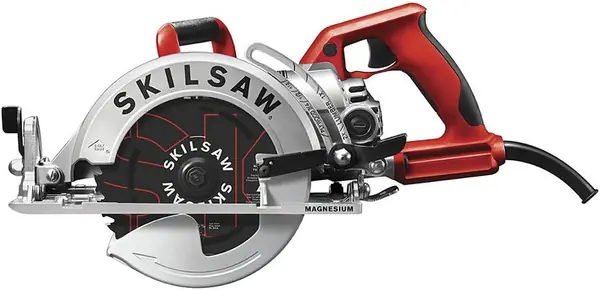
SKILSAW SPT77WML-01 magnesium worm drive circular saw with 7-1/4-inch blade in silver

Framing and decking

Shop Score 95/100
Blade Size
7-1/4 in.
Item Weight
11.5 lb
Max Depth At 90°
2-3/8 in.
Bevel Capacity
53°
View on Amazon

Eleven and a half pounds is the number that decides this one. A worm drive puts the motor behind the handle and the blade on the left, which is why framers like the layout: the weight sits over the hand that pushes, and the cut line stays open. SKILSAW built that layout out of magnesium, so owning a worm drive no longer means dragging the heaviest tool on the truck up a ladder.

Fifteen amps through a 7-1/4-inch blade gets you 2-3/8 inches of depth at 90 degrees and a 53-degree bevel, and the Cut-Ready depth lever is the detail we appreciated most. It drops to markings for quarter, half, and three-quarter ply and for 2x, so you set depth against the stock instead of hunting for a tape. We spent our cutting time watching for the two failures that show up on light worm drives, a guard that hangs and a shoe that flexes, and neither appeared. The magnesium housing also helps the motor shed heat across a long day.

Sitting in the middle of this group on price is the other half of the argument, because you're getting a genuine worm drive for less than a cordless saw costs before a single battery. Two things to know going in: there's no rip guide in the box, and the gear housing wants oil. Check the reservoir before the first cut and top it off now and then, and this saw gives you years rather than months.

Worth Noting

  • No rip guide included
Our Verdict

We recommend the SPT77WML-01 to anyone framing with a cord: it's the lightest worm drive here, and 15 amps keeps it cutting when the lumber gets ugly.

Check Latest Price
2.

DEWALT FLEXVOLT 60V MAX DCS577B Best Cordless Framing Saw

DEWALT FLEXVOLT DCS577B 60V rear handle circular saw with magnesium shoe in yellow and black

Cordless framing

Shop Score 94/100
Blade Size
7-1/4 in.
Item Weight
10.9 lb
Max Depth At 90°
2-7/16 in.
Bevel Capacity
53°
View on Amazon

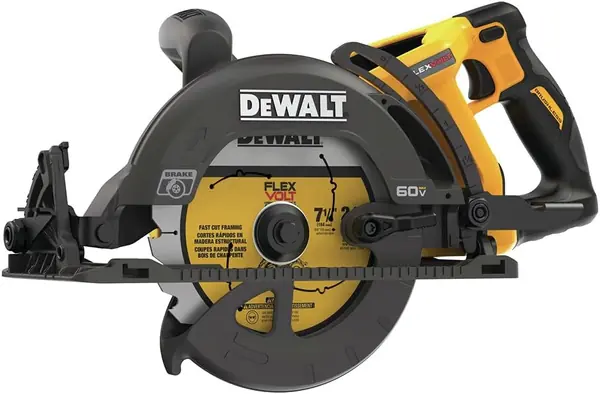
Two and seven-sixteenths of an inch of depth at 90 degrees is the most any saw on this page will give you, and the DCS577B gets there without a cord. The blade sits left of the motor, the handle sits at the back, and you're looking straight down the kerf: the sight line a worm drive gives you, at 5,800 rpm from a brushless motor.

What surprised us is how much of a corded saw's behavior it keeps. The electronic brake stops the blade fast enough that you aren't waiting between cuts, the magnesium shoe stays flat across a warped 2x, and the rafter hook keeps the saw within reach instead of on the deck. On a roof, or on a lot with no outlet in sight, that combination is the whole case for it.

The trade is heft. At 10.9 pounds bare it's near the top of this group once a FLEXVOLT pack goes on, and the mass rides high, which you notice by mid-afternoon. Park it on a rafter between cuts, though, and the weight earns its keep: it's the reason the shoe stays seated through a wet, warped 2x that a lighter saw wants to climb.

Worth Noting

  • Bare tool, batteries and charger sold separately
Our Verdict

For FLEXVOLT owners who want corded-class framing power on a roof, this is our cordless pick, once you accept the heft and a two-handed grip.

Check Latest Price
3.

Makita XSR01PT 36V Rear Handle Saw Kit Best Cordless Kit

Makita XSR01PT 36V rear handle circular saw kit with two 5.0 Ah batteries in teal

All-day cordless framing

Shop Score 93/100
Blade Size
7-1/4 in.
Speed
5,100 rpm
Voltage
36 V (18V X2)
Included Batteries
Two 5.0 Ah
View on Amazon

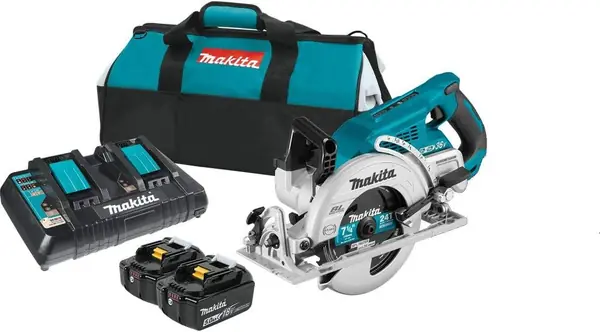
The kit is the point. Two 5.0 Ah LXT packs, a charger, a 24-tooth blade, and a wrench come in the box, so this is a saw you can hand a crew and put to work without anyone hunting for batteries. It draws on the same 18V packs as the rest of Makita's line, two at a time, which is how it pushes a 7-1/4-inch blade at 5,100 rpm with no cord behind it.

Runtime is where we stopped worrying. Makita rates it at up to 558 crosscuts per charge in 2x4 SPF and 291 in 2x10, and while nobody's framing is all clean SPF, the automatic speed change keeps the saw from bogging halfway through a stack of treated lumber. We also liked the metal upper guard, the part that takes the knocks when a saw rides in a truck bed, and the blade-left layout keeps the cut line open the way a rear handle should.

Long-term durability is the open question with any cordless saw, and the electronics are the part to watch when something does go. Makita's three-year warranty covers tool, battery, and charger together, so register the kit and keep the receipt in the case. That coverage is what makes a battery saw a reasonable bet for someone leaving a trailer full of corded tools behind.

Worth Noting

  • Heavy with both 5.0 Ah packs aboard
Our Verdict

Buy the kit, not the bare tool: two 5.0 Ah packs and a charger make the XSR01PT the cordless rear-handle saw we point full crews at.

Check Latest Price
4.

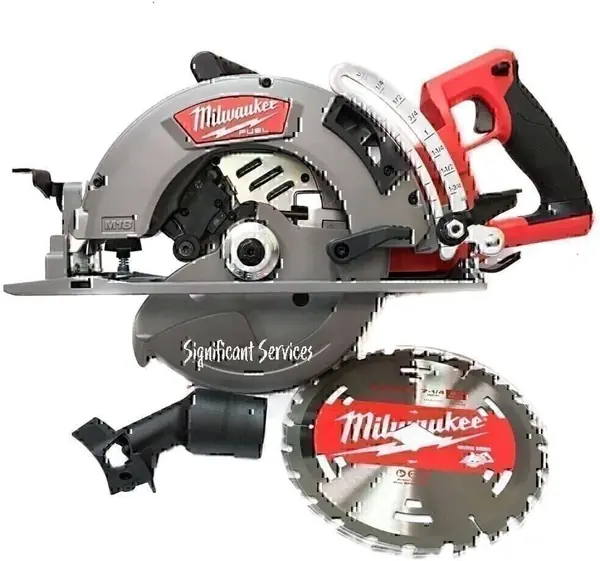
Milwaukee 2830-20 M18 Rear Handle Saw Best Lightweight Cordless

Milwaukee 2830-20 M18 rear handle circular saw in red and black with 7-1/4-inch blade

Overhead cutting

Shop Score 92/100
Blade Size
7-1/4 in.
Item Weight
9.92 lb
Speed
5,800 rpm
Voltage
18 V
View on Amazon

Corded worm drives announce themselves: pull the trigger and the whole saw twists against your wrist before the blade is up to speed. The 2830-20 doesn't do that. Startup is smooth, the blade reaches 5,800 rpm and holds it, and the cut feels like a sidewinder until you notice it is chewing through material a sidewinder would stall on.

At 9.92 pounds bare it's the lightest rear-handle saw on this page, and that is the number we keep coming back to for soffits, headers, and the underside of a deck. Milwaukee puts the mass over your palm rather than out at the nose, so it hangs steadier than its weight suggests, and the left blade keeps the line visible while throwing dust away from your face instead of into it.

It ships as a bare tool, so the real cost depends on the M18 packs you already own, and that is worth counting before you compare it with a corded saw. Fit a big pack and the saw hangs at head height without the cord drag that makes a corded worm drive feel heavier than its spec sheet claims.

Worth Noting

  • Needs High Output batteries for full-day runtime
Our Verdict

We reach for the 2830-20 when the cuts are overhead or awkward: at 9.92 pounds bare it's the lightest rear-handle saw here.

Check Latest Price
5.

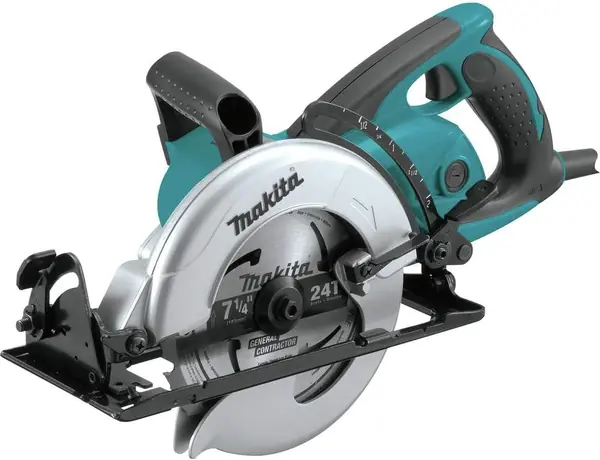
Makita 5477NB 7-1/4" Hypoid Saw Best Value Corded

Makita 5477NB 7-1/4-inch hypoid circular saw in teal with oil bath gear housing

Value framing

Shop Score 91/100
Blade Size
7-1/4 in.
Item Weight
18 lb
Max Depth At 90°
2-3/8 in.
Bevel Capacity
0–51.5°
View on Amazon

The gear housing is the story with this saw. Hypoid gears put more tooth surface in contact than a worm drive does, and Makita seals them in an oil bath with a built-in fan so lubrication reaches the whole gear set. In practice that means less fuss than a traditional worm drive demands and torque that arrives without complaint, which is why this saw has stayed in production while other hypoids came and went.

Fifteen amps and 4,500 rpm give you 2-3/8 inches at 90 degrees and a bevel that runs to 51.5 degrees with positive stops at 45 and 51.5. That second stop exists for truss and rafter cuts, and we appreciate a detent we don't have to eyeball against a protractor. The base is heavy and the saw tracks straight because of it, which is the payoff for carrying a saw that doesn't wander through a long rip.

Eighteen pounds is the most any corded saw here asks you to carry, and that is the one honest cost of the design. At bench height or on the ground it never registers; up a ladder you'll feel it by the end of the day. What you get back is straight tracking, an oil bath that needs little attention, and a price below the worm drives on this page.

Worth Noting

  • Startup torque takes a cut or two to learn
Our Verdict

For framers who want worm-drive torque without paying worm-drive money, this hypoid Makita is the one we hand them.

Check Latest Price
6.

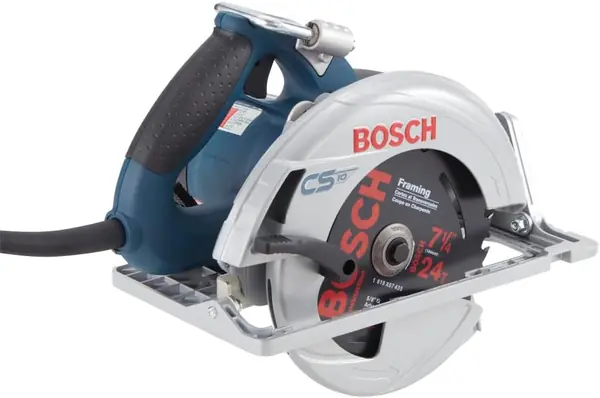
Bosch CS10 7-1/4 In. Circular Saw Best for Remodeling and Trim

Bosch CS10 7-1/4-inch circular saw in black with magnesium footplate and rear handle

Remodeling and trim

Shop Score 90/100
Blade Size
7-1/4 in.
Item Weight
10.2 lb
Max Depth At 90°
2-7/16 in.
Amperage
15 A
View on Amazon

If your week is stacks of 2x10 with a crew waiting on you, this isn't the saw. The CS10 is a 15-amp remodeling saw, happiest in plywood, siding, trim, and the occasional 4x4 post, and it is the least expensive way onto this page with a die-cast magnesium footplate and a rear-handle layout.

What we like is how much saw the money buys. The footplate stays flat, the blade sits left for a clear line, and Bosch's bevel louvers aim the blower's output straight at the kerf so the line stays visible instead of disappearing under dust. The direct-connect system takes an extension cord straight into the tool rather than a cord knotted around the handle, and the removable end cap makes brush service a job you do yourself.

It won't hold speed the way the 15-amp worm drives here will in wet, thick stock, and that is a statement about what the saw is for rather than a knock on it. As a second saw that lives in a truck for punch-list and remodel work, the CS10 does more than its share, and at 10.2 pounds it climbs a ladder more easily than either corded worm drive.

Worth Noting

  • Spindle speed tops out at 4,400 rpm
Our Verdict

For remodeling work that mixes plywood, siding, and trim, we rate the CS10 the best budget buy here: 15 amps and a flat magnesium foot.

Check Latest Price

How We Tested Rear-Handle Circular Saws

We started with spec sheets, filtering rear-handle saws by blade size, depth of cut at 90 degrees, bevel range and positive stops, and power source, then narrowed the field to nine saws spanning 15-amp corded worm drives, hypoid saws, and cordless kits. Price against the rest of the group was the last filter, not the first.

Every saw went to work on the same projects: deck framing, rafters and trusses, overhead cutting, and a long run of engineered lumber. We weighed each one on a scale, then compared that number to how it actually hung in the hand — a saw with a battery sitting high or a motor pushed far back feels heavier than its pounds suggest. We timed repeated rip cuts in stacked dimensional lumber and noted where a saw bogged down or burned its way through, and we ran the corded models off an extension cord matched to their 15-amp draw to see whether the motor held speed under load.

For bevel work we cut rafters at 45 degrees and checked every positive stop by hand before trusting it. We clamped or braced each workpiece and kept both hands on the saw, which is the only honest way to judge startup torque — a saw that leaps at the trigger behaves differently when the stock is locked down and you know it's coming. We watched the blade through the whole cut to score line of sight, and we counted a saw down if its anti-snag guard hung up on offcuts rather than clearing them.

Durability got judged the slow way: months of hauling, drops off sawhorses, and gear-housing upkeep, including which saws needed an oil change and which were sealed and needed nothing. We tracked battery runtime across full cutting days and set that against what each kit costs relative to the rest of the group.

How to Choose a Rear Handle Circular Saw

Corded Power Versus a Battery Platform

A corded 15-amp saw pulls constant power from the wall, costs less than a cordless equivalent, and never asks you to think about a charger. If your framing happens within reach of an outlet or a generator, that is still the simplest way to buy a saw, and both of our corded picks here follow that logic.

The trap with cordless is the bare-tool listing. A saw sold as tool-only is the start of the spend, not the end: you need two packs big enough to finish a wall plus a charger if you don't own them. Buy into the platform already in your truck, and price the saw with batteries before you compare it to a corded one.

Weight and Balance, Not Just the Number

Everything here lands between roughly 10 and 18 pounds, and the spread matters more than it sounds, because framing is a repeated motion. A saw you can lift two hundred times without thinking beats one that cuts better on the first pass and fights you on the ninetieth.

The number alone doesn't tell the story, because where the mass sits changes how the saw behaves. A rear handle puts the motor behind your grip and over your palm, which is why a heavier worm drive can feel steadier than a light sidewinder. Grip one as if finishing a cut and see whether the nose wants to drop; that is the balance question no spec sheet answers.

Depth of Cut and Bevel Stops

At 90 degrees these saws run from 2-3/8 to 2-7/16 inches, enough for a 2x in one pass and for most engineered lumber with a flip. Depth ratings are always quoted at 90 degrees, and the number shrinks as you bevel, so a saw that just clears a 2x flat will not clear it at 45.

Bevel capacity is what roof work turns on. Fifty-three degrees covers most rafter cuts, and the saws here offer positive stops at 22.5, 45, and on some models 51.5 degrees. A stop you can feel is worth more than a degree or two of extra travel, because it is what keeps a stack of identical cuts identical.

Drive Type and What It Costs to Own

Worm drive, hypoid, and rear-handle direct-drive saws all put the blade on the left and the motor behind the grip, which is the layout that keeps the kerf visible. Worm and hypoid gearing multiply torque, so these saws keep pulling in wet treated lumber where a sidewinder slows down. Worm drives typically run their gears in oil, Makita's hypoid saws use a sealed oil bath that asks less of you, and the cordless saws skip the question entirely.

The trade is startup torque and mass. A geared saw twists against your wrist when you pull the trigger and carries more heft than a compact sidewinder. Neither is a defect; both are why a framing saw tracks straight through a long rip once it is running.

Frequently Asked Questions

Final Verdict

Weight decides this category more than any single specification, and that is why the SKILSAW SPT77WML-01 is our pick: 11.5 pounds of genuine worm drive with 15 amps behind it and a depth lever you can set without a tape. It is the saw we point at a framing job with an outlet within reach.

If a cord isn't an option, the DEWALT DCS577B gives you the same rear-handle sight line and 2-7/16 inches of cut on FLEXVOLT packs, and the Milwaukee 2830-20 covers overhead work at under ten pounds bare. The Makita 5477NB is the corded answer for a tight budget that still wants hypoid torque.