↑↓ navigate ↵ open Esc close All results →

Best Saws for Cutting Plywood of 2026

Plywood punishes sloppy cuts quickly: a wandering blade, a pinching kerf, or splintered face veneer can ruin an expensive 4x8 sheet before the first cabinet side is even sized. Clean results depend less on motor size alone than on pairing the right saw style — straight sheet breakdown, curved cutouts, or quick trim — with stable panel support and an accurate fence or guide.

Across eight months of breaking down 3/4-inch and thicker panels in a garage shop and driveway with 12 table saws, circular saws, jigsaws, and a hand saw, we tracked tear-out, out-of-the-box fence alignment, dust capture, and workspace footprint. Blade tooth count and careful infeed support shaped edge quality just as much as raw power.

Whether you need full-sheet portability on sawhorses, repeatable cabinet rips in a tight shop, or clean curved sink cutouts, the seven saws below match distinct sheet-goods workflows and budgets.

Our Top Picks

The Best Saws for Cutting Plywood

1.

DEWALT DWE7485 8-1/4-Inch Table Saw Best Overall
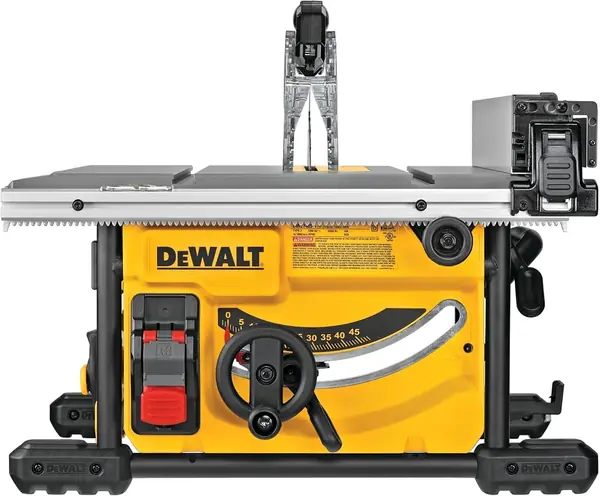
DEWALT DWE7485 jobsite table saw with a yellow roll cage base and rack-and-pinion fence

Sheet goods and rips

Shop Score 97/100
Weight
54 lb
Blade Size
8-1/4 inches
Motor
15 amps
Rip Capacity
24.5 inches
View on Amazon

Twenty-four and a half inches of rip capacity is the number that decides this pick. That's enough to take a 4x8 sheet of 3/4-inch plywood down to a cabinet side or a shelf in one pass, without flipping the panel and resetting the fence. The rack-and-pinion rails are the other half of it: you turn the knob, the fence slides smoothly, and it stays parallel where you leave it, so a measurement you make once holds for every piece in the run.

We think the fence is the most useful thing about this saw, and it's where cheaper table saws come apart. Plywood punishes a fence that isn't parallel — the blade binds, the motor labors, and the cut comes out tapered. A 15-amp motor turning an 8-1/4-inch blade has the torque to keep moving through 3/4-inch stock, and the edge left on veneered plywood is clean enough that a light sanding is all it takes before assembly.

Fifty-four pounds sounds like a lot until you compare it to a cabinet saw. The metal roll cage base gives you something to grab, one person can lift it, and it stores against a garage wall. What the smaller blade buys in portability it gives up in depth — it tops out well under what a 10-inch saw manages — so thick stock and stacked panels are the place this one stops.

Put it on a solid surface with support on both sides of the sheet and it produces parts that fit the first time. That's the whole argument: for plywood that becomes furniture, repeatability matters more than an extra inch of blade or a folding stand.

Worth Noting

  • Smaller blade means less depth than a 10-inch saw
Our Verdict

We make this the default because 24-1/2 inches of rip capacity and a fence that returns to the same setting are what turn a sheet of plywood into cabinet parts.

Check Latest Price
2.

SKIL 5280-01 7-1/4-Inch Circular Saw Best for Breaking Down Sheets

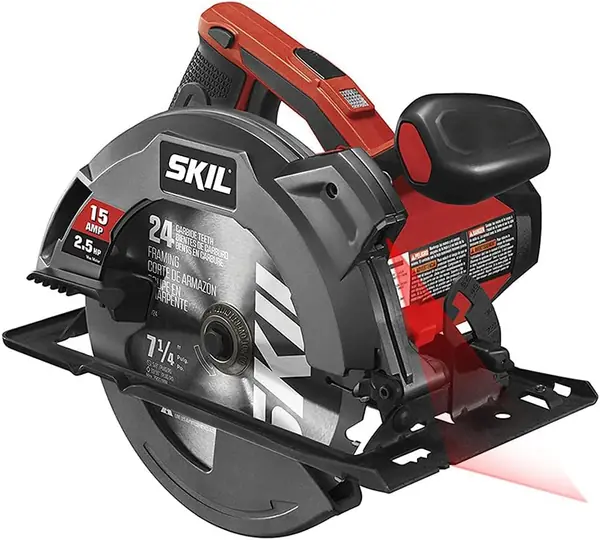
SKIL 5280-01 circular saw with a red body, 7-1/4-inch blade, and laser guide

Breaking down sheets

Shop Score 96/100
Weight
8.7 lb
Blade Size
7-1/4 inches
Motor
15 amps
Depth Of Cut
2-3/8 inches
View on Amazon

Breaking down a full sheet is a different job from ripping a shelf, and it's the job this saw is built for. Fifteen amps and 5,300 rpm push a 24-tooth carbide blade through 3/4-inch plywood without the bogging that stalls a small cordless saw halfway across a panel, and 8.7 pounds is light enough to steer down a line for the length of an eight-foot cut. That combination is exactly what we want in a saw that lives under a workbench and comes out on panel day.

The single-beam laser earns its place on plywood, where you're usually following a pencil line on a face the blade hides from you. It throws a bright line ahead of the cut, the dust blower keeps the kerf visible, and both switches land where your thumb expects them. None of it replaces a clamped straightedge — a circular saw goes where you push it — but it shortens the gap between a marked sheet and a stack of parts.

Longevity is what tempers the recommendation. This is the saw in the group where wear shows up soonest, with units that fail in the first session and others that quit after a couple of years of light use. Treat it as a saw for a few plywood weekends a year rather than a daily driver, and the value is hard to argue with.

Worth Noting

  • Early wear and reliability issues limit daily use
  • Still requires a clamped straightedge for straight cuts
Our Verdict

We hand this one to anyone breaking down a stack of plywood on sawhorses: 15 amps, a laser to follow, and a weight you can steer with one hand.

Check Latest Price
3.

DEWALT 20V MAX XR Jig Saw (DCS334B) Best Cordless Jigsaw

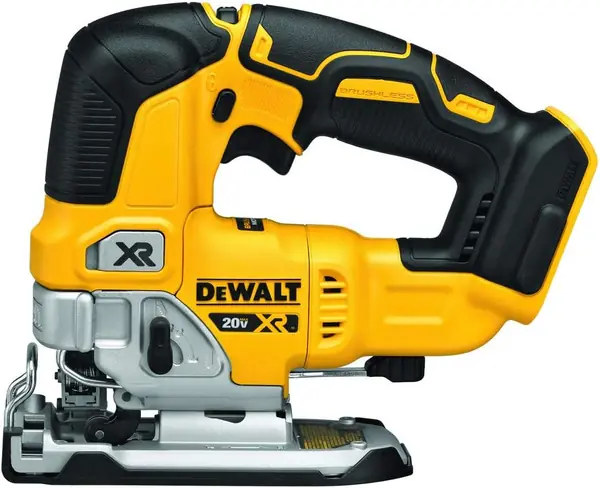
DEWALT 20V MAX cordless jigsaw in yellow and black with a keyless blade clamp

Curves and cutouts

Shop Score 95/100
Weight
4.2 lb
Blade Speed
3,200 spm
Power Source
20V MAX battery (bare tool)
Orbital Settings
4 positions
View on Amazon

Our first cut with it was a sink cutout in 3/4-inch plywood, and the saw moved through it faster than we expected a cordless jigsaw to. The brushless motor holds its 3,200 strokes per minute under load instead of sagging as the blade bites, and the four-position orbital action lets you set the blade to clear chips aggressively when the cut is rough work.

Cordless matters more on a jigsaw than on a circular saw. A jigsaw gets used inside a cabinet, overhead, and on a panel propped across two sawhorses, and a cord that snags on the workpiece ruins a curve. The listing is the bare tool, though, so this only makes sense if you're already on the 20V MAX platform; add a battery and charger and you've spent more than any corded jigsaw here.

What we like most is the blade clamp. It's an all-metal lever you flip, the blade drops out, and the new one seats without a hex key — a couple of seconds that matter when you're switching between a blade for a clean face and a scrolling blade for a tight curve. The shoe has detents at 0, 15, 30, and 45 degrees, so a bevel is one click instead of a protractor session.

The reservation is line of sight. The body is compact in the hand, but the housing sits right where you want to watch the blade enter the wood, so a clamped straightedge does more for accuracy here than it does on a trim saw. That's the cost of the power, and for cutouts and curves we'll pay it.

Worth Noting

  • Sold as a bare tool without battery
Our Verdict

The jigsaw we reach for on plywood: brushless power on batteries you already own, plus a blade clamp you can work with one hand.

Check Latest Price
4.

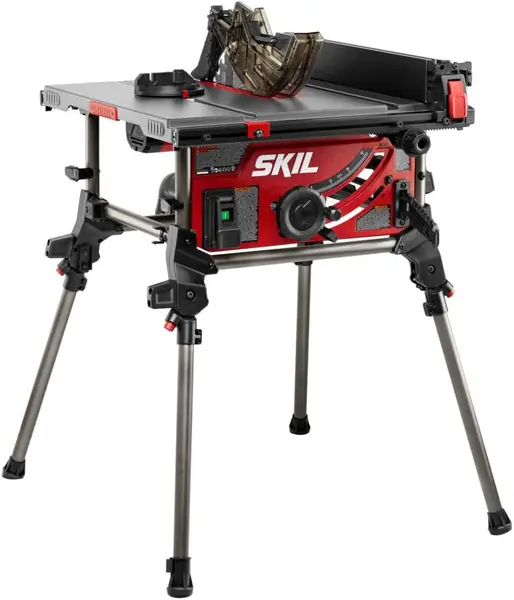
SKIL TS6307-00 10-Inch Jobsite Table Saw Best for Small Shops

SKIL 10-inch jobsite table saw on folding legs with a red and black frame

Small shops

Shop Score 94/100
Weight
51.2 lb
Blade Size
10 inches
Depth Of Cut
3-1/2 inches at 0 degrees bevel
Rip Capacity
25-1/2 inches
View on Amazon

The legs fold up under the saw and lock, and that's the feature that decides this one. A 51-pound table saw that one person can set up in a driveway in a couple of minutes and then stand against the garage wall afterward is a different tool from a cabinet saw you dedicate a corner to. Everything it needs stores on the machine: blade guard, riving knife, anti-kickback pawls, push stick, miter gauge, and wrenches all have a home.

Capacity is the other half of the case. The 10-inch blade cuts 3-1/2 inches deep at 90 degrees, so it handles 2-by stock and stacked panels that the smaller 8-1/4-inch saw here can't, and the rack-and-pinion fence rips 25-1/2 inches to the right of the blade — a 24-inch cabinet side comes off a full sheet with room for the fence. The dust port elbow takes a shop vacuum hose, which plywood dust makes worth the trouble.

Setup takes an evening. The blade needs checking for parallel to the miter slot, and the fence wants dialing in before you trust the scale on the rail; a couple of the adjustments that should arrive set from the factory need a second look. Do that once with a square and a tape measure and the saw holds it.

Where it gives ground to the DEWALT is in the table and the frame. The cast top is smaller and the whole saw has more flex in it when a full sheet is sliding across — on long rips in 3/4-inch plywood we noticed the difference. What you get for the trade is a bigger blade, a folding stand, and a lower price, which for weekend work in a shared garage is the right side of the deal. No other saw here arrives with its own stand.

Worth Noting

  • Stock 24-tooth blade is rough on plywood
Our Verdict

We point small shops here: a 10-inch blade, 25-1/2 inches of rip capacity, and legs that fold under it so the saw lives against a wall.

Check Latest Price
5.

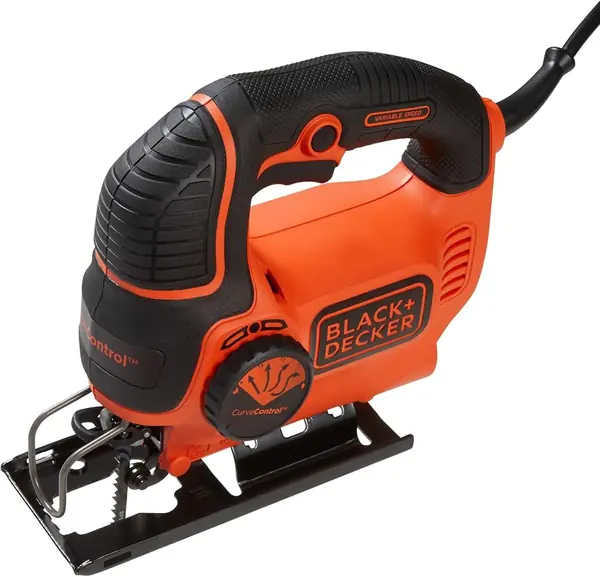
BLACK+DECKER BDEJS600C 5-Amp Jig Saw Best Budget Jigsaw

BLACK+DECKER corded jigsaw with an orange and black body and rubber handle

Budget cutouts

Shop Score 93/100
Weight
4.6 lb
Motor
5 amps
Blade Speed
3,000 spm
Curve Settings
4
View on Amazon

The question at this end of the price range is always whether a cheap jigsaw can cut plywood without wandering off the line and splintering the face. Five amps and 3,000 strokes per minute turn out to be enough for 3/4-inch stock; the saw goes through it at a pace that doesn't feel like a compromise, and the cut stays clean as long as the blade is sharp and you let the saw work instead of shoving it.

Four curve settings — BLACK+DECKER calls it CurveControl — change the orbit for thin material or thicker stock, and the dial sits where you can reach it mid-cut. The wire guard keeps the blade line visible, the shoe tilts to 45 degrees for a bevel, the blade clamp is keyless, and a dust blower keeps the pencil line readable. That's a full feature set at a budget price.

We reach for it for cutouts, not rips. A five-amp jigsaw follows a curve all day, but over an eight-foot straight cut it wanders, and no amount of care fixes that — clamp a straightedge, go slowly, and plan on a pass with a sanding block. That's the honest boundary of a saw at this price, and it's why a circular saw stays in the kit for panel work.

What we didn't expect is how controllable it feels: 4.6 pounds, a rubber over-molded handle, and a balanced body that doesn't fight you around a tight radius. Spend what you save on the rest of the kit — clamps, a straightedge, a sanding block — and it stops feeling like a compromise.

Worth Noting

  • Wanders on long straight rips without a guide
  • Stiff safety interlock takes a firm push
Our Verdict

Our budget jigsaw pick: five amps, four orbit settings, and a keyless clamp for a fraction of what the cordless saws cost.

Check Latest Price
6.

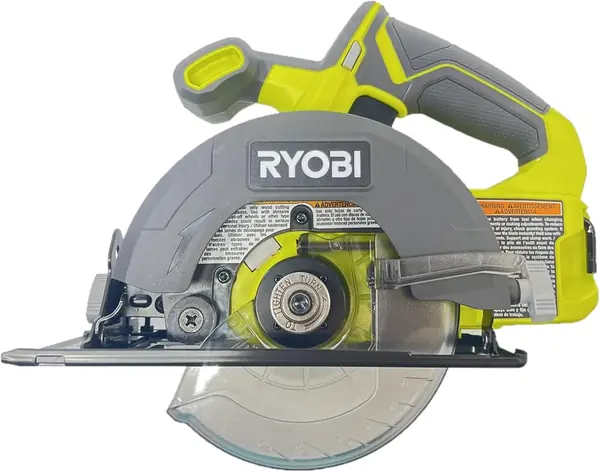
Ryobi ONE+ 18V 5-1/2-Inch Circular Saw (P505) Best for Quick Trim Work

Ryobi ONE+ 18V cordless circular saw in green with a 5-1/2-inch blade and side handle

Quick trim work

Shop Score 92/100
Weight
4.1 lb
Blade Size
5-1/2 inches
Speed
4,700 rpm
Bevel Capacity
50 degrees
View on Amazon

Five and a half inches of blade and 4.1 pounds of saw is a different proposition from the sheet-goods saws here, and it's one we like for the cuts that happen away from the bench: a shelf trimmed to fit an alcove, a notch in a cabinet back, a crosscut on a panel already screwed to a wall. At 4,700 rpm it spins close to corded speed, and the rubber over-mold plus the left-side handle make it easy to control in tight spots.

It is not the saw for a stack of sheets. Push it through 3/4-inch plywood at a real feed rate and the motor bogs; battery life under that load is short enough that a spare on the charger is part of the plan. Used for what it is — the saw that rides in the truck for panel adjustments — that trade is fine, because there's no cord to run and no outlet to find.

Durability is the reservation. Early motor-bearing failures show up on some of these saws, and a tool that quits mid-cut is a tool that can bind in the kerf, so keep both hands on it and the panel supported. The 30-day warranty is the shortest of anything here, which makes the first month of real work the test that matters.

Worth Noting

  • Bogs down when pushed through 3/4-inch plywood
  • Battery and charger sold separately
Our Verdict

A compact cordless saw for crosscuts and trim in plywood, provided you already own Ryobi 18V batteries and don't ask it to rip a sheet.

Check Latest Price
7.

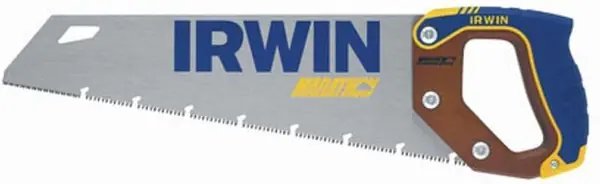
IRWIN ProTouch 15-Inch Hand Saw (2011201) Best for Hand Trimming

IRWIN ProTouch hand saw with a 15-inch steel blade and a black handle

Hand trimming

Shop Score 91/100
Weight
16 oz
Cut
Coarse
Blade Length
15 inches
View on Amazon

No cord, no battery, no noise, no setup — that's the case for a hand saw in a plywood shop, and it's why one stays on the wall. At 15 inches this is a toolbox-length blade rather than a panel saw: think cutting a small panel down to fit, trimming a piece of 1/2-inch ply for a jig, or taking two inches off a shelf without waking the house.

We like the cut it makes in plywood more than we expected from a coarse-tooth saw. The blade is thick enough to stay rigid through a cut, the tri-ground teeth start easily, and deep gullets clear chips instead of clogging halfway down the line. It won't match a circular saw along a long straight edge — a 15-inch blade over an eight-foot line is a lesson in humility — but for a cut through a panel you can hold with one hand, it's quick and it's quiet.

The ProTouch handle is comfortable enough for a full afternoon, and at 16 ounces the saw disappears into a toolbox until you need it. Hardened teeth hold an edge for a long time and can't be filed back to life once they go, so treat the blade as the life of the saw.

Worth Noting

  • 15-inch blade is short for full sheets
  • Hardened teeth cannot be resharpened
Our Verdict

Worth keeping in the shop for a fast trim through a small panel, and the saw we reach for when a power tool is more trouble than the cut.

Check Latest Price

How We Tested Saws for Plywood

We researched saws sold for plywood work, then filtered by specs, price, and footprint to models that could handle 3/4-inch and thicker panels, make straight rips or curves as intended, and suit a home shop. That left 12 units—table saws, circular saws, jigsaws, and a hand saw—used for eight months, not a single afternoon. We checked fit and finish out of the box—base flatness, fence lock, handle play—because quality shows up early in how repeatably a saw lines up.

The saws lived in a garage shop and on a driveway, breaking down full sheets, ripping 3/4-inch and thicker plywood, cutting sink openings, following curved templates, and trimming veneered panels. We squared each fence to the blade before the first cut and rechecked it after a day of use, inspected every cut edge for fuzz and splintering, and noted whether a different blade or a taped line changed the result. We carried each saw to the bench, judged its footprint, and watched how a full sheet behaved when supported on both sides. Indoors, we noted how much dust escaped and whether a bag or shop vacuum kept up.

Corded saws stayed plugged in; cordless saws got run through a full sheet on a charge, and we counted how many batteries a session took, along with what a bare tool costs once you add the platform. We timed blade changes and fence adjustments, paid attention to switch and guard action, and kept the saws in rotation to look for wobble, loose locks, or a base that stopped sitting flat. For every table-saw through cut we kept the blade guard, riving knife, and anti-kickback pawls in place, supported both sides of the panel, and unplugged the saw or pulled the battery before changing a blade.

How to Choose a Saw for Cutting Plywood

Start With the Cut, Not the Tool

Sheet breakdown and long straight rips belong to a circular saw with a clamped straightedge, or to a table saw when the parts have to repeat. Curves, cutouts, and notches belong to a jigsaw. A hand saw handles one small panel faster than you can run an extension cord. We rank a saw by how well it does its own job, not by how many jobs it claims: a 15-amp circular saw that tracks straight beats a table saw you can't feed a full sheet across.

Rip Capacity and Support Decide What a Sheet Becomes

On a table saw, rip capacity is the number that matters most. Our two picks rip 24-1/2 and 25-1/2 inches to the right of the blade, which is enough to take a 4x8 sheet down to a 24-inch cabinet side in a single pass.

The trap is the table itself. A compact jobsite saw needs outfeed support for a full sheet, and no saw this size is a one-person sheet-goods machine — plan on sawhorses, a roller stand, or a helper before the first cut, not after the panel drops.

Corded Power or Cordless Freedom

Cutting plywood is a sustained load, and sustained load is where cordless saws show their limits: a compact 18V saw bogs where a 15-amp corded one keeps going, and the battery that gets you through a cutout may not get you through a sheet. Cordless earns its place on a jigsaw, which gets used in awkward positions, and on a circular saw that travels.

If the listing says bare tool, price the batteries and charger in before you decide. That changes the math more than the saw does.

Edge Quality in Veneered Plywood

Tear-out happens where the blade exits the veneer, so the saw's job is to keep the blade from wobbling and yours is to support the exit side. A sharp blade with more teeth — 40 or more in a 7-1/4-inch circular saw — leaves a cleaner edge than the 24-tooth ripping blade most saws ship with. On a jigsaw, cut with the good face down using a down-cut blade, and run painter's tape along the line.

A fence that isn't parallel to the blade causes more chip-out than tooth count ever will. Check the fence before you blame the blade.

Weight, Space, and the Dust You'll Make

Plywood and MDF make a lot of dust, and the saw that sprays it across a garage gets used less. Look for a dust port you can hook to a vacuum, or a blower that keeps the cut line clear on a saw without one.

Weight is the other half of the decision: 8.7 pounds of circular saw moves to the driveway whenever you want, while 54 pounds of table saw wants a permanent home or a folding stand and a plan for where it goes back.

Frequently Asked Questions

Final Verdict

For plywood that has to come out square and repeatable — cabinet sides, shelves, a run of identical parts — we start with the DEWALT DWE7485. Its 24-1/2-inch rip capacity and rack-and-pinion fence are what turn a 4x8 sheet into parts, and nothing else here does that as surely.

When the sheets get broken down on sawhorses instead of fed across a table, the SKIL 5280-01 is the better match: lighter, far cheaper, and built for exactly that cut.